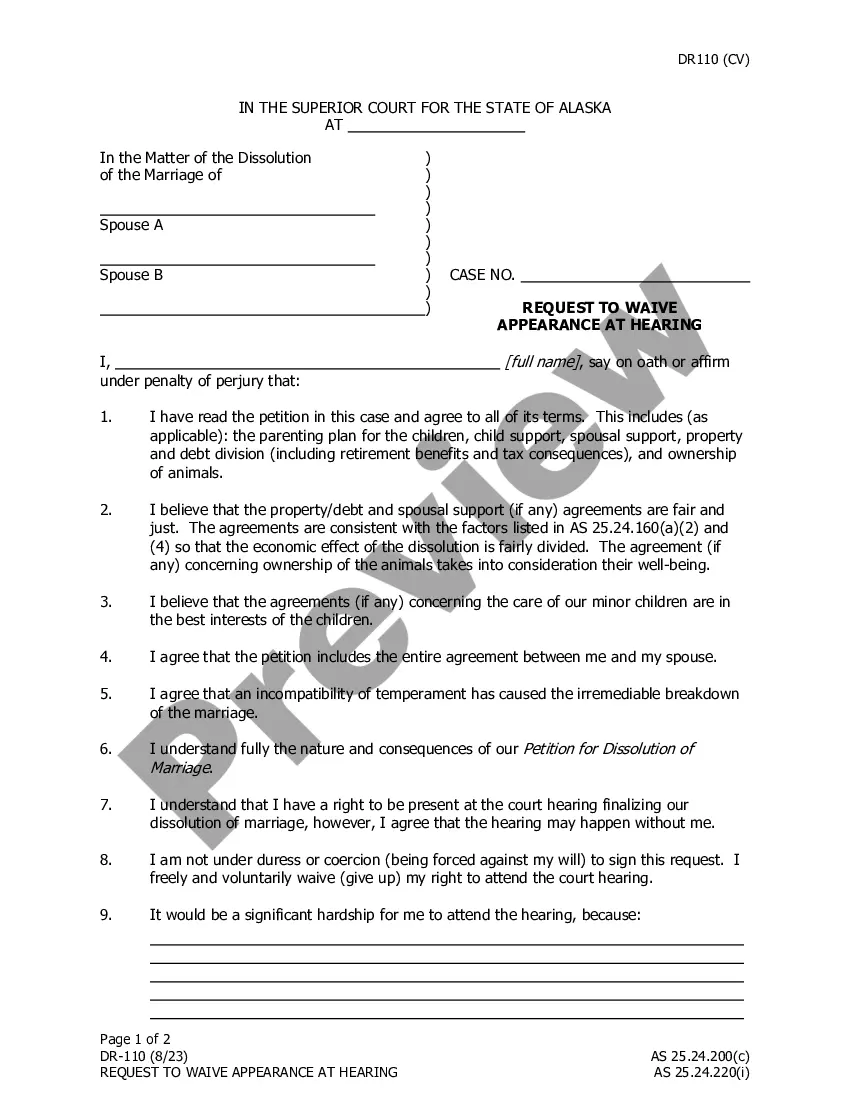
Ohio Request for Lien Information - Corporation
What this document covers
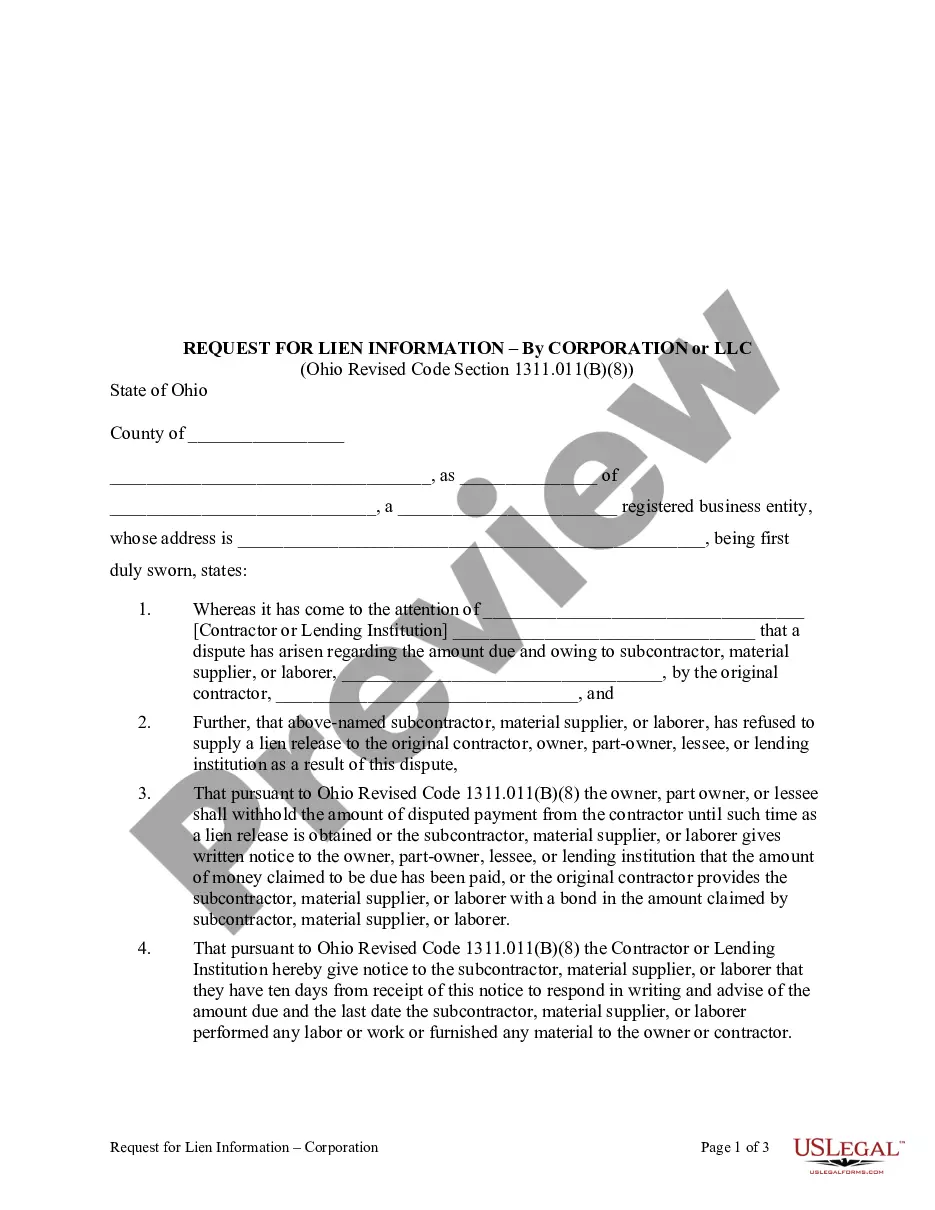
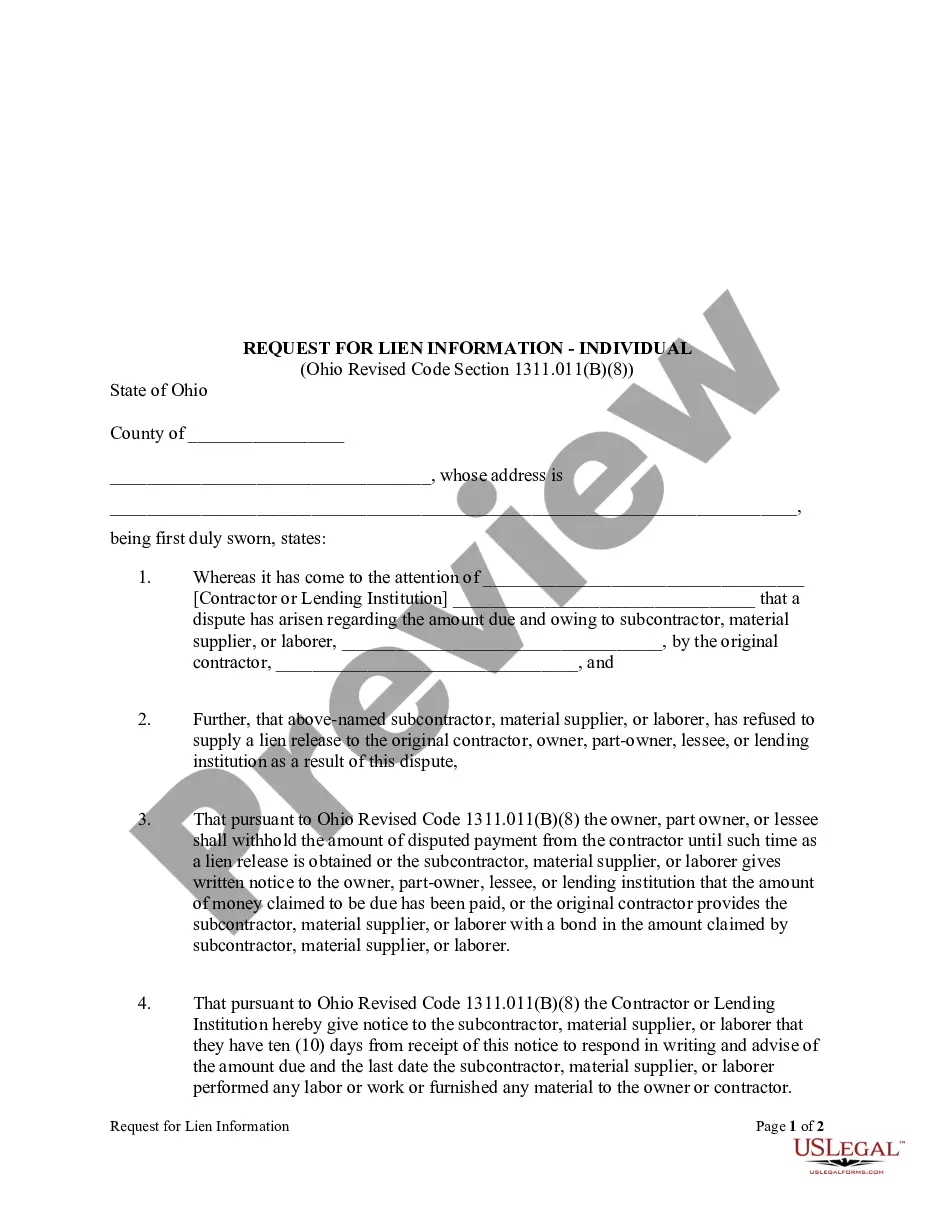
The Request for Lien Information - Corporation form is a legal document used to address disputes related to payment between contractors and subcontractors, material suppliers, or laborers. This form serves as a formal request for lien information when the subcontractor or laborer refuses to release their lien due to a payment disagreement. It is crucial for ensuring the contractor or lending institution can mitigate potential financial losses while the dispute is resolved.
Form components explained
- Identification of the contractor or lending institution.
- Details regarding the disputed amount due to the subcontractor, material supplier, or laborer.
- Notification of the subcontractor's refusal to provide a lien release.
- Reference to relevant Ohio Revised Code provisions.
- Deadline for the subcontractor or laborer to respond with the amount due.
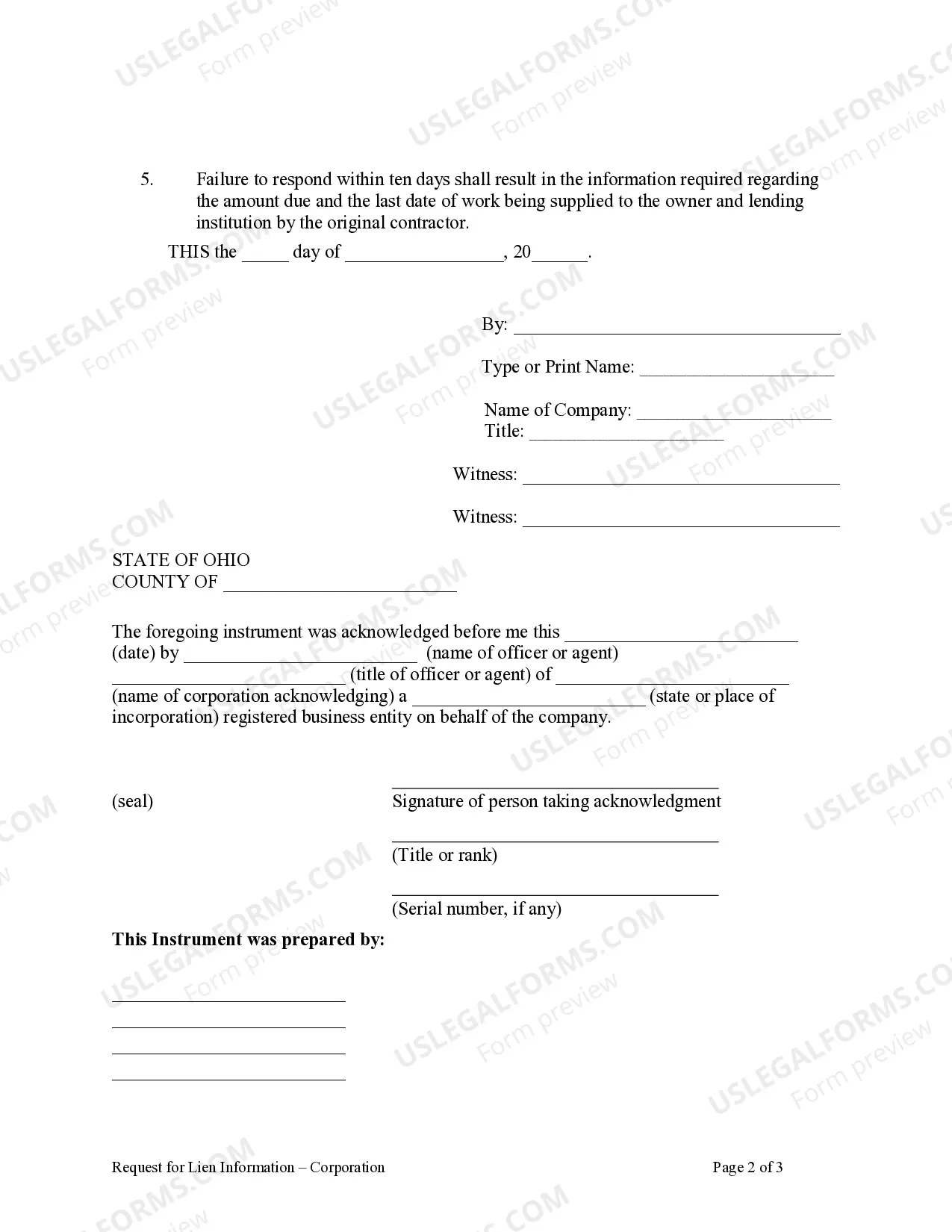
- Signatures of authorized representatives from the contractor or lending institution.
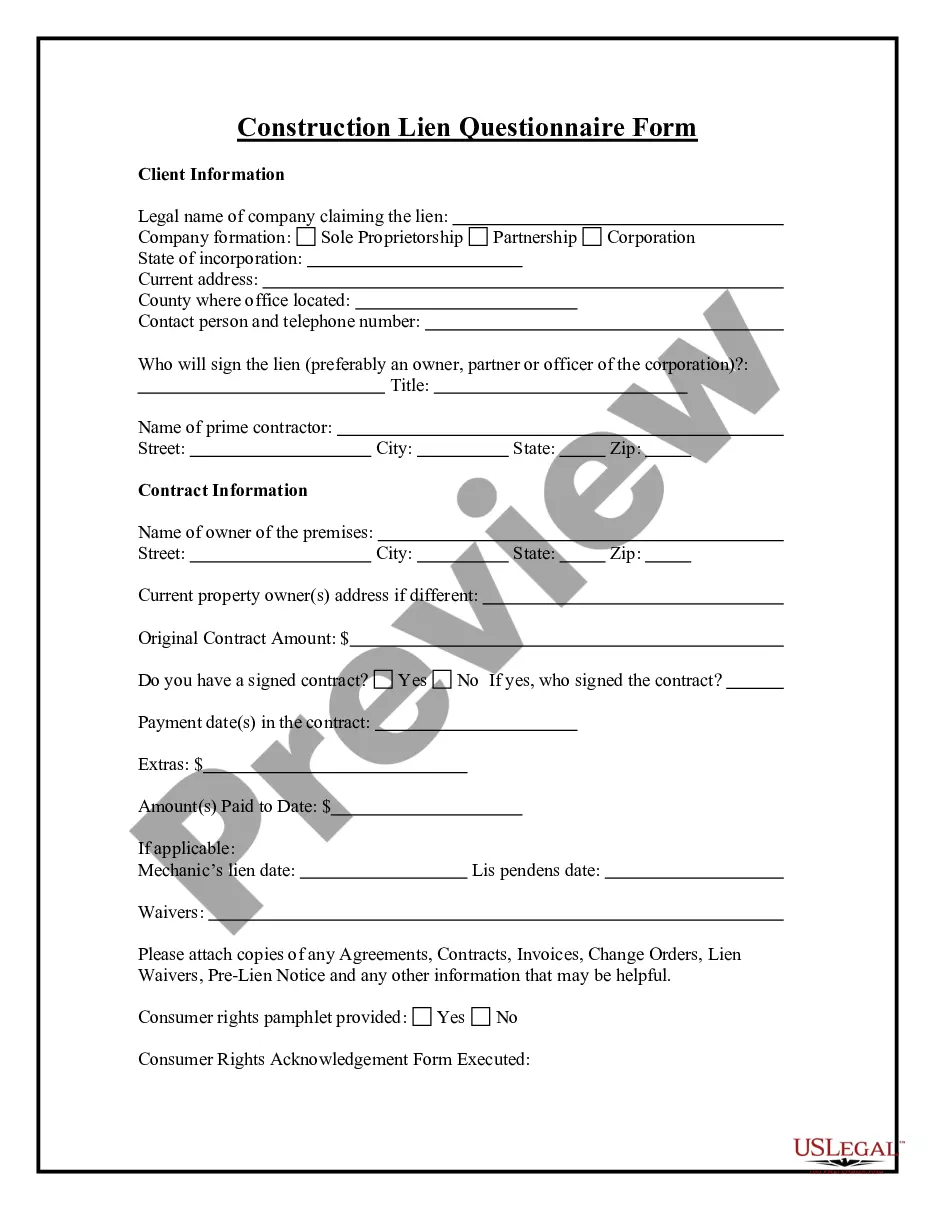
When this form is needed
This form should be used when there is a dispute over payments between contractors and subcontractors, material suppliers, or laborers. If the subcontractor refuses to release their lien, the contractor or lender can use this form to formally request the necessary lien information. It helps clarify the disputed amount and ensures that proper communication is established to resolve the payment issue efficiently.
Intended users of this form
- Contractors seeking to obtain necessary lien information to protect their interests.
- Lending institutions providing financing for construction projects.
- Corporations engaged in construction-related contracts with subcontractors or suppliers.
- Subcontractors or laborers involved in payment disputes requiring clear documentation.
Instructions for completing this form
- Identify and fill in the names of the contractor or lending institution and the subcontractor or laborer involved in the dispute.
- Specify the disputed amount and date the subcontractor last performed work or provided materials.
- Include a clear statement of the refusal to release the lien.
- Indicate the deadline for the subcontractor or laborer to respond with the required information.
- Obtain signatures from authorized representatives and ensure all details are correct.
Does this form need to be notarized?
This form does not typically require notarization unless specified by local law. However, having the form notarized can improve its legal standing and provide an additional layer of authenticity.
Get your form ready online
Our built-in tools help you complete, sign, share, and store your documents in one place.
Make edits, fill in missing information, and update formatting in US Legal Forms—just like you would in MS Word.
Download a copy, print it, send it by email, or mail it via USPS—whatever works best for your next step.
Sign and collect signatures with our SignNow integration. Send to multiple recipients, set reminders, and more. Go Premium to unlock E-Sign.
If this form requires notarization, complete it online through a secure video call—no need to meet a notary in person or wait for an appointment.
We protect your documents and personal data by following strict security and privacy standards.

Make edits, fill in missing information, and update formatting in US Legal Forms—just like you would in MS Word.

Download a copy, print it, send it by email, or mail it via USPS—whatever works best for your next step.

Sign and collect signatures with our SignNow integration. Send to multiple recipients, set reminders, and more. Go Premium to unlock E-Sign.

If this form requires notarization, complete it online through a secure video call—no need to meet a notary in person or wait for an appointment.

We protect your documents and personal data by following strict security and privacy standards.
Common mistakes
- Failing to accurately identify all parties involved in the dispute.
- Not specifying the correct amount of the disputed payment.
- Missing the ten-day response deadline when filling out the form.
- Not obtaining the necessary signatures from authorized representatives.
Why use this form online
- Immediate access to professionally drafted legal templates.
- Easy to customize for specific circumstances and parties involved.
- Convenient downloading options for print or electronic submission.
- Time-saving process compared to traditional document preparation methods.
Legal use & context
- This form is legally binding when properly filled out and executed according to Ohio law.
- It helps protect the owner and lending institutionâs interests in payment disputes.
- Failure to respond within the stipulated timeline may have legal implications for the subcontractor or supplier.
Looking for another form?
Form popularity
FAQ
An LLC Operating Agreement is Not Compulsory, but it is Highly Recommended. An LLC operating agreement is not necessarily compulsory, although this depends on the state where your business is based. You could get into a lot of unnecessary strife if situations change in your LLC.
Ohio does not require an operating agreement in order to form an LLC, but executing one is highly advisable.The operating agreement does not need to be filed with the state.
An operating agreement is a key document used by LLCs because it outlines the business' financial and functional decisions including rules, regulations and provisions. The purpose of the document is to govern the internal operations of the business in a way that suits the specific needs of the business owners.
An operating agreement is mandatory as per laws in only 5 states: California, Delaware, Maine, Missouri, and New York. LLCs operating without an operating agreement are governed by the state's default rules contained in the relevant statute and developed through state court decisions.
In Ohio you can find out if your property has a lien on it by simply checking the records of the local county recorder and the local clerk of courts.
Choose a Name for Your LLC. Appoint a Registered Agent. File Articles of Organization. Prepare an Operating Agreement. Comply With Other Tax and Regulatory Requirements.
Register Your Ohio DBA You can file online with the Secretary of State's website, or you can complete the Name Registration form. The application will ask for your new DBA name and legal information about your business, such as: Whether you are filing for a trade name or a fictitious business name.
A limited liability company (LLC) is not required to have bylaws. Bylaws, which are only relevant to businesses structured as corporations, include rules and regulations that govern a corporation's internal management.Alternatively, LLCs create operating agreements to provide a framework for their businesses.
To obtain more information about the lien, contact the Attorney General's Office. For business taxes call 1-888-246-0488, for individual taxes call 1-888-301-8885.