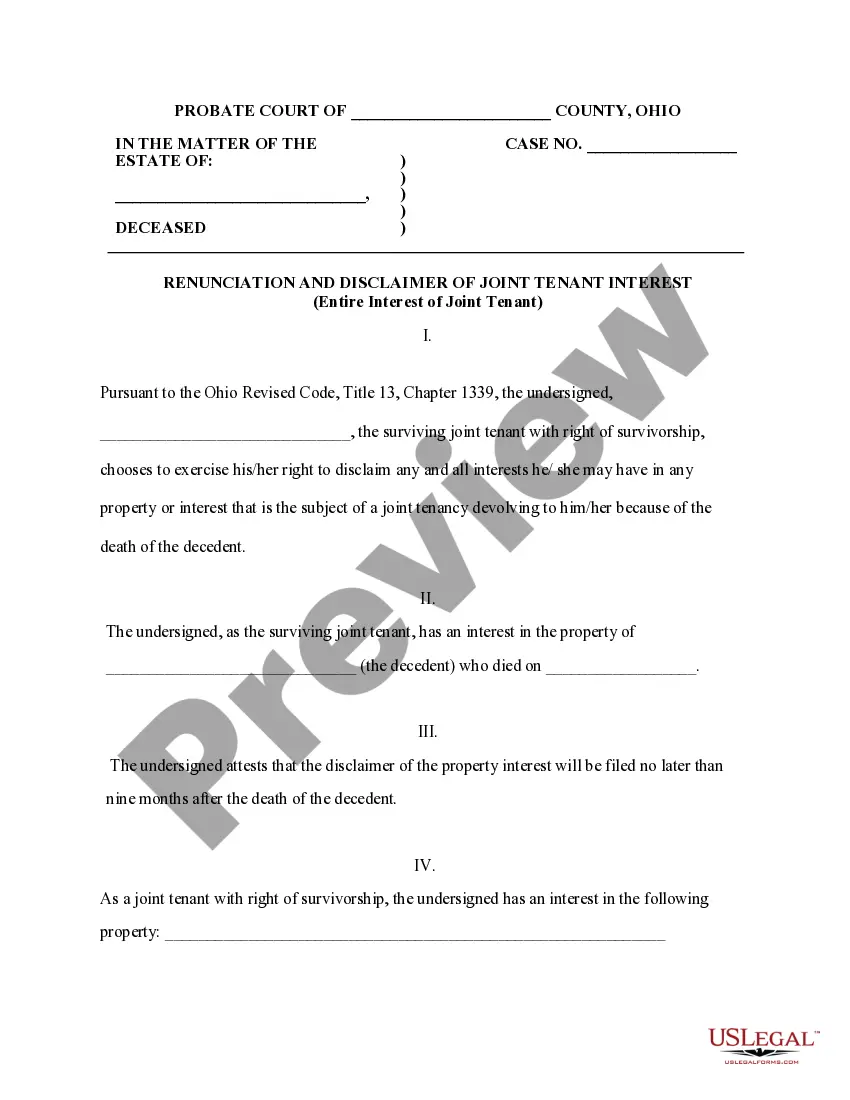
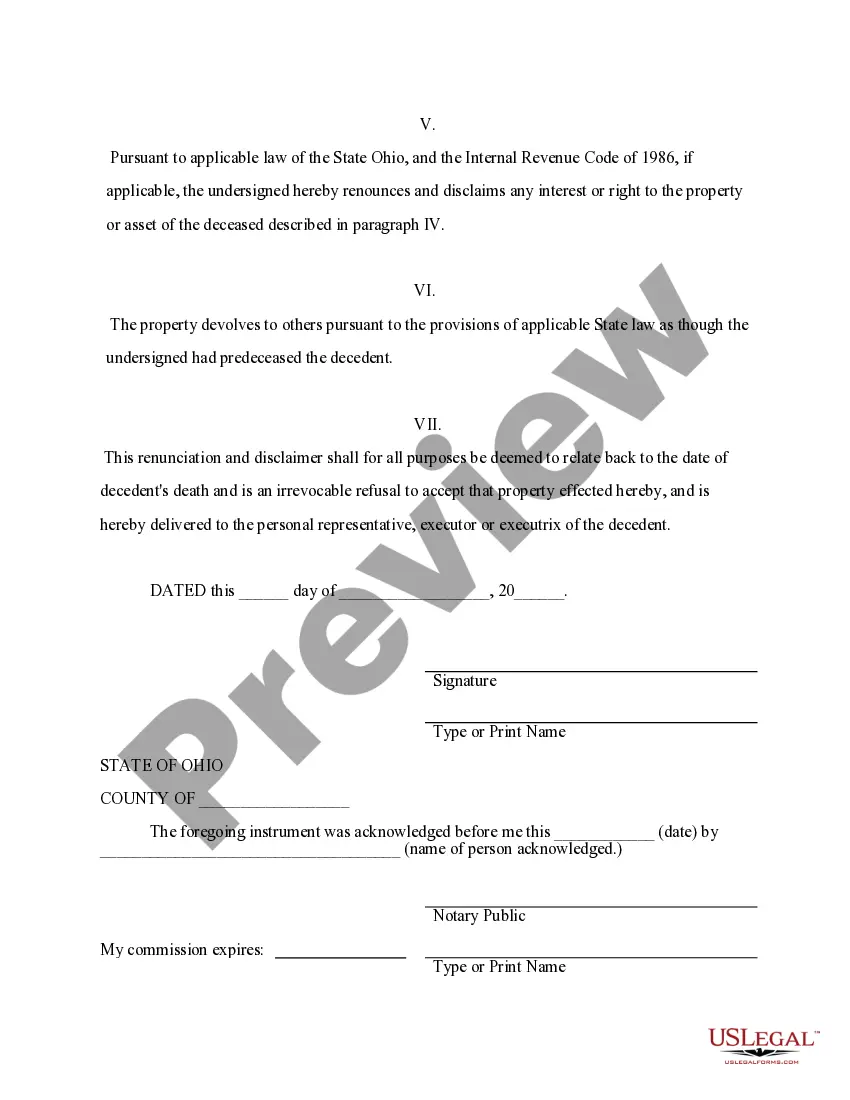
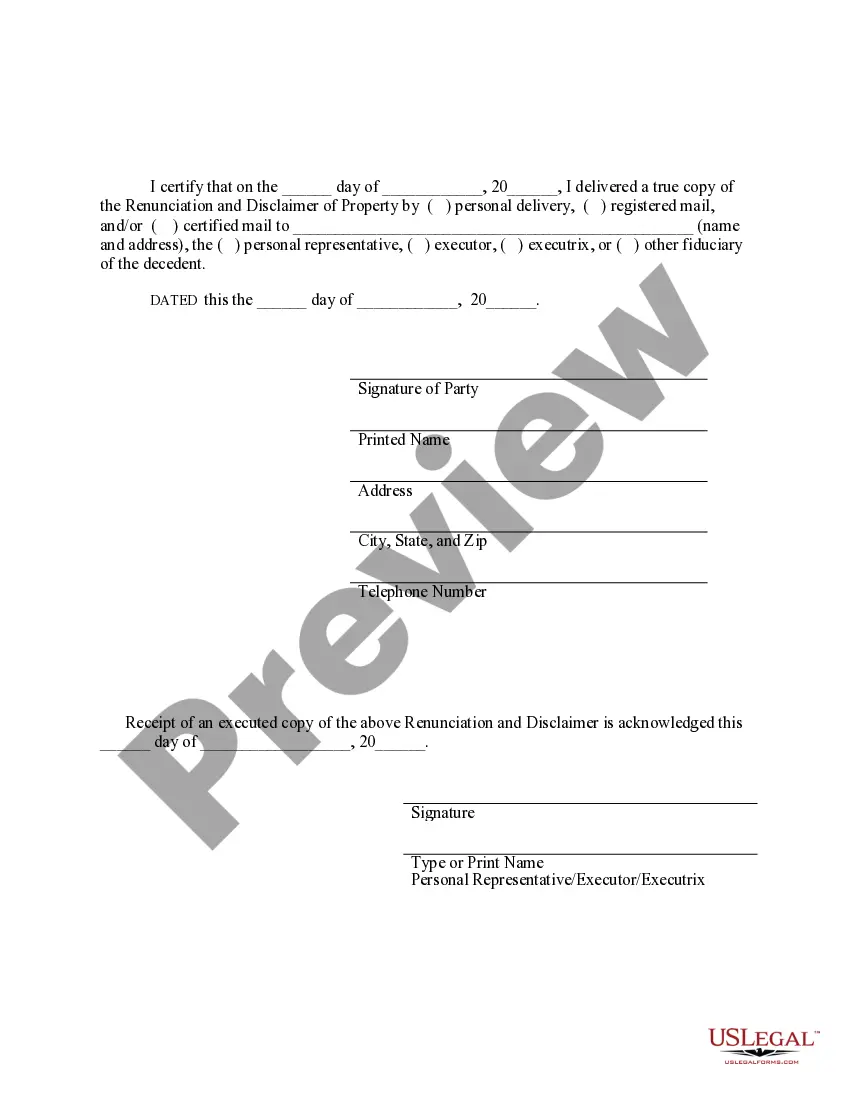
Renunciation And Disclaimer of Joint Tenant or Tenancy Interest
Disclaimer of Property Interest-Ohio
Ohio Revised Code
TITLE [13] XIII COMMERCIAL TRANSACTIONS -- OHIO UNIFORM COMMERCIAL CODE
CHAPTER 1339: FIDUCIARY LAW
Disclaimer of testamentary and nontestamentary succession to
real and personal property.
Text of Statute
(A) As used in this section:
(1) "Disclaimant" means any person, any guardian or personal
representative of a person or estate of a person, or any attorney-in-fact
or agent of a person having a general or specific authority to act granted
in a written instrument, who is any of the following:
(a) With respect to testamentary instruments and intestate
succession, an heir, next of kin, devisee, legatee, donee, person succeeding
to a disclaimed interest, surviving joint tenant, surviving tenant by the
entireties, surviving tenant of a tenancy with a right of survivorship,
beneficiary under a testamentary instrument, or person designated to take
pursuant to a power of appointment exercised by a testamentary instrument;
(b) With respect to nontestamentary instruments, a grantee, donee,
person succeeding to a disclaimed interest, surviving joint tenant, surviving
tenant by the entireties, surviving tenant of a tenancy with a right of
survivorship, beneficiary under a nontestamentary instrument, or person
designated to take pursuant to a power of appointment exercised by a nontestamentary
instrument;
(c) With respect to fiduciary rights, privileges, powers, and immunities,
a fiduciary under a testamentary or nontestamentary instrument. This section
does not authorize a fiduciary to disclaim the rights of beneficiaries
unless the instrument creating the fiduciary relationship authorizes such
a disclaimer.
(2) "Property" means all forms of property, real and personal, tangible
and intangible.
(B)
(1) A disclaimant, other than a fiduciary under an instrument
who is not authorized by the instrument to disclaim the interest of a beneficiary,
may disclaim, in whole or in part, the succession to any property by executing
and by delivering, filing, or recording a written disclaimer instrument
in the manner provided in this section.
(2) A disclaimant who is a fiduciary under an instrument may disclaim,
in whole or in part, any right, power, privilege, or immunity, by executing
and by delivering, filing, or recording a written disclaimer instrument
in the manner provided in this section.
(3) The written instrument of disclaimer shall be signed and acknowledged
by the disclaimant and shall contain all of the following:
(b) A description of the property, part of property, or interest
disclaimed, and of any fiduciary right, power, privilege, or immunity disclaimed;
(4) The guardian of the estate of a minor or an incompetent, or the
personal representative of a deceased person, with the consent of the probate
division of the court of common pleas, may disclaim, in whole or in part,
the succession to any property, or interest in property, that the ward,
if an adult and competent, or the deceased, if living, might have disclaimed.
The guardian or personal representative, or any interested person may file
an application with the probate division of the court of common pleas that
has jurisdiction of the estate, asking that the court order the guardian
or personal representative to execute and deliver, file, or record the
disclaimer on behalf of the ward or estate. The court shall order the guardian
or personal representative to execute and deliver, file, or record the
disclaimer if the court finds, upon hearing after notice to interested
parties and such other persons as the court shall direct, that:
(b) It would not materially, adversely affect the minor or incompetent,
or the beneficiaries of the estate of the decedent, taking into consideration
other available resources and the age, probable life expectancy, physical
and mental condition, and present and reasonably anticipated future needs
of the minor or incompetent or the beneficiaries of the estate of the decedent.
A written instrument of disclaimer ordered by the
court under this division shall be executed and be delivered, filed, or
recorded within the time and in the manner in which the person could have
disclaimed if the person were living, an adult, and competent.
(C) A partial disclaimer of property that is subject to
a burdensome interest created by the donative instrument is not effective
unless the disclaimed property constitutes a gift that is separate and
distinct from undisclaimed gifts.
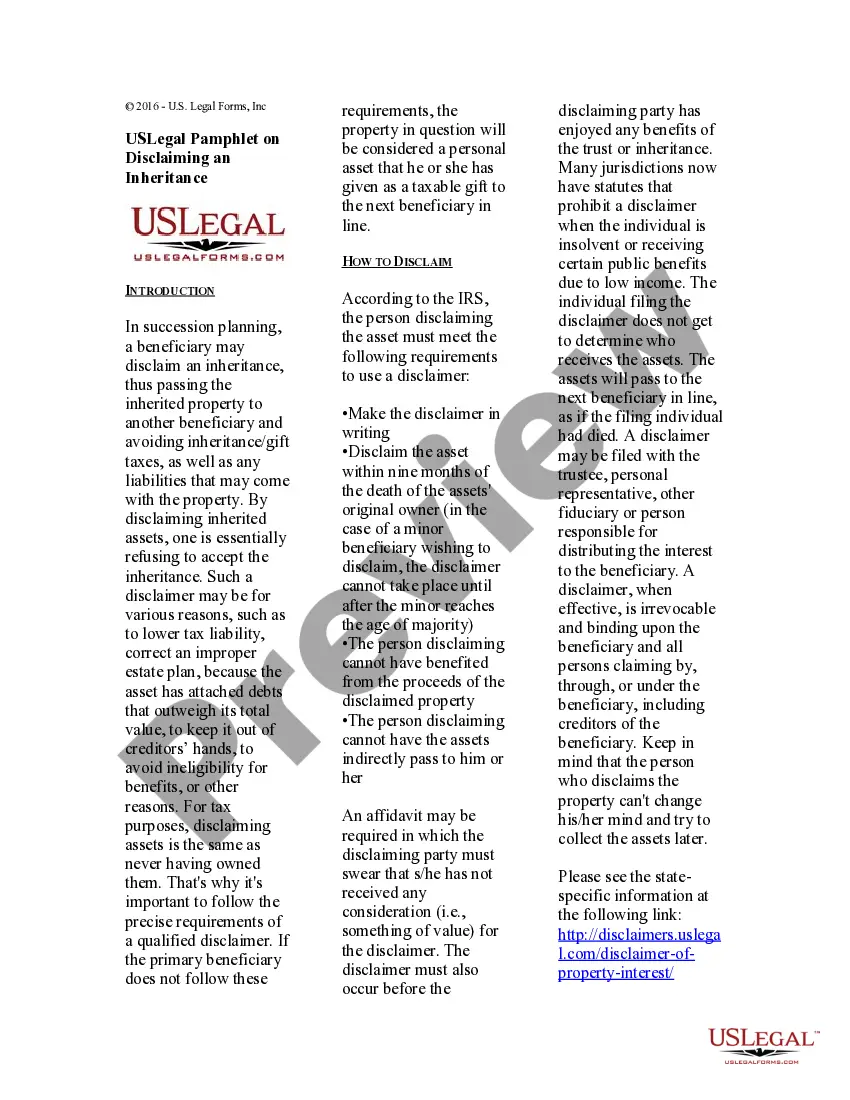
(D) The disclaimant shall deliver, file, or record the disclaimer,
or cause the same to be done, not later than nine months after the latest
of the following dates:
(1) The effective date of the donative instrument if both
the taker and the taker's interest in the property are finally ascertained
on that date;
(2) The date of the occurrence of the event upon which both the
taker and the taker's interest in the property become finally ascertainable;
(3) The date on which the disclaimant attains twenty-one years of
age or is no longer an incompetent, without tendering or repaying any benefit
received while the disclaimant was under twenty-one years of age or an
incompetent, and even if a guardian of a minor or incompetent had filed
an application pursuant to division (B)(4) of this section and the probate
division of the court of common pleas involved did not consent to the guardian
executing a disclaimer.
(E) No disclaimer instrument is effective under this section if either
of the following applies under the terms of the disclaimer instrument:
(2) The disclaimant may transfer, or direct to be transferred, to
self the entire legal and equitable ownership of the property subject to
the disclaimer instrument.
(F)
(1) Subject to division (F)(2) of this section, if the
interest disclaimed is created by a nontestamentary instrument, the disclaimer
instrument shall be delivered personally or by certified mail to the trustee
or other person who has legal title to, or possession of, the property
disclaimed.
(2) If the interest disclaimed is created by a testamentary instrument,
by intestate succession, or by a transfer on death deed pursuant to section
5302.22 of the Revised Code, the disclaimer instrument shall be filed in
the probate division of the court of common pleas in the county in which
proceedings for the administration of the decedent's estate have been commenced,
and an executed copy of the disclaimer instrument shall be delivered personally
or by certified mail to the personal representative of the decedent's estate.
(3) If no proceedings for the administration of the decedent's estate
have been commenced, the disclaimer instrument shall be filed in the probate
division of the court of common pleas in the county in which proceedings
for the administration of the decedent's estate might be commenced according
to law. The disclaimer instrument shall be filed and indexed, and fees
charged, in the same manner as provided by law for an application to be
appointed as personal representative to administer the decedent's estate.
The disclaimer is effective whether or not proceedings thereafter are commenced
to administer the decedent's estate. If proceedings thereafter are commenced
for the administration of the decedent's estate, they shall be filed under,
or consolidated with, the case number assigned to the disclaimer instrument.
(4) If an interest in real estate is disclaimed, an executed copy
of the disclaimer instrument also shall be recorded in the office of the
recorder of the county in which the real estate is located. The disclaimer
instrument shall include a description of the real estate with sufficient
certainty to identify it, and shall contain a reference to the record of
the instrument that created the interest disclaimed. If title to the real
estate is registered under Chapters 5309. and 5310. of the Revised Code,
the disclaimer interest shall be entered as a memorial on the last certificate
of title. A spouse of a disclaimant has no dower or other interest in the
real estate disclaimed.
(G) Unless the donative instrument expressly provides that, if there
is a disclaimer, there shall not be any acceleration of remainders or other
interests, the property, part of property, or interest in property disclaimed,
and any future interest that is to take effect in possession or enjoyment
at or after the termination of the interest disclaimed, shall descend,
be distributed, or otherwise be disposed of, and shall be accelerated,
in the following manner:
(1) If intestate or testate succession is disclaimed, as
if the disclaimant had predeceased the decedent;
(2) If the disclaimant is one designated to take pursuant to a power
of appointment exercised by a testamentary instrument, as if the disclaimant
had predeceased the donee of the power;
(3) If the donative instrument is a nontestamentary instrument,
as if the disclaimant had died before the effective date of the nontestamentary
instrument;
(4) If the disclaimer is of a fiduciary right, power, privilege,
or immunity, as if the right, power, privilege, or immunity was never in
the donative instrument.
(H) A disclaimer pursuant to this section is effective as of, and relates
back for all purposes to, the date upon which the taker and the taker's
interest have been finally ascertained.
(I) A disclaimant who has a present and future interest in property,
and disclaims the disclaimant's present interest in whole or in part, is
considered to have disclaimed the disclaimant's future interest to the
same extent, unless a contrary intention appears in the disclaimer instrument
or the donative instrument. A disclaimant is not precluded from receiving,
as an alternative taker, a beneficial interest in the property disclaimed,
unless a contrary intention appears in the disclaimer instrument or in
the donative instrument.
(J) The disclaimant's right to disclaim under this section is barred
if, before the expiration of the period within which the disclaimant may
disclaim the interest, the disclaimant does any of the following:
(1) Assigns, conveys, encumbers, pledges, or transfers,
or contracts to assign, convey, encumber, pledge, or transfer, the property
or any interest in it;
(2) Waives in writing the disclaimant's right to disclaim and executes
and delivers, files, or records the waiver in the manner provided in this
section for a disclaimer instrument;
(4) Permits or suffers a sale or other disposition of the property
pursuant to judicial action against the disclaimant.
(K) A fiduciary's application for appointment or assumption of duties
as a fiduciary does not waive or bar the disclaimant's right to disclaim
a right, power, privilege, or immunity.
(L) The right to disclaim under this section exists irrespective
of any limitation on the interest of the disclaimant in the nature of a
spendthrift provision or similar restriction.
(M) A disclaimer instrument or written waiver of the right to disclaim
that has been executed and delivered, filed, or recorded as required by
this section is final and binding upon all persons.
(N) The right to disclaim and the procedures for disclaimer established
by this section are in addition to, and do not exclude or abridge, any
other rights or procedures existing under any other section of the Revised
Code or at common law to assign, convey, release, refuse to accept, renounce,
waive, or disclaim property.
(O)
(1) No person is liable for distributing or disposing of
property in a manner inconsistent with the terms of a valid disclaimer
if the distribution or disposition is otherwise proper and the person has
no actual knowledge of the disclaimer.
(2) No person is liable for distributing or disposing of property
in reliance upon the terms of a disclaimer that is invalid because the
right of disclaimer has been waived or barred if the distribution or disposition
is otherwise proper and the person has no actual knowledge of the facts
that constitute a waiver or bar to the right to disclaim.
(P)
(1) A disclaimant may disclaim pursuant to this section
any interest in property that is in existence on September 27, 1976, if
either the interest in the property or the taker of the interest in the
property is not finally ascertained on that date.
(2) No disclaimer executed pursuant to this section destroys or
diminishes an interest in property that exists on September 27, 1976, in
any person other than the disclaimant.
Title XIII, Chap. 1339, § 1339.68