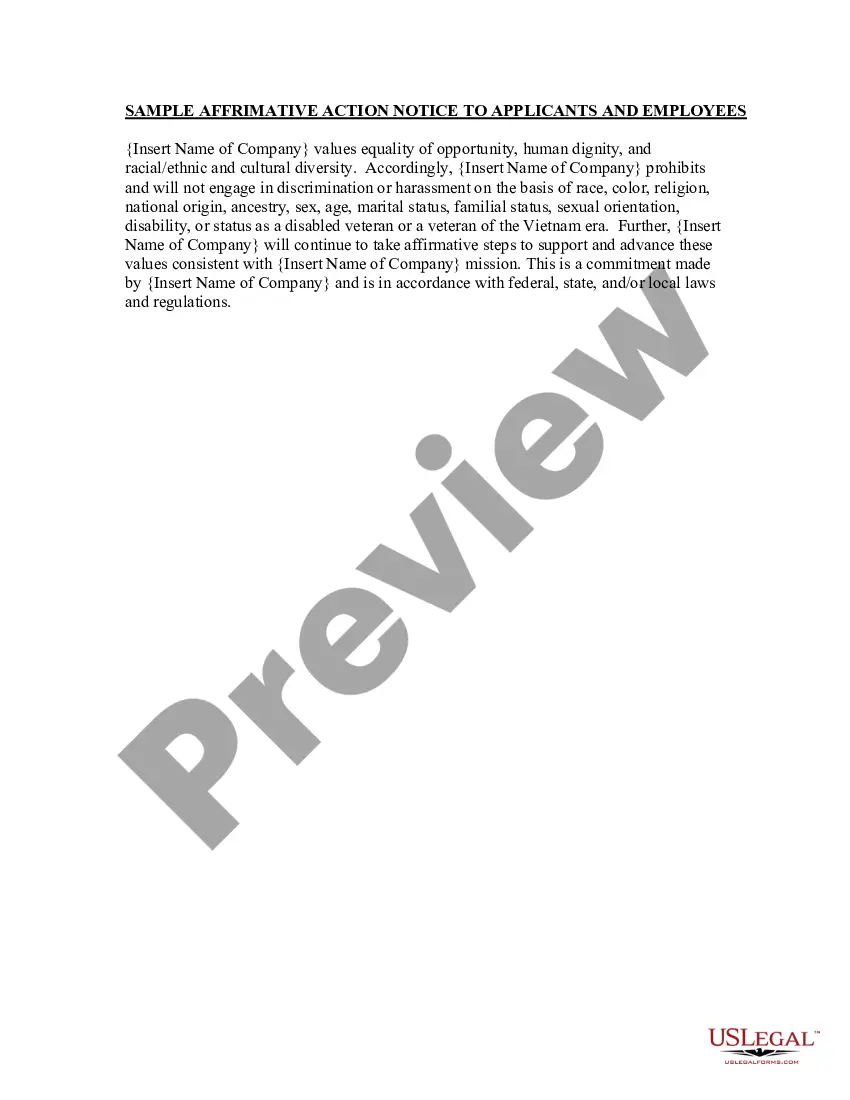
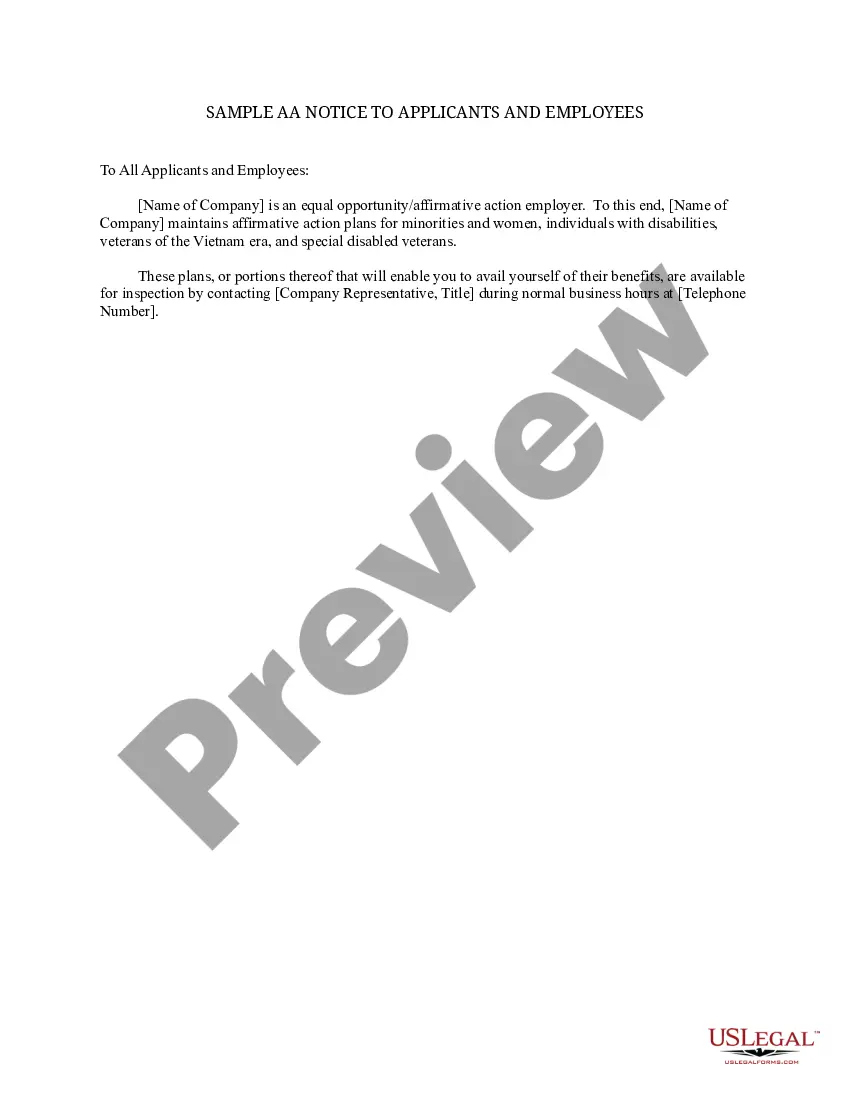
New York Sample Affirmative Action Notice to Applicants and Employees
Description
Get your form ready online
Our built-in tools help you complete, sign, share, and store your documents in one place.
Make edits, fill in missing information, and update formatting in US Legal Forms—just like you would in MS Word.
Download a copy, print it, send it by email, or mail it via USPS—whatever works best for your next step.
Sign and collect signatures with our SignNow integration. Send to multiple recipients, set reminders, and more. Go Premium to unlock E-Sign.
If this form requires notarization, complete it online through a secure video call—no need to meet a notary in person or wait for an appointment.
We protect your documents and personal data by following strict security and privacy standards.

Make edits, fill in missing information, and update formatting in US Legal Forms—just like you would in MS Word.

Download a copy, print it, send it by email, or mail it via USPS—whatever works best for your next step.

Sign and collect signatures with our SignNow integration. Send to multiple recipients, set reminders, and more. Go Premium to unlock E-Sign.

If this form requires notarization, complete it online through a secure video call—no need to meet a notary in person or wait for an appointment.

We protect your documents and personal data by following strict security and privacy standards.
Looking for another form?
How to fill out Sample Affirmative Action Notice To Applicants And Employees?
If you desire to be thorough, acquire, or create authentic document templates, utilize US Legal Forms, the premier collection of legal forms, accessible online.
Take advantage of the website’s user-friendly and convenient search feature to locate the documents you need.
Various templates for corporate and personal purposes are categorized by types and states, or keywords.
Step 4. Once you have found the form you need, choose the Purchase now button. Select your preferred payment plan and enter your details to create an account.
Step 5. Process the transaction. You can use your credit card or PayPal account to complete the payment.
- Employ US Legal Forms to obtain the New York Sample Affirmative Action Notice to Applicants and Employees in just a few clicks.
- If you are already a US Legal Forms customer, sign in to your account and click on the Download button to get the New York Sample Affirmative Action Notice to Applicants and Employees.
- You can also access forms you previously downloaded from the My documents section of your account.
- If this is your first time using US Legal Forms, follow the instructions below.
- Step 1. Ensure you have selected the form for the correct city/state.
- Step 2. Use the Preview option to review the content of the form. Always remember to check the description.
- Step 3. If you are not satisfied with the document, utilize the Search box at the top of the screen to find alternative versions of the legal form template.
Form popularity
FAQ
For federal contractors and subcontractors, affirmative action must be taken by covered employers to recruit and advance qualified minorities, women, persons with disabilities, and covered veterans. Affirmative actions include training programs, outreach efforts, and other positive steps.
Affirmative Action regulation forbids employers to discriminate against individuals because of their race, color, religion, sex, or national origin in decisions regarding hiring, firing, compensation or other forms of employment.
Affirmative action plans (AAPs) define an employer's standard for proactively recruiting, hiring and promoting women, minorities, disabled individuals and veterans. Affirmative action is deemed a moral and social obligation to amend historical wrongs and eliminate the present effects of past discrimination.
As of March 2015, New York state law required state contractors to have an affirmative action program to ensure that minority groups and women are afforded equal employment opportunities.
Outreach campaigns, targeted recruitment, employee and management development, and employee support programs are examples of affirmative action in employment.
Step 1: Develop and Post an Equal Opportunity Policy.Step 2: Assign Responsibility for AAP Review and Implementation.Step 3: Develop an Organizational Display.Step 4: Conduct a Workforce Analysis.Step 5: Perform a Job Group Analysis.Step 6: Conduct an Availability Analysis.More items...
Affirmative action requirements are intended to ensure that applicants and employees of federal contractors have equal opportunity for recruitment, selection, advancement, and every other term and privilege associated with employment, without regard to their race, color, religion, sex, sexual orientation, gender
An Affirmative Action Plan (AAP) is a tool, a written program in which an employer details the steps it has taken and will take to ensure the right of all persons to advance on the basis of merit and ability without regard to race, color, religion, sex, national origin, age, disability, genetic information, veteran's
Historically and internationally, support for affirmative action has sought to achieve goals such as bridging inequalities in employment and pay, increasing access to education, promoting diversity, and redressing apparent past wrongs, harms, or hindrances.