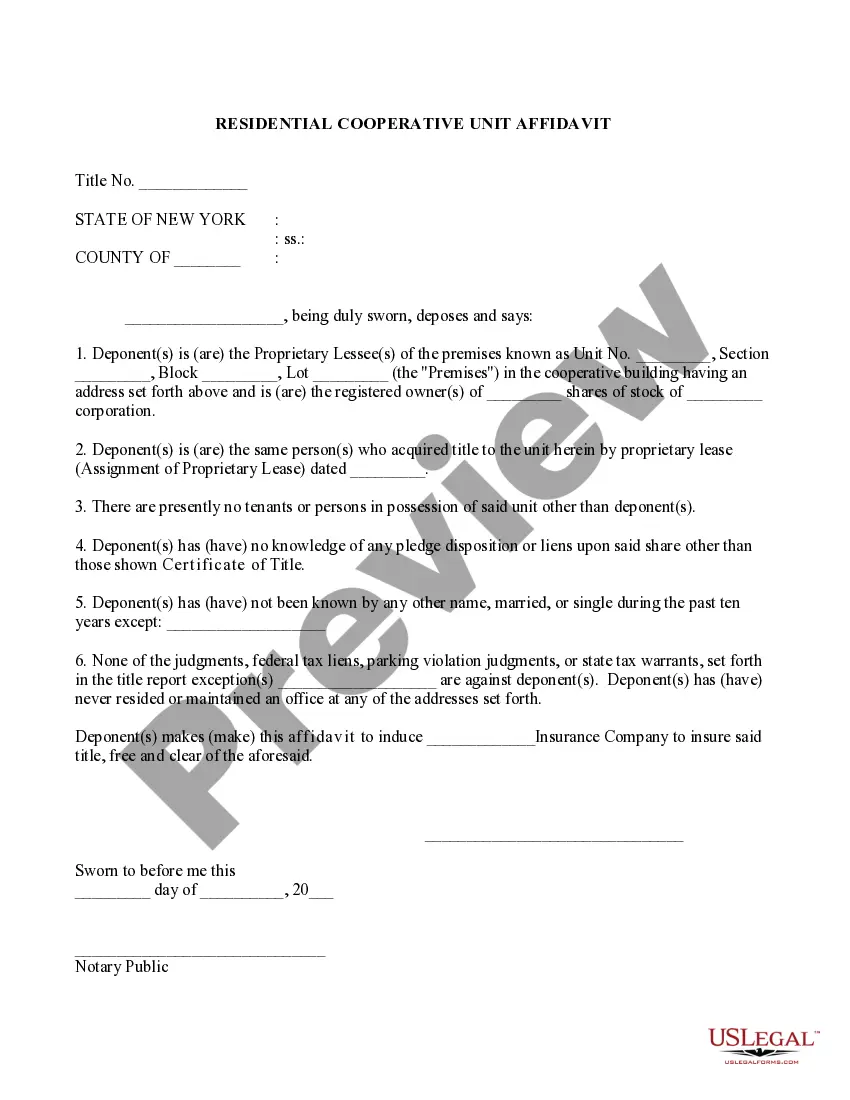
New York Residential Cooperative Unit Affidavit
What this document covers
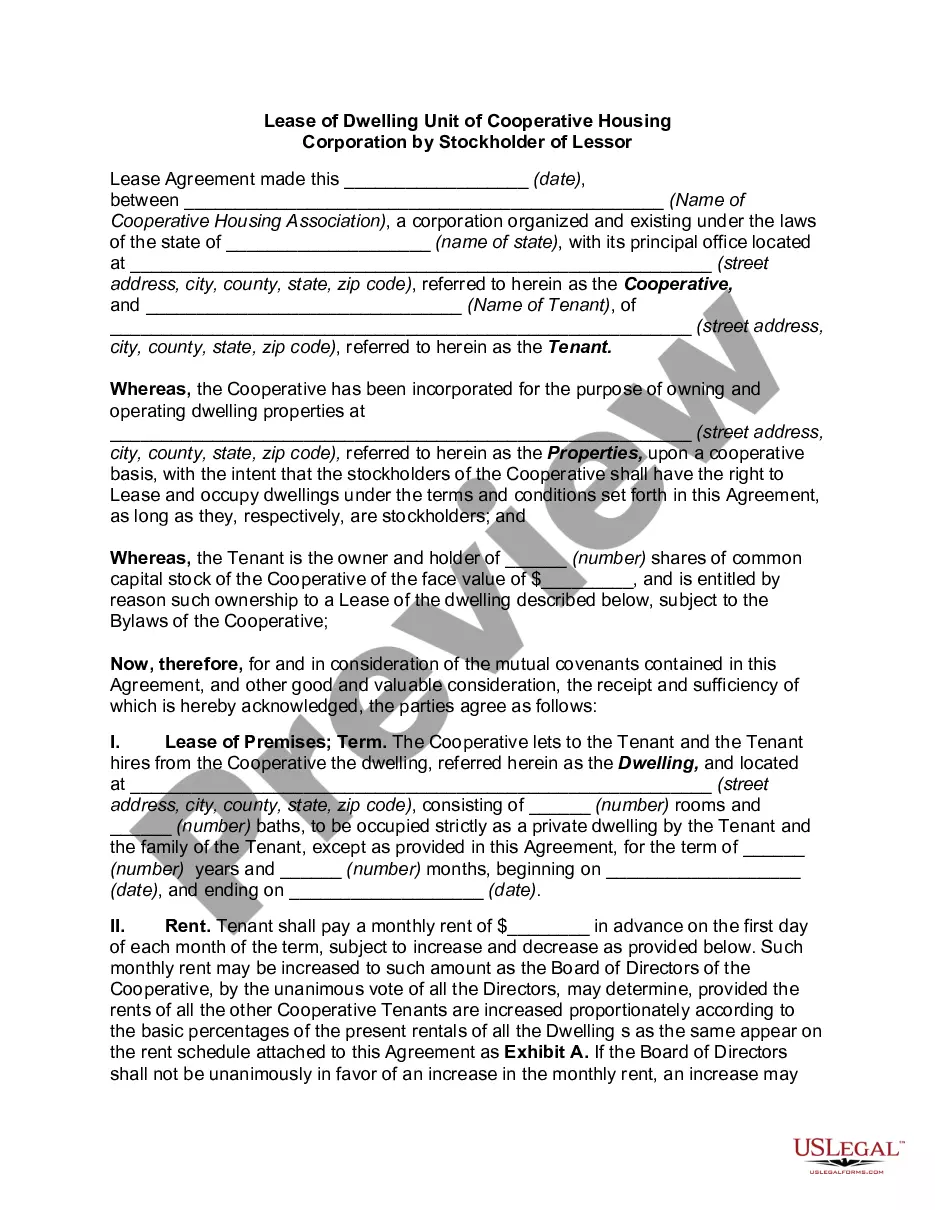
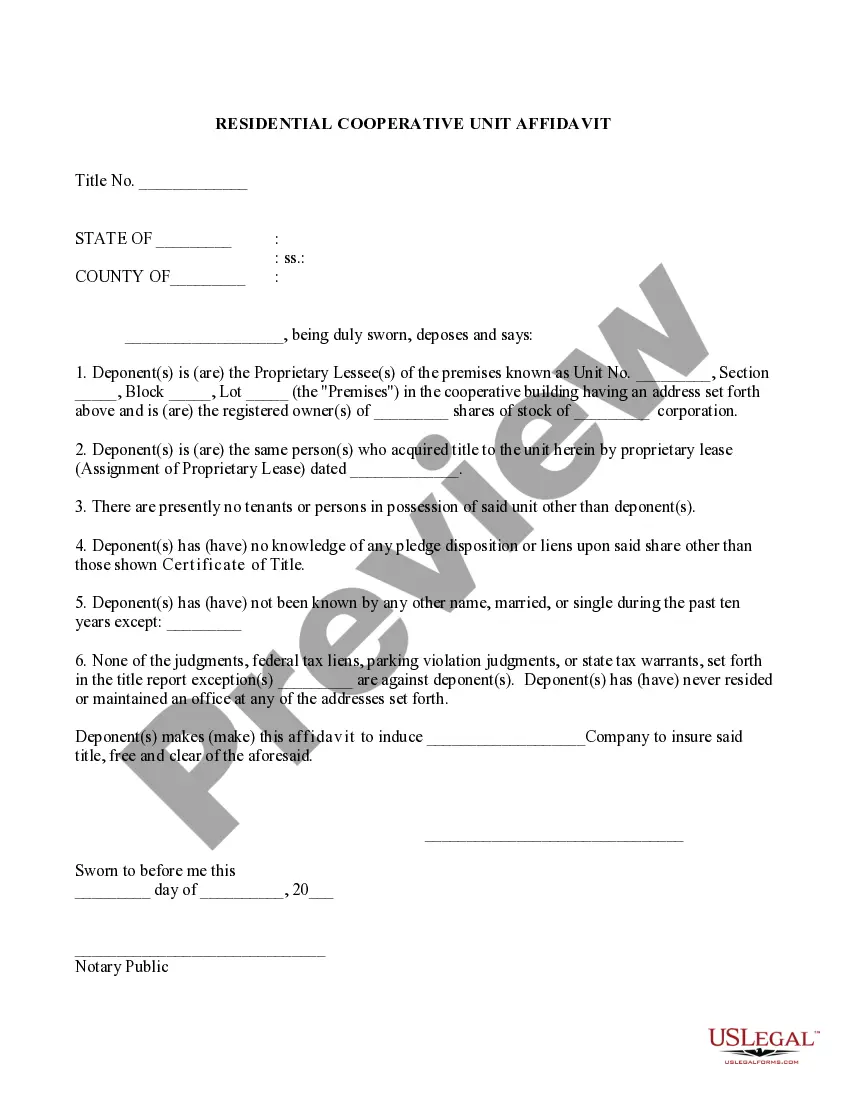
The Residential Cooperative Unit Affidavit is a legal document confirming that the ownership title for a unit in a cooperative building is free from any liens or judgments. This affidavit serves to assure a prospective insurance company or lender that there are no outstanding claims against the unit, differentiating it from other property verification forms by its specific focus on cooperative unit ownership.
What’s included in this form
- Identification of the deponent(s) as the Proprietary Lessee(s) of the cooperative unit.
- Confirmation of the absence of tenants or other occupants in the unit.
- Declarations regarding prior ownership and any liens on the shares of the cooperative corporation.
- Affirmation that no judgments or liens affect the deponent(s).
- A section for notarization to validate the affidavit.
When to use this form
This affidavit is typically used when a co-op owner is refinancing their mortgage, selling the unit, or obtaining title insurance. It is essential when proof of clear title is needed to reassure financial institutions or prospective buyers of the unit's status.
Who can use this document
This form is intended for:
- Current proprietary lessees of cooperative units seeking to sell or refinance their property.
- Individuals applying for title insurance related to their cooperative ownership.
- Anyone needing to verify that their cooperative unit is free of legal claims.
How to complete this form
- Identify the deponent(s) and fill in their names and the unit details.
- State the number of shares owned in the cooperative corporation.
- Provide the date of acquisition of the proprietary lease.
- Confirm no other parties occupy the unit.
- Ensure all prior names and details are accurately disclosed.
- Sign the document in the presence of a notary public.
Notarization guidance
Yes, this form must be notarized to be legally valid. US Legal Forms provides an online notarization service that is available 24/7. This service ensures the document is signed securely via video call, with legal equivalence to in-person notarization, eliminating the need for travel.
Get your form ready online
Our built-in tools help you complete, sign, share, and store your documents in one place.
Make edits, fill in missing information, and update formatting in US Legal Forms—just like you would in MS Word.
Download a copy, print it, send it by email, or mail it via USPS—whatever works best for your next step.
Sign and collect signatures with our SignNow integration. Send to multiple recipients, set reminders, and more. Go Premium to unlock E-Sign.
If this form requires notarization, complete it online through a secure video call—no need to meet a notary in person or wait for an appointment.
We protect your documents and personal data by following strict security and privacy standards.

Make edits, fill in missing information, and update formatting in US Legal Forms—just like you would in MS Word.

Download a copy, print it, send it by email, or mail it via USPS—whatever works best for your next step.

Sign and collect signatures with our SignNow integration. Send to multiple recipients, set reminders, and more. Go Premium to unlock E-Sign.

If this form requires notarization, complete it online through a secure video call—no need to meet a notary in person or wait for an appointment.

We protect your documents and personal data by following strict security and privacy standards.
Common mistakes
- Failing to fill in all required sections, particularly the details about ownership and liens.
- Not having the affidavit notarized, which may invalidate the document.
- Neglecting to verify the absence of outstanding judgments or liens before completing the form.
Main things to remember
- The Residential Cooperative Unit Affidavit confirms the clear title of a cooperative unit.
- It is essential for financial transactions associated with cooperative ownership.
- Proper completion and notarization are crucial to ensure the document's legality.
Looking for another form?
Form popularity
FAQ
421a tax abatement benefits The longer the term of the abatement (i.e. 10 years vs. 25 years), the larger the savings you receive during your period of ownership. The post-construction tax benefits phase out over time based on a set schedule, and the property becomes fully taxable upon expiration of the abatement.
The reduction percentage is between 17.5% and 28.1% if the owners meet certain requirements to apply for the abatement. The abatement is solely for a co-op and condo owner that uses the unit as their primary residence. If you purchased a condo unit as an investment property, you will not be eligible.
It's all one payment because remember you don't actually own the apartment. You own shares in a building and the entire building receives the property tax bill, not the individual owners. A maintenance payment is usually about 50% property taxes and 50% common charges.
Pros of 421a Tax Abatements for NYC Home Buyers For example, if an owner has a 20-year tax abatement, they will pay pennies on the dollar for the first 12 years of the abatement. After that, the tax will jump by 20% of the whole amount every two years.
To determine the beginning and end dates for tax benefits given to a building for either of these two programs, log on to .nyc.gov/finance.
Owners of cooperative units and condominiums who meet the eligibility requirements for the Cooperative and Condominium Property Tax Abatement can have their property taxes reduced. The amount of the abatement is based on the average assessed value of the residential units in the development.
421-a Tax Abatement Enhanced 35-year Benefit Benefits are available primarily for rental projects. The benefit includes 100% real estate tax exemption for up to three years during the construction period and an additional 35 years after construction.
Owners of cooperative units and condominiums who meet the eligibility requirements for the Cooperative and Condominium Property Tax Abatement can have their property taxes reduced. The amount of the abatement is based on the average assessed value of the residential units in the development.