New York Affidavit for Judgment By Confession
What this document covers
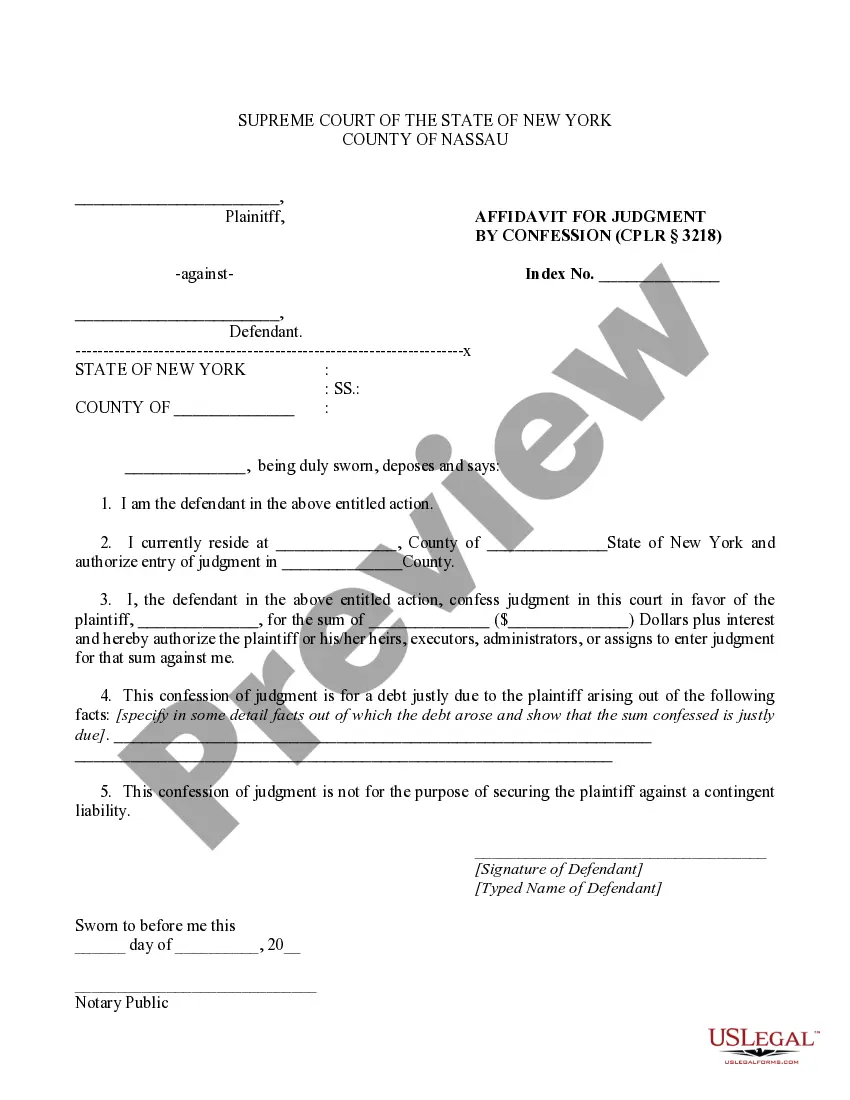
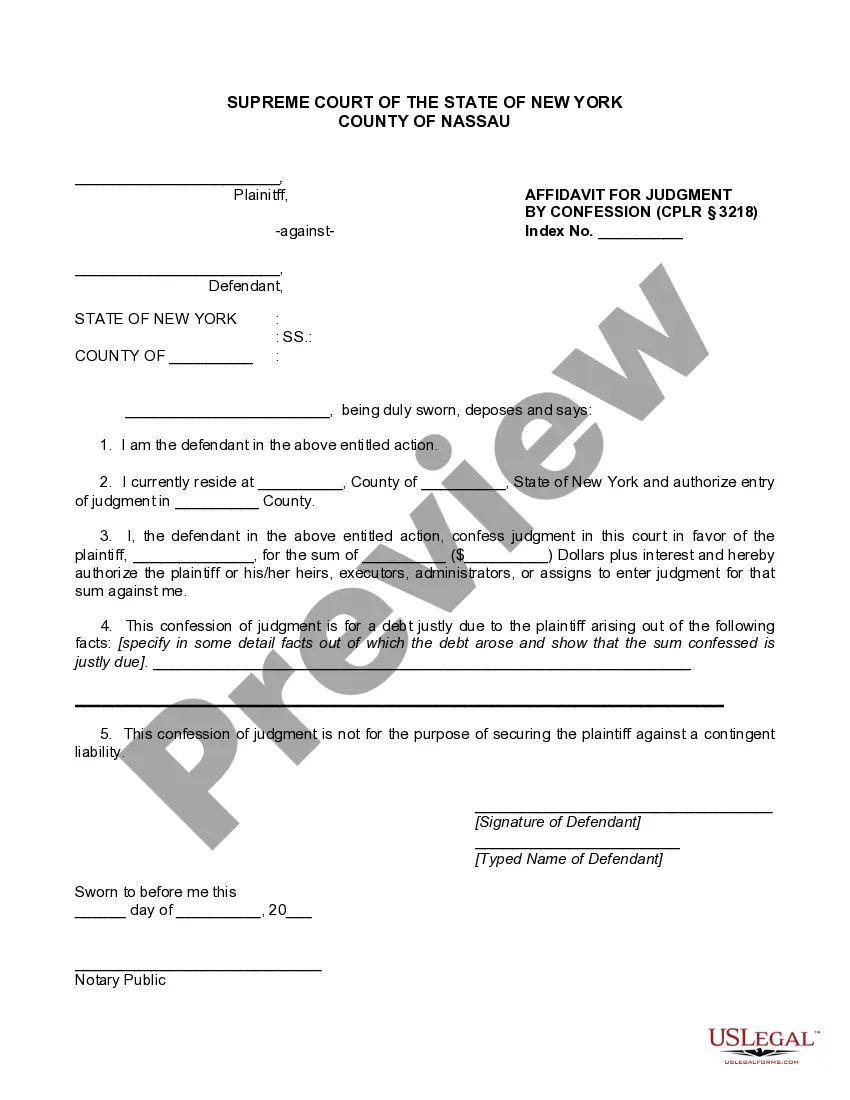
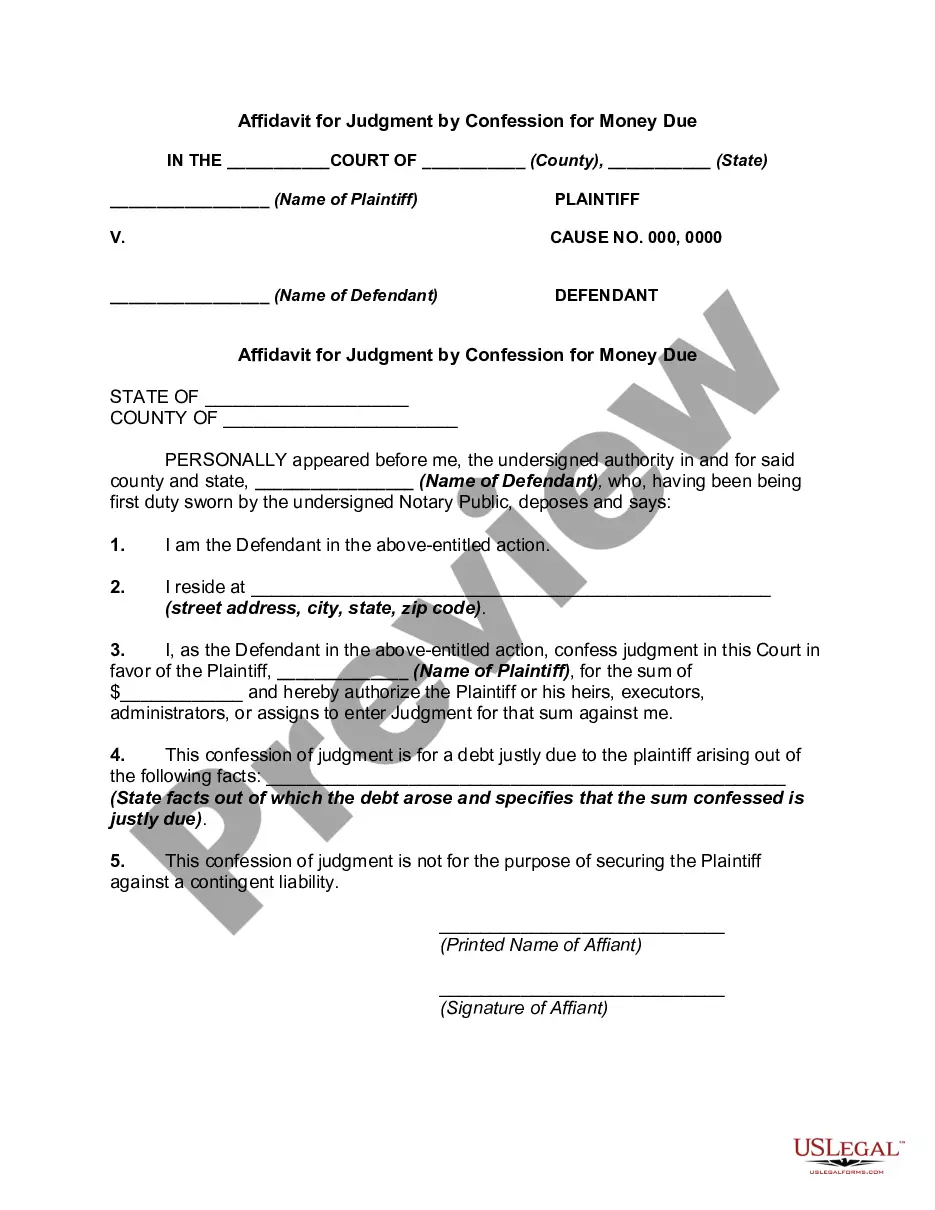
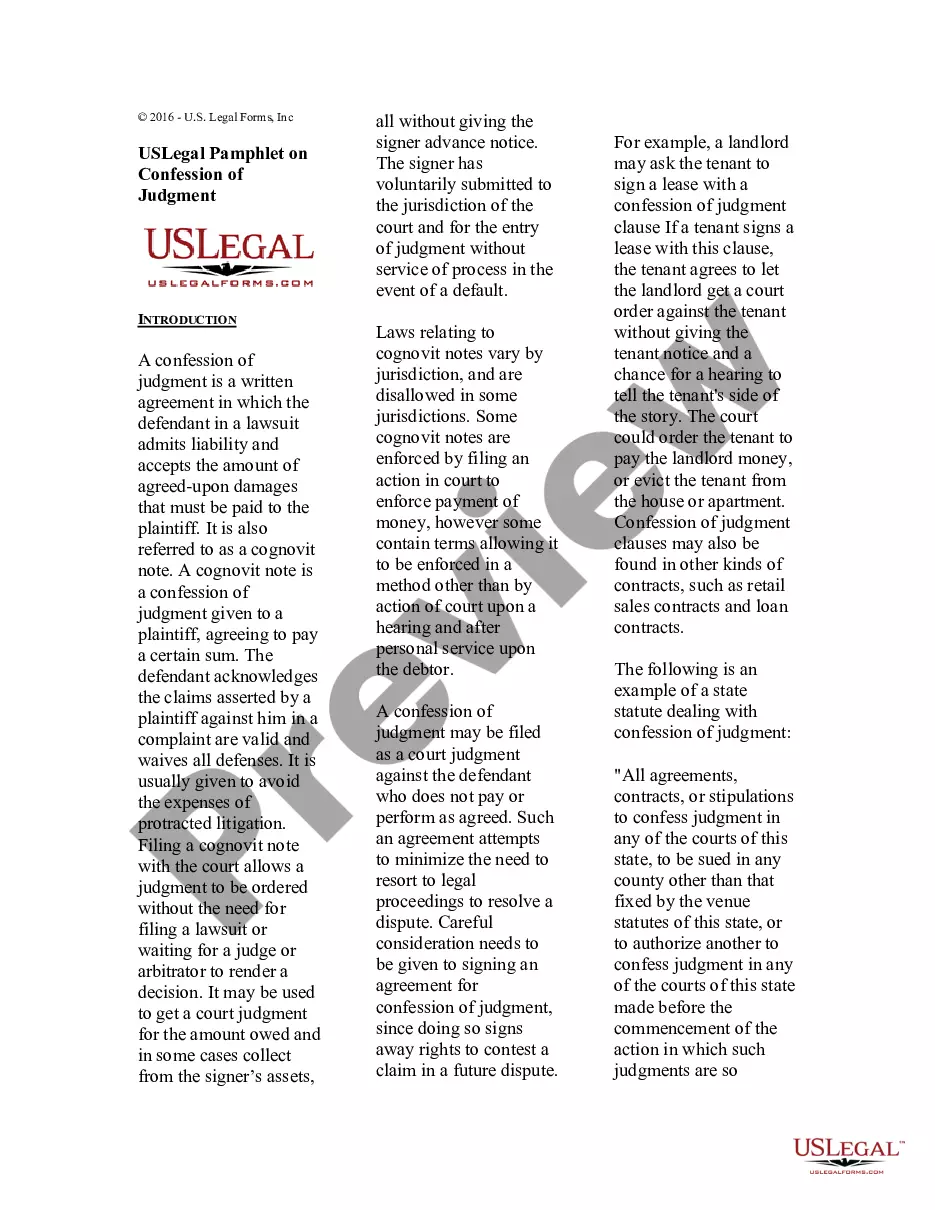
The Affidavit for Judgment By Confession is a legal document that allows a defendant to admit liability for a debt or obligation to a plaintiff. This form is unique because it is a confession of judgment, meaning that the defendant acknowledges the debt and permits the plaintiff to file it as a judgment if certain conditions are met. Unlike other loan acknowledgment forms, this affidavit serves as a binding admission of liability, making it important for both parties involved.
Key parts of this document
- Name of the plaintiff and defendant
- Details of the judgment amount
- Specific facts that led to the debt
- Defendant's signature and notarization
- Confirmation of residency
When this form is needed
This form is typically used when a defendant acknowledges that they owe a debt to a plaintiff and agrees to the terms of a judgment. It can be useful in situations such as settling debts amicably, where the plaintiff needs a formal acknowledgment of the debt for collection purposes. This might apply in personal loans, business transactions, or contractual obligations where the defendant is unable or unwilling to dispute the claim.
Intended users of this form
- Defendants who are willing to admit liability for a debt
- Creditors seeking formal acknowledgment of a debt by the debtor
- Parties involved in a loan or financial agreement where a confession of judgment is necessary
Steps to complete this form
- Enter the names of the plaintiff and defendant at the beginning of the form.
- Specify the amount of judgment the defendant confesses to owing.
- Detail the facts supporting the debt, explaining why the amount stated is due.
- Indicate the defendant's current residence and authorized county for judgment entry.
- Have the defendant sign the affidavit and ensure it is notarized.
Does this form need to be notarized?
Yes, this form must be notarized to be legally valid. The defendant's signature requires a notary public to verify identity and witness the signing, ensuring that the affidavit is enforceable in court. US Legal Forms offers reliable online notarization services, available anytime for secure video calls.
Get your form ready online
Our built-in tools help you complete, sign, share, and store your documents in one place.
Make edits, fill in missing information, and update formatting in US Legal Forms—just like you would in MS Word.
Download a copy, print it, send it by email, or mail it via USPS—whatever works best for your next step.
Sign and collect signatures with our SignNow integration. Send to multiple recipients, set reminders, and more. Go Premium to unlock E-Sign.
If this form requires notarization, complete it online through a secure video call—no need to meet a notary in person or wait for an appointment.
We protect your documents and personal data by following strict security and privacy standards.

Make edits, fill in missing information, and update formatting in US Legal Forms—just like you would in MS Word.

Download a copy, print it, send it by email, or mail it via USPS—whatever works best for your next step.

Sign and collect signatures with our SignNow integration. Send to multiple recipients, set reminders, and more. Go Premium to unlock E-Sign.

If this form requires notarization, complete it online through a secure video call—no need to meet a notary in person or wait for an appointment.

We protect your documents and personal data by following strict security and privacy standards.
Common mistakes
- Failing to provide a detailed explanation of how the debt arose.
- Omitting the defendant's signature or notarization.
- Incorrectly filling in the court name or case number.
- Using an outdated version of the form not compliant with current laws.
Benefits of completing this form online
- Convenient access to legally drafted forms from licensed attorneys.
- Edit and customize the form to fit specific circumstances.
- Immediate download for quick use without waiting for mail delivery.
- Ease of storage and sharing capabilities of digital forms.
Looking for another form?
Form popularity
FAQ
In particular, confessions of judgment are only valid for three years after they are signed. Given how quickly a confession of judgment can be turned into an actual judgment, and the potential for abuse, the New York legislature has recently amended CPLR § 3218 further to restrict the use of confessions of judgment.
New York law has long permitted a creditor to obtain a money judgment against a debtor by simply filing a confession of judgment ? an affidavit signed by the debtor ? with a county clerk within the state. The use of confessions of judgment is governed by CPLR 3218.
When seeking to set aside a judgment on default or entered pursuant to a confession, you need to submit an affidavit to the court in support of an application to vacate the judgment. The application will either be by motion to vacate or by order to show cause.
A confession of judgment is a legal device - usually a clause within a contract - in which a debtor agrees to allow a creditor, upon the nonoccurrence of a payment, to obtain a judgment against the debtor, often without advanced notice or a hearing.
New York Judgment Statute of Limitations The statute of limitations for collecting on a New York judgment is 20 years, which starts the day the judgment creditor is first able to collect on the judgment. This timeline can sometimes be restarted.
New York law has long permitted a creditor to obtain a money judgment against a debtor by simply filing a confession of judgment ? an affidavit signed by the debtor ? with a county clerk within the state. The use of confessions of judgment is governed by CPLR 3218.
A confession of judgment is a significant legal concession, so it requires appropriate formalities to be executed and subsequently enforceable. California Code of Civil Procedure (CCP) sections 1132, 1133, and 1134 govern confessions of judgment.