New York Warrant
What this document covers
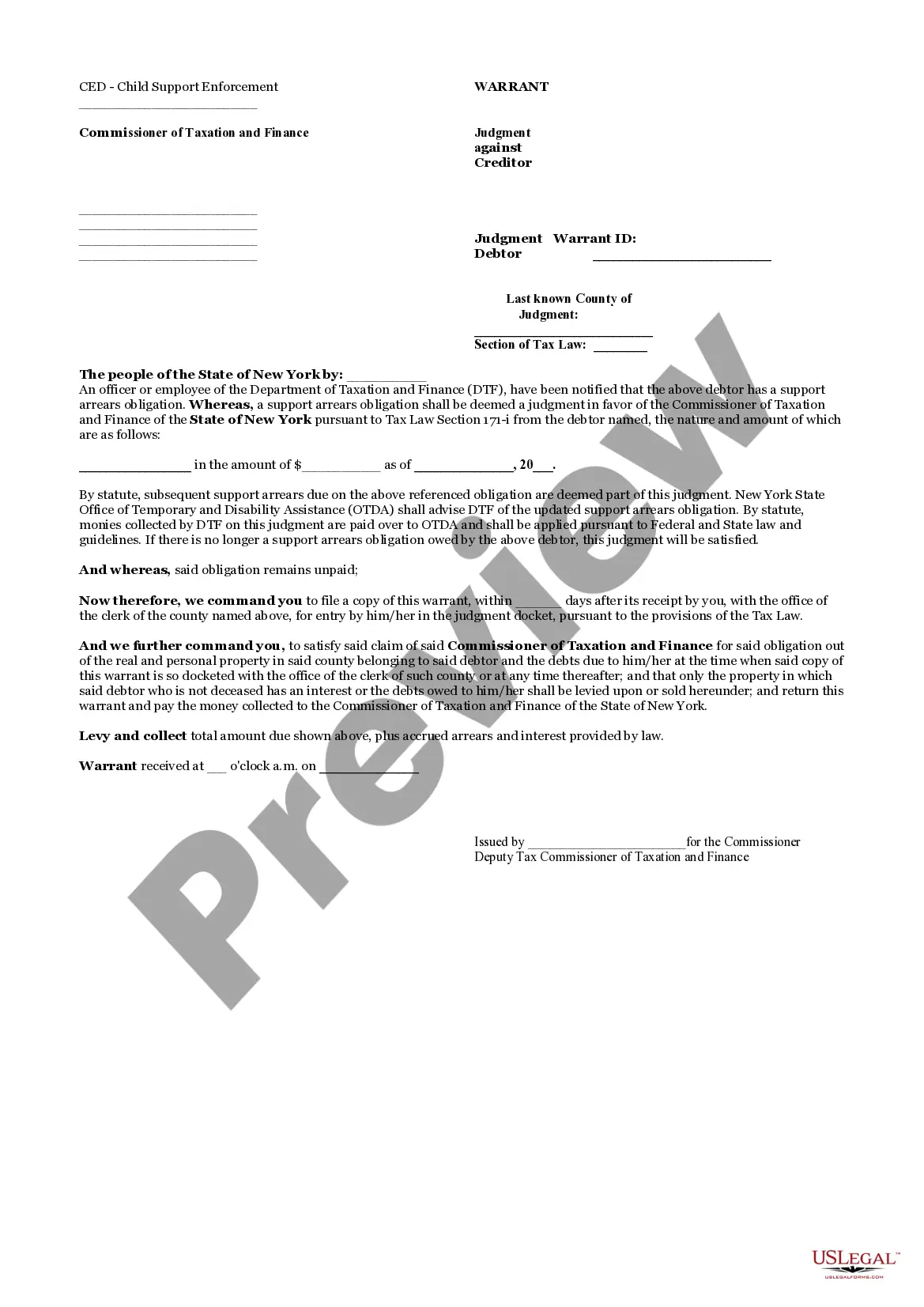
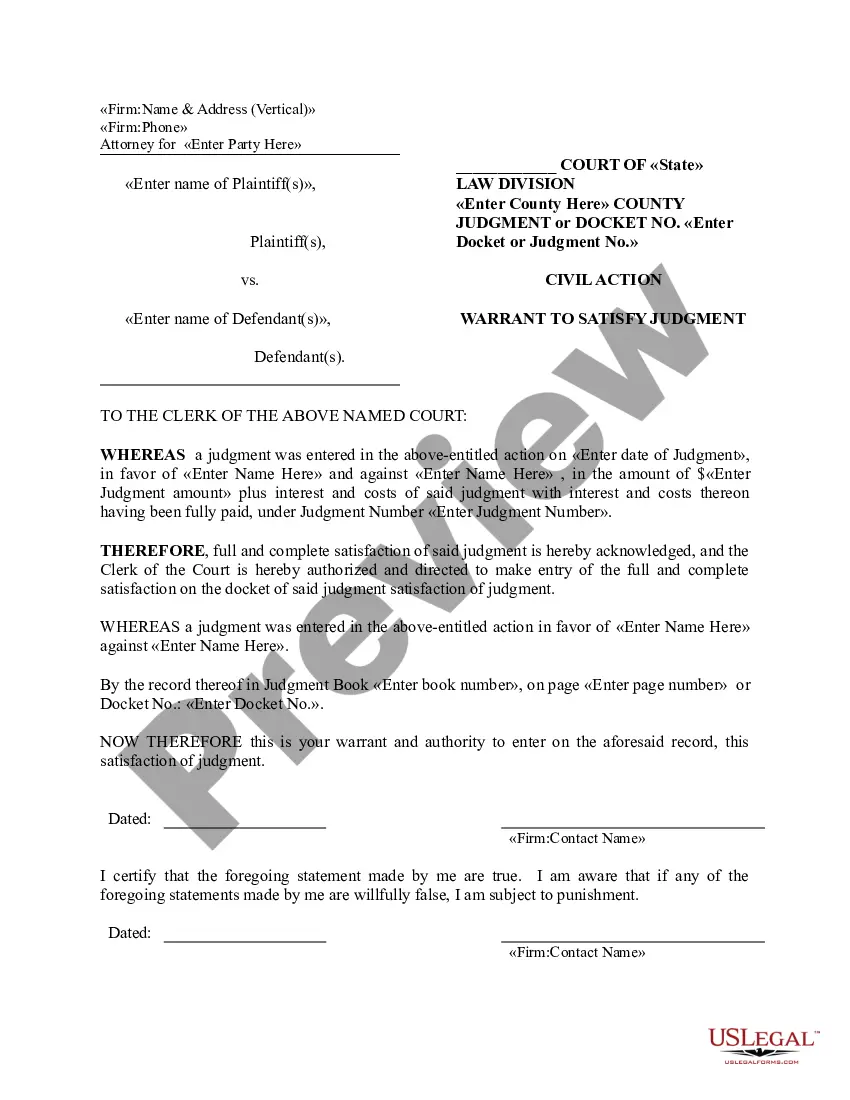
The Warrant form is a legal document used by the Department of Taxation and Finance to enforce a judgment related to child support arrears. This form specifically authorizes the collection of outstanding child support payments owed by a debtor, distinguishing it from other legal forms related to debts or judgments. By filing this warrant, the Commissioner of Taxation and Finance aims to ensure compliance with child support obligations under New York law.
Main sections of this form
- Identifying information for the debtor and creditor.
- Warrant ID for tracking and reference.
- Total amount of child support owed, including any accrued arrears and interest.
- Specific instructions for filing the warrant in the appropriate county clerkâs office.
- Signature of the Deputy Tax Commissioner for validation.
When to use this document
This form should be used when there is an outstanding child support obligation that remains unpaid. It is particularly applicable in situations where the Department of Taxation and Finance needs legal authority to collect child support arrears from a debtor. If you are a creditor seeking to enforce a judgment for child support owed in arrears, this form is necessary to initiate collection actions.
Who should use this form
- Creditors seeking the enforcement of child support judgments.
- Representatives from the Department of Taxation and Finance.
- Legal professionals assisting clients with child support collection.
- Individuals or organizations owed child support payments by a debtor.
Instructions for completing this form
- Identify the debtor's full name and address.
- Fill in the creditor's details, including name and address.
- Specify the amount owed and date of the judgment.
- Complete the warrant ID and county of judgment.
- Sign and date the form, ensuring it is submitted to the appropriate county clerk's office.
Is notarization required?
This form does not typically require notarization unless specified by local law.
Get your form ready online
Our built-in tools help you complete, sign, share, and store your documents in one place.
Make edits, fill in missing information, and update formatting in US Legal Forms—just like you would in MS Word.
Download a copy, print it, send it by email, or mail it via USPS—whatever works best for your next step.
Sign and collect signatures with our SignNow integration. Send to multiple recipients, set reminders, and more. Go Premium to unlock E-Sign.
If this form requires notarization, complete it online through a secure video call—no need to meet a notary in person or wait for an appointment.
We protect your documents and personal data by following strict security and privacy standards.

Make edits, fill in missing information, and update formatting in US Legal Forms—just like you would in MS Word.

Download a copy, print it, send it by email, or mail it via USPS—whatever works best for your next step.

Sign and collect signatures with our SignNow integration. Send to multiple recipients, set reminders, and more. Go Premium to unlock E-Sign.

If this form requires notarization, complete it online through a secure video call—no need to meet a notary in person or wait for an appointment.

We protect your documents and personal data by following strict security and privacy standards.
Common mistakes
- Failing to include complete and accurate creditor and debtor information.
- Not providing the correct amount of arrears owed.
- Missing the deadline for filing the warrant after it is received.
- Not obtaining the necessary signatures for validation.
Benefits of completing this form online
- Convenient access to downloadable templates tailored to legal requirements.
- Editable formats allow for easy customization based on specific cases.
- Reliable forms drafted by licensed attorneys minimize the risk of errors.
Legal use & context
- Enforcement of child support obligations is governed by New York State Tax Law.
- The warrant serves as a legal tool to recover outstanding child support debts.
- Failure to comply with this judgment could lead to further legal actions against the debtor.
What to keep in mind
- The Warrant form is crucial for enforcing child support judgments in New York.
- Proper completion and filing of the form can facilitate the recovery of unpaid child support.
- Being aware of common mistakes can improve the accuracy of your submission.
Looking for another form?
Form popularity
FAQ
The State of New York has 20 years from the date a warrant could have been filed to collect on a tax debt. This is double the ten years given for the IRS Collection Statute Expiration Date. NYS will be actively trying to collect while IRS debts are already expired.
Police are not allowed to keep you under arrest without charge indefinitely. Unless you are suspected of terrorism, they can only keep you under arrest for six hours before they either charge you with an offence or release you from custody, unless an extension is granted by a detention warrant.
You can get information about arrest warrants issued by the New York City Police Department by contacting the Criminal Court's information line or office of arrest. If you are going in person, you must bring a valid ID. The offices are open Monday to Friday, 9 AM to 5 PM.
A tax warrant is a public record that is attached to all your current and future assets. You will be unable to sell or refinance these assets while the lien is in effect. If you do not attempt to settle your tax debt with the IRS, your property can be seized to satisfy the debt.
If a law enforcement officer stops an individual with an outstanding bench warrant against him, the person may be detained on the warrant, and may be held in jail until a bond is posted or a hearing is held on the warrant.
Like a summons, a warrant is also a written order issued by a court after the filing of a criminal or traffic complaint, but unlike a summons, a warrant requires the police to arrest the person named in the warrant.
A tax warrant is equivalent to a civil judgment against you, and protects New York State's interests and priority in the collection of outstanding tax debt. We file a tax warrant with the appropriate New York State county clerk's office and the New York State Department of State, and it becomes a public record.
Property taxes are considered delinquent for purposes of this program under either of the following circumstances: The taxes remain unpaid one year after the last date on which they could have been paid without interest.