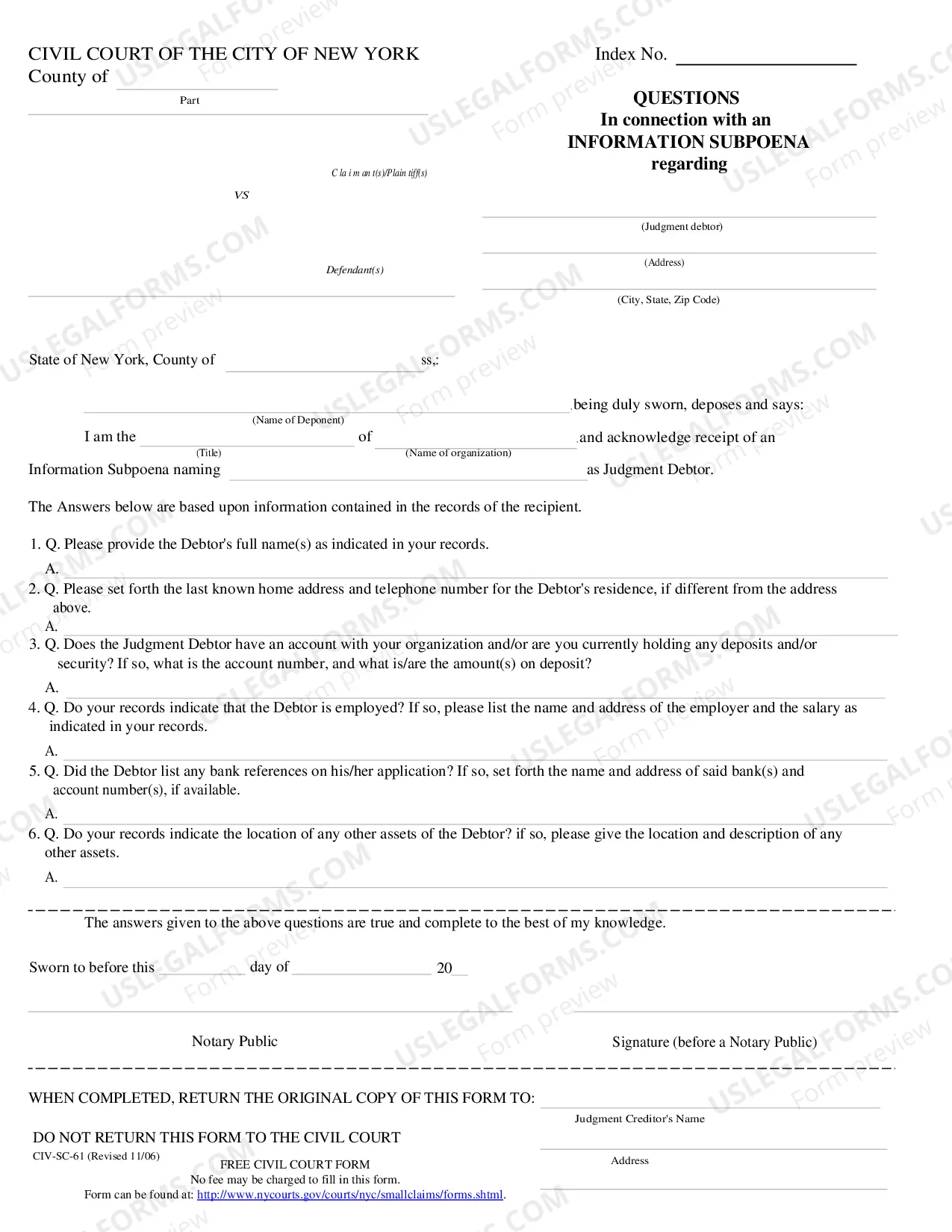
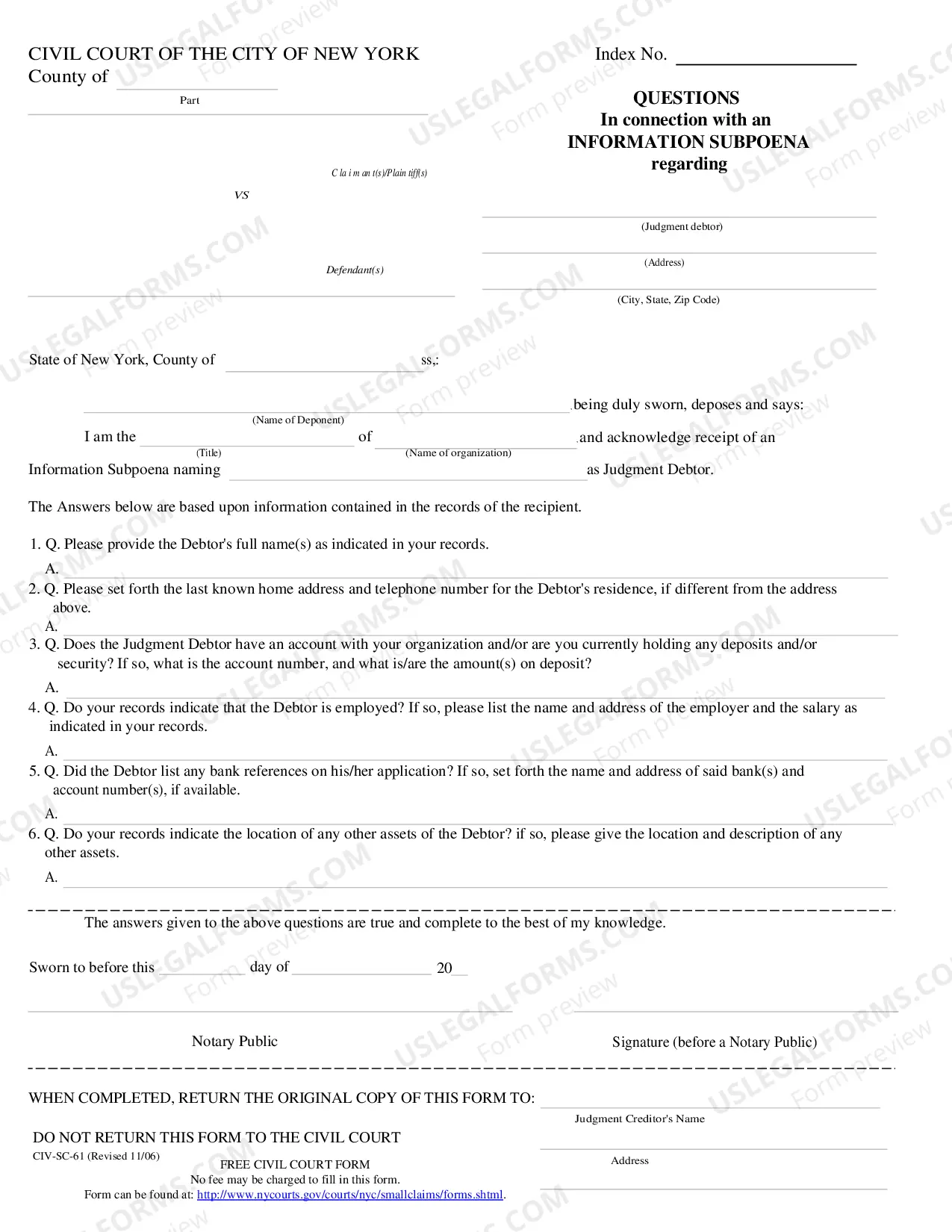
New York Questions in Connection with an Information Subpoena (CIV-SC-61)
What is this form?
The Questions in Connection with an Information Subpoena (CIV-SC-61) is a legal document designed for creditors seeking information about a judgment debtor's assets and financial status. This form allows the creditor to officially request relevant information from a third party, such as a bank or employer, to facilitate the collection of a debt. Unlike other forms, this subpoena specifically targets information needed to enforce a judgment already made in court.
What’s included in this form
- Index Number: Identifies the specific case in court.
- Name and Address: Information regarding the judgment debtor and their last known residence.
- Questions: A series of inquiries aimed at gathering details about the debtor's assets, accounts, and employment.
- Sworn Statement: A declaration of truthfulness that the answers provided by the recipient are accurate.
- Notarization: A requirement for formal verification of the document if necessary.
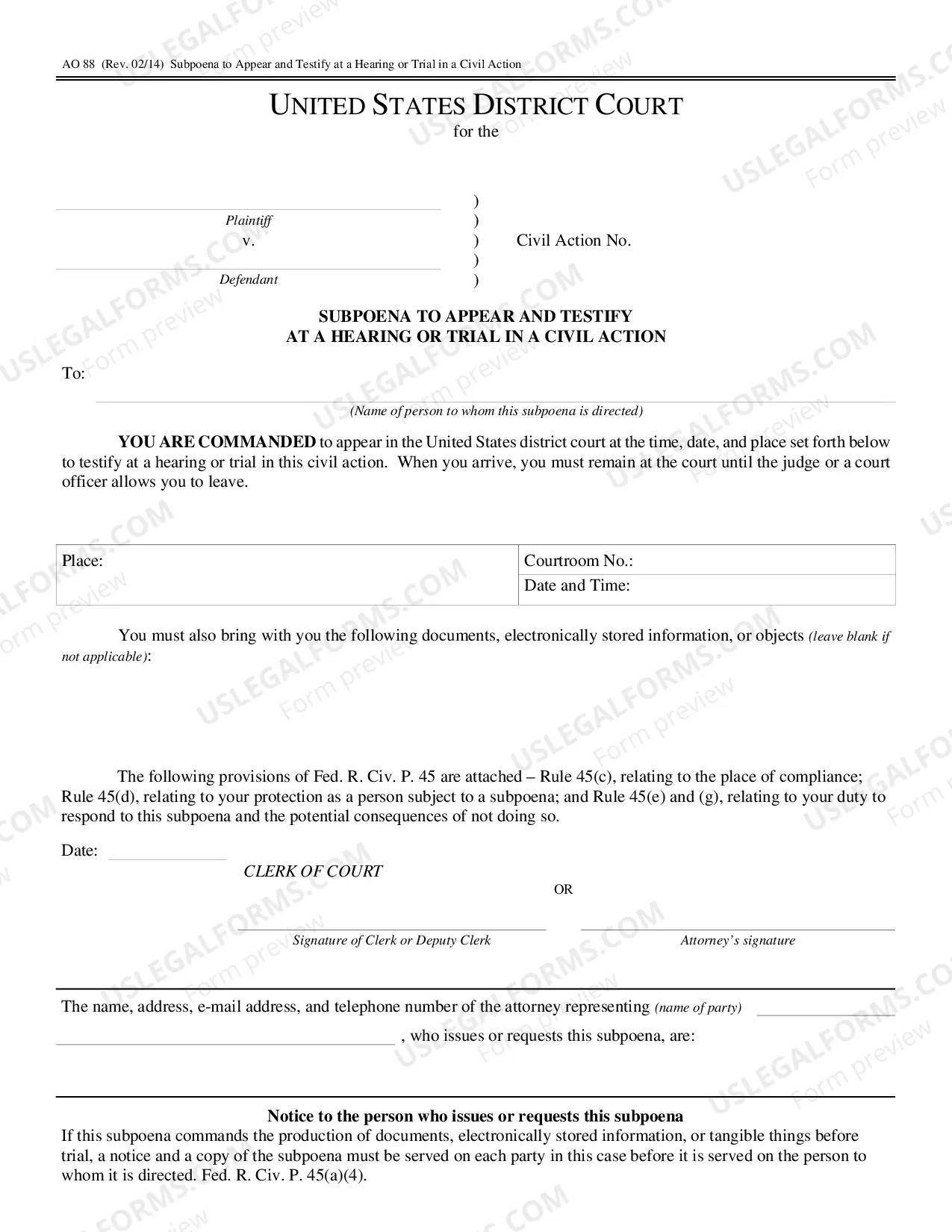
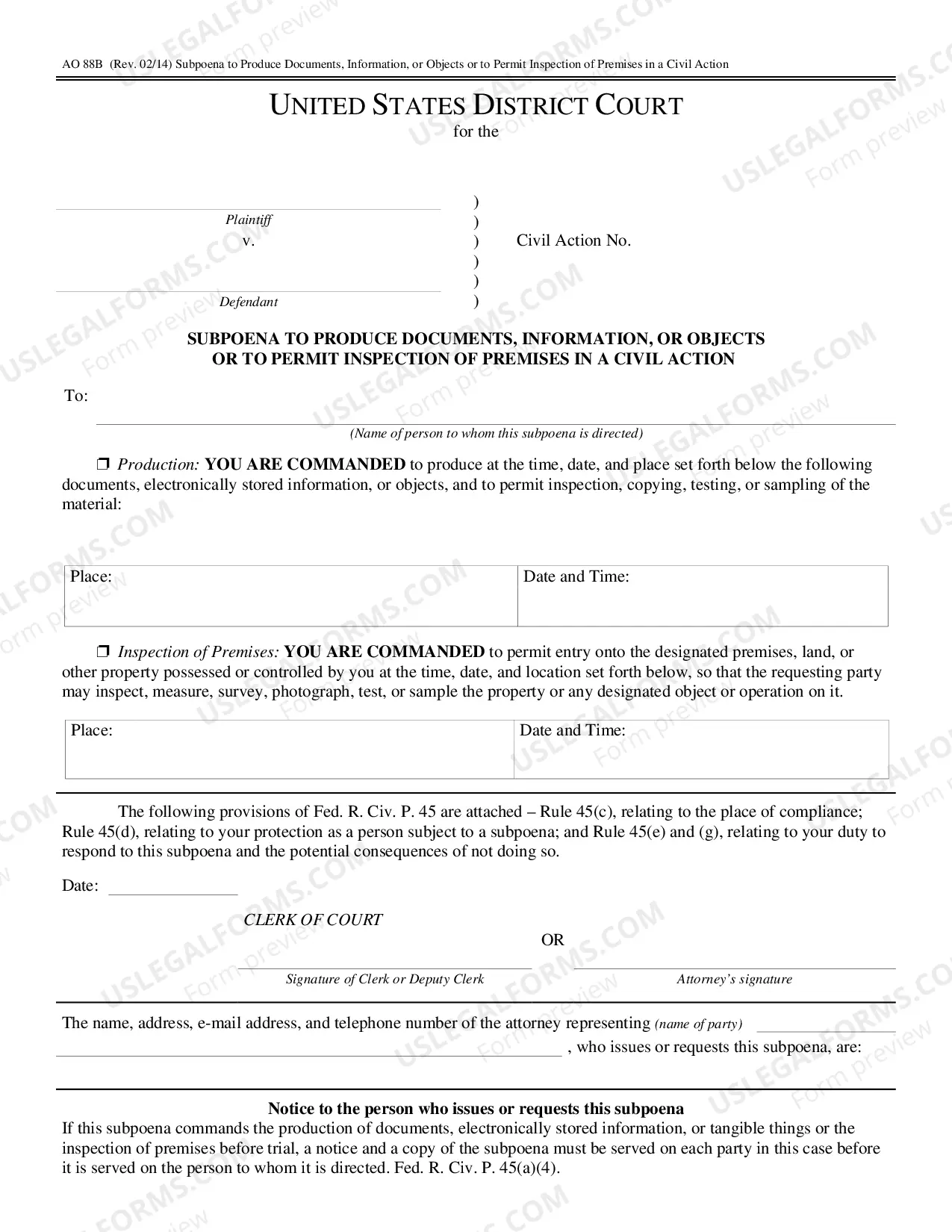
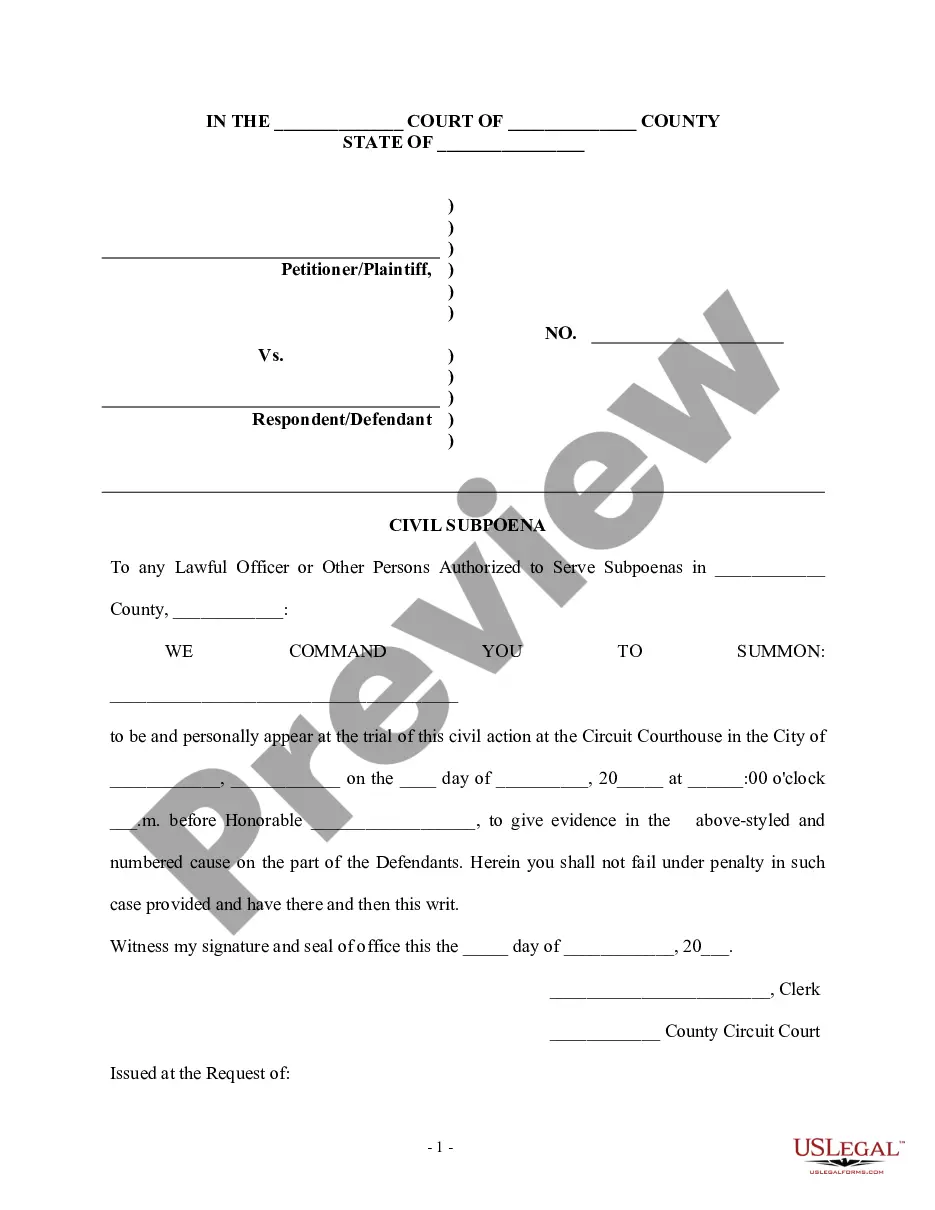
Situations where this form applies
This form should be used when a creditor has obtained a judgment against a debtor and needs to gather further information about the debtor's financial situation. It is particularly useful in cases where the creditor wants to locate bank accounts, employment details, or other assets that can be targeted for debt recovery. Using this form can help ensure the creditor has all necessary information to enforce the judgment effectively.
Who this form is for
- Creditors who have a valid court judgment against debtors.
- Individuals or businesses seeking to enforce payment of a debt.
- Attorneys representing clients in debt recovery cases.
- Entities needing to locate assets or employment information for a debtor.
Instructions for completing this form
- Specify the Index Number related to the judgment case.
- Fill in the names and addresses of both the creditor and debtor accurately.
- Answer all questions posed in the form, providing truthful and complete information.
- Sign the form before a Notary Public to verify the statements made.
- Submit the completed original copy to the creditor as instructed.
Notarization guidance
In most cases, this form does not require notarization. However, some jurisdictions or signing circumstances might. US Legal Forms offers online notarization powered by Notarize, accessible 24/7 for a quick, remote process.
Get your form ready online
Our built-in tools help you complete, sign, share, and store your documents in one place.
Make edits, fill in missing information, and update formatting in US Legal Forms—just like you would in MS Word.
Download a copy, print it, send it by email, or mail it via USPS—whatever works best for your next step.
Sign and collect signatures with our SignNow integration. Send to multiple recipients, set reminders, and more. Go Premium to unlock E-Sign.
If this form requires notarization, complete it online through a secure video call—no need to meet a notary in person or wait for an appointment.
We protect your documents and personal data by following strict security and privacy standards.

Make edits, fill in missing information, and update formatting in US Legal Forms—just like you would in MS Word.

Download a copy, print it, send it by email, or mail it via USPS—whatever works best for your next step.

Sign and collect signatures with our SignNow integration. Send to multiple recipients, set reminders, and more. Go Premium to unlock E-Sign.

If this form requires notarization, complete it online through a secure video call—no need to meet a notary in person or wait for an appointment.

We protect your documents and personal data by following strict security and privacy standards.
Mistakes to watch out for
- Failing to provide complete and accurate information about the debtor.
- Not notarizing the document when required.
- Submitting the form to the incorrect party, such as the court instead of the creditor.
- Leaving questions blank that could assist in locating debtor assets.
Why use this form online
- Convenience of downloading the form directly for immediate use.
- Editability allows users to complete information at their own pace.
- Access to templates drafted by licensed attorneys ensures legal compliance.
- Easy storage and retrieval of digital documents for future reference.
Looking for another form?
Form popularity
FAQ
A Notice of Appearance is a document we file alerting the Clerk of Court and all the attorneys in your case that we are representing you as your attorneys. The notice is usually titled ?Notice of Appearance and Designation of Email Address.?
Small Claims Court is a special part of the court where you can sue for money without a lawyer. You cannot sue to make someone do something or for pain and suffering. Anyone 18 years of age or older can sue in Small Claims Court. If you are less than 18 years old, your parent or guardian may sue on your behalf.
To file a claim you must fill out forms and provide the correct business name, legal name, and business address. To find the business legal name, a County Clerk's office can help you. You will have to pay a maximum $20.00 filing fee, depending on the amount of the claim, or where you live.
Information Subpoena: It is a legal direction to a person or institution to answer certain questions about where the assets of the Defendant are located. The Information Subpoena may be served upon the Judgment Debtor and upon any person or corporation that you believe has knowledge of the Judge Debtor's assets.
By obtaining a TRANSCRIPT OF JUDGMENT for a fee (payable by cash or money order only) from the City Court and then filing or docketing that Transcript in the County Clerk's office (for an additional fee), a Creditor creates a lien against any real property, that is, real estate, the Debtor owns in the county.
(NY) This notice of appearance is a standard template that attorneys, including those admitted pro hac vice, can use to record their appearance in an action pending in New York Supreme Court. A notice of appearance notifies the court and other parties that you represent a party in the litigation.
(NY) This notice of appearance is a standard template that attorneys, including those admitted pro hac vice, can use to record their appearance in an action pending in New York Supreme Court. A notice of appearance notifies the court and other parties that you represent a party in the litigation.
Notice to appear. The court may at any time order that a person who is under a sentence of probation or of conditional discharge appear before it. Such order may be in the form of a written notice, specifying the time and place of appearance, mailed to or served personally upon the defendant as the court may direct.
After a summons with notice is served, the defendant will demand that the plaintiff serve a complaint. The plaintiff must then have the complaint served within 20 days after being served with the demand, or the case may be dismissed.