New York Qualified Domestic Relations Order
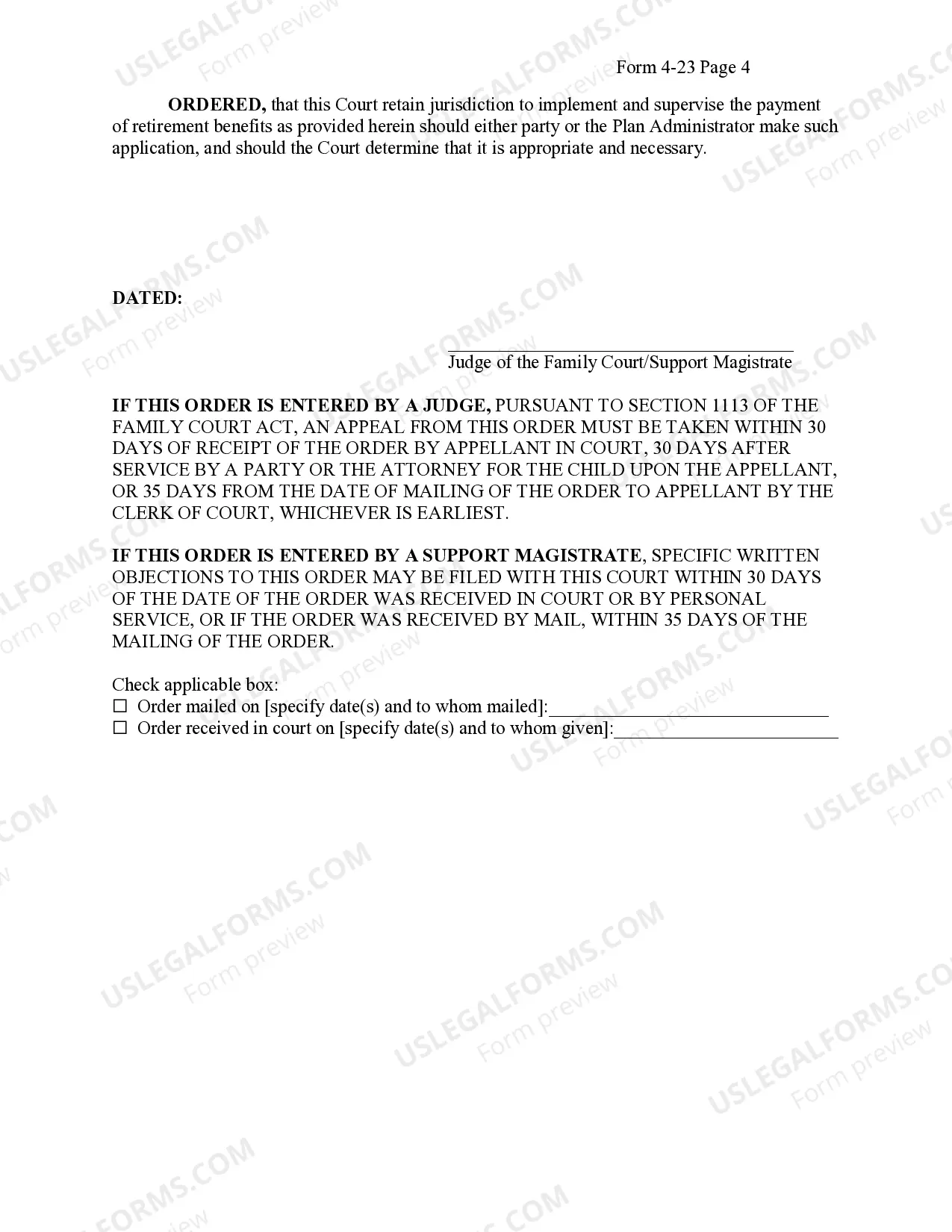
The Qualified Domestic Relations Order (QDRO) is a legal document that allows for the division of retirement assets during divorce proceedings. This form specifically pertains to New York Family Court and is essential for ensuring that a divorced spouse can receive their share of retirement benefits. Unlike other divorce-related forms, a QDRO is uniquely designed to address the distribution of pension and retirement accounts, making it crucial for parties negotiating equitable settlement terms.
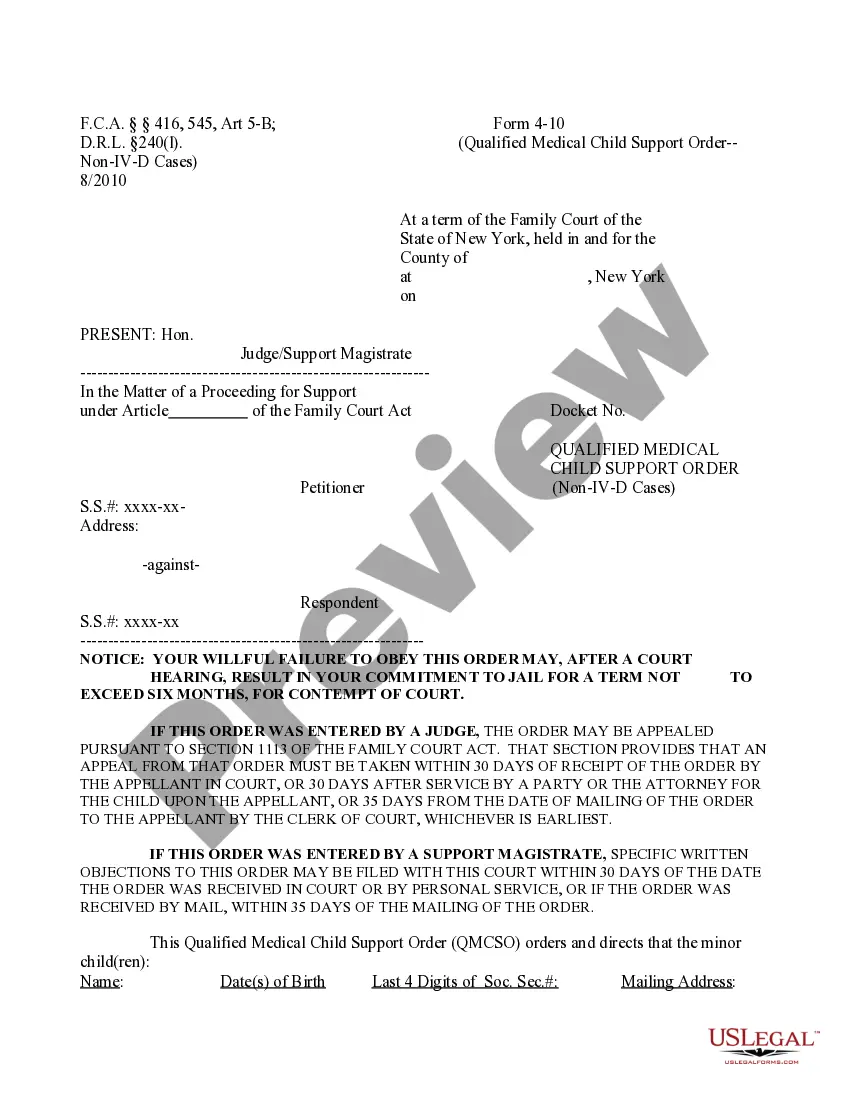
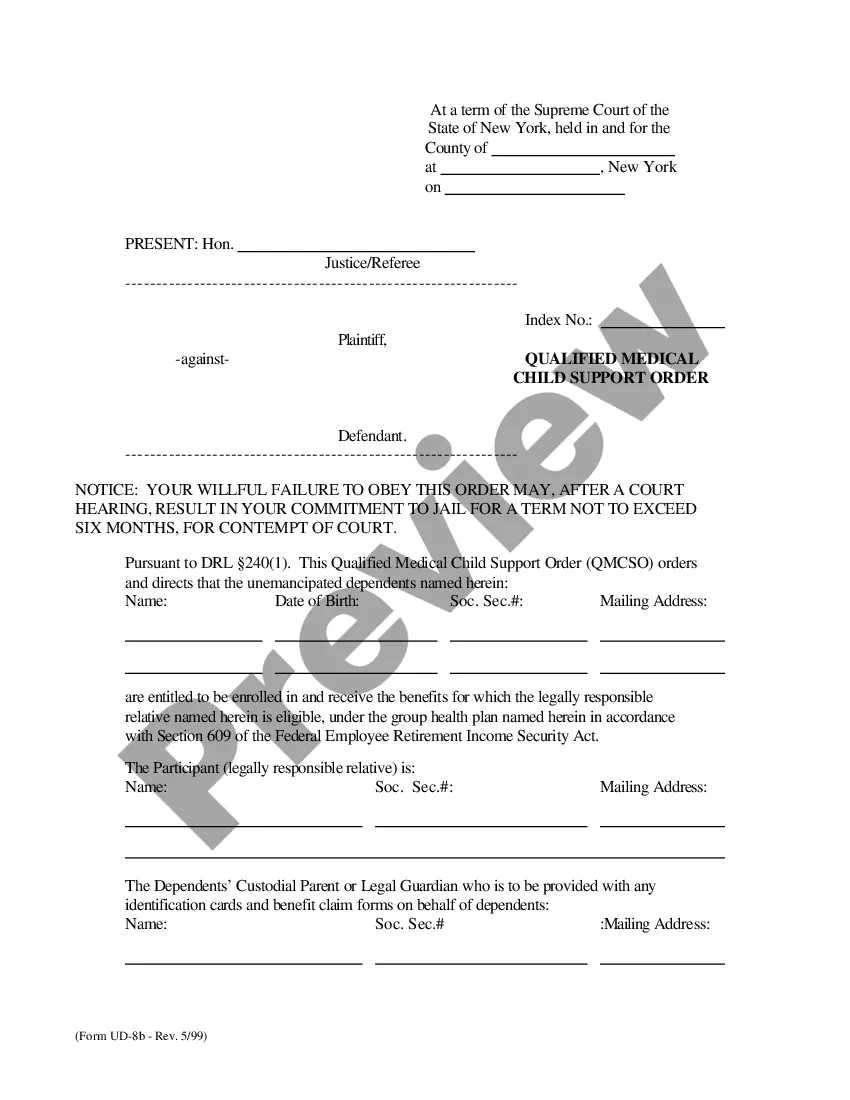
- Identification of the parties involved, including their relationship and addresses.
- Details of the retirement plans affected by the order.
- Specifications for how assets will be divided between spouses.
- Signature lines for both parties and the judge.
- Provision for the enforcement of the order through the retirement plan administrator.
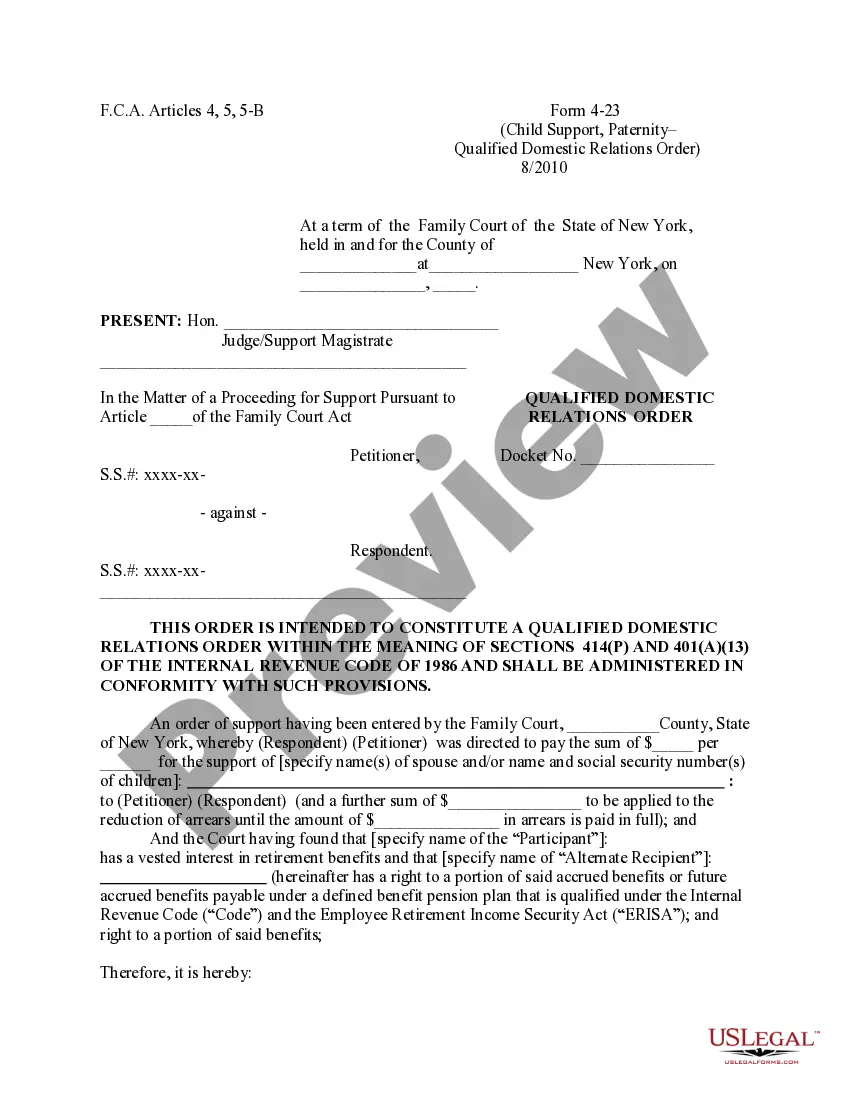
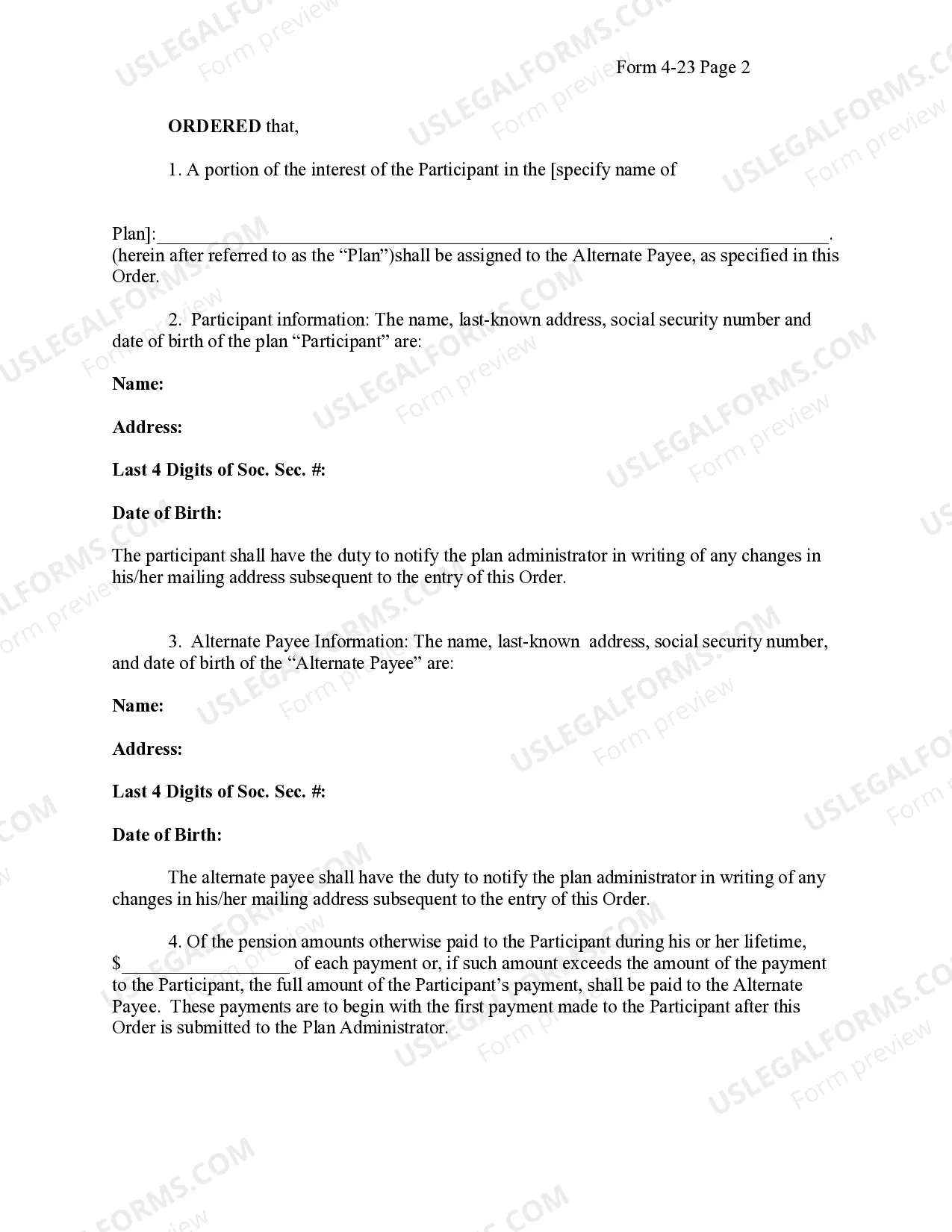
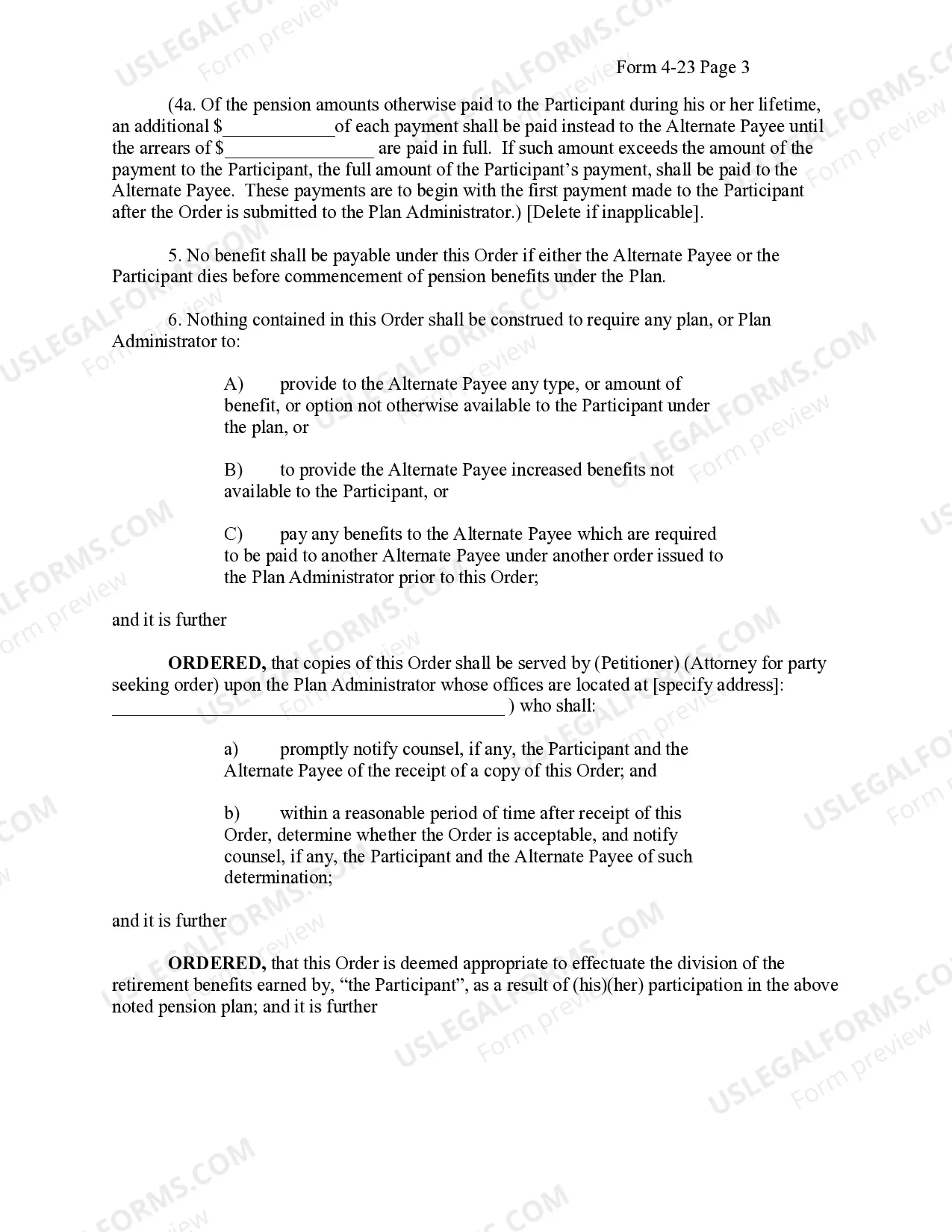
This form should be used when parties are finalizing their divorce and need to address the division of retirement assets. If one spouse holds a retirement account, such as a pension or 401(k), and both parties have agreed on how these assets will be divided, a QDRO is necessary to authorize the transfer of the designated benefits to the non-owner spouse. It is crucial in settlements involving significant retirement benefits.
The following individuals should consider using this form:
- Individuals going through a divorce with retirement assets involved.
- Spouses who are entitled to a portion of their partner's retirement funds.
- Divorce attorneys managing asset division on behalf of their clients.
- Retirement plan administrators seeking to comply with court orders.
Follow these steps to complete the Qualified Domestic Relations Order:
- Identify the names and addresses of both parties involved in the divorce.
- Specify the retirement plans that are subject to division under this order.
- Detail how the retirement benefits will be shared, including percentages or amounts.
- Gather necessary signatures from both parties and a judge.
- File the completed QDRO with the appropriate state agency or retirement plan administrator.
This form does not typically require notarization unless specified by local law. Ensure to check any additional requirements that may mandate notarization for the QDRO to be legally binding.
Get your form ready online
Our built-in tools help you complete, sign, share, and store your documents in one place.
Make edits, fill in missing information, and update formatting in US Legal Forms—just like you would in MS Word.
Download a copy, print it, send it by email, or mail it via USPS—whatever works best for your next step.
Sign and collect signatures with our SignNow integration. Send to multiple recipients, set reminders, and more. Go Premium to unlock E-Sign.
If this form requires notarization, complete it online through a secure video call—no need to meet a notary in person or wait for an appointment.
We protect your documents and personal data by following strict security and privacy standards.

Make edits, fill in missing information, and update formatting in US Legal Forms—just like you would in MS Word.

Download a copy, print it, send it by email, or mail it via USPS—whatever works best for your next step.

Sign and collect signatures with our SignNow integration. Send to multiple recipients, set reminders, and more. Go Premium to unlock E-Sign.

If this form requires notarization, complete it online through a secure video call—no need to meet a notary in person or wait for an appointment.

We protect your documents and personal data by following strict security and privacy standards.
- Failing to accurately identify the retirement plans involved.
- Not specifying the exact share or percentage to be awarded.
- Omitting necessary signatures, which can invalidate the order.
- Submitting the QDRO to the wrong entity or agency.
- Using outdated forms that do not meet current legal requirements.
- Conveniently download the form in multiple formats: Word, WordPerfect, and PDF.
- Edit the form to customize it according to your specific needs without hassle.
- Utilize a reliable source with templates drafted by licensed attorneys.
- Access the document at any time, simplifying your legal process.
Legal use & context
- The QDRO is legally binding and must comply with the Employee Retirement Income Security Act (ERISA).
- It ensures that retirement funds are divided according to the court's orders.
- Improperly drafted QDROs can lead to delays and legal complications.
- A QDRO is essential for dividing retirement assets during a divorce.
- The form must comply with New York's specific requirements.
- Accurate completion and submission are critical to enforce the division of assets.
- Using a downloadable template can simplify the process for both parties.
Looking for another form?


Form popularity
FAQ
Many states, such as New Jersey, Pennsylvania, New York, and California, use a coverture approach in terms of dividing a pension in a deferred distribution scheme (QDRO).The coverture fraction is defined by marital service divided by total service.
Who pays for the QDRO depends on your court orders. In about half the cases our office is hired on, both parties split the fees. In the other half of cases we are retained on, one party pays all the QDRO fees. In many cases, the court orders require the fees be split but one party still refuses.
A QDRO typically costs between $500 and $750 for drafting fees, depending on the state and the attorney. Companies that draft QDROs do not always offer a licensed attorney to help with the legal QDRO process. However, a lawyer can help walk both parties through the retirement plan and state regulations.
Once the QDRO is pre-approved by the plan administrator, you and your spouse must sign the QDRO. Submit the QDRO with the court to have the judge sign the order.Despite common belief, you do not need to hire an attorney to file a QDRO after divorce in California.
The answer to this question depends on what type of retirement plan is being divided. If it is a defined contribution plan (a 401(k), 457, 403(b) or similar plan), or an IRA, the funds are typically transferred into an account in the alternate payee's name within two to five weeks.
With a QDRO, the plan provider can divide the plan in whatever proportion the parties agree upon or a judge orders. The non-participating spouse, or alternate payee, generally sets up a rollover IRA for his or her share of the funds.
If you don't have a lawyer, you can also use the model template given to you by the plan administrator to create a QDRO that you can submit to the court for approval and signature.
A QDRO requires the approval of the pension department and signature of the judge. A fee of $1,000 to $1,500 doesn't seem unreasonable.