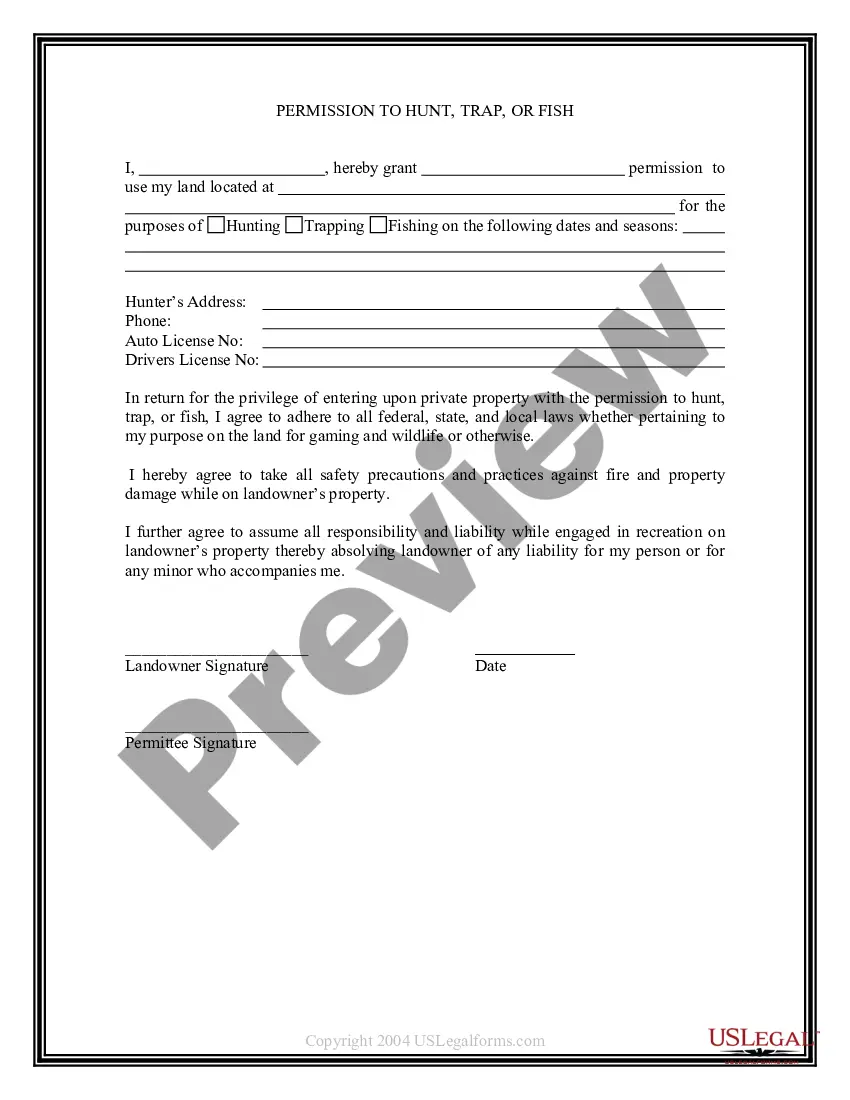
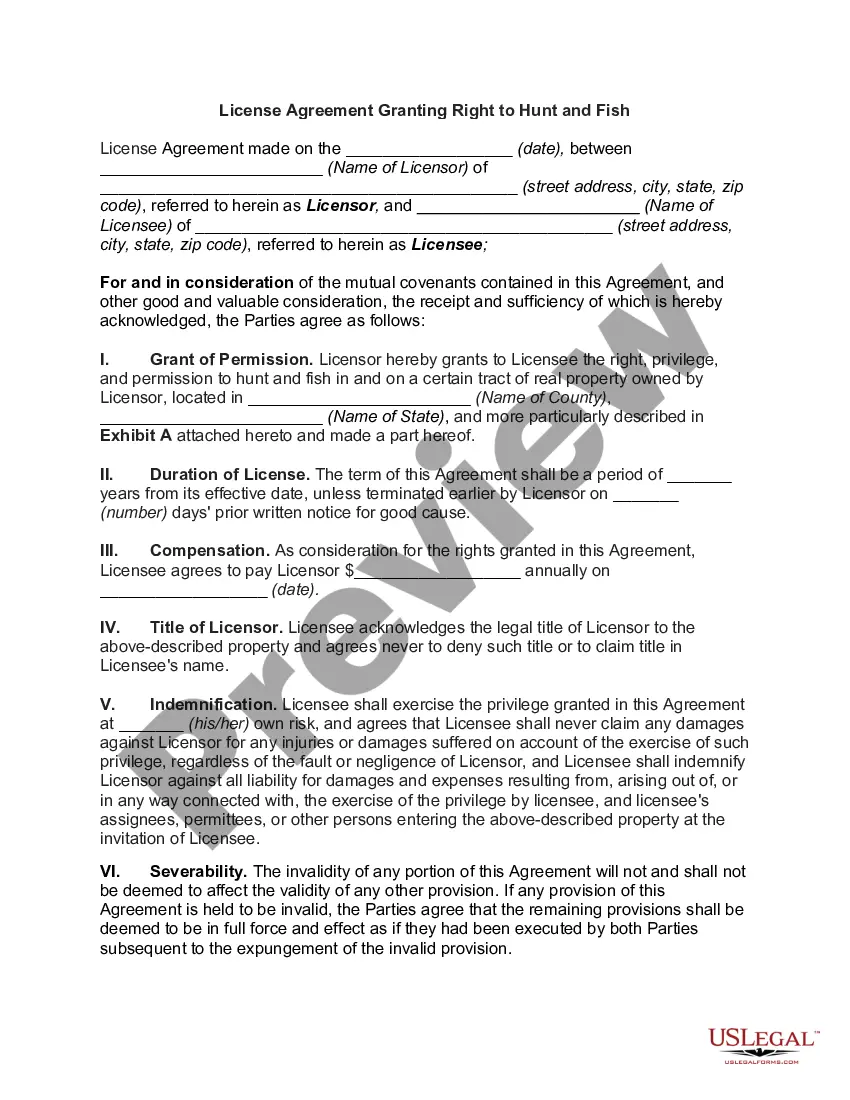
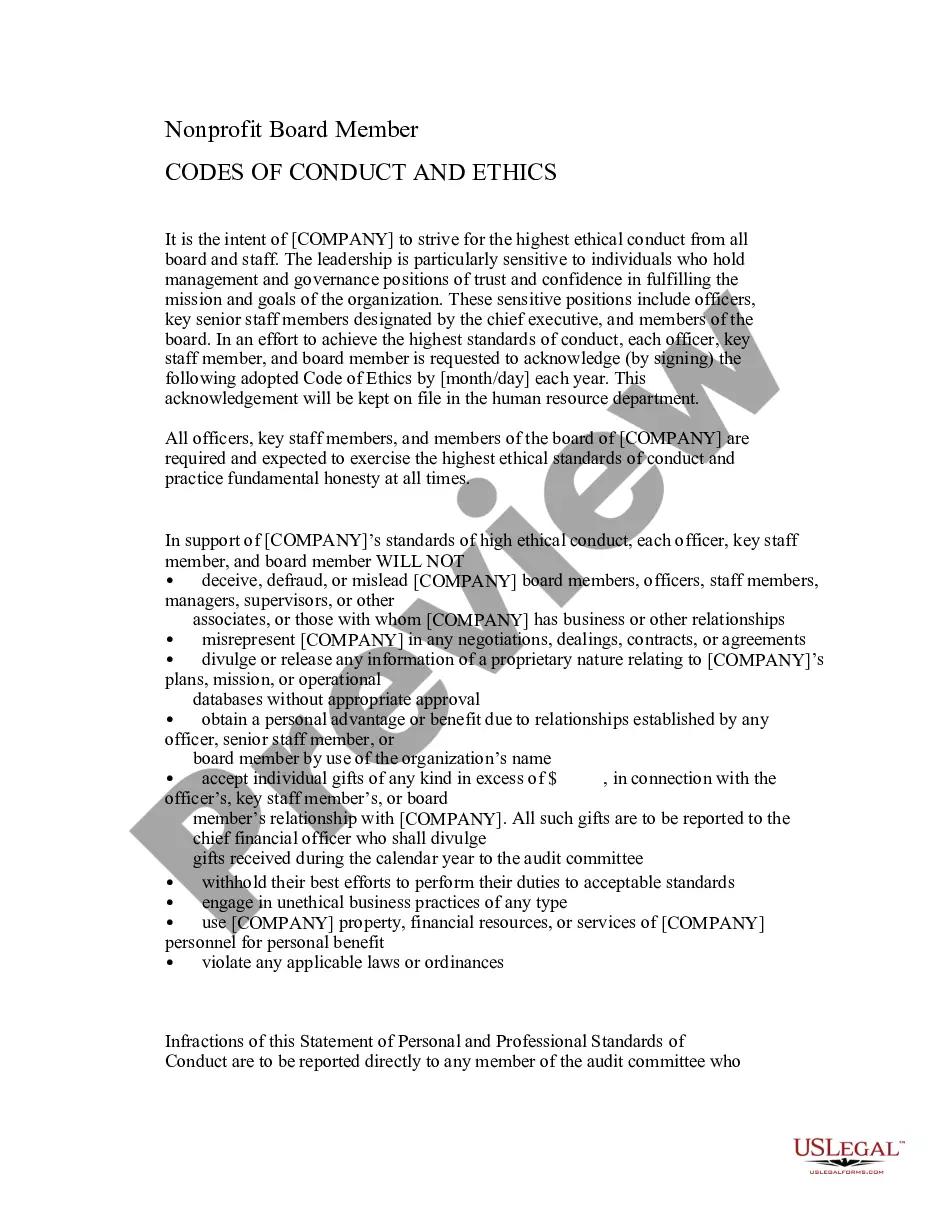
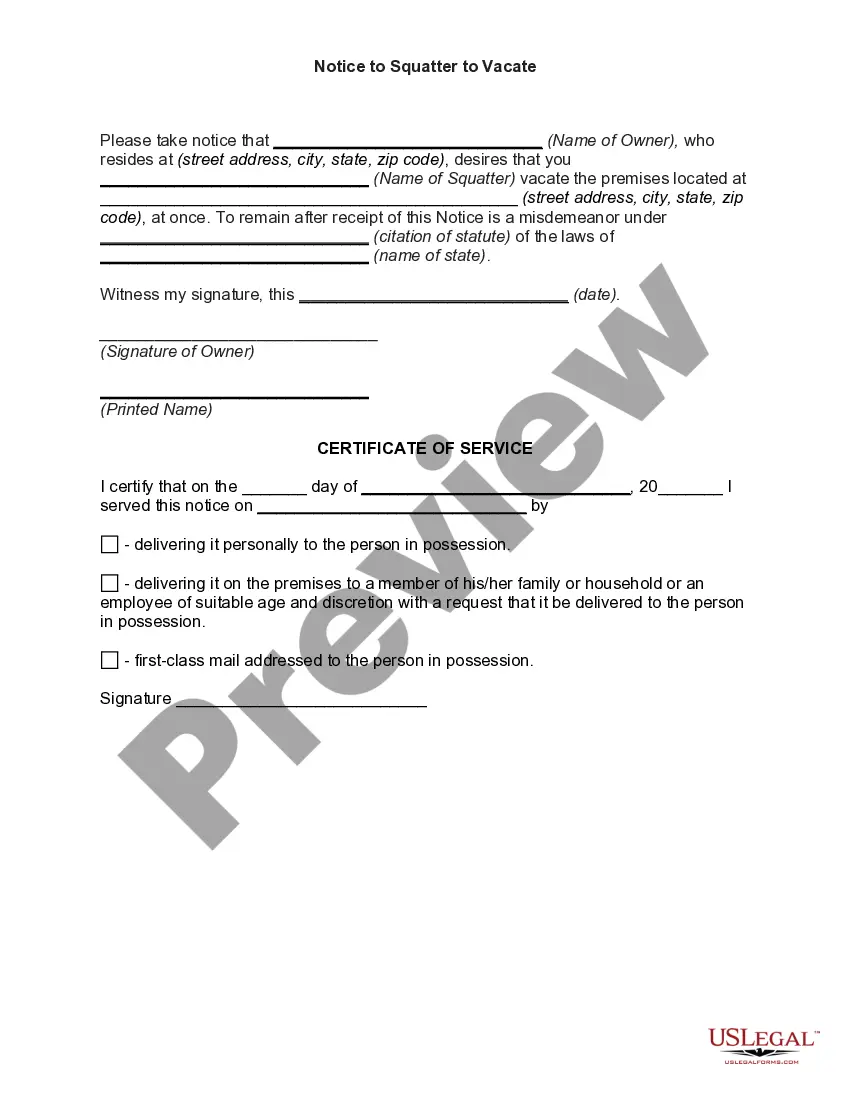
This form is completed by a landowner who is extending permission for an individual to hunt, trap, or fish on landowner's property. Both landowner and hunter (permittee) sign this form. Permittee also agrees to absolve landowner of any liability.
Nevada Permission To Hunt Trap or Fish
State:
Multi-State
Control #:
US-PRM-15
Format:
Word;
Rich Text
Instant download
Description
How to fill out Permission To Hunt Trap Or Fish?
You can spend time online trying to locate the authentic document template that complies with the federal and state requirements you need.
US Legal Forms provides a vast array of legitimate forms that have been evaluated by professionals.
You can easily download or print the Nevada Permission To Hunt Trap or Fish from the service.
If available, utilize the Review button to preview the document template as well. To obtain another version of the form, use the Search field to find the template that meets your needs and specifications. Once you have found the template you require, click Buy now to proceed. Choose the pricing plan you desire, enter your credentials, and register for an account on US Legal Forms. Complete the transaction. You may use your credit card or PayPal account to pay for the legitimate form. Select the format of the document and download it to your device. Make adjustments to your document if necessary. You can complete, modify, sign, and print the Nevada Permission To Hunt Trap or Fish. Acquire and print a multitude of document templates using the US Legal Forms website, which offers the largest selection of legitimate forms. Utilize professional and state-specific templates to address your business or personal needs.
- If you already possess a US Legal Forms account, you can sign in and click the Obtain button.
- Subsequently, you can complete, modify, print, or sign the Nevada Permission To Hunt Trap or Fish.
- Every legitimate document template you purchase is yours permanently.
- To retrieve another copy of a purchased form, visit the My documents section and click the corresponding button.
- If you are using the US Legal Forms website for the first time, follow the simple instructions below.
- First, ensure that you have selected the correct document template for your state/city that you choose.
- Review the form description to confirm you have selected the appropriate form.
Form popularity
FAQ
In Nevada, certain small game species may not require a license for hunting, but regulations can vary. It is crucial to check the current state laws and guidelines to ensure you are compliant with all requirements. For any activity involving wildlife, having your Nevada Permission To Hunt Trap or Fish is strongly recommended to avoid penalties and ensure a safe, enjoyable experience.
To gain hunting rights in Nevada, you need to apply for the appropriate permits, which may include a hunting license and specific tags for the game you wish to pursue. You can easily navigate the application process through platforms like US Legal Forms, which provide the necessary documentation and guidance. Securing your Nevada Permission To Hunt Trap or Fish opens up exciting opportunities for you to explore Nevada's vast landscapes.
Nevada wildlife offers various permits, tailored to different activities such as hunting, trapping, and fishing. Each permit allows you to engage in these activities legally and responsibly. By obtaining the proper Nevada Permission To Hunt Trap or Fish, you ensure compliance with state regulations and enjoy your outdoor experiences to the fullest.
Coyotes are allowed to be hunted with dogs, decoys, bait, and electronic calls. Keep in mind that if someone catches another animal in a coyote trap that animal must be released. While coyote hunting season is year-round, some counties allow nighting hunting while others prohibit nighttime shooting.
Counties that allow night hunting include: Mineral County Nye County (At least three miles from Tonopah) Esmeralda County (must be at least a mile away from an occupied residence) Carson City County (see ordinance on firearms) Storey County (see ordinance on weapons)
Shooting of individuals or dynamiting or other continued destruction of lodges, bank dens, and dams, where legal, will occasionally move young colonies out of an area. None are registered; however, there is some evidence that repellents may be useful.
Specific species that you can hunt with an open season but can't sell without a trapping license. Species classified as furbearers in Nevada include beaver, bobcat, gray fox, kit fox, red fox, mink, muskrat and otter.
Unprotected quarry in Nevada that don't require licenses to hunt include:Ground squirrels.Raccoons.Coyotes.Badgers.Skunks.Black-tailed jackrabbits.European starlings.House sparrows.
Nevada is more than eighty percent public land, almost all of it open to hunting, but some sportsmen still mistakenly enter private property and should be more careful about trespassing. Every year we receive reports of trespassing and private property damage, said Mike Maynard, chief game warden for NDOW.
Residents may not hunt or leave bullet shells behind on private property that is not their own, the ordinance states. Other provisions state individuals may not discharge firearms between a half-hour before sunrise and a half-hour after sunset as shooters cannot see where the rounds are going, Royal said.