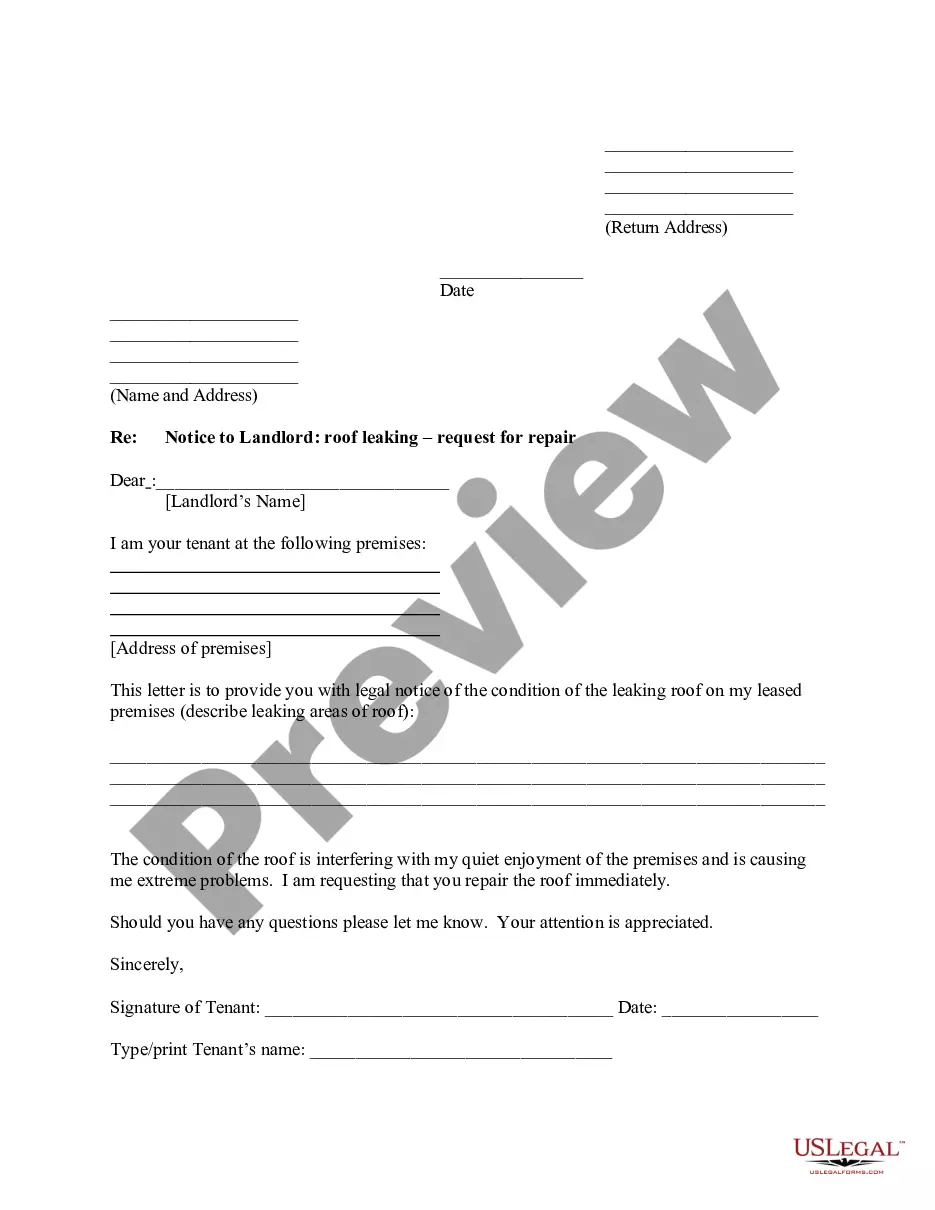
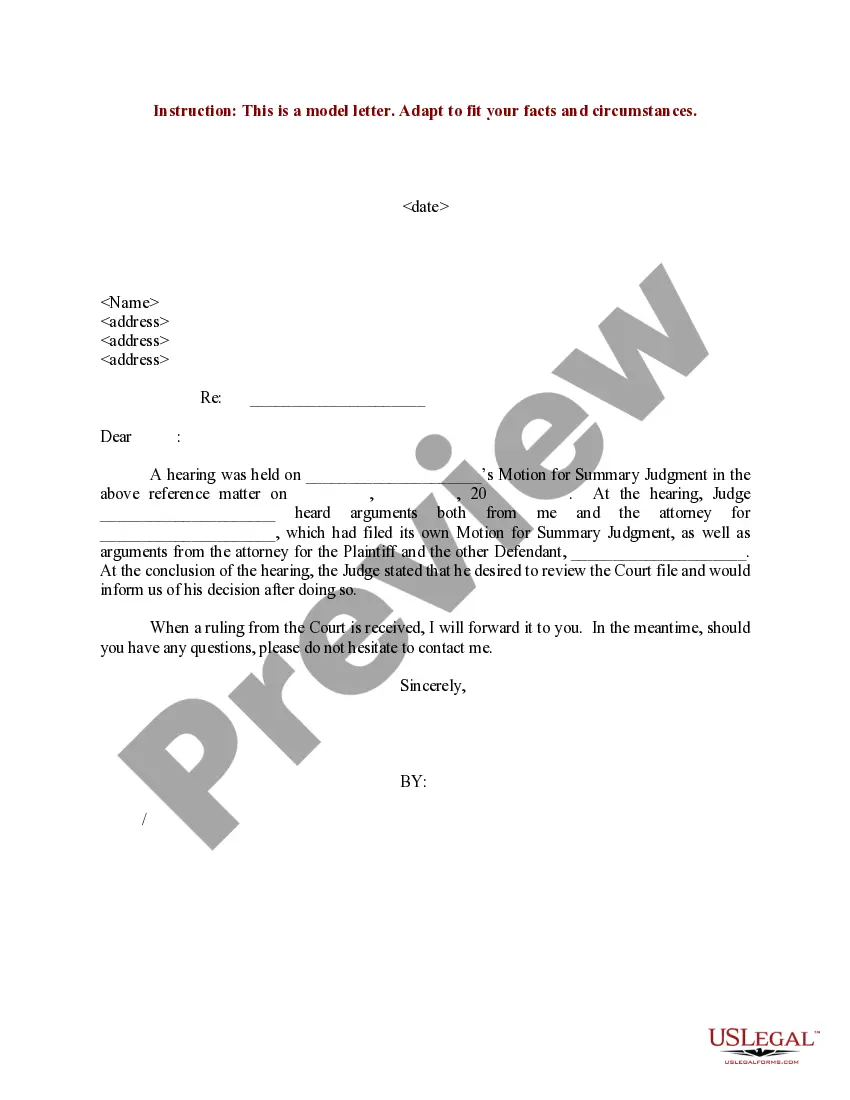
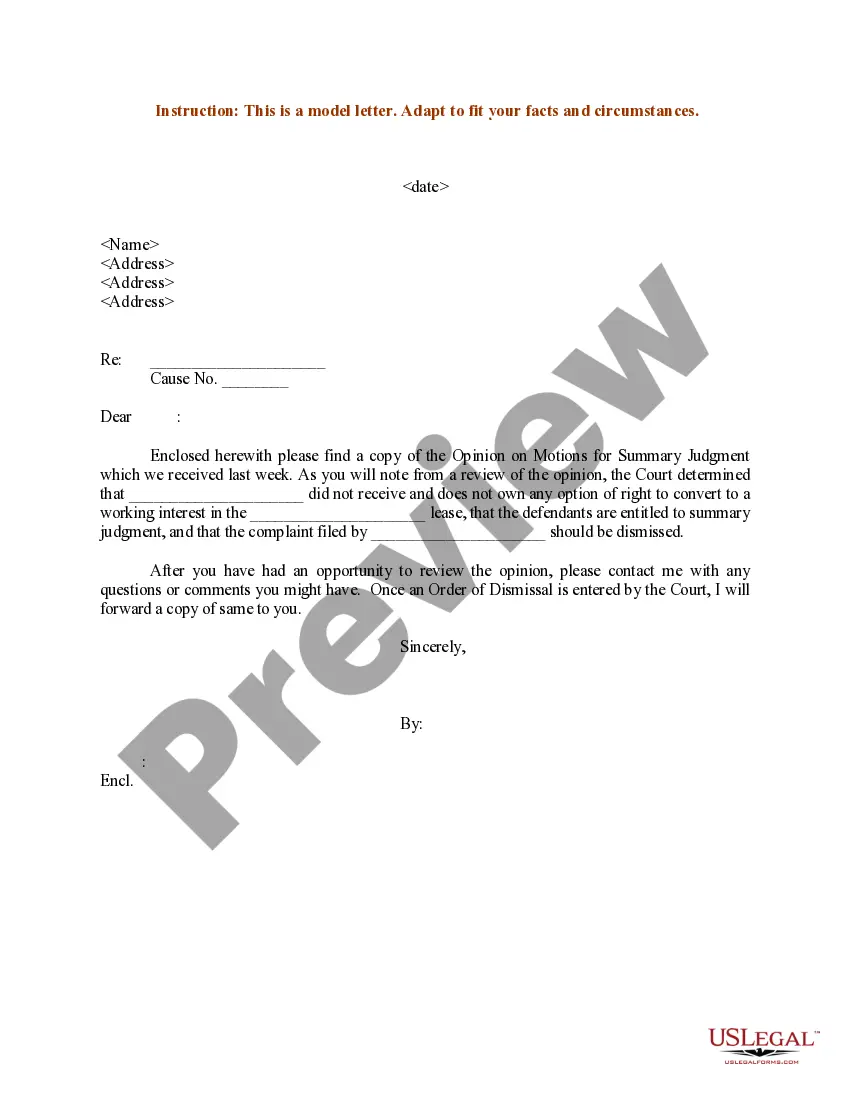
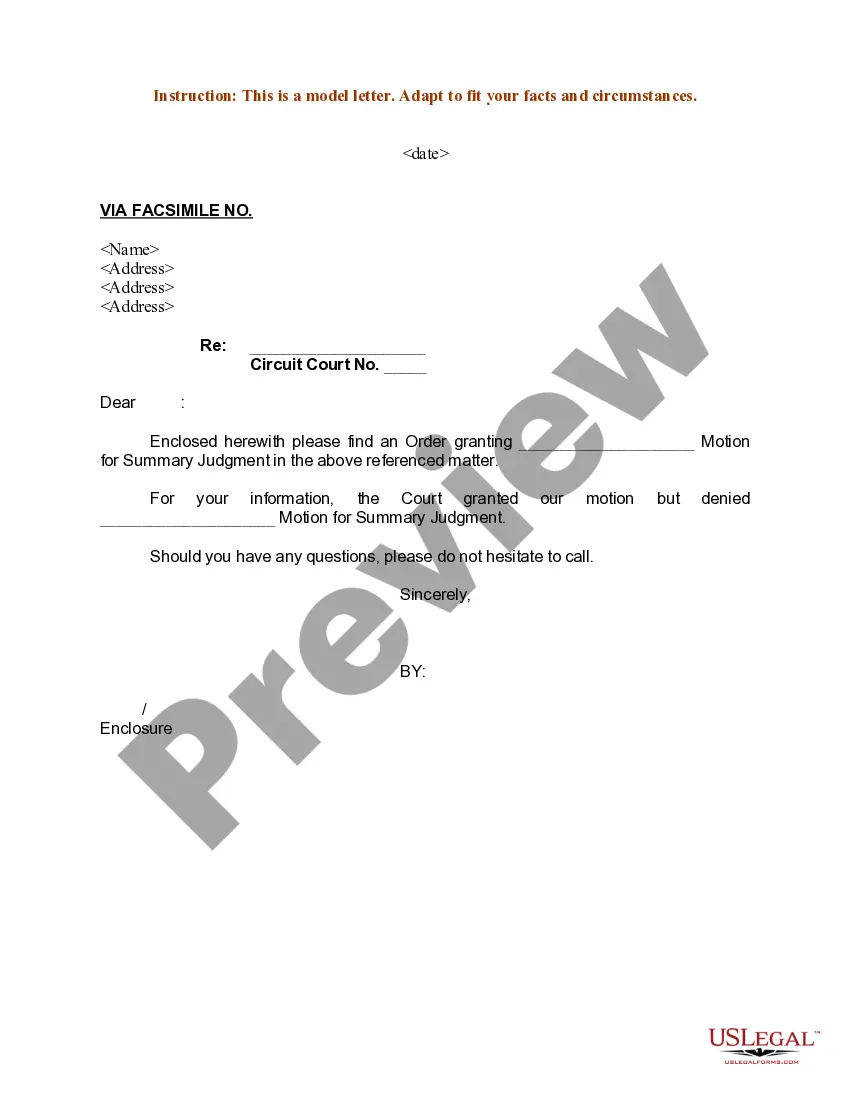
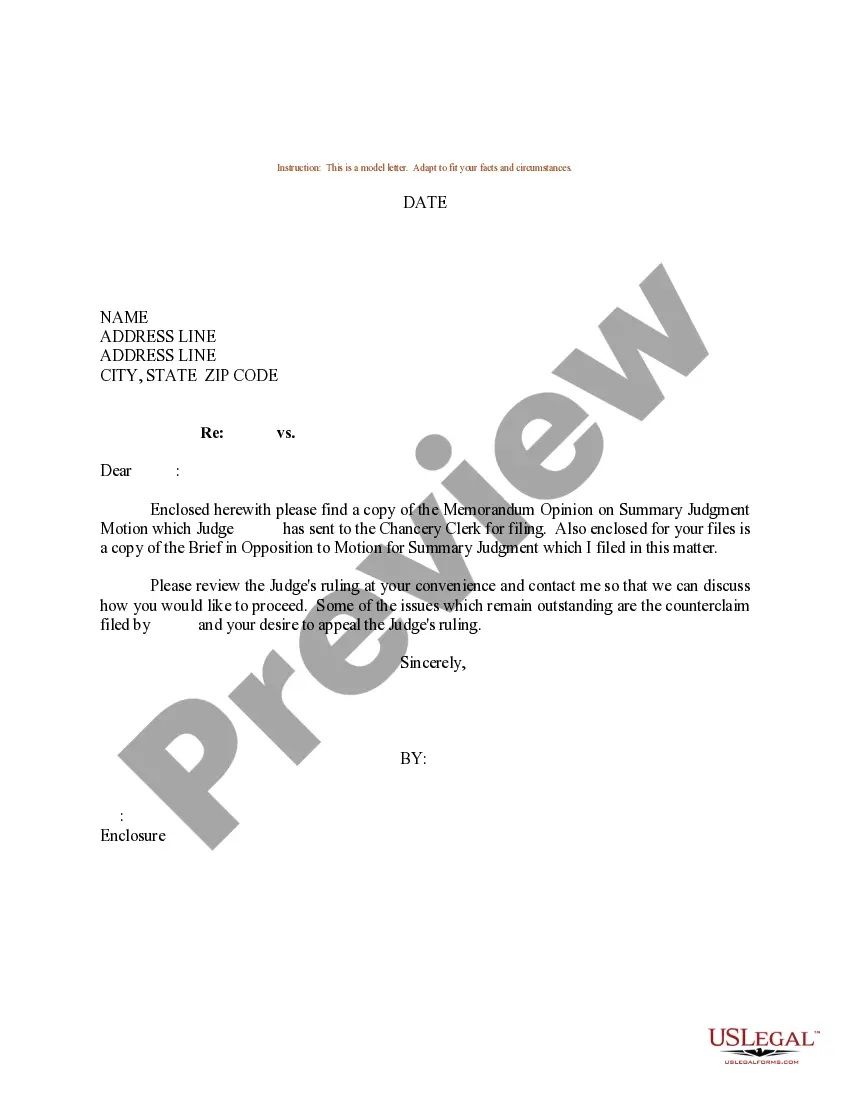
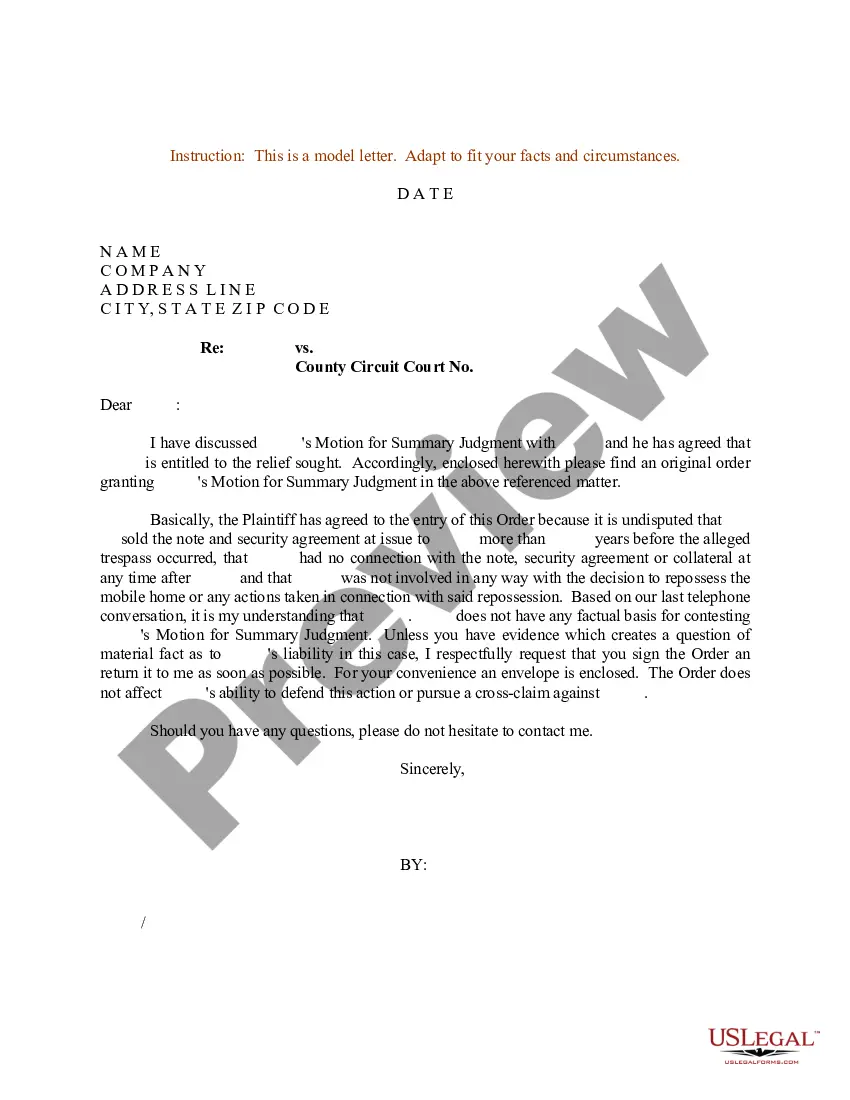
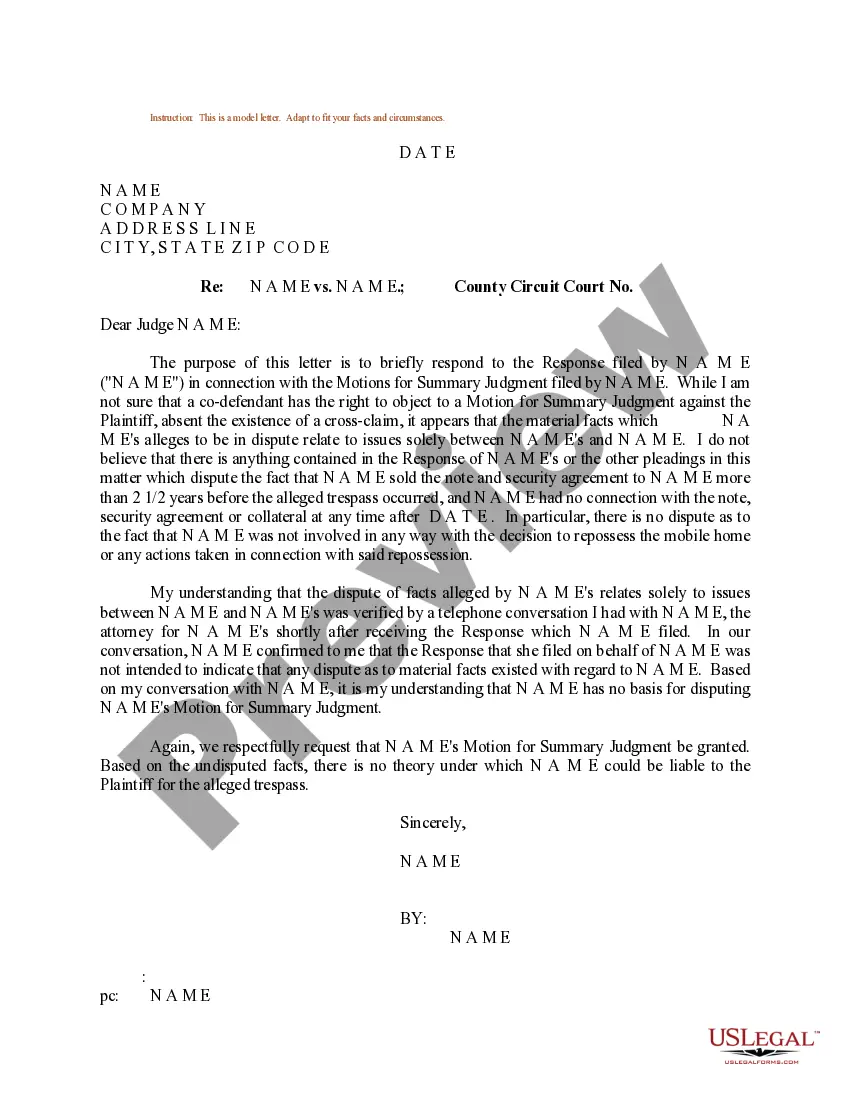
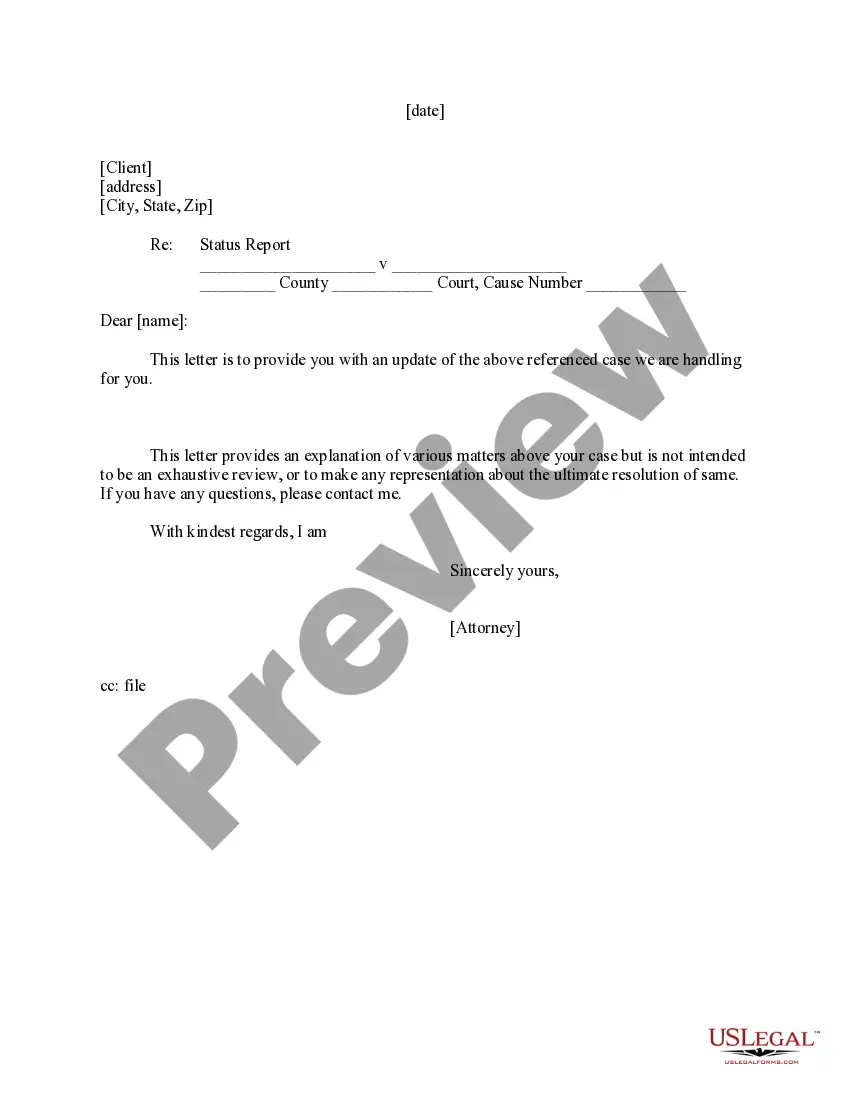
This form is a sample letter in Word format covering the subject matter of the title of the form.
Nevada Sample Letter to Client concerning Hearing on Motion of Summary Judgment
Category:
State:
Multi-State
Control #:
US-0007LTR
Format:
Word;
Rich Text
Instant download
Description
Get your form ready online
Our built-in tools help you complete, sign, share, and store your documents in one place.
Built-in online Word editor
Make edits, fill in missing information, and update formatting in US Legal Forms—just like you would in MS Word.
Export easily
Download a copy, print it, send it by email, or mail it via USPS—whatever works best for your next step.
E-sign your document
Sign and collect signatures with our SignNow integration. Send to multiple recipients, set reminders, and more. Go Premium to unlock E-Sign.
Notarize online 24/7
If this form requires notarization, complete it online through a secure video call—no need to meet a notary in person or wait for an appointment.
Store your document securely
We protect your documents and personal data by following strict security and privacy standards.

Make edits, fill in missing information, and update formatting in US Legal Forms—just like you would in MS Word.

Download a copy, print it, send it by email, or mail it via USPS—whatever works best for your next step.

Sign and collect signatures with our SignNow integration. Send to multiple recipients, set reminders, and more. Go Premium to unlock E-Sign.

If this form requires notarization, complete it online through a secure video call—no need to meet a notary in person or wait for an appointment.

We protect your documents and personal data by following strict security and privacy standards.
Looking for another form?



How to fill out Sample Letter To Client Concerning Hearing On Motion Of Summary Judgment?
If you're looking for extensive, download, or print lawful document templates, utilize US Legal Forms, the largest collection of legal forms available online.
Employ the site's simple and user-friendly search to find the documents you need. A range of templates for business and personal purposes are categorized by types and claims, or keywords.
Use US Legal Forms to find the Nevada Sample Letter to Client regarding Hearing on Motion of Summary Judgment in just a few clicks.
Step 5. Complete the transaction. You can use your credit card or PayPal account to finalize the transaction.
Step 6. Choose the format of the legal document and download it to your device. Step 7. Complete, modify, and print or sign the Nevada Sample Letter to Client regarding Hearing on Motion of Summary Judgment.
Every legal document template you acquire is yours forever. You will have access to every document you saved in your account. Visit the My documents section and select a document to print or download again.
Complete and download, and print the Nevada Sample Letter to Client regarding Hearing on Motion of Summary Judgment with US Legal Forms. There are millions of professional and state-specific forms you can utilize for your business or personal needs.
- If you are currently a US Legal Forms customer, Log In to your account and click the Download button to retrieve the Nevada Sample Letter to Client regarding Hearing on Motion of Summary Judgment.
- You can also access forms you previously saved from the My documents tab in your account.
- If you are using US Legal Forms for the first time, refer to the instructions below.
- Step 1. Ensure you have selected the form for the correct city/state.
- Step 2. Use the Review option to examine the form's content. Don't forget to read the description.
- Step 3. If you are not satisfied with the document, use the Search field at the top of the screen to find other variations in the legal document template.
- Step 4. Once you've found the form you need, click the Buy now button. Choose the pricing plan you prefer and provide your details to register for an account.
Form popularity
FAQ
The evidence supporting a motion for summary judgment must be presented in admissible formats, such as affidavits, depositions, or declarations. This evidence must be clear and relevant to the issues at hand, demonstrating that there are no material facts in dispute. Properly organizing this evidence is crucial for a successful motion. For guidance, consider utilizing a Nevada Sample Letter to Client concerning Hearing on Motion of Summary Judgment from USLegalForms to ensure you meet the court’s requirements.
A motion for summary judgment in Nevada is a request to the court to rule in favor of one party without a full trial. This motion asserts that there are no genuine disputes over material facts, allowing the judge to make a decision based on the law. Understanding this process is vital for both plaintiffs and defendants. You may find it beneficial to refer to a Nevada Sample Letter to Client concerning Hearing on Motion of Summary Judgment for clarity on how to approach this aspect of your case.
To write an effective opposition to a summary judgment, start by clearly stating your reasons for opposing the motion. Include factual evidence and legal arguments to support your position. Use clear and concise language, focusing on the key points that counter the motion. Utilizing a Nevada Sample Letter to Client concerning Hearing on Motion of Summary Judgment can help guide you in structuring your opposition effectively.
Rule 59 in Nevada allows a party to request a new trial or to alter or amend a judgment. This rule provides specific grounds for such requests, including newly discovered evidence or irregularities during the trial. If you are navigating a case involving a motion for summary judgment, understanding Rule 59 is essential. For assistance, consider using a Nevada Sample Letter to Client concerning Hearing on Motion of Summary Judgment from USLegalForms.
A party opposing a summary judgment motion must, within 28 days after the movant serves the motion, file and serve a response brief and any evidence (that is not already in the record) that the party relies on to oppose the motion.
1. A responding party should file additional proposed findings of fact if it needs them to defeat the motion for summary judgment. 2. The purpose of additional proposed findings of fact is to SUPPLEMENT the moving party's proposed findings of fact, not to dispute any facts proposed by the moving party.
If you are opposing a motion for summary judgment, your affidavit or affirmation should attach and refer to any relevant exhibits. You may also attach affidavits or affirmations from other people who have personal knowledge of relevant information regarding the motion.
You must include a summary of the legal basis for your opposition, explain the reason you are opposing the motion, and state what you would like the judge to order.
The chance of success in these cases is less than 10% [1]. Another study found that summary judgment is mostly granted in Title VII cases, for example, cases involving equal pay or employment discrimination [2]. When it comes to federal cases, summary judgments are filed in 17% of total cases.
Therefore, to win on summary judgment you have to convince a judge that it is a good use of his or her very limited time and resources to write the decision. This means that your written material has to demonstrate that the law and facts support summary judgment, and contain no misstatements of law or fact.