Nevada Affidavit of Entitlement for Estates
About this form
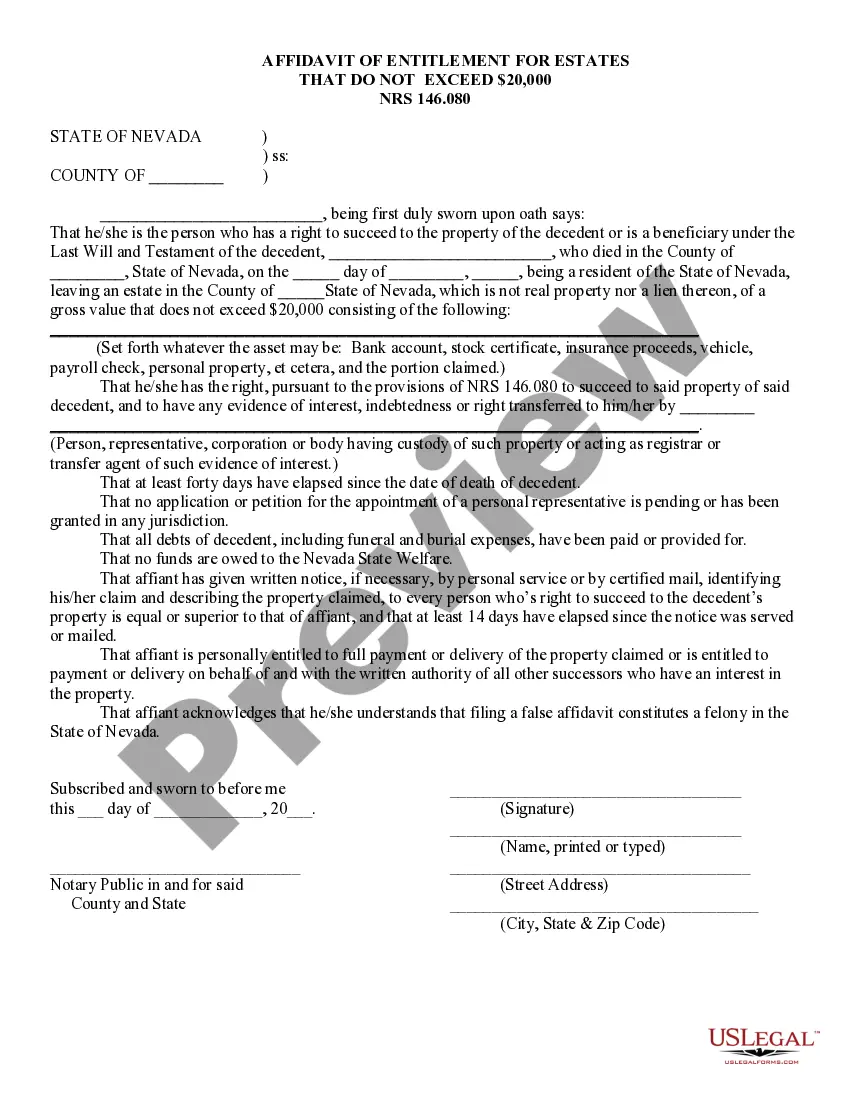
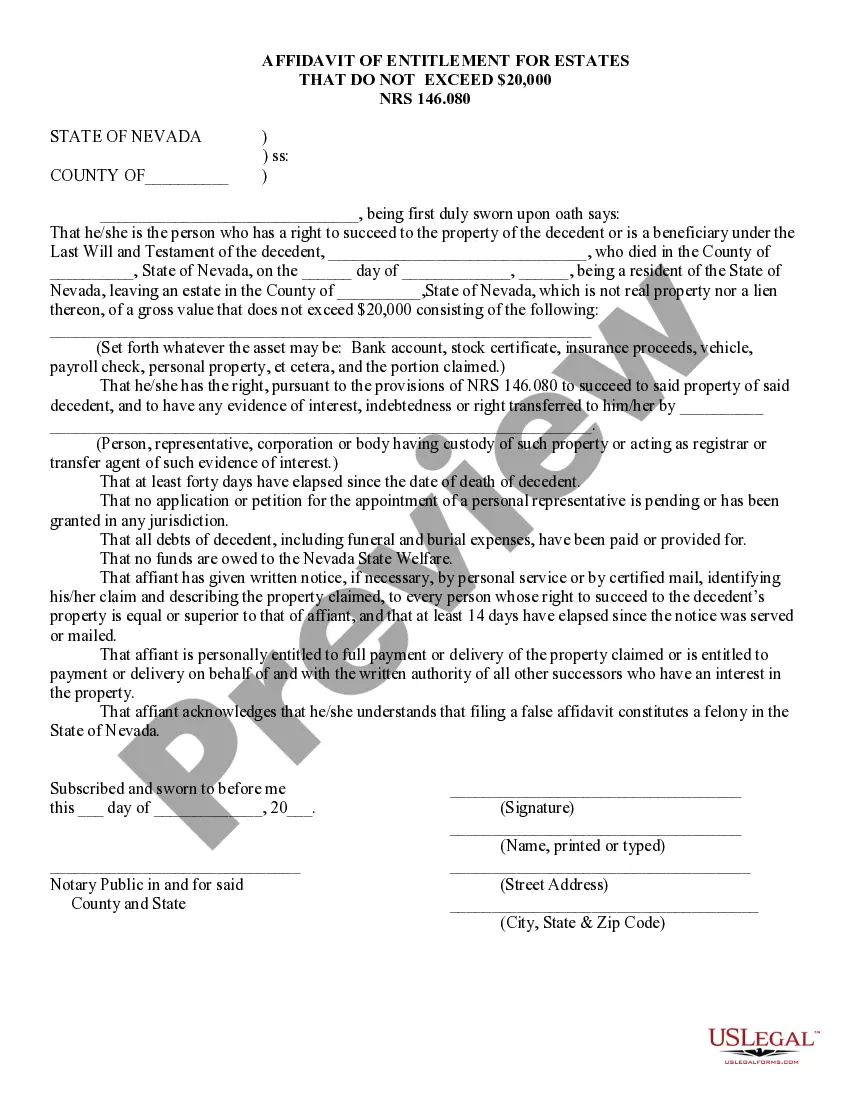
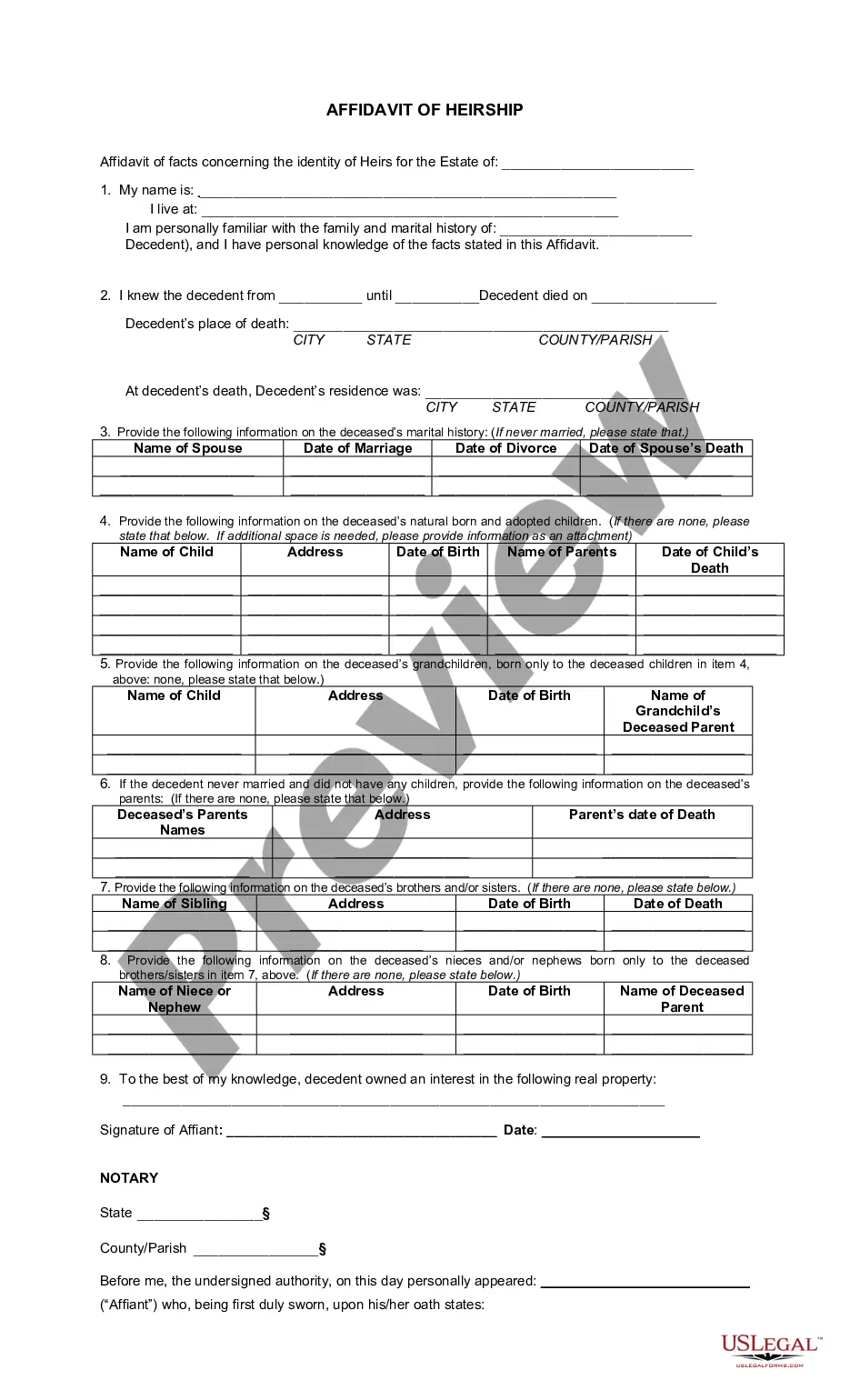
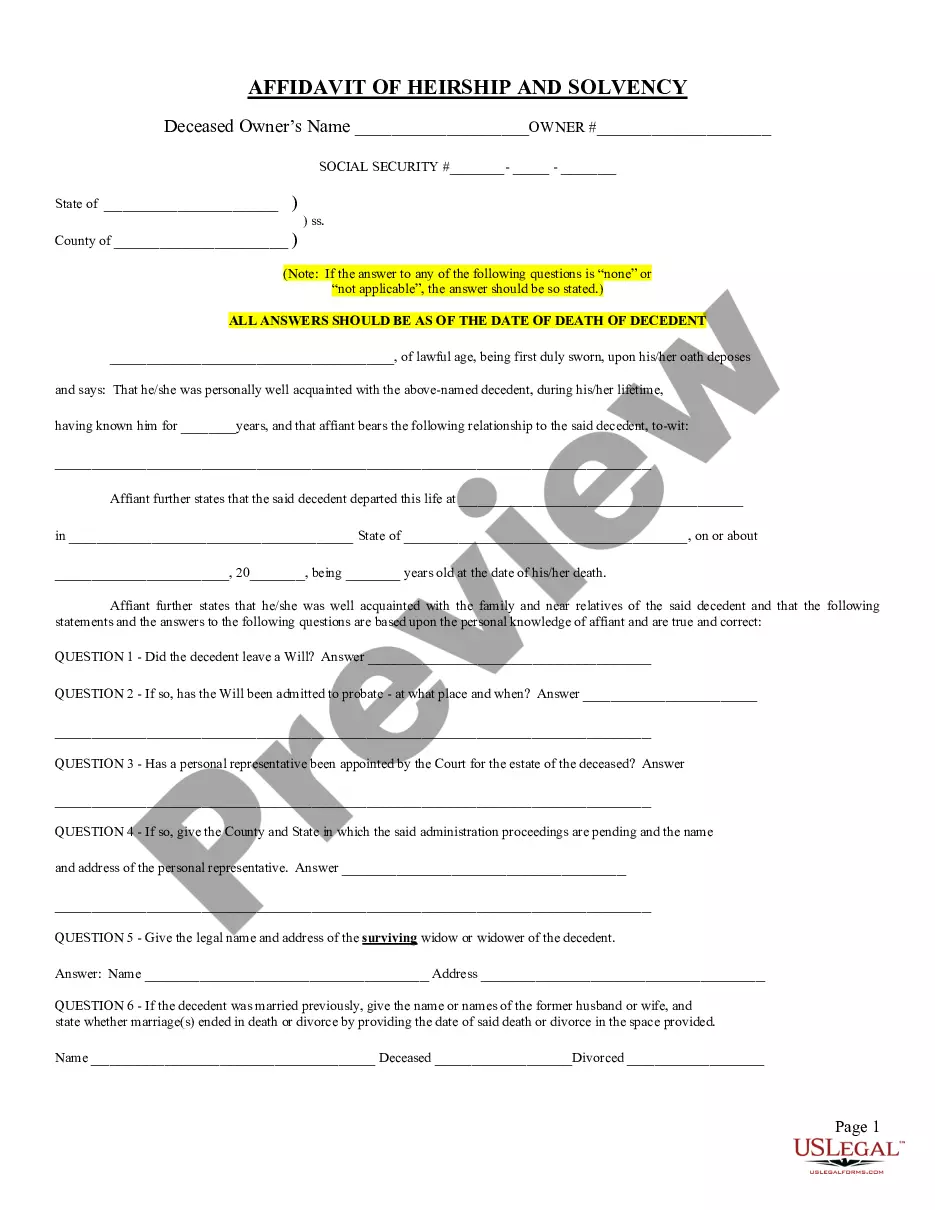
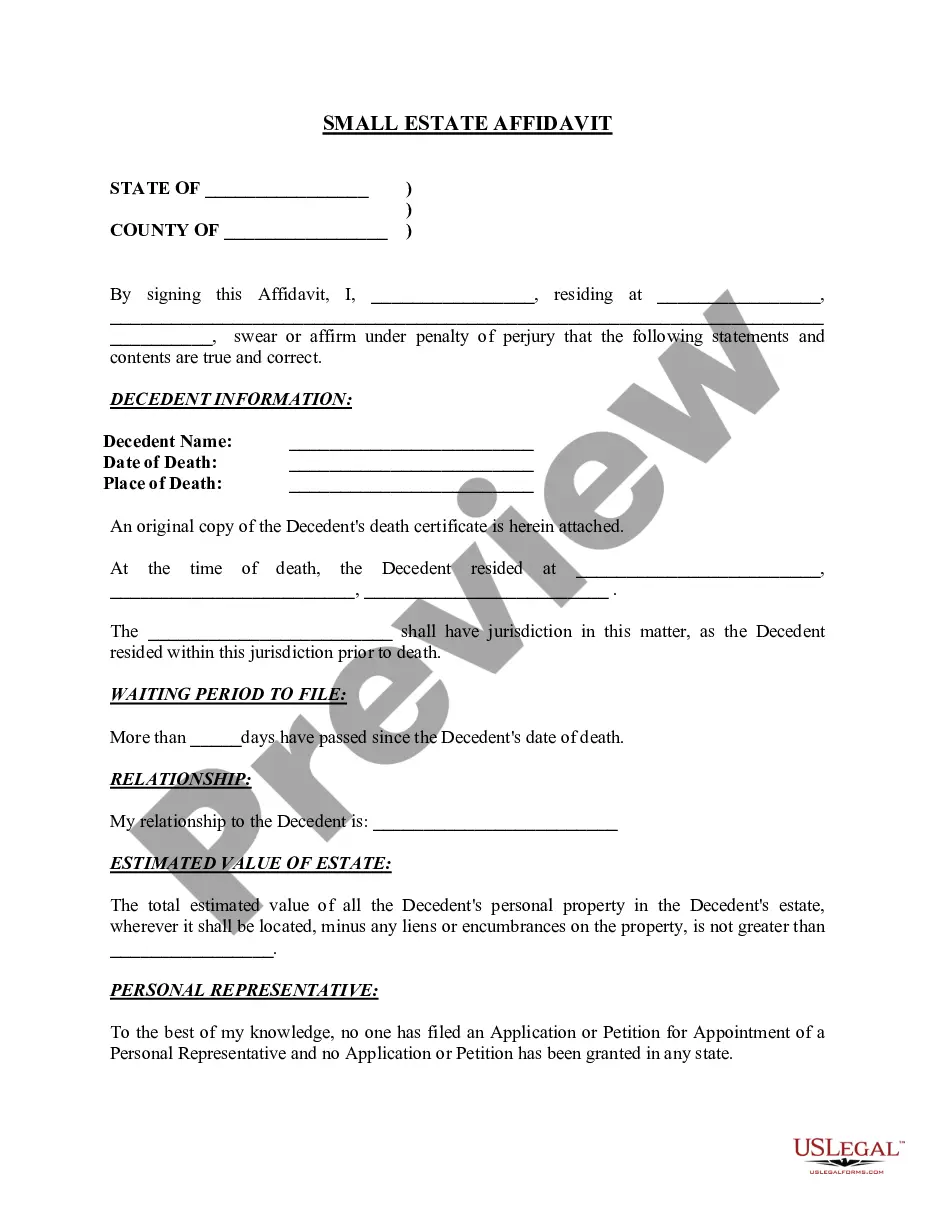
The Affidavit of Entitlement for Estates is a legal document designed for very small estates, typically those with a total value not exceeding $20,000. This form allows designated heirs or beneficiaries to claim and distribute the assets of a deceased person without the need for a lengthy probate process. Unlike traditional probate procedures, which can be costly and time-consuming, this affidavit simplifies the transfer of assets directly to those entitled, thereby expediting the process for all parties involved.
What’s included in this form
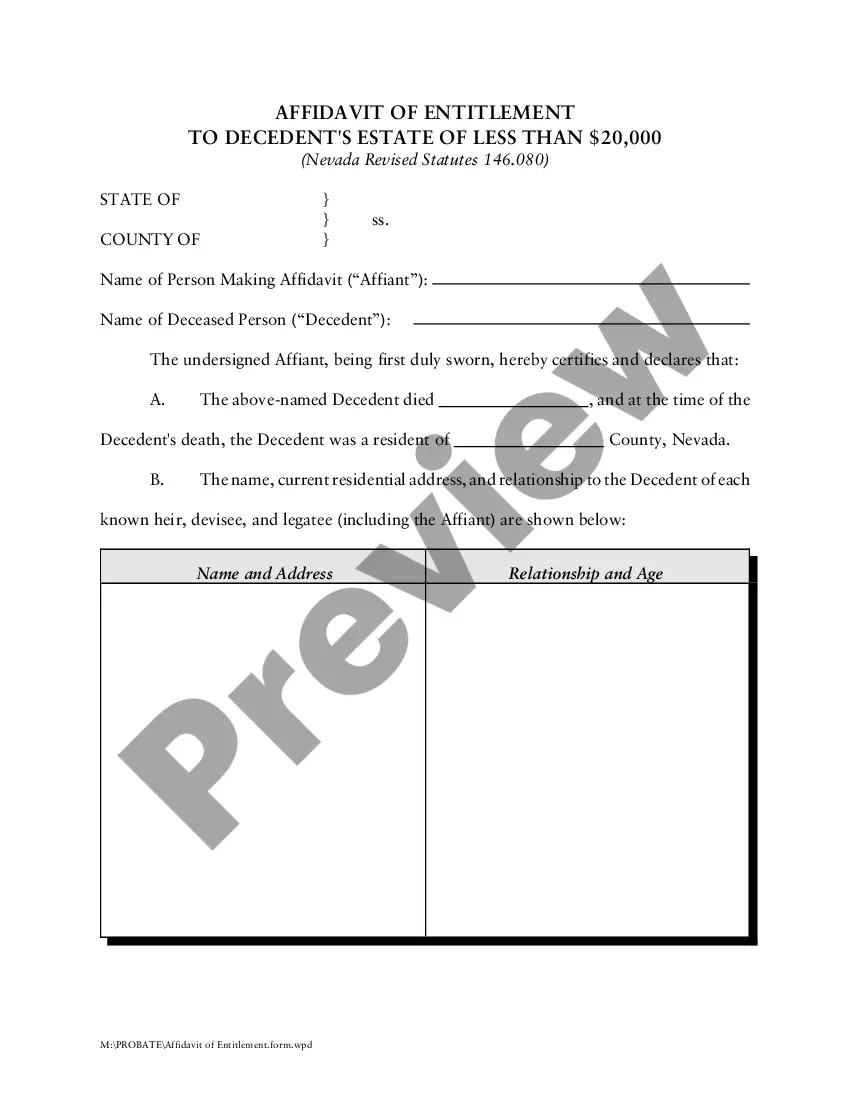
- Identification of the affiant and their relationship to the decedent.
- Details of the decedent, including date of death and residency.
- A list of the decedent's assets that are being claimed.
- A statement confirming that no probate application is pending.
- A declaration that all debts and expenses of the decedent have been settled.
- Affidavit must be witnessed and notarized for legal validity.
Common use cases
This form is used when a decedent's estate consists only of personal property and has a gross value that does not exceed $20,000. It is particularly beneficial when there are no outstanding debts or probate proceedings. Situations may include collecting bank accounts, insurance payouts, or transferring vehicle titles quickly and without additional court intervention.
Who needs this form
- Persons who are heirs or beneficiaries of a decedent's estate under Nevada law.
- Individuals who want to transfer ownership of assets without probate.
- Anyone handling a small estate with a value under $20,000.
Completing this form step by step
- Clearly identify yourself (the affiant) and your relationship to the decedent.
- Provide the name of the decedent and the date of their death.
- Enumerate the assets you are claiming, specifying their types and values.
- Ensure that at least forty days have elapsed since the decedent's death.
- Gather and provide evidence that all debts of the decedent have been settled.
- Sign the affidavit in front of a notary public, confirming its truthfulness.
Is notarization required?
Yes, this form must be notarized to be legally valid. US Legal Forms offers integrated online notarization services, allowing you to notarize your document through secure video calls at any time, ensuring compliance with legal requirements without the need to travel.
Get your form ready online
Our built-in tools help you complete, sign, share, and store your documents in one place.
Make edits, fill in missing information, and update formatting in US Legal Forms—just like you would in MS Word.
Download a copy, print it, send it by email, or mail it via USPS—whatever works best for your next step.
Sign and collect signatures with our SignNow integration. Send to multiple recipients, set reminders, and more. Go Premium to unlock E-Sign.
If this form requires notarization, complete it online through a secure video call—no need to meet a notary in person or wait for an appointment.
We protect your documents and personal data by following strict security and privacy standards.

Make edits, fill in missing information, and update formatting in US Legal Forms—just like you would in MS Word.

Download a copy, print it, send it by email, or mail it via USPS—whatever works best for your next step.

Sign and collect signatures with our SignNow integration. Send to multiple recipients, set reminders, and more. Go Premium to unlock E-Sign.

If this form requires notarization, complete it online through a secure video call—no need to meet a notary in person or wait for an appointment.

We protect your documents and personal data by following strict security and privacy standards.
Common mistakes
- Failing to provide complete details about the decedent's assets.
- Not waiting the required forty days before submitting the affidavit.
- Overlooking necessary signatures or notarization.
- Neglecting to notify other beneficiaries when required.
Quick recap
- The Affidavit of Entitlement simplifies the process of transferring small estates without probate.
- This form is specifically applicable in Nevada for estates under $20,000.
- Complete and accurate information, along with notarization, is crucial for validity.
Looking for another form?
Form popularity
FAQ
Not all states require probate for every estate. In Nevada, probate is mandatory if the value of property owned by the deceased at the time of death is more than $150,000.
If a deceased Nevada resident-owned assets worth $100,000 or less at the time of death and left behind no real estate, you may be able to avoid formal probate by filing a Nevada Small Estate Affidavit.
An ?Affidavit of Entitlement? is a legal document that allows very small estates to obtain and distribute the assets of a decedent without having to go to probate court (in most cases).
Nevada law allows a simplified process for estates that do not include real property (homes or land) and are less than $25,000 (not including the value of vehicles).
This transfer technically happens "as a function of law" when one owner dies. Even so, surviving spouses must initiate the process by recording an affidavit of death, accompanied by a certified copy of the death certificate, to terminate all title to or interest in real property of the deceased spouse.
How to File (4 steps) Step 1 ? Notify Other Claimants. Step 2 ? Wait 40 Days. Step 3 ? Fill Out the Form. Step 4 ? Collect the Property.