Nevada Quitclaim Deed from an Individual to Three Individuals
Understanding this form
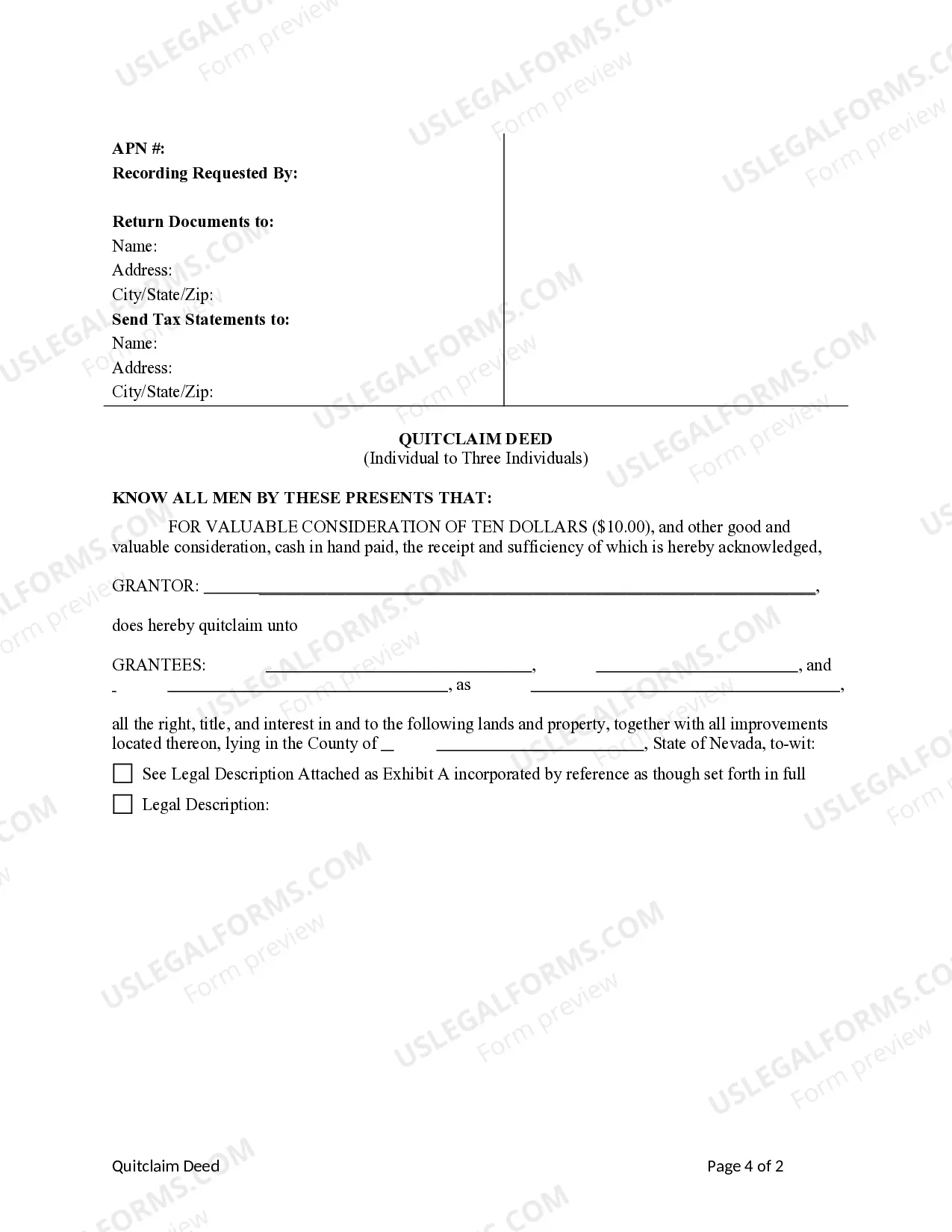
This Quitclaim Deed allows an individual, referred to as the Grantor, to transfer their interest in a property to three designated individuals, known as the Grantees. Unlike a warranty deed, this form does not provide any guarantees about the property's title, meaning the Grantor is only conveying whatever interest they have at the time of the deed's execution. This form is particularly useful when the Grantor wishes to simplify the transfer process without the complexities of title examination or assurances typical with other deed types.
Form components explained
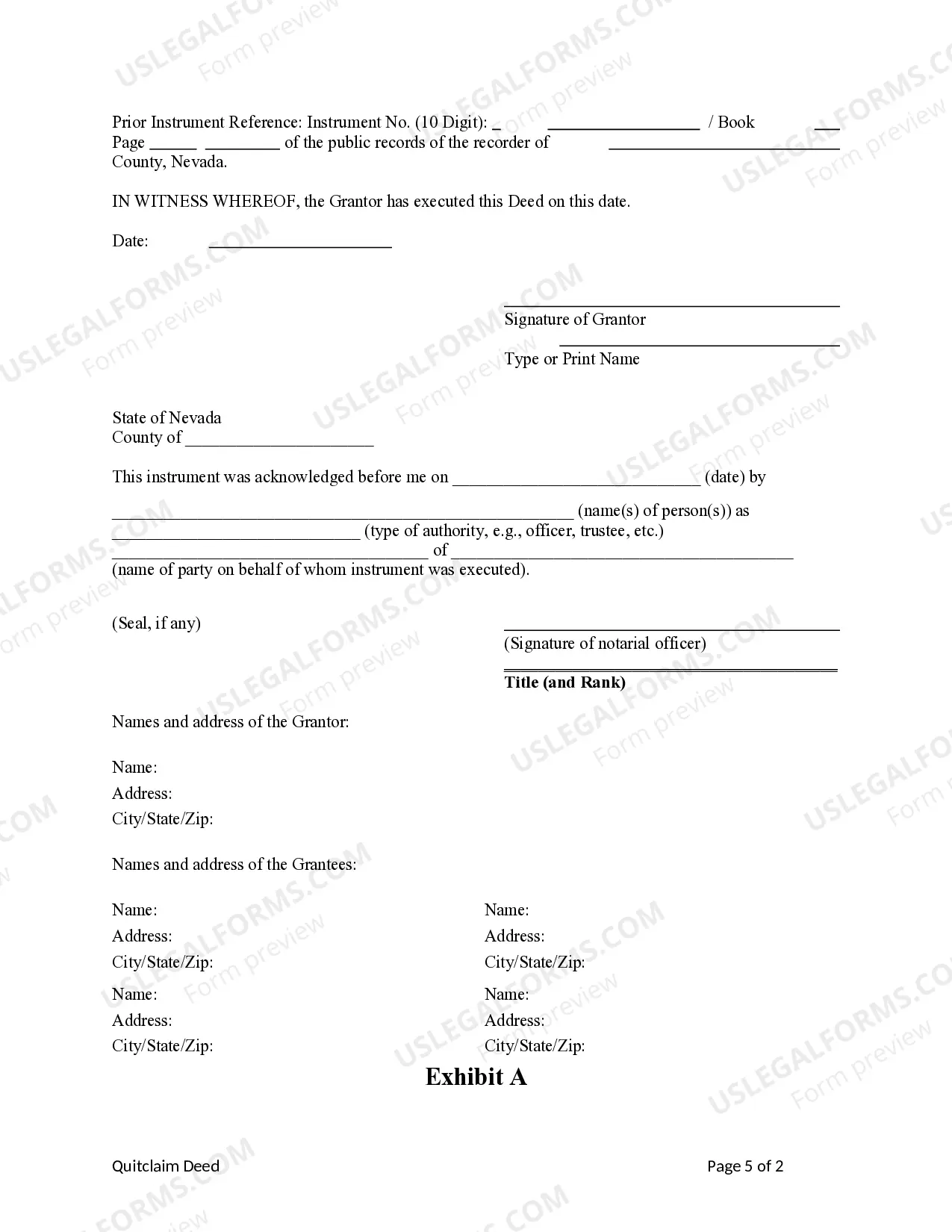
- Grantor and Grantee information fields
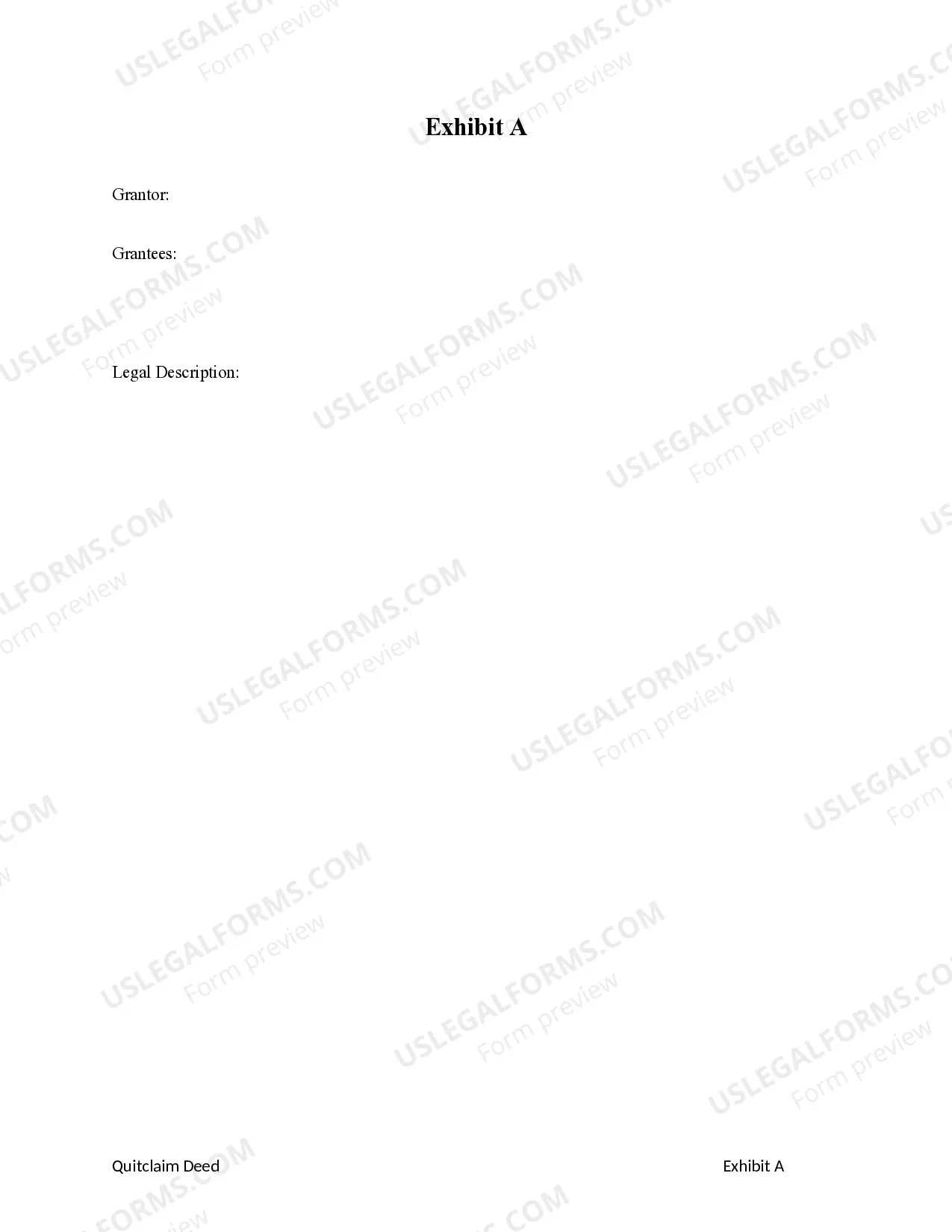
- Description of the property being transferred
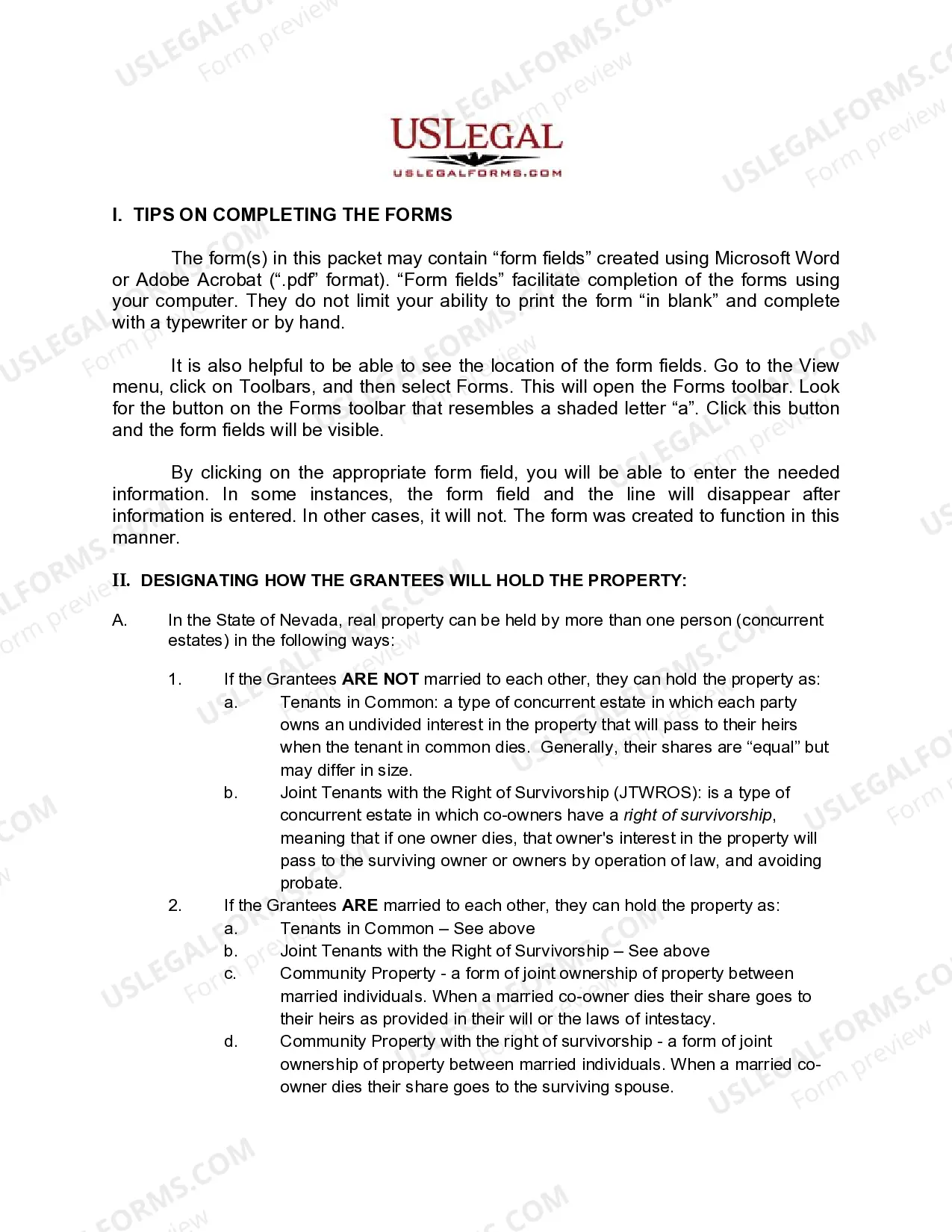
- Choice of property holding arrangement for Grantees
- Date of transfer
- Signature lines for the Grantor




When to use this document
This Quitclaim Deed is ideal for situations where an individual wishes to transfer their property interest to multiple individuals, such as family members or friends. Common scenarios include gifting real estate, transferring property within a family estate, or simplifying ownership among joint owners. It is important to use this form when a complete transfer of title is needed without the Grantor making any claims about the value or status of the property.
Who should use this form
This form is suitable for:
- Individuals transferring property to multiple parties
- Family members who want to simplify property ownership
- Friends sharing ownership of a property
- Anyone looking to transfer property quickly without legal complications
Instructions for completing this form
- Identify the Grantor and the three Grantees, ensuring all names are accurate.
- Provide a precise description of the property being transferred, including the address or legal description.
- Select how the Grantees will hold the property, such as Tenants in Common or Joint Tenants with Right of Survivorship.
- Enter the date of the transfer to document when the ownership change takes effect.
- Have the Grantor sign the document in the designated area provided.
Does this form need to be notarized?
To make this form legally binding, it must be notarized. Our online notarization service, powered by Notarize, lets you verify and sign documents remotely through an encrypted video session.
Get your form ready online
Our built-in tools help you complete, sign, share, and store your documents in one place.
Make edits, fill in missing information, and update formatting in US Legal Forms—just like you would in MS Word.
Download a copy, print it, send it by email, or mail it via USPS—whatever works best for your next step.
Sign and collect signatures with our SignNow integration. Send to multiple recipients, set reminders, and more. Go Premium to unlock E-Sign.
If this form requires notarization, complete it online through a secure video call—no need to meet a notary in person or wait for an appointment.
We protect your documents and personal data by following strict security and privacy standards.

Make edits, fill in missing information, and update formatting in US Legal Forms—just like you would in MS Word.

Download a copy, print it, send it by email, or mail it via USPS—whatever works best for your next step.

Sign and collect signatures with our SignNow integration. Send to multiple recipients, set reminders, and more. Go Premium to unlock E-Sign.

If this form requires notarization, complete it online through a secure video call—no need to meet a notary in person or wait for an appointment.

We protect your documents and personal data by following strict security and privacy standards.
Common mistakes
- Incorrectly identifying the Grantor or Grantees, leading to invalidation of the deed.
- Failing to describe the property adequately, which can create confusion in ownership.
- Neglecting to select the appropriate type of property holding arrangement for the Grantees.
- Forgetting to sign the deed, which is essential for its legality.
Why use this form online
- Convenient access to legal forms anytime and anywhere.
- Editable fields allow for easy completion with a computer.
- Streamlined process reduces the time it takes to complete legal documentation.
- Reliable templates created by licensed attorneys to ensure legal compliance.
Quick recap
- A Quitclaim Deed is used to transfer ownership of property from one individual to multiple others.
- The form must detail how the Grantees will hold the property.
- Completing the deed accurately is vital to ensure legal effectiveness and avoid disputes.
- Taking advantages of online resources can simplify the process of creating a Quitclaim Deed.
Looking for another form?




Form popularity
FAQ
Nevada's statewide real property transfer tax is $1.95 per $500 of value over $100. Some counties in Nevada, such as Washoe and Churchill, add $0.10 to the rate. Clark County adds $0.60. The tax is collected by the county recorder.
Fill out the quit claim deed form, which can be obtained online, or write your own using the form as a guide. The person giving up the interest in the property is the grantor, and the person receiving the interest is the grantee.
Yes, you can use a Quitclaim Deed to transfer a gift of property to someone. You must still include consideration when filing your Quitclaim Deed with the County Recorder's Office to show that title has been transferred, so you would use $10.00 as the consideration for the property.
When done properly, a deed is recorded anywhere from two weeks to three months after closing. However, there are many instances where deeds are not properly recorded. Title agents commit errors, lose deeds, and even go out of business. Even county offices sometimes fail to record deeds that were properly submitted.
If the quitclaim deed requires the signature of all co-owners, the deed is invalid unless all co-owners have signed it and the deed is then delivered to the grantee.If one individual owns real estate and desires to add a co-owner such as a spouse, a quitclaim deed might be used.
You must pay a fee to file a deed with the county recorder. The fee should be $14.00 to record the first page of a quitclaim deed and $1.00 for each additional page. However, you should call ahead of time to check about the amount and acceptable methods of payment.
But you might be wondering if an owner can transfer a deed to another person without a real estate lawyer. The answer is yes. Parties to a transaction are always free to prepare their own deeds.A quitclaim deed, for example, is far simpler than a warranty deed.
The Grantee and Grantor are jointly and severally liable for the payment of the tax. When all taxes and recording fees required are paid, the deed is recorded. Each County Recorder's Office: 1.
The drawback, quite simply, is that quitclaim deeds offer the grantee/recipient no protection or guarantees whatsoever about the property or their ownership of it. Maybe the grantor did not own the property at all, or maybe they only had partial ownership.