Nevada Instructions to the Constable
Understanding this form
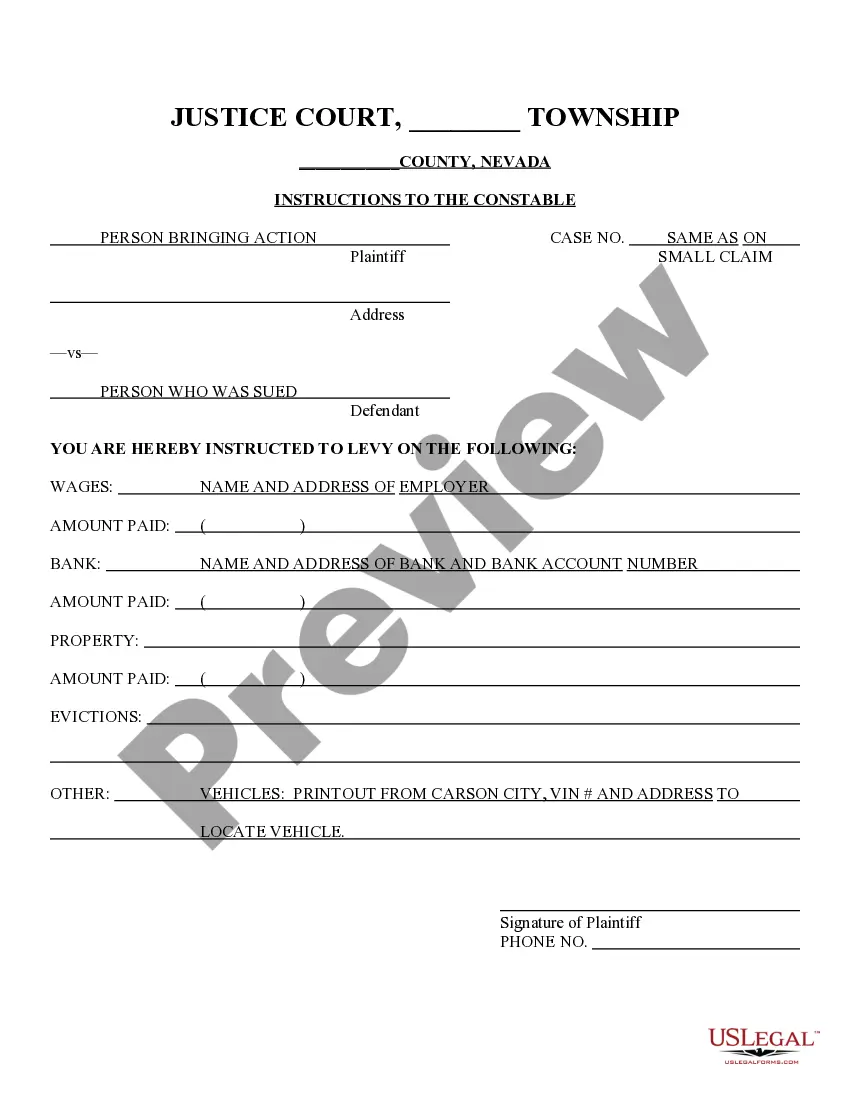
The Instructions to the Constable is a legal form used in Nevada small claims court. This form provides the necessary directions to the constable for enforcing a court judgment by levying on wages, bank accounts, or property. Unlike other legal forms, this document specifically outlines the actions the constable must take to collect awarded amounts from a defendant following a judgment. It is essential for plaintiffs looking to inform the constable about how and where to collect money owed to them.
Form components explained
- County designation: Identifies the county in Nevada where the form is being filed.
- Case number: Refers to the unique identifier assigned to your small claims case.
- Plaintiff's information: Includes name, address, and contact information for the person bringing the action.
- Defendant's information: Lists the individual or entity being sued.
- Levy instructions: Specifies the wages, bank accounts, or other property to be levied.
- Signature: Requires the plaintiff's signature to validate the instructions provided.
When to use this form
This form should be used when a plaintiff has obtained a judgment in a small claims court and needs to instruct the constable on how to enforce it. You might find yourself needing this form if the defendant has not voluntarily paid the awarded amount and you need assistance in collecting the debt through legal channels.
Who needs this form
- Plaintiffs who have won a small claims court judgment in Nevada.
- Individuals or entities needing to collect money owed to them from a defendant after a court ruling.
- Parties unfamiliar with the legal process, seeking straightforward instructions for enforcing a judgment.
Instructions for completing this form
- Identify the county and enter it at the top of the form.
- Fill in the case number as assigned by the court.
- Provide your name and address in the plaintiff's section.
- Complete the defendant's section with their name and address.
- List the wages, bank account details, or property you wish to levy on.
- Sign the form and include your phone number for further contact.
Does this form need to be notarized?
This form does not typically require notarization unless specified by local law. However, it is recommended to confirm whether notarization is necessary for enforcement in your specific situation.
Get your form ready online
Our built-in tools help you complete, sign, share, and store your documents in one place.
Make edits, fill in missing information, and update formatting in US Legal Forms—just like you would in MS Word.
Download a copy, print it, send it by email, or mail it via USPS—whatever works best for your next step.
Sign and collect signatures with our SignNow integration. Send to multiple recipients, set reminders, and more. Go Premium to unlock E-Sign.
If this form requires notarization, complete it online through a secure video call—no need to meet a notary in person or wait for an appointment.
We protect your documents and personal data by following strict security and privacy standards.

Make edits, fill in missing information, and update formatting in US Legal Forms—just like you would in MS Word.

Download a copy, print it, send it by email, or mail it via USPS—whatever works best for your next step.

Sign and collect signatures with our SignNow integration. Send to multiple recipients, set reminders, and more. Go Premium to unlock E-Sign.

If this form requires notarization, complete it online through a secure video call—no need to meet a notary in person or wait for an appointment.

We protect your documents and personal data by following strict security and privacy standards.
Common mistakes to avoid
- Failing to complete all required fields, such as case number and defendant's information.
- Not signing the form, which can invalidate the instructions provided.
- Using incorrect county designations or case numbers, leading to processing delays.
Why complete this form online
- Convenience: Access and download the form from anywhere at any time.
- Editability: Customize the form to meet your specific legal circumstances.
- Legal reliability: The forms are drafted by licensed attorneys to ensure compliance with state laws.
Legal use & context
- The form provides legal instructions to enforce a court order.
- It's essential for ensuring compliance with court rulings regarding judgments in small claims.
- Improper use or completion may hinder the enforcement process.
Key takeaways
- The Instructions to the Constable is essential for enforcing small claims court judgments in Nevada.
- Complete the form accurately with proper identification of involved parties.
- This form does not usually require notarization unless stated otherwise.
Looking for another form?

Form popularity
FAQ
Evictions may take anywhere from 10 to 180 days, depending on the circumstances of the case. You may use the Constable's Office or a licensed process server. Nevada Revised Statute 118A. 390 makes it illegal for a landlord to use "self-help evictions" to carry out an eviction.
Nevada constable offices are among the oldest law enforcement agencies in the state, established in the 1850s while Nevada was still a territory.The responsibilities of the agency include the support and execution of documents, orders, and evictions that are issued out of the Henderson Justice Court and other courts.
Nevada's new eviction ban prevents protected tenants from being evicted from residential properties through March 31, 2021. Importantly, the ban is not automatic so tenants must take action to protect themselves.
After waiting periods are met, most criminal records can be sealed (see waiting periods below). Criminal record sealing in Nevada typically takes about 4 to 6 months. Most attorney charge around $750 to seal a criminal record.
Evictions may take anywhere from 10 to 180 days, depending on the circumstances of the case. You may use the Constable's Office or a licensed process server. Nevada Revised Statute 118A. 390 makes it illegal for a landlord to use "self-help evictions" to carry out an eviction.
Las Vegas Defense Group » Nevada Blog A» Criminal Defense A» How much does it cost to seal my criminal record in Nevada? Process of getting a criminal record seal in Nevada amounts to around $150 total if the person does not use an attorney.
Talk to Your Landlord You may be able to come to an agreement without going to court. An eviction will cost both of you money (as well as time), and your landlord may be willing to stop the eviction if you agree to certain terms, such as paying rent you owe or stopping behavior that violates the lease.
Removing an eviction from your public record actually isn't that difficult. If you have an eviction record that will show up in your background check, you can petition the court in the county where the case was filed to have the record expunged, or sealed.
STEP 1 Gather Information About Your Eviction. STEP 2 Fill Out the Motion to Seal Eviction Form in the Packet. STEP 3 File the Motion with the Justice Court (Reno or Sparks) STEP 4 Serve the Landlord with a Copy of the Motion. STEP 5 Wait the Correct Amount of Time.