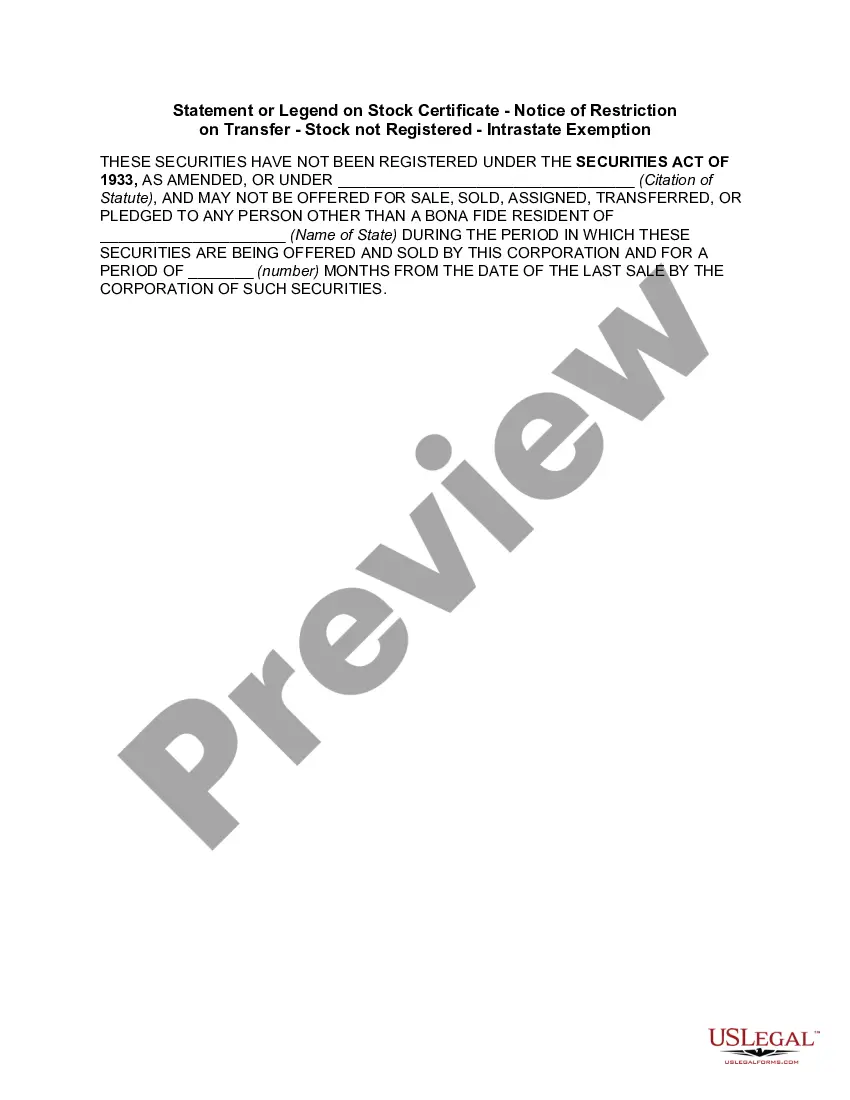
New Jersey Statement or Legend on Stock Certificate - Notice of Restriction on Transfer - Stock not Registered - Intrastate Exemption
Description
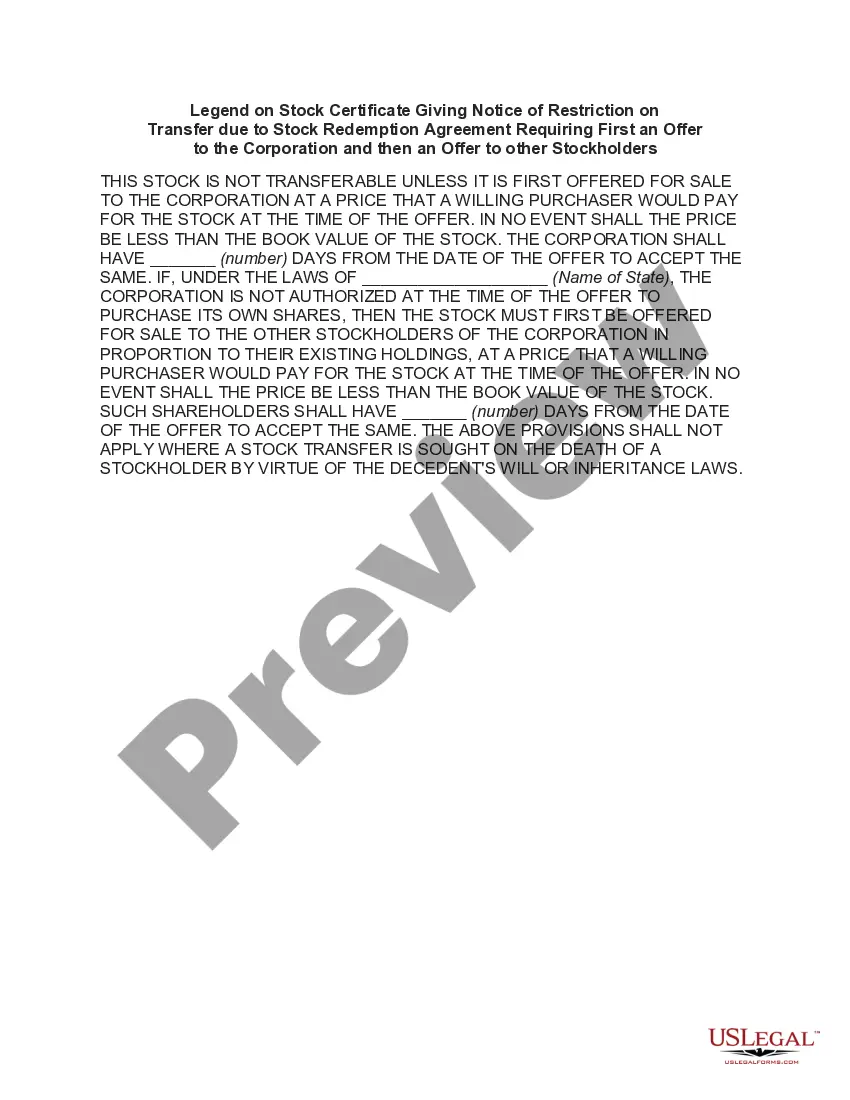

How to fill out Statement Or Legend On Stock Certificate - Notice Of Restriction On Transfer - Stock Not Registered - Intrastate Exemption?
It is possible to spend hours on-line searching for the legitimate record template that meets the state and federal specifications you need. US Legal Forms provides 1000s of legitimate kinds that happen to be reviewed by specialists. It is simple to obtain or print the New Jersey Statement or Legend on Stock Certificate - Notice of Restriction on Transfer - Stock not Registered - Intrastate Exemption from the assistance.
If you already possess a US Legal Forms account, you are able to log in and click the Acquire key. Afterward, you are able to comprehensive, change, print, or indication the New Jersey Statement or Legend on Stock Certificate - Notice of Restriction on Transfer - Stock not Registered - Intrastate Exemption. Every legitimate record template you get is your own property forever. To have another backup for any acquired develop, check out the My Forms tab and click the related key.
If you work with the US Legal Forms website for the first time, follow the easy guidelines listed below:
- First, ensure that you have selected the proper record template to the area/metropolis of your choice. See the develop information to make sure you have selected the appropriate develop. If available, use the Review key to appear through the record template too.
- In order to find another model of the develop, use the Lookup industry to discover the template that meets your needs and specifications.
- After you have identified the template you want, simply click Purchase now to proceed.
- Choose the prices program you want, enter your qualifications, and register for an account on US Legal Forms.
- Complete the purchase. You should use your Visa or Mastercard or PayPal account to fund the legitimate develop.
- Choose the structure of the record and obtain it in your system.
- Make adjustments in your record if necessary. It is possible to comprehensive, change and indication and print New Jersey Statement or Legend on Stock Certificate - Notice of Restriction on Transfer - Stock not Registered - Intrastate Exemption.
Acquire and print 1000s of record templates while using US Legal Forms website, that provides the greatest selection of legitimate kinds. Use professional and status-certain templates to tackle your company or specific requirements.
Form popularity
FAQ
What Are Unregistered Shares? Unregistered shares, also known as restricted stock, are securities that are not registered with the Securities and Exchange Commission (SEC).
Rule 701 is a federal exemption under the Securities Act of 1933 that allows private companies to issue securities to employees and other service providers. This is especially useful when not all of your employees or service providers are accredited investors eligible for other securities exemptions like Regulation D.
Rule 701 is important because if a company expects that the total aggregate sales price of stock options issued during any consecutive 12-month period will exceed $10 million, then Rule 701 requires the company to provide certain information to prospective purchasers (i.e., stock option holders who are exercising their ...
In order to have the legend on a stock certificate removed, investors should contact the company's shareholder relations department to find out the details of the removal process. Following that, the company will send a confirmation authorizing its transfer agent to remove the legend.
Restricted stocks are unregistered shares that are non-transferable for holders until they meet certain conditions. Well-established companies offer restricted stocks to company executives and directors as a form of equity compensation. Some restrictive conditions may be particular tenure or specific performance goals.
The purpose of the restrictive legend or notation is to protect the issuing company from loosing its private placement exemption for the initial sale of the securities and to notify the investor that the restricted securities cannot be resold into the public securities market without satisfying certain requirements.
Rule 701 exempts certain sales of securities made to compensate employees, consultants and advisors. This exemption is not available to Exchange Act reporting companies. A company can sell at least $1 million of securities under this exemption, regardless of its size.
Created by the Securities and Exchange Commission (SEC), Rule 701 is a safe harbor exemption allowing companies to issue stocks or stock options to employees without needing to register the stock under the Securities Act. For most startups, this is one of the legal requirements for equity compensation.
Under the U.S. Securities Laws, specifically The Securities Act of 1933, the mere offer to sell a security ? unless there is an effective registration statement on file with the SEC for the offer ? via the Internet can be a felony subjecting the offeror to a 5 year federal prison term.
Broker-Dealers Must Register Before Selling Unregistered Securities ? Including Private Placements (or Regulation D offerings) A security sold in a transaction that is exempt from registration under the Securities Act of 1933 (the "1933 Act") is not necessarily an "exempted security" under the Exchange Act.