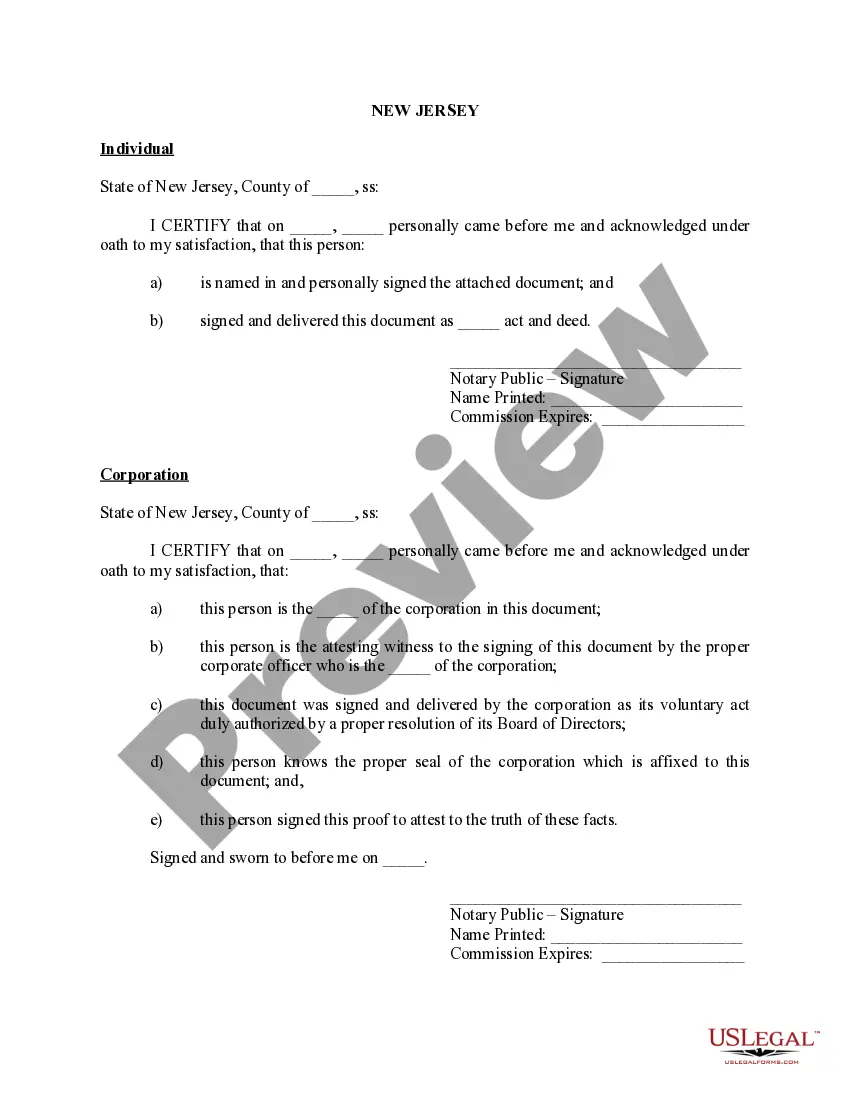
New Jersey Oil and Gas Acknowledgement
About this form
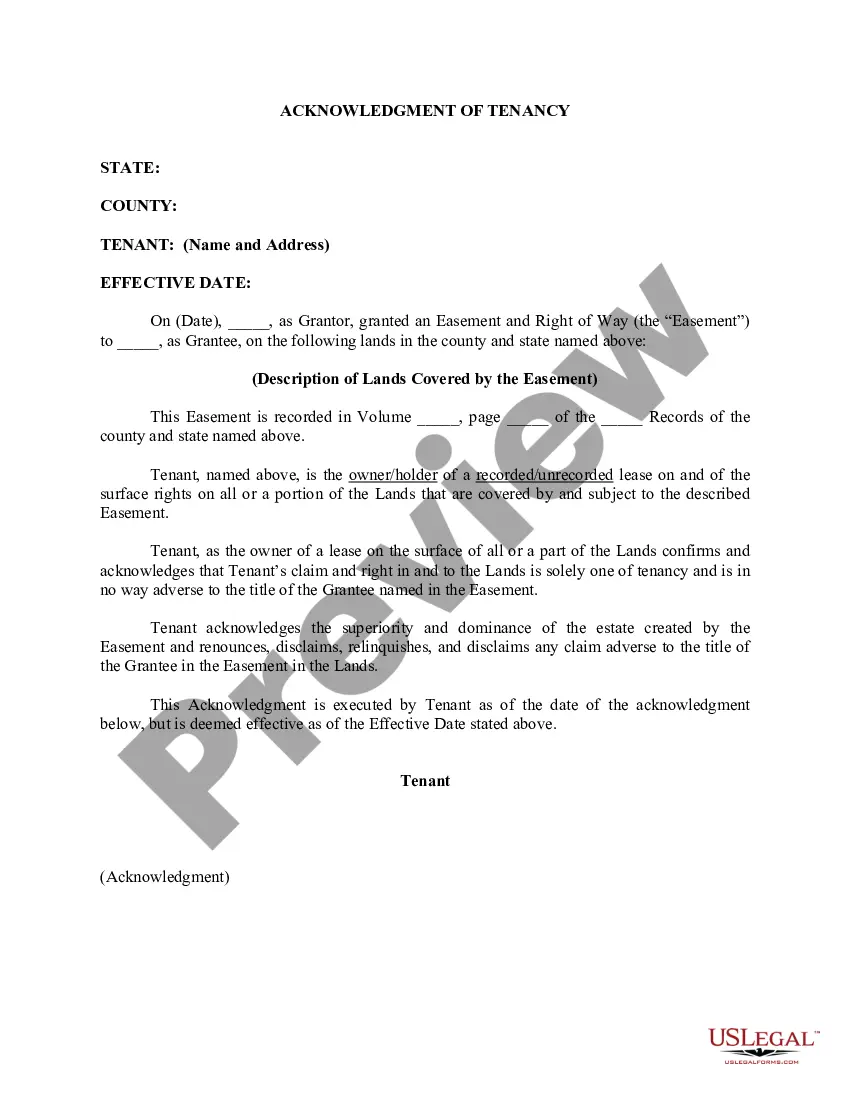
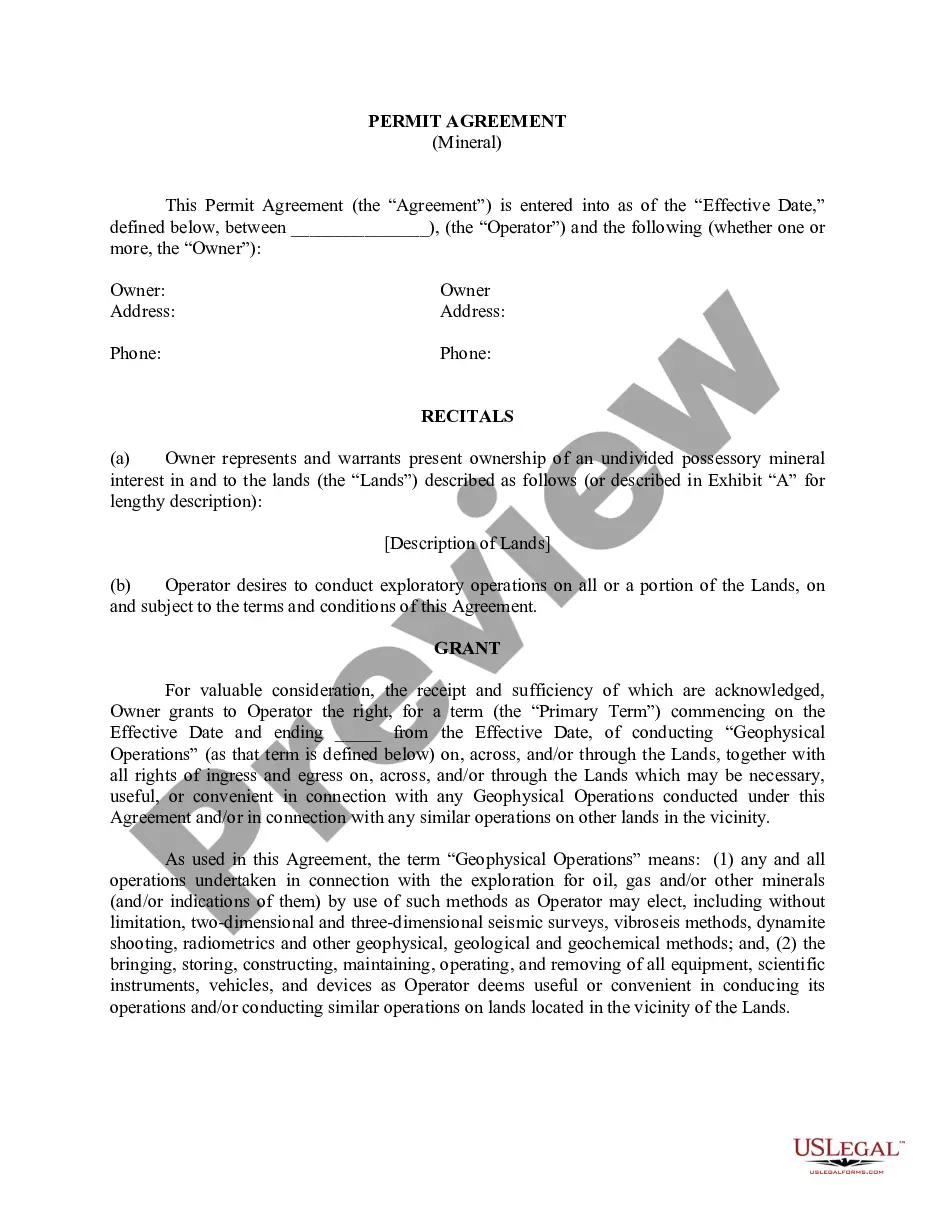
The New Jersey Oil and Gas Acknowledgement form is a legal document used to certify that a signing party has acknowledged their signature on an instrument. This acknowledgment is crucial for any instrument that may be recorded or that relates to transferring any interests in oil and gas. It differs from similar forms by emphasizing the need for proper notarization and the declaration of the individual's authority in corporate contexts.
What’s included in this form
- Individual and corporate acknowledgment sections.
- Details about the person acknowledging the signature.
- Notary public signature and printed name for verification.
- Expiration date of the notary's commission.
- Affirmation of the corporate officer's authority for corporate acknowledgments.
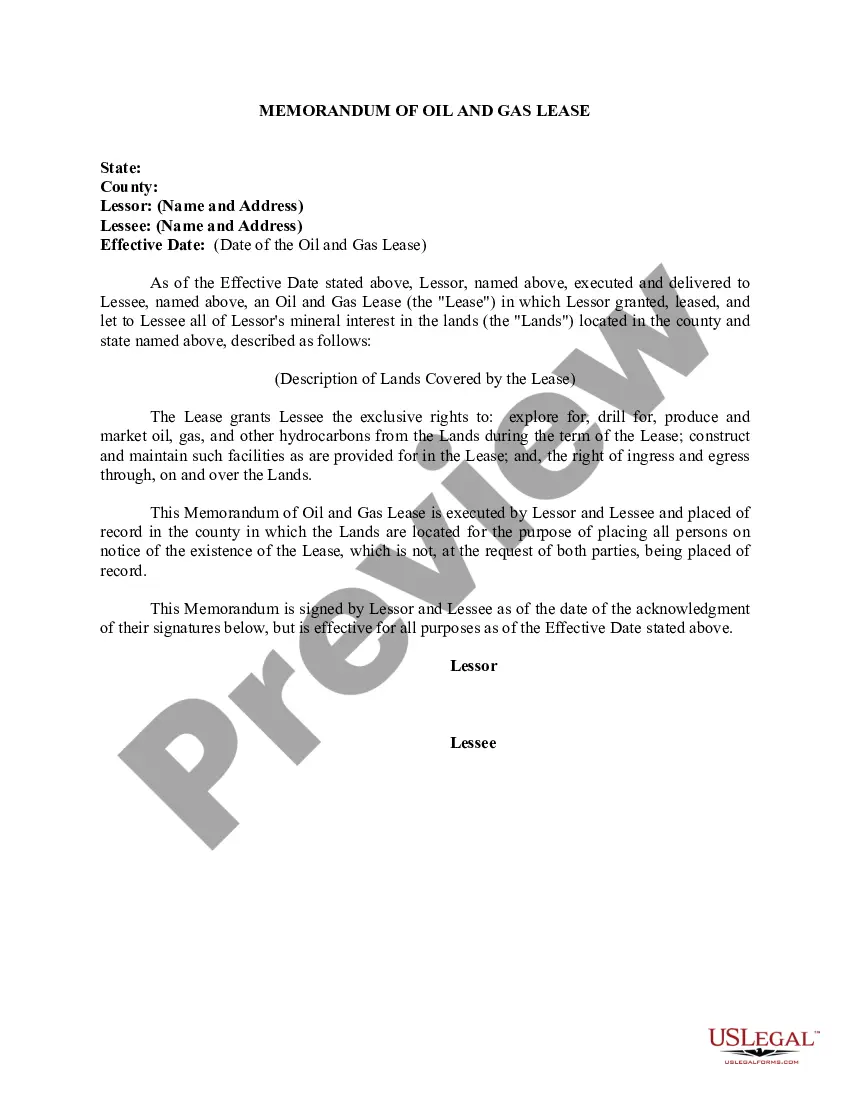
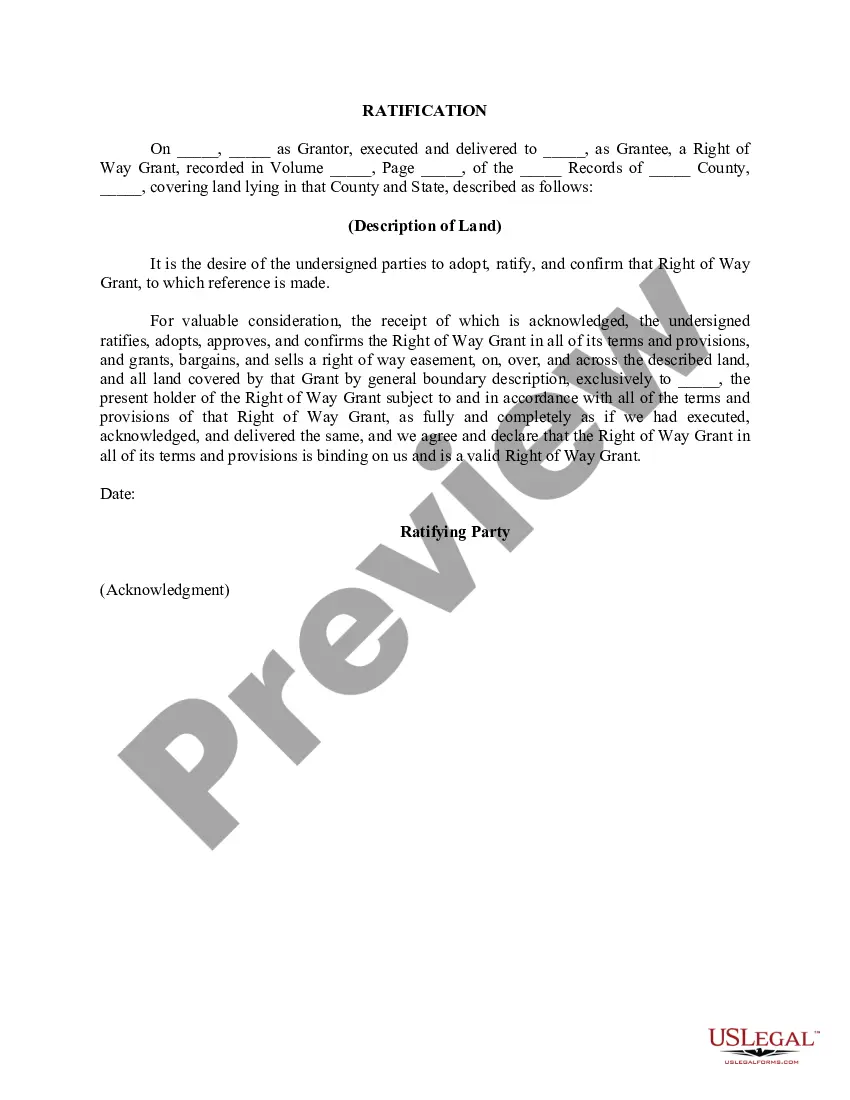
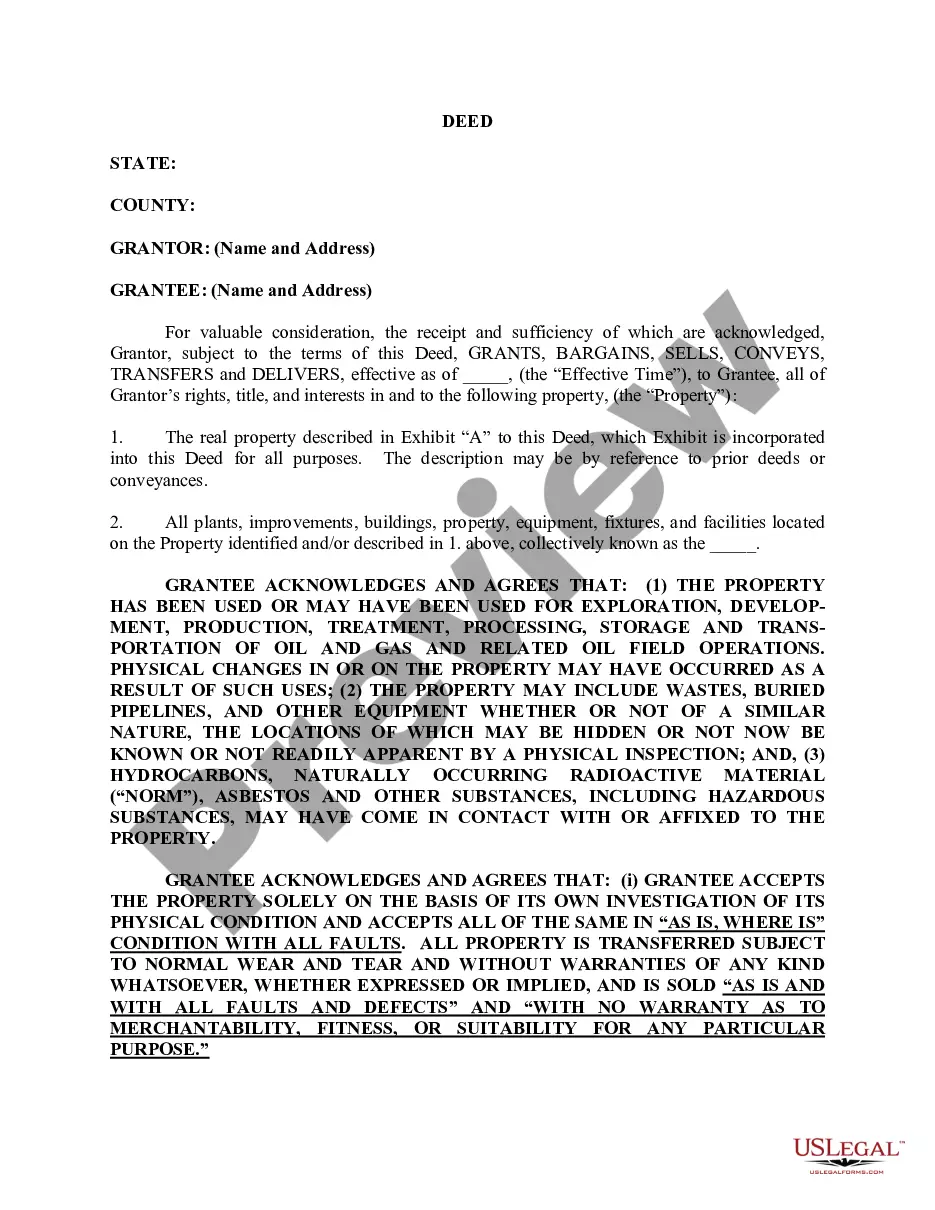
When to use this document
This form is typically used when a party is signing a legal document related to oil and gas rights in New Jersey. It is essential when the document needs to be notarized for legal purposes, such as in transactions involving the transfer of interests or rights that must be recorded with the appropriate governmental agency.
Who needs this form
- Individuals signing documents related to oil and gas agreements.
- Corporations involved in transactions affecting oil and gas interests.
- Notary publics certifying signatures on these instruments.
Steps to complete this form
- Identify the individual or corporate party signing the document.
- Enter the date and location where the acknowledgment is taking place.
- Have the signatory acknowledge their signature before a notary public.
- Ensure the notary public completes their section with signature and printed name.
- For corporate acknowledgments, confirm the authority of the signing officer and affix the corporate seal if required.
Does this document require notarization?
Yes, this form must be notarized to be legally valid. The acknowledgment by a notary public ensures that the signatures are verified and that the document can be recognized in legal contexts. US Legal Forms offers a convenient online notarization service available 24/7, enabling secure video calls with notaries for easy document validation without the need for travel.
Get your form ready online
Our built-in tools help you complete, sign, share, and store your documents in one place.
Make edits, fill in missing information, and update formatting in US Legal Forms—just like you would in MS Word.
Download a copy, print it, send it by email, or mail it via USPS—whatever works best for your next step.
Sign and collect signatures with our SignNow integration. Send to multiple recipients, set reminders, and more. Go Premium to unlock E-Sign.
If this form requires notarization, complete it online through a secure video call—no need to meet a notary in person or wait for an appointment.
We protect your documents and personal data by following strict security and privacy standards.

Make edits, fill in missing information, and update formatting in US Legal Forms—just like you would in MS Word.

Download a copy, print it, send it by email, or mail it via USPS—whatever works best for your next step.

Sign and collect signatures with our SignNow integration. Send to multiple recipients, set reminders, and more. Go Premium to unlock E-Sign.

If this form requires notarization, complete it online through a secure video call—no need to meet a notary in person or wait for an appointment.

We protect your documents and personal data by following strict security and privacy standards.
Avoid these common issues
- Failing to have the form notarized when required.
- Leaving out the expiration date of the notary's commission.
- Not properly identifying the individual or corporate entity signing the document.
- Overlooking to use the correct corporate officer in corporate acknowledgments.
Why use this form online
- Convenient access to legal forms at any time.
- Edit and customize the form easily to suit your specific needs.
- Forms drafted by licensed attorneys ensure compliance with state laws.
- Immediate download for quick document execution.
Looking for another form?
Form popularity
FAQ
A notary public who has a direct or indirect financial (or other beneficial) interest in a document may not notarize such a document. The better practice is not to notarize for a spouse or family member in order to preserve the integrity of the notarization and to prevent a challenge to the notarization.
In New Jersey, all power of attorney documents require that both the principal and the attorney-in-fact are competent and be of sound mind at the point at which they are executed. They must be signed in the presence of at least 2 witnesses and in the presence of a licensed Notary of the State of New Jersey.
The notary public must then: 1) print the document; 2) add the required certificate language; 3) sign as the notary; and 4) transmit the notarized document back to the Principal on the same date that the document was signed by the Principal.
Step 1: Require Personal Appearance. Step 2: Check Over The Document. Step 3: Carefully Identify The Signer. Step 4: Record Your Journal Entry. Step 5: Complete The Notarial Certificate. A Last Note: Never Give Advice.
As long as the signer is personally present before the notary and acknowledges the signature, then the notary can proceed with performing the notarial act.If the document has already been signed, the signer can sign his or her name again above or next to the first signature. You can then proceed with the notarization.
N. the section at the end of a document where a notary public verifies that the signer of the document states he/she actually signed it. The acknowledgment or due proof of the instrument by witnesses, must be made before it can be put upon record.
A Notary Public must be a resident of New Jersey or a resident of an adjoining state who maintains, or is regularly employed in, an office in this State. A Notary Public must be 18 years or older.
While notarizing for a parent is not prohibited, as suggested in Article II-B-5 of The Notary Public Code Of Professional Responsibility the NNA recommends that you not notarize for a parent, sibling or other family members related by heredity or marriage because the financial affairs of family members are often
The maximum allowable fees a New Jersey notary public can charge for notarial acts are listed below: For taking an acknowledgment - $2.50. For administering an oath and affirmation - $2.50. Executing a jurat - $2.50.