New Jersey Order Granting Summary Judgment
About this form
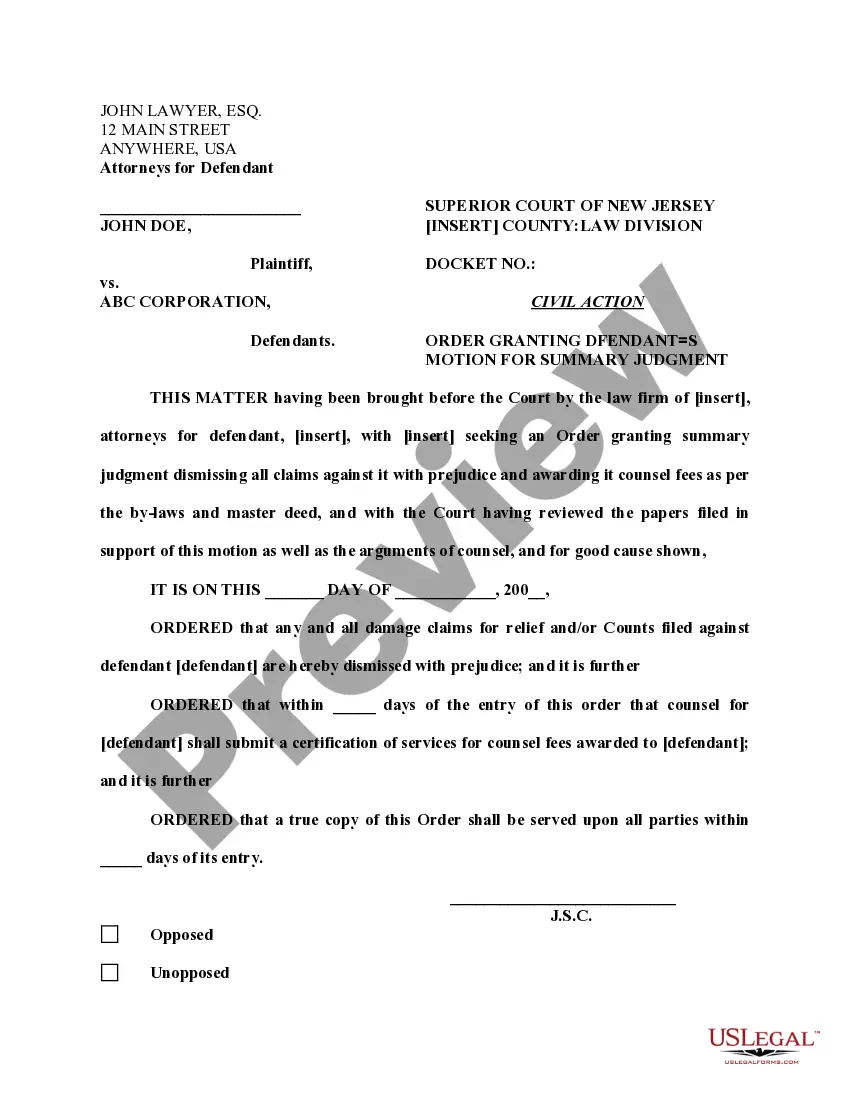
The Order Granting Summary Judgment is a legal document used in New Jersey courts to formally dismiss a case without proceeding to trial. This order is signed by a judge after considering a motion for summary judgment, which asserts that there are no material facts in dispute and that the law is on the side of the requesting party. Unlike other legal forms that may allow for a trial, this form seeks to finalize the matter expeditiously based on the records submitted.
Form components explained
- Case caption identifying the plaintiff and defendant.
- Court information, including the county and docket number.
- Specification of the motion being granted or denied.
- Order to dismiss all claims with prejudice.
- Instructions regarding the submission of counsel fees.
- Signature line for the judge.
Situations where this form applies
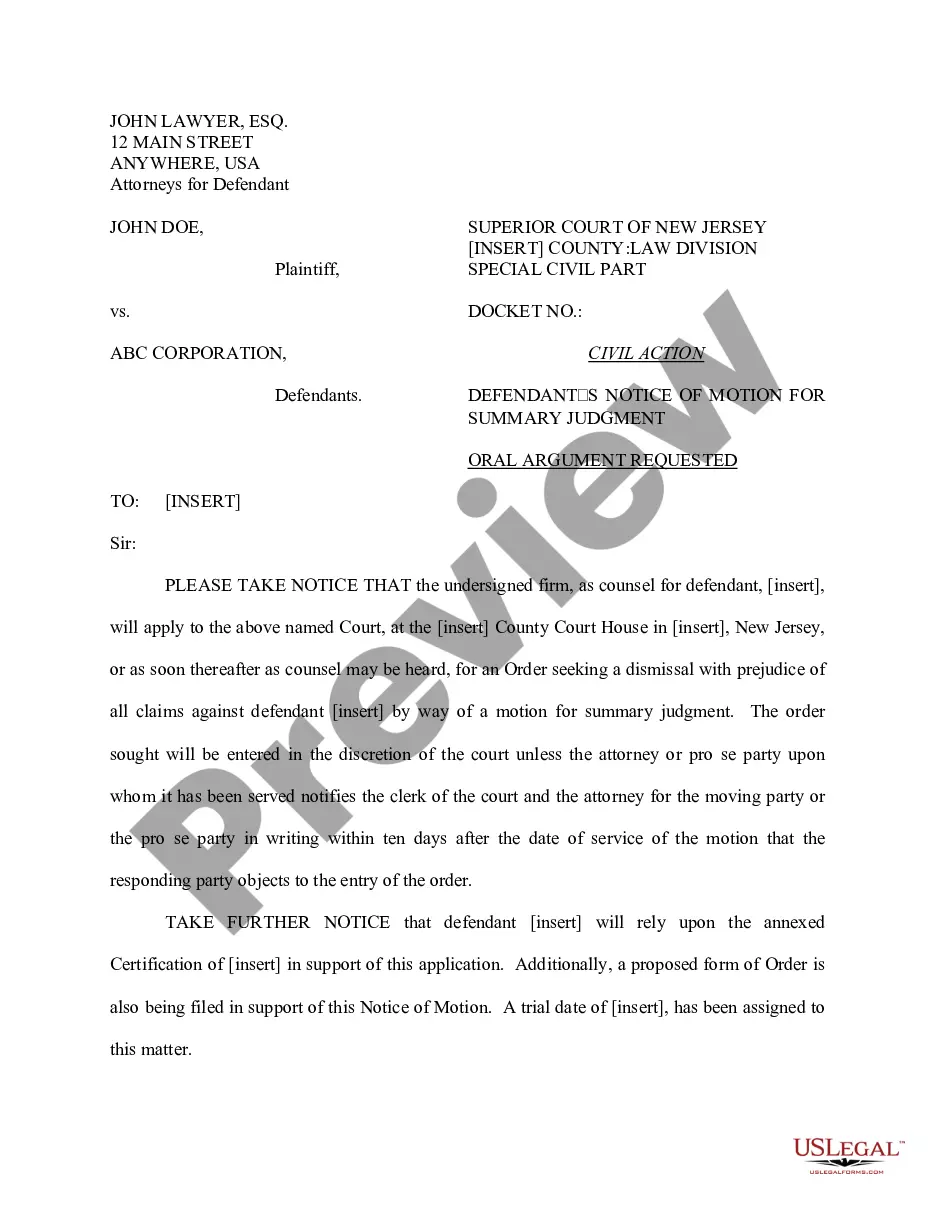
This form should be used when a party to a civil action believes that there are no factual disputes that would warrant a trial. If you seek to have the court dismiss all claims against you or your client, filing this order is a crucial step. It is commonly utilized in cases where the evidence overwhelmingly supports one side, making further legal proceedings unnecessary.
Intended users of this form
This form is primarily intended for:
- Attorneys representing defendants in civil lawsuits.
- Parties seeking to have claims against them dismissed without a trial.
- Legal professionals who need to formalize the dismissal of a case in New Jersey.
Instructions for completing this form
- Fill in the case caption with the names of the plaintiff and defendant.
- Enter the relevant court information, including the county and docket number.
- Specify whether the motion is opposed or unopposed.
- Provide the date and signature of the judge when the order is entered.
- Include details regarding the submission of any counsel fees.
- Ensure that all parties receive a copy of the order once it is filed.
Does this document require notarization?
This form does not typically require notarization unless specified by local law. However, ensure to check specific court requirements or legal guidelines that may apply to your case.
Get your form ready online
Our built-in tools help you complete, sign, share, and store your documents in one place.
Make edits, fill in missing information, and update formatting in US Legal Forms—just like you would in MS Word.
Download a copy, print it, send it by email, or mail it via USPS—whatever works best for your next step.
Sign and collect signatures with our SignNow integration. Send to multiple recipients, set reminders, and more. Go Premium to unlock E-Sign.
If this form requires notarization, complete it online through a secure video call—no need to meet a notary in person or wait for an appointment.
We protect your documents and personal data by following strict security and privacy standards.

Make edits, fill in missing information, and update formatting in US Legal Forms—just like you would in MS Word.

Download a copy, print it, send it by email, or mail it via USPS—whatever works best for your next step.

Sign and collect signatures with our SignNow integration. Send to multiple recipients, set reminders, and more. Go Premium to unlock E-Sign.

If this form requires notarization, complete it online through a secure video call—no need to meet a notary in person or wait for an appointment.

We protect your documents and personal data by following strict security and privacy standards.
Mistakes to watch out for
- Failing to include complete case information, such as the docket number.
- Omitting the judge's signature or not entering the order date.
- Not notifying all parties of the order in a timely manner.
- Confusing the terms "with prejudice" and "without prejudice" regarding claim dismissal.
Advantages of online completion
- Convenient access to a legally validated form without the need for in-person visits.
- Editable templates allow for customization based on specific case details.
- Instant download options facilitate rapid filing with the court.
- Reliable legal guidance ensures compliance with local court rules.
Summary of main points
- The Order Granting Summary Judgment is essential for dismissing claims without a trial in New Jersey.
- It is critical to follow the specific requirements for the form to ensure legal compliance.
- Utilizing online resources for this form streamlines the process of obtaining judicial approval.
Looking for another form?
Form popularity
FAQ
How Is Summary Judgment Granted? Summary judgment is granted when there are no other facts to be tried.Summary judgment is granted when the facts can be decided upon without needing to go to trial, where the opposing party would lose due to a lack of evidence.
Attack the Legal Argument. The first place to look for a weakness in your opponent's motion is at their legal argument. Attack the Evidence. Attack the Separate Statement. Consider Whether Your Opponent's Motion Meets its Burden. Consider Seeking a Continuance to Conduct More Discovery. Conclusion.
A summary judgement occurs when, in a civil case, one party wants to move to a court decision without a trial.When a motion for summary judgement is granted, it indicates there is sufficient evidence to declare one party the clear winner.
What happens during a motion for summary judgment hearing? Once the motion and response has been filed, the judge will read both and then preside over a hearing. At the hearing, each party will be given a certain amount of time to reiterate their argument in front of the judge.
The grant of summary judgment usually results in a final judgment only if the grant resolves all issues as to all parties. An order for summary judgment is interlocutory if it does not entirely end the proceedings before the trial court.
Denial of the motion is not a final judgment; it is not a final decision on the merits."
The key to defeating a motion for summary judgment is to show the court that there are still facts in dispute. Summary judgment is only appropriate if none of the facts are disputed.
If the motion is granted, the judgment on the issue or case is deemed to be a final judgment from which a party may seek an appeal. The court of appeal can reverse the grant of summary judgment and reinstate the claim in the lower court. However, this is rarely done and most summary judgments are upheld on appeal.
Motions filed, the percent of cases with motions granted in whole or in part, and the percent of cases terminated by summary judgment. The percentage of cases with summary judgment motions, averaged across the six courts in the study, has increased from approximately 12% in 1975, to 17% in 1985, to 19% in 1988.