New Jersey Amendment to Living Trust

Overview of this form
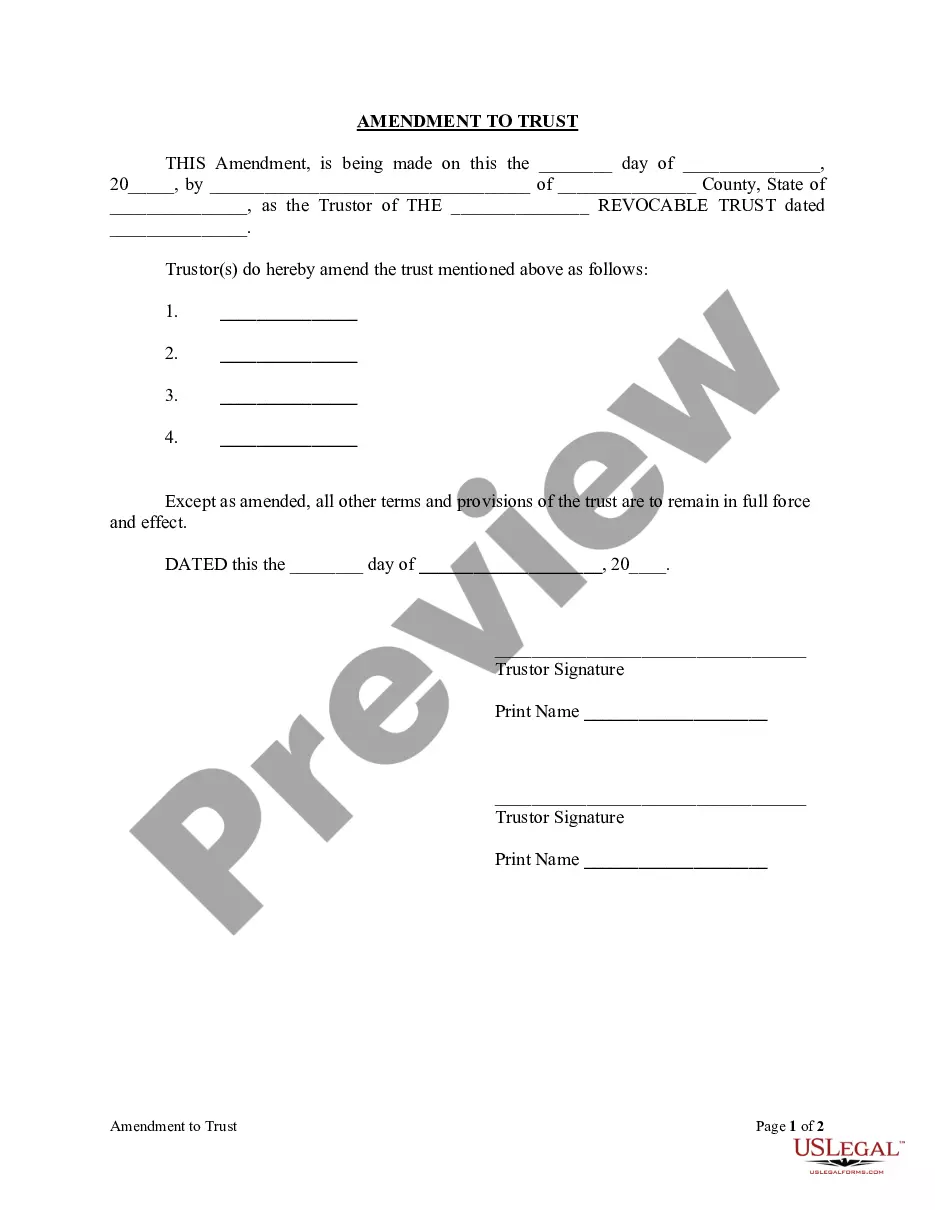
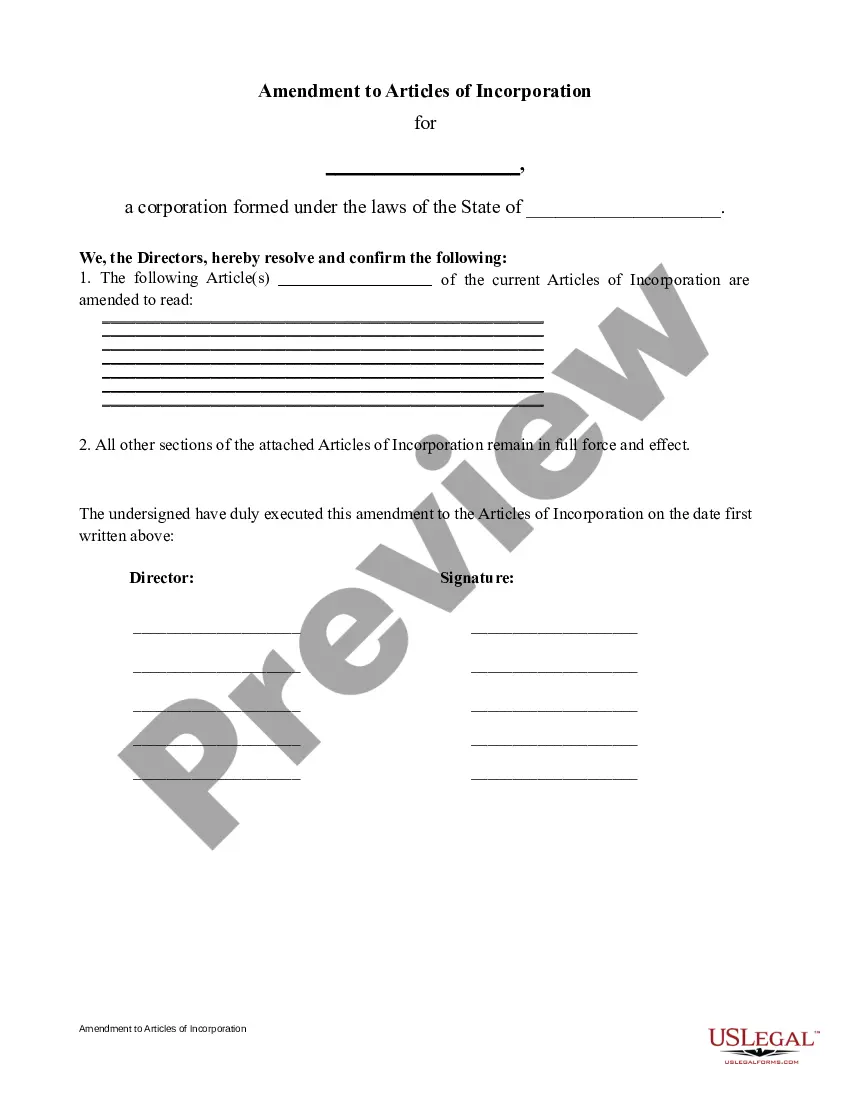
The Amendment to Living Trust is a legal document that allows a Trustor to modify the terms of an existing revocable trust without altering its primary purpose. Unlike creating a new trust, this form efficiently addresses changes such as adding or removing beneficiaries, updating asset allocations, or changing trustee provisions. This ensures that the living trust remains current with the Trustor's wishes while all other terms remain effective.
What’s included in this form
- Identification of the Trustor and the specific living trust being amended.
- Clear outline of the amendments being made to the trust's provisions.
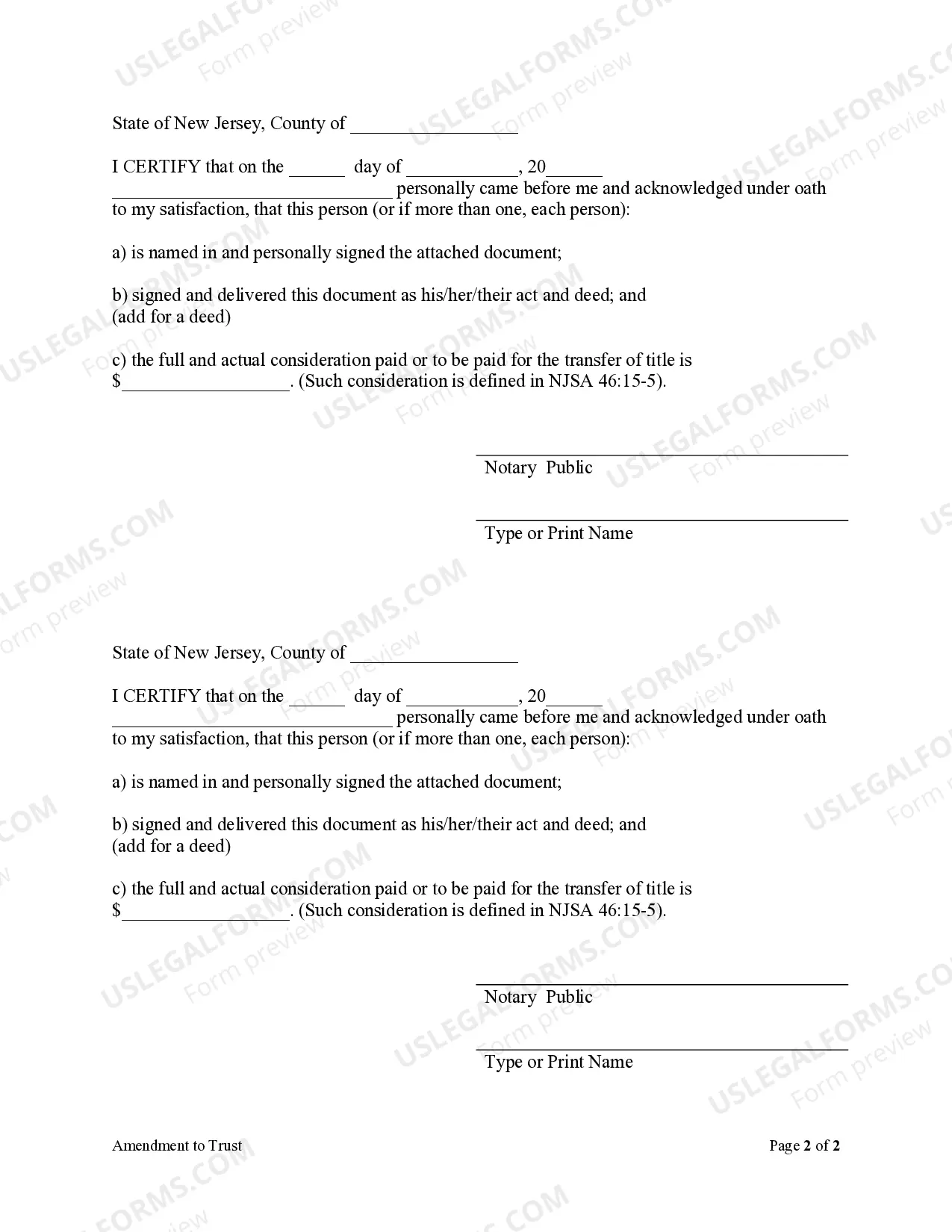
- Verification of the Trustor's signature, which requires notarization.
- A declaration that all other terms of the trust remain unchanged.
- Notary acknowledgment to validate the document legally.



Common use cases
This form is useful when you need to update specific provisions in your living trust. Common scenarios include changing beneficiaries due to life events, modifying asset distributions, or correcting errors in the original trust. If your financial situation changes or your personal circumstances evolve, this amendment form helps maintain alignment with your current intentions.
Who should use this form
- Individuals who have established a living trust and wish to make changes.
- Trustors wanting to adjust beneficiary designations or asset allocations.
- Trustors seeking to clarify or correct terms within the trust document.
Completing this form step by step
- Identify the Trustor and include their details along with the name and date of the original trust.
- Clearly list each amendment being made to the trust, using numbered sections for clarity.
- Ensure both Trustors sign the document in the designated areas.
- Obtain a notary's acknowledgment of the signatures to validate the amendments.
- Keep a copy of the amended trust with your original trust documents for future reference.
Does this document require notarization?
This form must be notarized to be legally valid. US Legal Forms provides secure online notarization powered by Notarize, allowing you to complete the process through a verified video call.
Get your form ready online
Our built-in tools help you complete, sign, share, and store your documents in one place.
Make edits, fill in missing information, and update formatting in US Legal Forms—just like you would in MS Word.
Download a copy, print it, send it by email, or mail it via USPS—whatever works best for your next step.
Sign and collect signatures with our SignNow integration. Send to multiple recipients, set reminders, and more. Go Premium to unlock E-Sign.
If this form requires notarization, complete it online through a secure video call—no need to meet a notary in person or wait for an appointment.
We protect your documents and personal data by following strict security and privacy standards.

Make edits, fill in missing information, and update formatting in US Legal Forms—just like you would in MS Word.

Download a copy, print it, send it by email, or mail it via USPS—whatever works best for your next step.

Sign and collect signatures with our SignNow integration. Send to multiple recipients, set reminders, and more. Go Premium to unlock E-Sign.

If this form requires notarization, complete it online through a secure video call—no need to meet a notary in person or wait for an appointment.

We protect your documents and personal data by following strict security and privacy standards.
Common mistakes
- Failing to specify all amendments clearly can lead to confusion later.
- Not obtaining notarization, which may invalidate the amendment.
- Overlooking the need for all Trustors to sign if there are multiple Trustors.
Advantages of online completion
- Convenient access to the form from anywhere at any time.
- Easily editable to reflect your specific needs without legal jargon.
- Reliable templates drafted by licensed attorneys to ensure compliance with legal standards.
Key takeaways
- The Amendment to Living Trust allows for targeted modifications to an existing trust.
- Use this form to keep your estate plan current and reflective of your wishes.
- Ensure all parties sign and the form is notarized to maintain its validity.
- Review state-specific requirements to comply with local laws.
Looking for another form?

Form popularity
FAQ
Just about any writing will suffice to make a valid Trust amendment. Having the writing typed is not legally required. That's really the point of Trust amendments, to allow a Settlor to express his or her intent as easily as possible. As long as the Trust terms are followed, any writing will do.
An amendment to a trust is not required to be notarized or witnessed unless the terms of the original trust require it.
A court can, when given reasons for a good cause, amend the terms of irrevocable trust when a trustee and/or a beneficiary petitions the court for a modification.Such modification provisions are common with charitable trusts, to allow modifications when federal tax law changes.
You can change your living trust, usually without incurring lawyer bills.Because you and your spouse made the trust together, you should both sign the amendment, and when you sign it, get your signatures notarized, just like the original. Another way to go is to create a "restatement" of your trust.
The trust deed lists the trustees. Therefore, to change an individual trustee, you need to amend the trust deed. Most trust deeds permit a change of trustee by way of a trustee resolution and entry into a deed of variation.A change of trustee will usually require the consent of the appointor of the trust.
Locate the original trust. The grantor must locate the original trust documents and identify the specific provisions that require amendment. Prepare an amendment form. Get the amendment form notarized. Attach amendment form to original trust.
You can change your living trust, usually without incurring lawyer bills.Because you and your spouse made the trust together, you should both sign the amendment, and when you sign it, get your signatures notarized, just like the original. Another way to go is to create a "restatement" of your trust.
Revoking or amending a revocable living trust can be done with or without an attorney. You can amend a living trust without having to go to court. There are a few ways to do this. You can do it yourself, using living trust forms you find online, you can use an online service, or you can use an attorney.