New Hampshire Aeseptic Techniques
Description
Get your form ready online
Our built-in tools help you complete, sign, share, and store your documents in one place.
Make edits, fill in missing information, and update formatting in US Legal Forms—just like you would in MS Word.
Download a copy, print it, send it by email, or mail it via USPS—whatever works best for your next step.
Sign and collect signatures with our SignNow integration. Send to multiple recipients, set reminders, and more. Go Premium to unlock E-Sign.
If this form requires notarization, complete it online through a secure video call—no need to meet a notary in person or wait for an appointment.
We protect your documents and personal data by following strict security and privacy standards.

Make edits, fill in missing information, and update formatting in US Legal Forms—just like you would in MS Word.

Download a copy, print it, send it by email, or mail it via USPS—whatever works best for your next step.

Sign and collect signatures with our SignNow integration. Send to multiple recipients, set reminders, and more. Go Premium to unlock E-Sign.

If this form requires notarization, complete it online through a secure video call—no need to meet a notary in person or wait for an appointment.

We protect your documents and personal data by following strict security and privacy standards.
Looking for another form?


How to fill out Aeseptic Techniques?
Are you in a scenario where you require paperwork for either business or personal matters almost all the time.
There are numerous legal document templates accessible online, but locating ones you can rely on is challenging.
US Legal Forms offers a wide array of form templates, including the New Hampshire Aseptic Techniques, that are designed to comply with state and federal requirements.
Choose a convenient paper format and download your copy.
View all the document templates you have purchased in the My documents section. You can easily obtain another copy of New Hampshire Aseptic Techniques whenever necessary. Just choose the required form to download or print the document template.
- If you are already familiar with the US Legal Forms website and have an account, just Log In.
- From there, you can download the New Hampshire Aseptic Techniques template.
- If you do not have an account and wish to start using US Legal Forms, follow these steps.
- Locate the form you need and confirm it is for the correct city/county.
- Utilize the Review button to preview the document.
- Check the details to ensure you have selected the correct form.
- If the document is not what you are looking for, use the Search field to find the form that suits your requirements.
- Once you find the right template, click Purchase now.
- Select the pricing plan you desire, complete the required information to set up your account, and finalize the payment using your PayPal or credit card.
Form popularity
FAQ
Examples of surgical aseptic technique include the use of sterile drapes, gloves, and instruments during operations. These practices are essential to prevent infections and ensure patient safety. By implementing New Hampshire Aseptic Techniques, healthcare providers can effectively uphold high standards in surgical settings. Resources available on platforms like USLegalForms can assist in learning these techniques comprehensively.
There are three types of aseptic technique:Sterile a technique that aims to achieve total absence of microorganisms.Standard a technique that utilises a general aseptic field, critical micro aseptic fields, hand hygiene, non touch technique and non sterile gloves to achieve a safe level of asepsis for:13 July 2019
Healthcare professionals use aseptic technique when they are:performing surgical procedures.performing biopsies.dressing surgical wounds or burns.suturing wounds.inserting a urinary catheter, wound drain, intravenous line, or chest tube.administering injections.using instruments to conduct a vaginal examination.More items...?
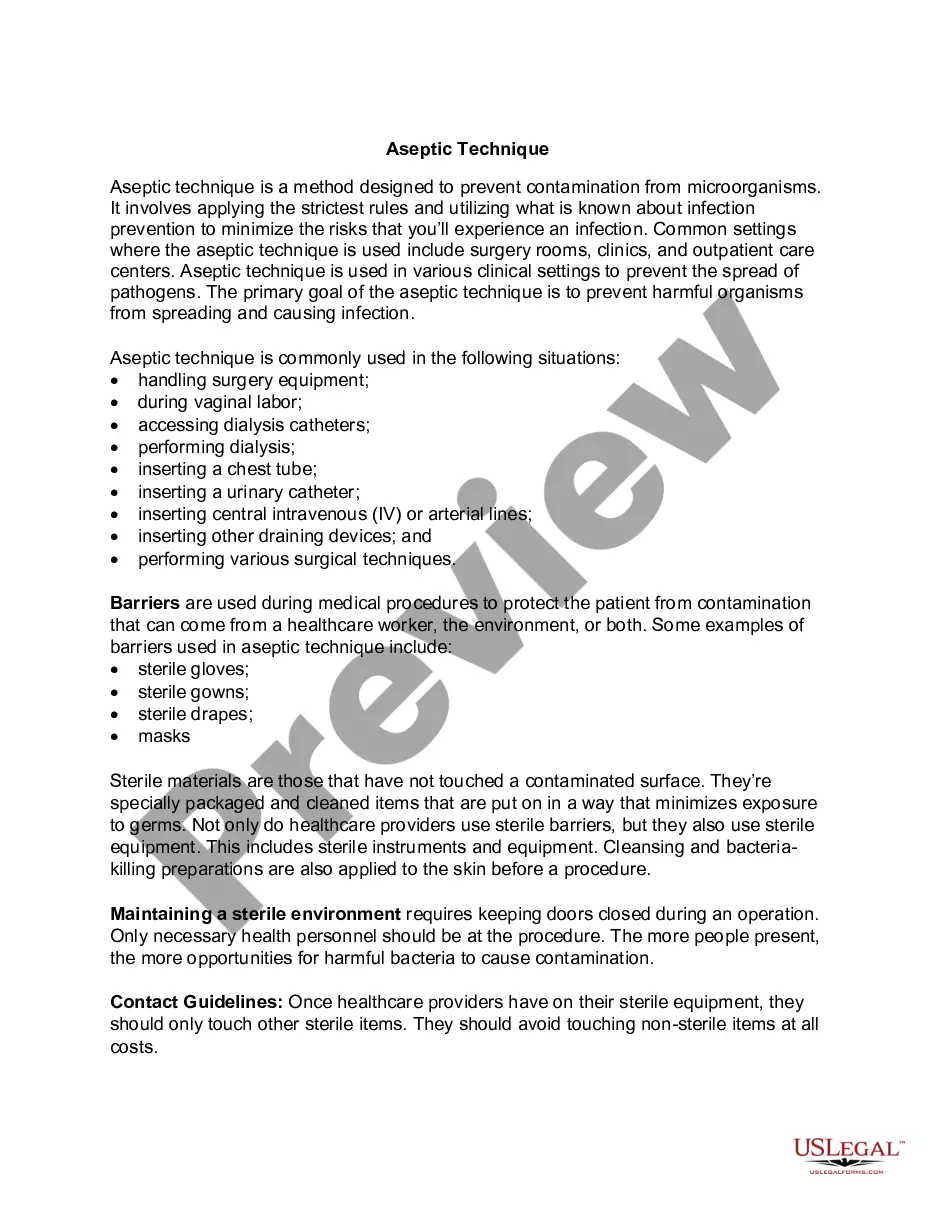
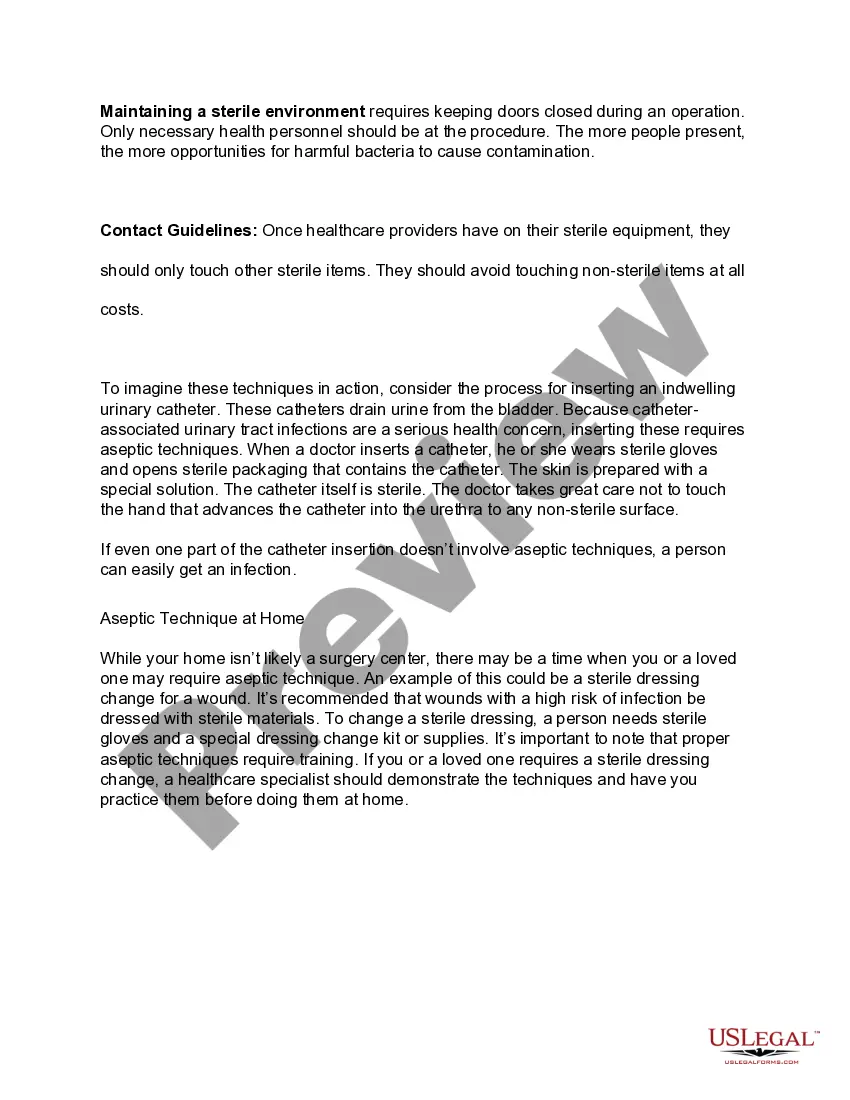
According to The Joint Commission, there are four chief aspects of the aseptic technique: barriers, patient equipment and preparation, environmental controls, and contact guidelines. Each plays an important role in infection prevention during a medical procedure.
These principles include the following: (1) use only sterile items within a sterile field; (2) sterile (scrubbed) personnel are gowned and gloved; (3) sterile personnel operate within a sterile field (sterile personnel touch only sterile items or areas, unsterile personnel touch only unsterile items or areas); (4)
Aseptic technique is classified into two different categories: standard aseptic technique and surgical aseptic technique.
Aseptic techniques include:Wiping bench with disinfectant/alcohol. Not growing microorganisms at body temperature. Using sterile loops when transferring cultures . Flaming culture bottle necks to prevent contamination. Sterilising (using an autoclave ) or disposing of all used equipment.
Procedures that involve aseptic technique include:200cInserting PICC lines.200cPerforming dialysis.200cInserting catheters.200cRunning IVs.200cInserting chest tubes.200cPerforming surgeries.200cDressing wounds.