New Hampshire Qualified Income Miller Trust

State:
Multi-State
Category:
Control #:
US-02035BG
Format:
Word; 
Rich Text
624 downloads

Description

A trustor is the person who creates a trust. A trustor is also called a grantor, donor or settlor. A trust is a separate legal entity that holds property or assets of some kind for the benefit of a specific person, group of people or organization known as the beneficiary/beneficiaries. When a trust is established, an individual or corporate entity is named to oversee or manage the assets in the trust. This individual or entity is called a trustee. A trustee can be a professional with financial knowledge, a relative or loyal friend or a corporation. More than one trustee can be named by the trustor.


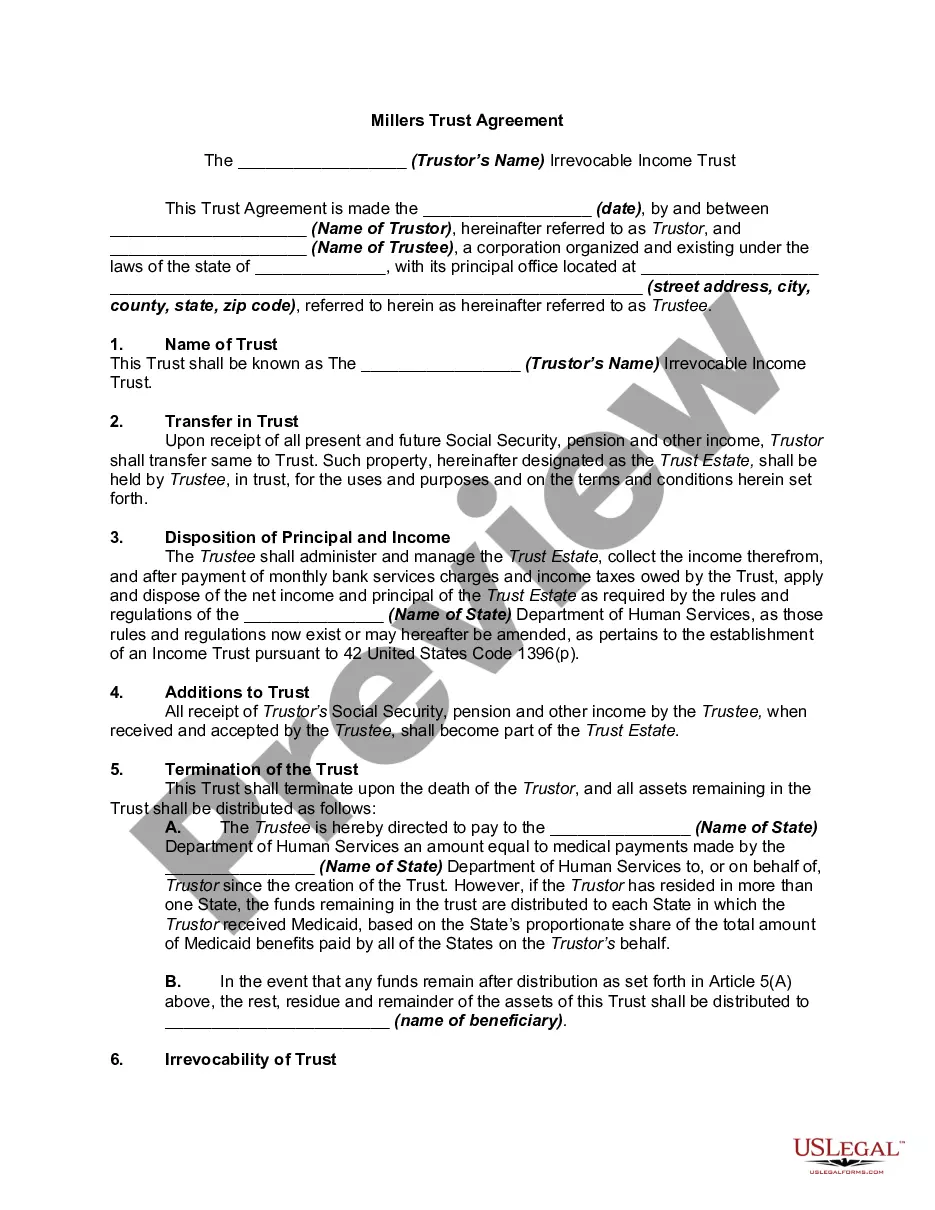
The qualified Medicaid income trust is a legal instrument which meets criteria in 42 United States Code 1396(p) and which allows individuals with income over the institutional care program limits to qualify for institutional care services or for home and community based services assistance.


A Medicaid trust may take various forms and laws vary by state. There are differing requirements under state laws regarding what assets may be counted or reached for recovery upon death. To comply with applicable requirements, professional financial advice should be sought. The term "Miller Trust" is an informal name. A more accurate name for this trust is an "Income Cap Trust". It has also been called an Income Assignment Trust. This is because, after the trust is created, the patient assigns his or her right to receive social security and pension to the trust.
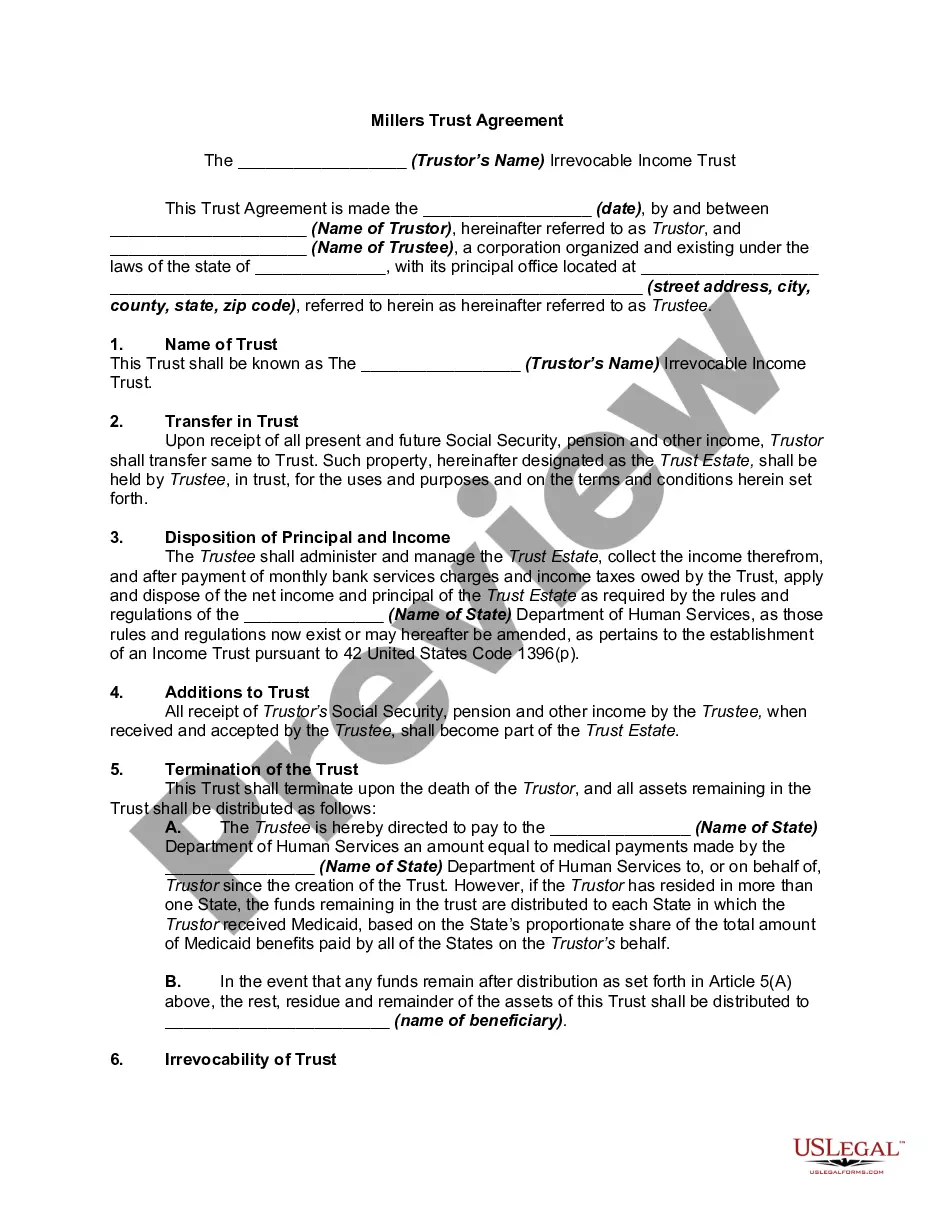
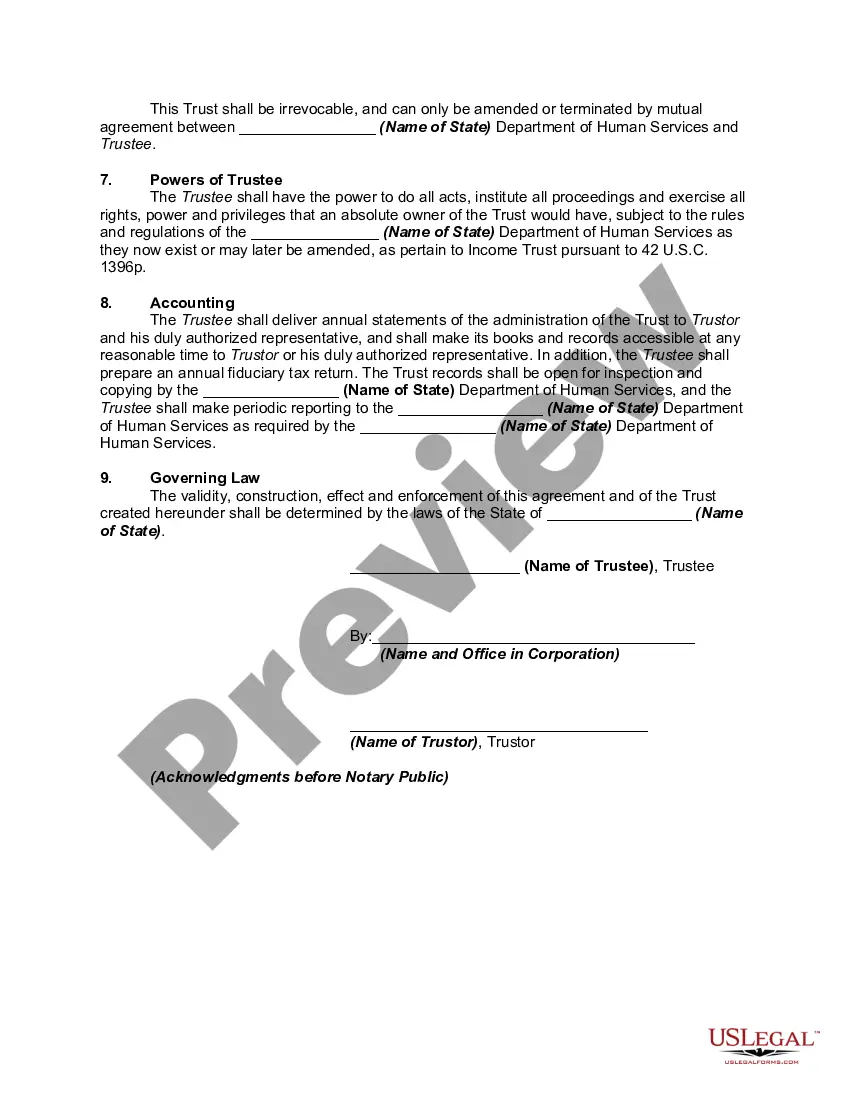
Free preview
  • Preview Qualified Income Miller Trust
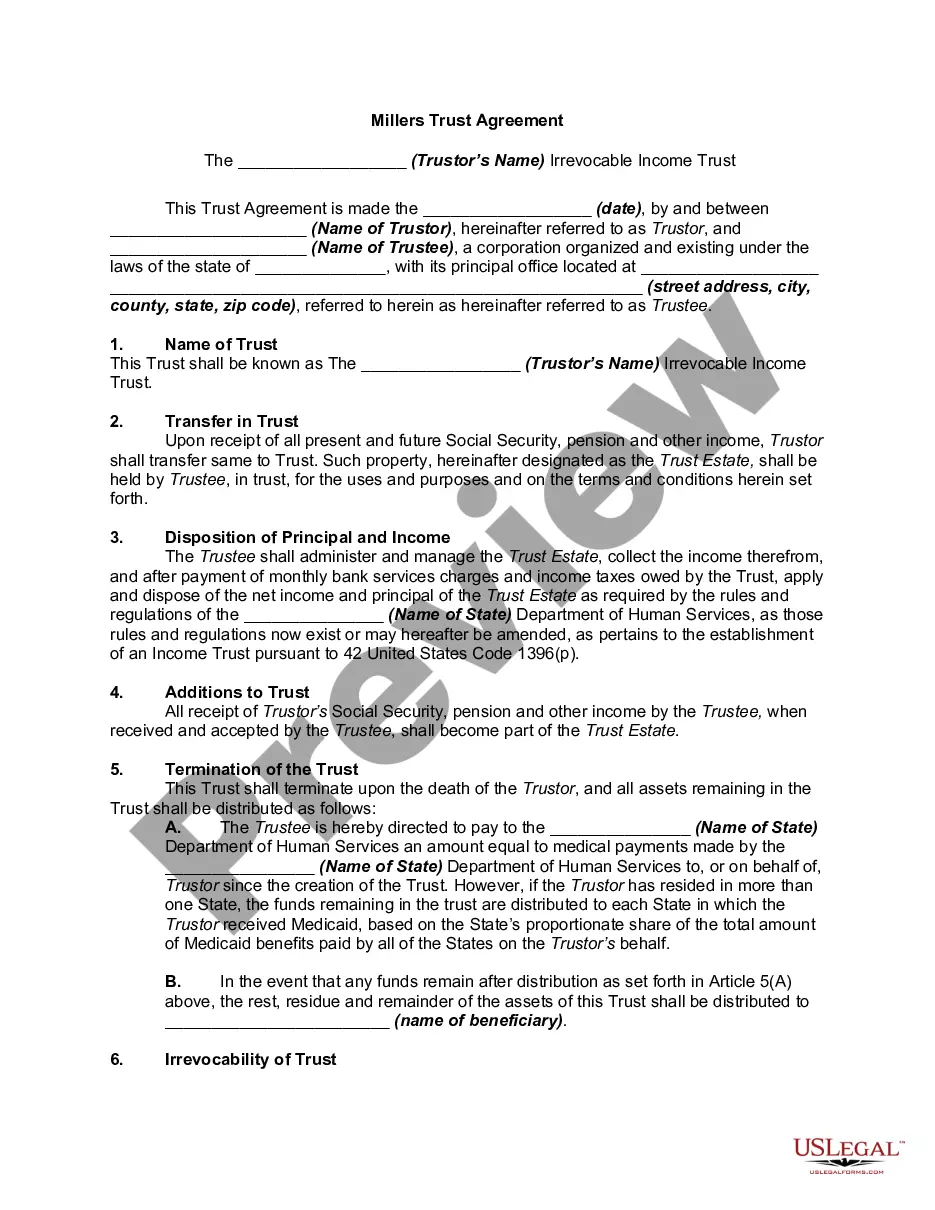
  • Preview Qualified Income Miller Trust

Get your form ready online

Our built-in tools help you complete, sign, share, and store your documents in one place.

Built-in online Word editor

Make edits, fill in missing information, and update formatting in US Legal Forms—just like you would in MS Word.

Export easily

Download a copy, print it, send it by email, or mail it via USPS—whatever works best for your next step.

E-sign your document

Sign and collect signatures with our SignNow integration. Send to multiple recipients, set reminders, and more. Go Premium to unlock E-Sign.

Notarize online 24/7

If this form requires notarization, complete it online through a secure video call—no need to meet a notary in person or wait for an appointment.

Store your document securely

We protect your documents and personal data by following strict security and privacy standards.

Form selector

Make edits, fill in missing information, and update formatting in US Legal Forms—just like you would in MS Word.

Form selector

Download a copy, print it, send it by email, or mail it via USPS—whatever works best for your next step.

Form selector

Sign and collect signatures with our SignNow integration. Send to multiple recipients, set reminders, and more. Go Premium to unlock E-Sign.

Form selector

If this form requires notarization, complete it online through a secure video call—no need to meet a notary in person or wait for an appointment.

Form selector

We protect your documents and personal data by following strict security and privacy standards.

Looking for another form?

This field is required
Ohio
Select state

How to fill out Qualified Income Miller Trust?

Are you presently in a situation where you require documentation for both corporate or personal reasons on a regular basis.

There is a multitude of legal document templates available online, but finding ones you can rely on is not straightforward.

US Legal Forms provides thousands of template forms, including the New Hampshire Qualified Income Miller Trust, which can be generated to comply with state and federal regulations.

Select a suitable document format and download your version.

Access all the document templates you have purchased in the My documents section. You can retrieve an additional version of the New Hampshire Qualified Income Miller Trust anytime, if necessary. Click on the desired form to download or print the template.

  1. If you are familiar with the US Legal Forms website and have an account, simply sign in.
  2. Afterward, you can download the New Hampshire Qualified Income Miller Trust template.
  3. If you do not have an account and want to start using US Legal Forms, follow these instructions.
  4. Find the form you need and ensure it corresponds to the correct city/area.
  5. Use the Preview feature to review the form.
  6. Check the description to ensure you have selected the correct form.
  7. If the form is not what you are looking for, utilize the Search bar to find the form that meets your needs and requirements.
  8. Once you locate the appropriate form, click Get now.
  9. Choose the pricing plan you want, provide the required information to create your account, and pay for the transaction using your PayPal or credit card.

Form popularity

FAQ

Generally, a revocable trust becomes irrevocable upon the death of the grantor, which can change its filing requirements. After the grantor's death, the trust may need to file a tax return if it generates income. It's wise to consider the implications on the taxes of any New Hampshire Qualified Income Miller Trust involved. Consulting with professionals through platforms like US Legal Forms can provide clarity and assist with compliance after such significant life events.

If your trust has no income for the tax year, you generally do not need to file IRS Form 1041. However, there are exceptions based on specific circumstances. For instance, if the trust is a New Hampshire Qualified Income Miller Trust, consult a tax professional for tailored advice. It's important to ensure compliance with all tax regulations, even if your trust appears inactive or income-less.

Yes, a Miller trust, also known as a New Hampshire Qualified Income Miller Trust, is required to file a tax return if it generates income. This obligation exists because the trust acts as a separate tax entity. If the Miller trust does not earn income, you may not need to file a return, but confirming this with a tax advisor is always a sound approach. Using the US Legal Forms platform can help guide you through the tax requirements of your trust.

Whether your trust needs to file a tax return mainly depends on its type. If your trust generates income, it typically must file a return regardless of whether it is a New Hampshire Qualified Income Miller Trust. However, if your trust does not produce any income, the filing requirements may differ. It’s advisable to consult with a tax professional to get specific guidance on your trust's obligations.

In New Hampshire, the highest income level to qualify for Medicaid varies depending on the program you're applying for. Typically, for individuals, the income limit is set around 138% of the federal poverty level. If your income exceeds this threshold, a New Hampshire Qualified Income Miller Trust can help you qualify by redirecting excess funds to the trust. This ensures you can access vital medical services while remaining eligible for Medicaid.

To set up a qualified income trust, begin by developing a plan that details your income sources and beneficiaries. Then, create the trust document, ensuring it meets New Hampshire's legal requirements for a Qualified Income Miller Trust. Once you've funded the trust, consider using a service like USLegalForms to handle the paperwork efficiently and ensure you meet all legal obligations. This can make the process easier and give you peace of mind.

Setting up a New Hampshire Qualified Income Trust involves several clear steps. First, you need to draft the trust document, outlining the trust's purpose and terms. Then, you must fund the trust by transferring the necessary income resources into it. It’s advisable to ensure compliance with state regulations, and using a reputable platform like USLegalForms can provide the necessary resources and templates for a smooth setup.

In New Hampshire, income generated by a trust is generally not taxed at the state level. However, it's important to understand that Federal tax obligations still apply to the New Hampshire Qualified Income Miller Trust. This means that while you may avoid state taxes, you must adhere to the IRS guidelines for reporting trust income. Consulting with a tax professional can provide clarity on how this may affect your individual financial situation.

You do not necessarily need a lawyer to set up a New Hampshire Qualified Income Miller Trust, but having one can simplify the process. A qualified attorney can guide you through the legal requirements and help ensure that your trust meets all necessary regulations. This is especially important if you have specific assets or complex situations to consider. Engaging a professional can ultimately save you time and reduce potential mistakes.

A significant disadvantage of a Medicaid trust, such as a New Hampshire Qualified Income Miller Trust, is the restriction on how funds can be used. Once set up, the funds can only serve specific purposes, impacting flexibility in managing finances. Additionally, there are costs associated with establishing and maintaining these trusts. Understanding these limitations upfront can help you make informed decisions about your Medicaid planning.

Trusted and secure by over 3 million people of the world’s leading companies

New Hampshire Qualified Income Miller Trust