New Hampshire Important Mediation Information
What is this form?
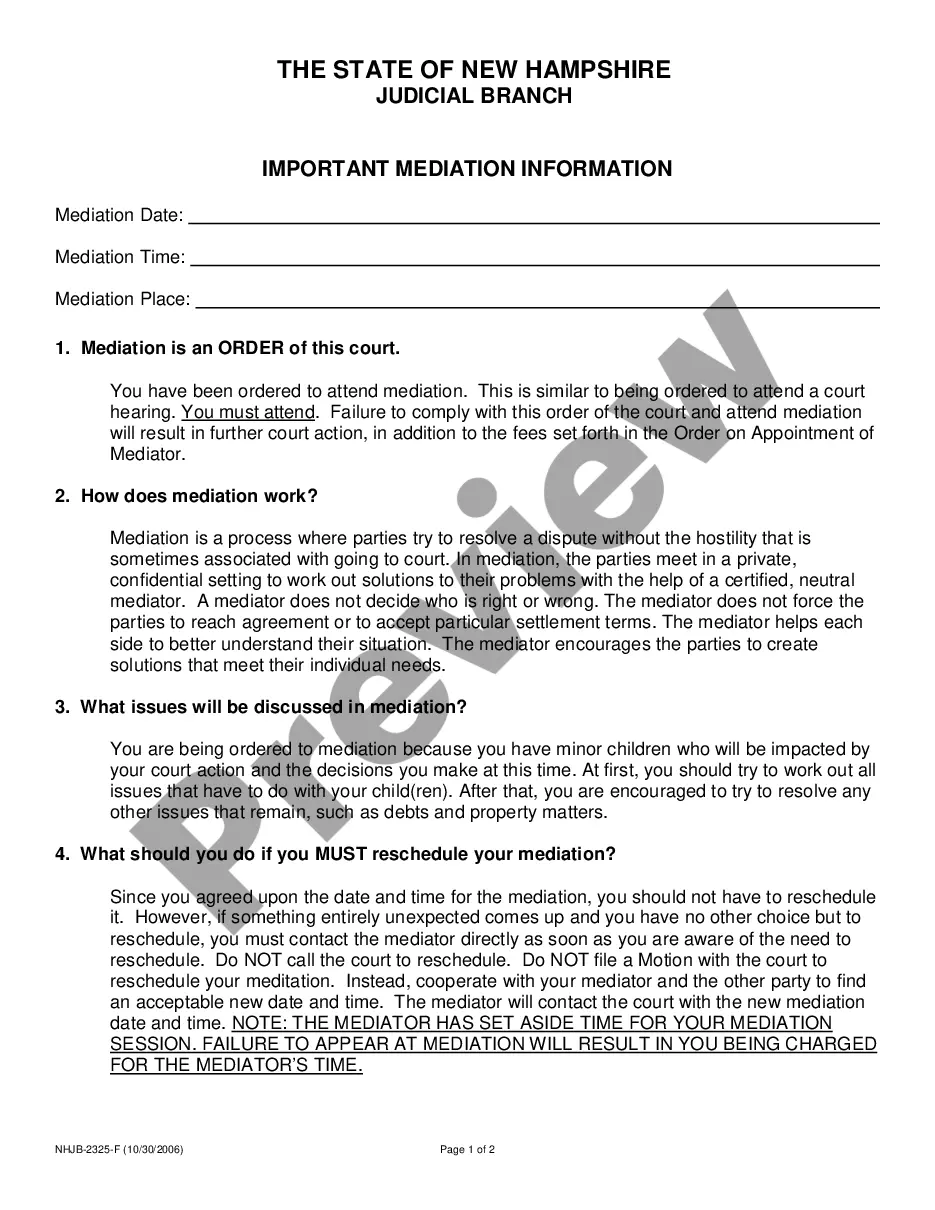
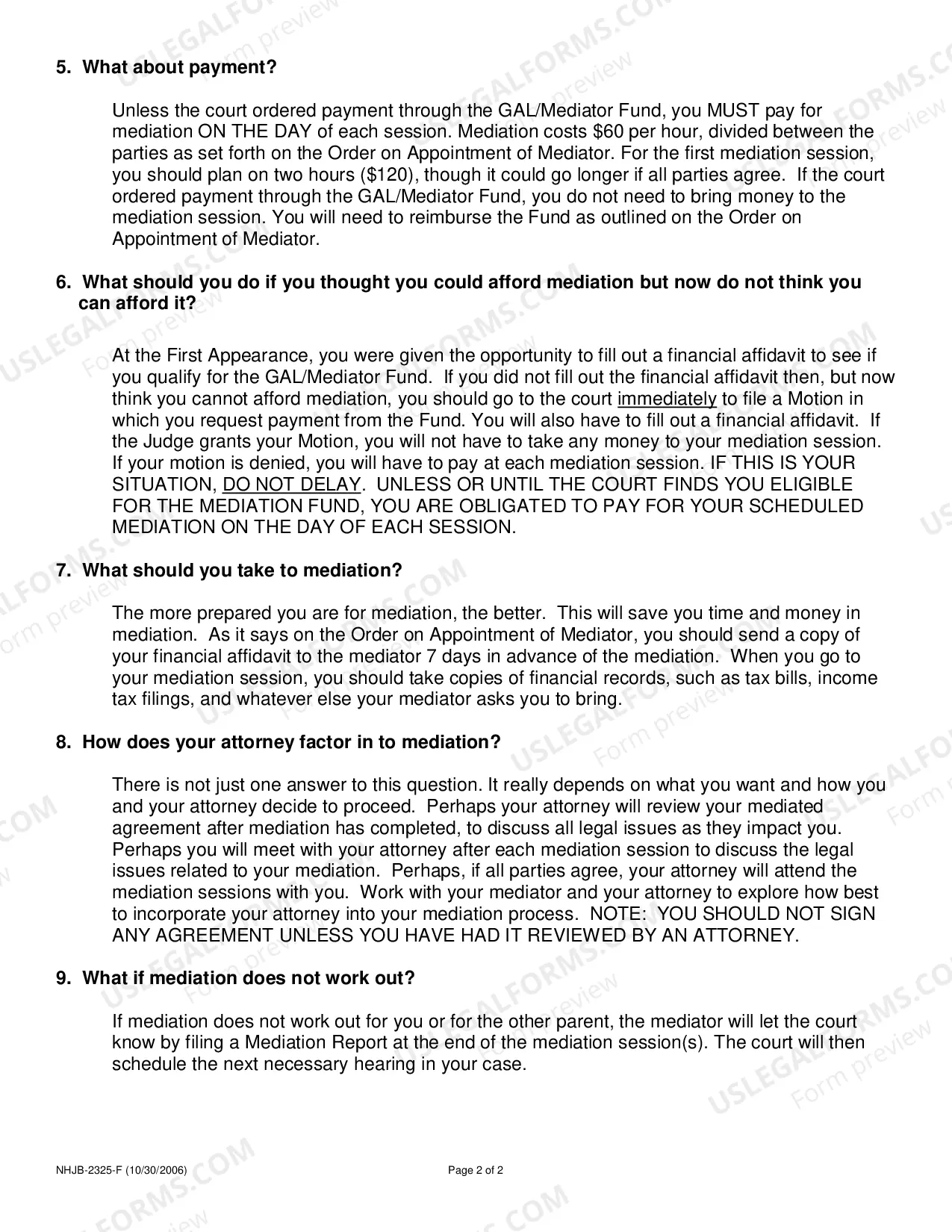
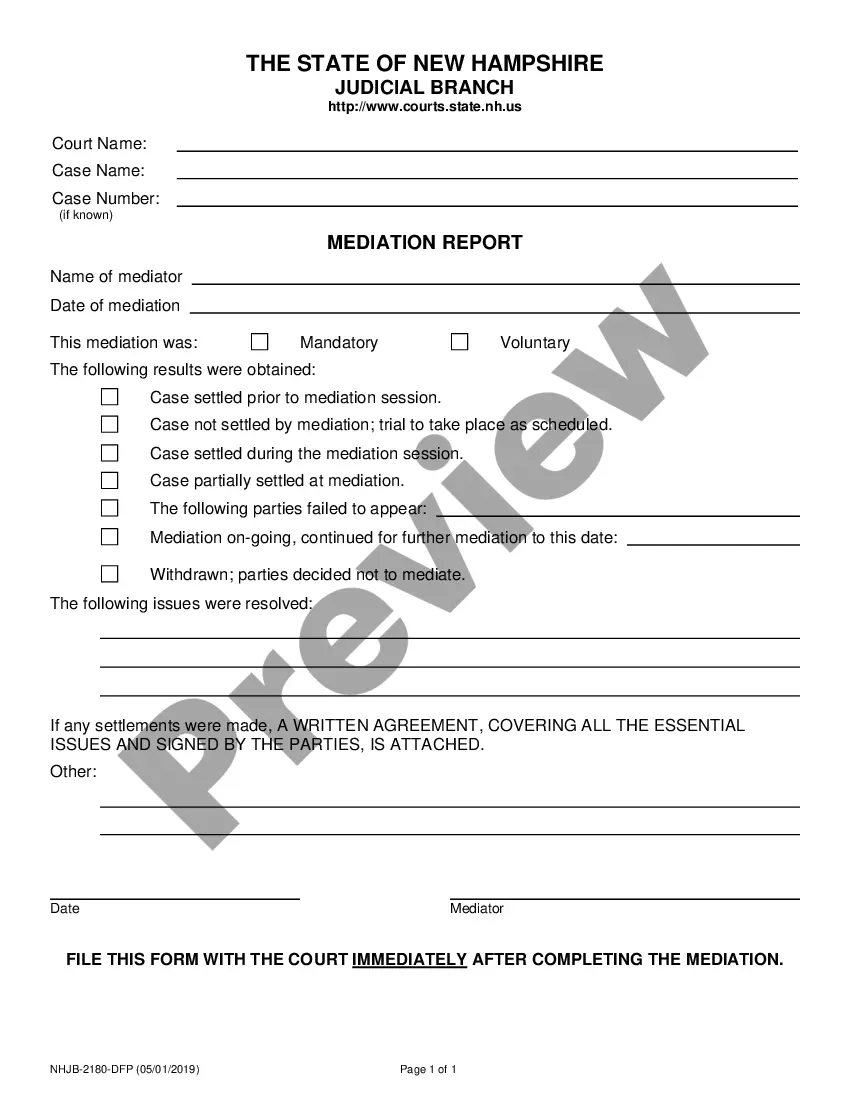
The Important Mediation Information form provides critical details regarding court-ordered mediation in New Hampshire. This official document outlines what to expect, including the mediation process, payment obligations, and necessary preparations. Unlike generic mediation forms, this one complies with New Hampshire laws and is tailored to the state's legal requirements for families involved in court actions, especially those concerning minor children.
Form components explained
- Mediation date, time, and place information
- Instructions on the mandatory nature of mediation attendance
- Overview of the mediation process and mediator's role
- Guidelines for discussing child-related issues and other disputes
- Payment details and responsibilities for mediation fees
- Recommendations on preparation for the mediation session
Common use cases
This form should be used when a court orders mediation in family law cases involving disputes about children, property, or debt. It is essential to refer to this form to understand the obligations and procedures you must follow to ensure a smooth mediation process.
Who this form is for
- Individuals involved in family law disputes in New Hampshire
- Parents seeking resolution regarding child custody or support matters
- Parties who have been ordered by the court to attend mediation
- Anyone needing clarity on preparing for mediation sessions
How to prepare this document
- Fill in the mediation date, time, and location as provided by the court.
- Review the instructions and guidelines on mediation participation and responsibilities.
- Prepare necessary documents, including your financial affidavit, to share with the mediator.
- Contact the mediator directly if you need to reschedule and confirm the new arrangements.
- Bring payment for the mediation session, if applicable, or ensure you have the required documentation for the GAL/Mediator Fund.
Does this document require notarization?
This form does not typically require notarization to be legally valid. However, some jurisdictions or document types may still require it. US Legal Forms provides secure online notarization powered by Notarize, available 24/7 for added convenience.
Get your form ready online
Our built-in tools help you complete, sign, share, and store your documents in one place.
Make edits, fill in missing information, and update formatting in US Legal Forms—just like you would in MS Word.
Download a copy, print it, send it by email, or mail it via USPS—whatever works best for your next step.
Sign and collect signatures with our SignNow integration. Send to multiple recipients, set reminders, and more. Go Premium to unlock E-Sign.
If this form requires notarization, complete it online through a secure video call—no need to meet a notary in person or wait for an appointment.
We protect your documents and personal data by following strict security and privacy standards.

Make edits, fill in missing information, and update formatting in US Legal Forms—just like you would in MS Word.

Download a copy, print it, send it by email, or mail it via USPS—whatever works best for your next step.

Sign and collect signatures with our SignNow integration. Send to multiple recipients, set reminders, and more. Go Premium to unlock E-Sign.

If this form requires notarization, complete it online through a secure video call—no need to meet a notary in person or wait for an appointment.

We protect your documents and personal data by following strict security and privacy standards.
Typical mistakes to avoid
- Not attending the mediation session as ordered by the court.
- Failing to prepare necessary financial documents ahead of time.
- Assuming mediation is optional when it is mandated by the court.
- Trying to reschedule through the court instead of contacting the mediator directly.
Why use this form online
- Immediate access to the most current version of the form, updated with New Hampshire legal requirements.
- Easy to download and print, ensuring you have the necessary documents on hand.
- Convenient format allows for easy completion and submission.
- Reliability in using consistently formatted and legally compliant forms.
What to keep in mind
- The Important Mediation Information form is required for court-ordered mediation in New Hampshire.
- Understanding the mediation process is crucial for successfully resolving disputes.
- Preparation is keyâbringing the right documents can facilitate the mediation process.
- Payment for mediation needs to be handled according to specific guidelines outlined in the form.
Looking for another form?


Form popularity
FAQ
Do I feel comfortable with this mediator? Do I feel like this mediator has integrity? Do I feel like this mediator will be fair and balanced and maintain integrity in the process?
There are essentially 5 steps to a successful mediation. They are comprised of the introduction; statement of the problem; information gathering; identification of the problems; bargaining; and finally, settlement.
Don't rule out all opening statements because you have had bad experiences with them before. Think about whether there is anything either side could say that would be productive. Avoid saying alienating things, and say difficult things in the least alienating way possible.
A disadvantage to mediation is that the parties may not be able to come together on an agreement and will end up in court anyway. Arbitration is a more formal process for resolving disputes. Arbitration often follows formal rules of procedure and the arbitrator may have legal training that a mediator does not.
Decide When to Mediate. Learn About Your Mediator. Analyze Your Case Early and Often. Prepare an Effective and Persuasive Mediation Statement. Consider a Conference Call with the Mediator before the Mediation. Decide Who Will Attend and Who Will Speak at the Mediation. Master Mediation Etiquette.
The principle of confidentiality. The principle of impartiality of the mediator. The principle of voluntariness. The principle of procedural economy. The principle of effectiveness and the principle of co-creation of the process. The principle of the independence of the mediator. The principle of competence of the mediators.
Mediation sessions usually begin with the introduction of the mediator to the two parties.The mediator will then explain the role of the mediator -- to be an impartial facilitator, not an advocate or judge of either party, and to assist the parties in arriving at their own solutions.
Planning. Before the mediation process begins, the mediator helps the parties decide where they should meet and who should be present. Mediator's introduction. Opening remarks. Joint discussion. Caucuses. Negotiation.
Planning. Mediator's introduction. Opening remarks. Joint discussion. Caucuses. Negotiation. What do you think is most valuable to the mediation process?