New Hampshire Acknowlegment for Attorneys
What this document covers
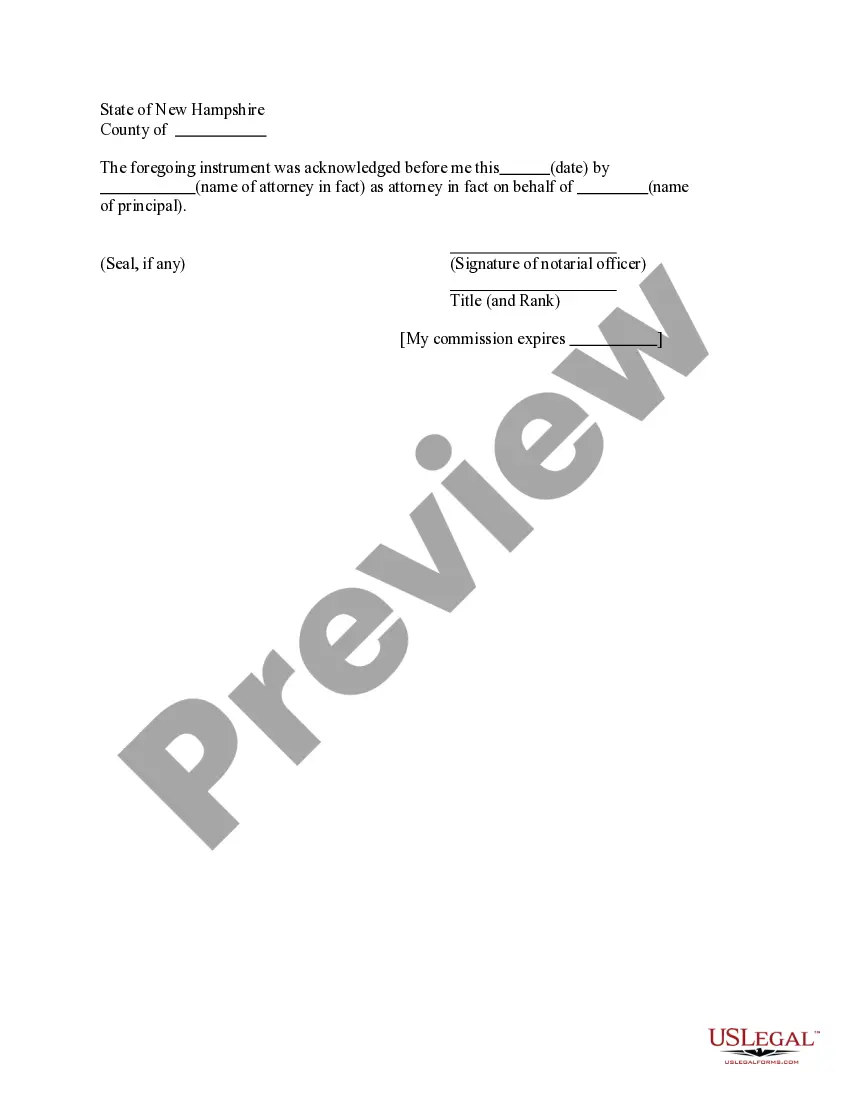
The Acknowledgment for Attorneys is a legal form used to confirm the acknowledgement of an act or signature by an attorney in fact on behalf of a principal. This form serves to authenticate that the attorney has the authority to act on behalf of the principal and provides an official record of the transaction. It is important because it functions differently from other forms of acknowledgment by explicitly involving an attorney in fact, thereby ensuring clarity in legal representation and authority.
Key components of this form
- Date of acknowledgment
- Name of the attorney in fact
- Name of the principal
- Signature of the notarial officer
- Seal if applicable
- Title and rank of the notarial officer
- Expiration date of the commission

When to use this form
This form is needed when an attorney in fact needs to document their authority to act on behalf of a principal in legal matters. It is particularly useful in situations where a legal document must be signed or acknowledged, such as in property transactions, financial arrangements, or legal declarations. Using this form helps prevent disputes regarding the authority of the attorney in fact.
Who can use this document
- Individuals granting authority to an attorney in fact
- Attorneys acting on behalf of principals
- Notarial officers who require proof of authority
- Parties involved in legal transactions necessitating formal acknowledgment
Instructions for completing this form
- Identify the date of the acknowledgment.
- Enter the name of the attorney in fact.
- Specify the name of the principal.
- Include the signature of the notarial officer.
- Attach a seal if required.
- Provide the title and rank of the notarizing officer along with the expiration of their commission.
Does this form need to be notarized?
Yes, this form must be notarized to be legally valid. The notarization confirms the identity of the individuals involved and authenticates the document, providing an official seal that verifies its legitimacy. US Legal Forms offers integrated online notarization services, allowing you to complete the process securely via video call, without the need for travel.
Get your form ready online
Our built-in tools help you complete, sign, share, and store your documents in one place.
Make edits, fill in missing information, and update formatting in US Legal Forms—just like you would in MS Word.
Download a copy, print it, send it by email, or mail it via USPS—whatever works best for your next step.
Sign and collect signatures with our SignNow integration. Send to multiple recipients, set reminders, and more. Go Premium to unlock E-Sign.
If this form requires notarization, complete it online through a secure video call—no need to meet a notary in person or wait for an appointment.
We protect your documents and personal data by following strict security and privacy standards.

Make edits, fill in missing information, and update formatting in US Legal Forms—just like you would in MS Word.

Download a copy, print it, send it by email, or mail it via USPS—whatever works best for your next step.

Sign and collect signatures with our SignNow integration. Send to multiple recipients, set reminders, and more. Go Premium to unlock E-Sign.

If this form requires notarization, complete it online through a secure video call—no need to meet a notary in person or wait for an appointment.

We protect your documents and personal data by following strict security and privacy standards.
Common mistakes
- Failing to accurately identify the principal or attorney in fact.
- Neglecting to include the date of acknowledgment.
- Omitting the notarial officerâs signature or seal.
- Incorrectly stating the expiration of the notarial officerâs commission.
Benefits of using this form online
- Convenient: Downloadable and easy to use from anywhere.
- Editable: Allows customization to fit specific circumstances.
- Reliable: Drafted by licensed attorneys, ensuring legal compliance.
- Accessible: Available 24/7, making it easy to complete when needed.
Legal use & context
- This form provides legal proof of authority, which can be crucial in disputes.
- It ensures that the actions taken by the attorney in fact are recognized legally.
- Failure to use this form may result in challenges to the validity of actions taken by the attorney.
Summary of main points
- The Acknowledgment for Attorneys is essential for validating actions taken by an attorney in fact.
- Accurate completion is critical to avoid legal disputes.
- Notarization is required for the form to be recognized legally.
- Using this form online enhances convenience and efficiency.
Looking for another form?


Form popularity
FAQ
They key difference is that for a signature witnessing, the signer must always sign the document in the Notary's presence.An acknowledgment, on the other hand, does not require the Notary to witness the signature in most states (one exception is Maryland).
Yes, you may notarize a signature on a document that includes handwritten paragraphs. A document can be typed or handwritten. If the notarial certificate under the signature is not included, be sure to attach a loose certificate chosen by your customer.
Unlike jurats, an acknowledgment does not need to be signed in the presence of a notary. However, the affiant does need to swear or affirm that they signed under their own free will.
The certificate of a notary public, justice of the peace, or other authorized officer, attached to a deed, mortgage, or other instrument, setting forth that the parties thereto personally appeared before him on such a date and acknowledged the instrument to be their free and voluntary act and deed. Read v.
A witness is brought in during the signing of a document to physically observe the parties sign it. Witnesses should be able to confirm the identity of both parties. They then sign the document as a witness to confirm that they saw each party sign.
The purpose of an acknowledgment is for a signer, whose identity has been verified, to declare to a Notary or notarial officer that he or she has willingly signed a document.The signer may either sign the document before appearing before you, or in your presence.
The purpose of an acknowledgment is for a signer, whose identity has been verified, to declare to a Notary or notarial officer that he or she has willingly signed a document. Click to expand.The signer must declare (acknowledge) signing the document for its intended purpose.