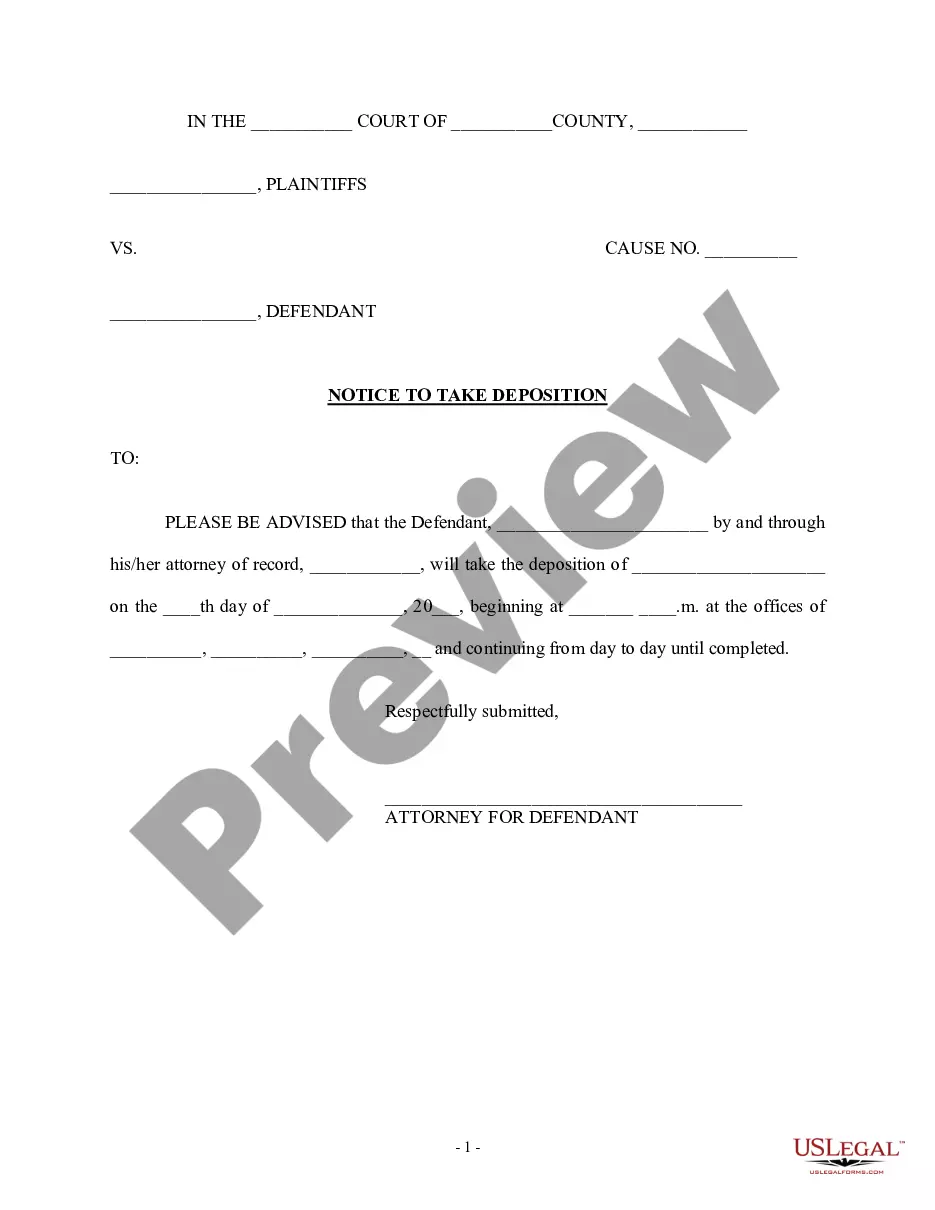
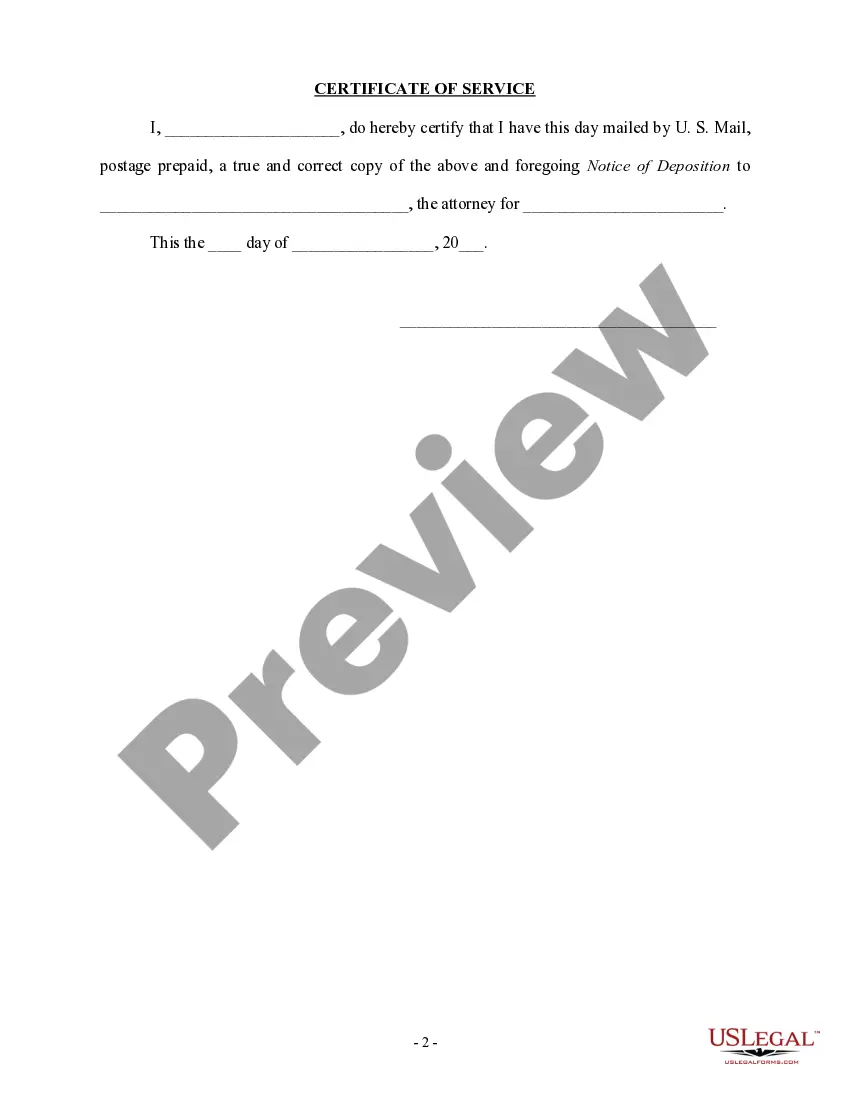
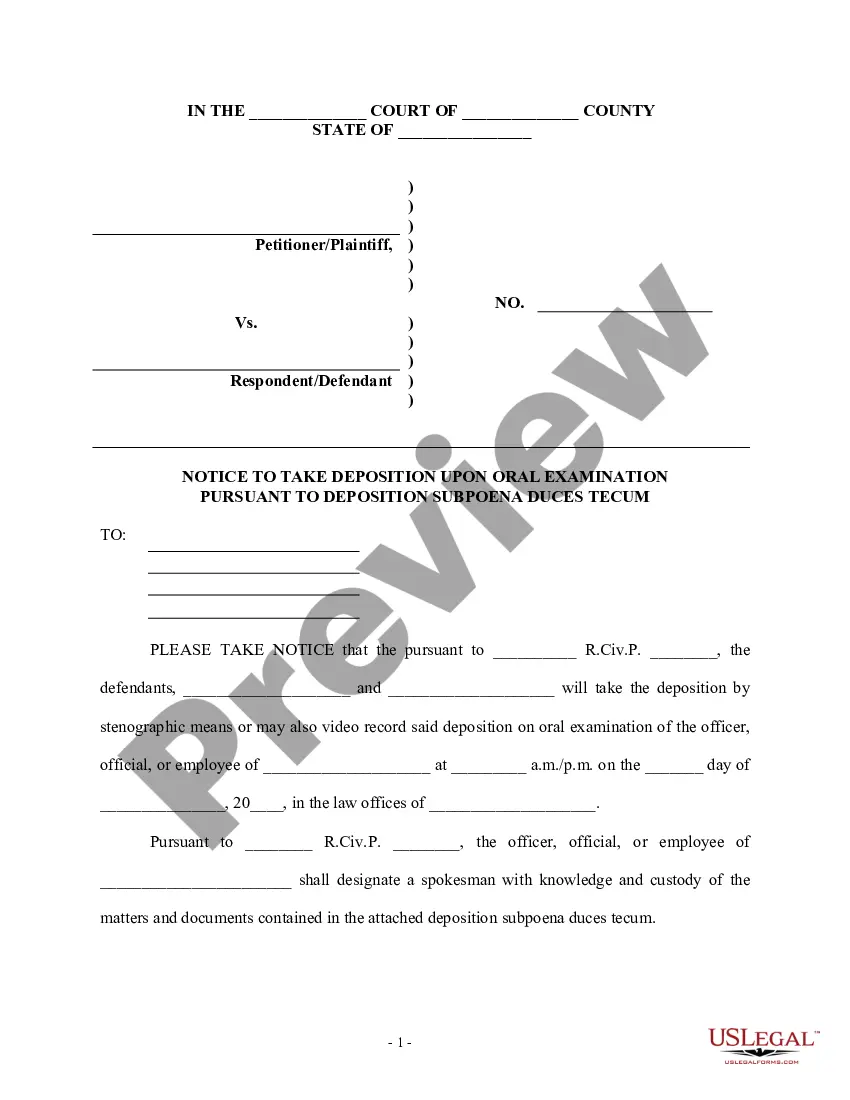
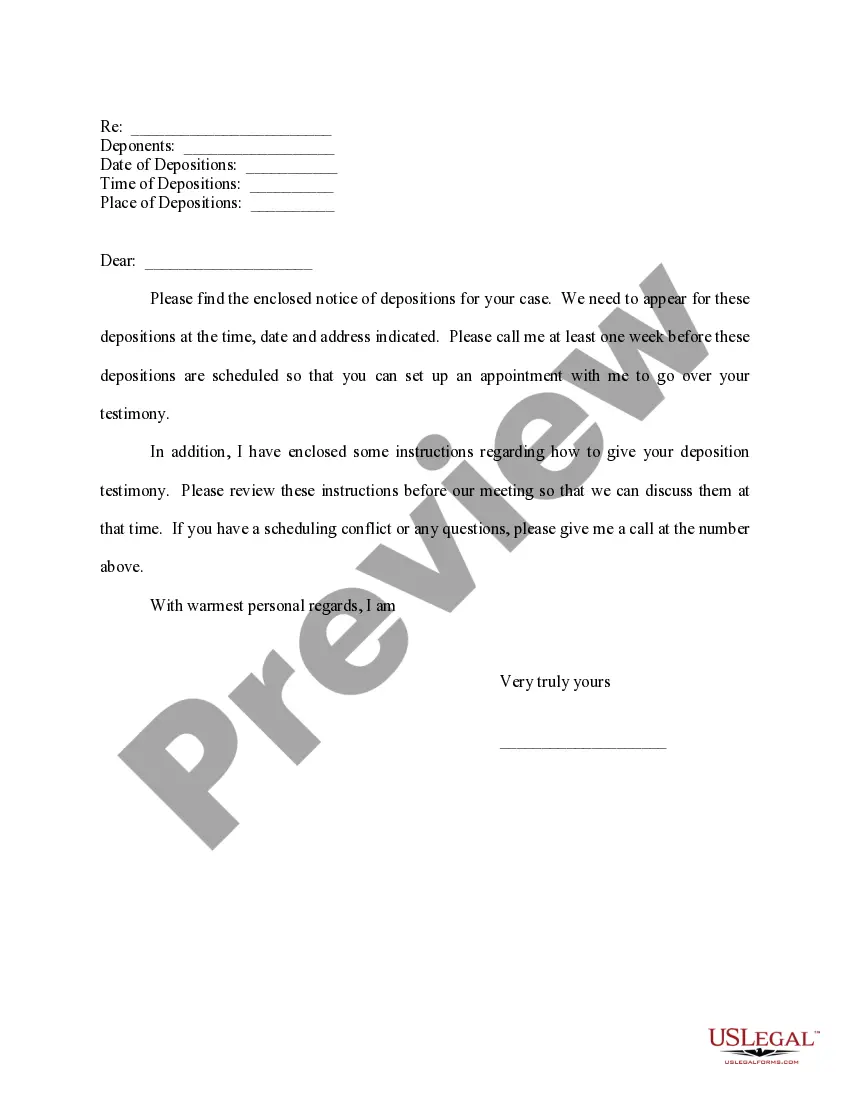
Defendant submits his/her notice to take depositions from day to day until completed. The form also contains a Certificate of Service which states that a true and correct copy of the Notice to Take Deposition was mailed via U.S. Mail and
Nebraska Notice to Take Deposition - Discovery
State:
Multi-State
Control #:
US-00904
Format:
Word;
Rich Text
191 downloads
Description
Free preview
Get your form ready online
Our built-in tools help you complete, sign, share, and store your documents in one place.
Built-in online Word editor
Make edits, fill in missing information, and update formatting in US Legal Forms—just like you would in MS Word.
Export easily
Download a copy, print it, send it by email, or mail it via USPS—whatever works best for your next step.
E-sign your document
Sign and collect signatures with our SignNow integration. Send to multiple recipients, set reminders, and more. Go Premium to unlock E-Sign.
Notarize online 24/7
If this form requires notarization, complete it online through a secure video call—no need to meet a notary in person or wait for an appointment.
Store your document securely
We protect your documents and personal data by following strict security and privacy standards.

Make edits, fill in missing information, and update formatting in US Legal Forms—just like you would in MS Word.

Download a copy, print it, send it by email, or mail it via USPS—whatever works best for your next step.

Sign and collect signatures with our SignNow integration. Send to multiple recipients, set reminders, and more. Go Premium to unlock E-Sign.

If this form requires notarization, complete it online through a secure video call—no need to meet a notary in person or wait for an appointment.

We protect your documents and personal data by following strict security and privacy standards.
Looking for another form?
How to fill out Notice To Take Deposition - Discovery?
If you need to total, download, or print valid document templates, utilize US Legal Forms, the largest selection of legal forms available online. Take advantage of the site's simple and efficient search to find the documents you need. A variety of templates for business and personal use are organized by categories and states, or keywords. Use US Legal Forms to find the Nebraska Notice to Take Deposition - Discovery with just a few clicks.
If you are already a US Legal Forms user, Log In to your account and click the Download button to obtain the Nebraska Notice to Take Deposition - Discovery. You can also access forms you previously downloaded in the My documents section of your account.
If you are using US Legal Forms for the first time, follow the steps below: Step 1. Ensure you have selected the form for the correct city/state. Step 2. Use the Review option to browse the form's content. Always remember to read the details. Step 3. If you are not satisfied with the form, utilize the Search box at the top of the screen to find other types of your legal form template. Step 4. Once you have found the form you need, click the Get now button. Choose the pricing plan you prefer and enter your details to register for an account. Step 5. Complete the purchase. You can use your Visa or Mastercard or PayPal account to finalize the transaction. Step 6. Select the format of your legal form and download it to your device. Step 7. Complete, modify, and print or sign the Nebraska Notice to Take Deposition - Discovery.
- Every legal document template you purchase is yours forever.
- You will have access to every form you downloaded with your account.
- Click on the My documents section and select a form to print or download again.
- Stay competitive and download and print the Nebraska Notice to Take Deposition - Discovery with US Legal Forms.
- There are thousands of professional and state-specific forms you can use for your business or personal needs.
Form popularity
FAQ
JF: A deposition is an opportunity for parties in a civil lawsuit to obtain testimony from a witness under oath prior to trial. It's part of the discovery process by which parties gather facts and information so they can be better prepared at trial to present their claims and defenses.
That disclosure is accomplished through a methodical process called "discovery." Discovery takes three basic forms: written discovery, document production and depositions.
Sometimes depositions are recorded by a stenographer, although electronic recordings are increasingly common. At the deposition, all parties may question the witness. Lawyers may not coach their clients' testimony, and the lawyers' ability to object to deposition questions is usually limited.
(1) Examination and cross-examination of witnesses may proceed as permitted at the trial under the provisions of the Nebraska Evidence Rules. The officer before whom the deposition is to be taken shall put the witness under oath and, if an interpreter is used, also put the interpreter under oath.
One of the most common methods of discovery is to take depositions. A deposition is an out-of-court statement given under oath by any person involved in the case. It is to be used at trial or in preparation for trial.
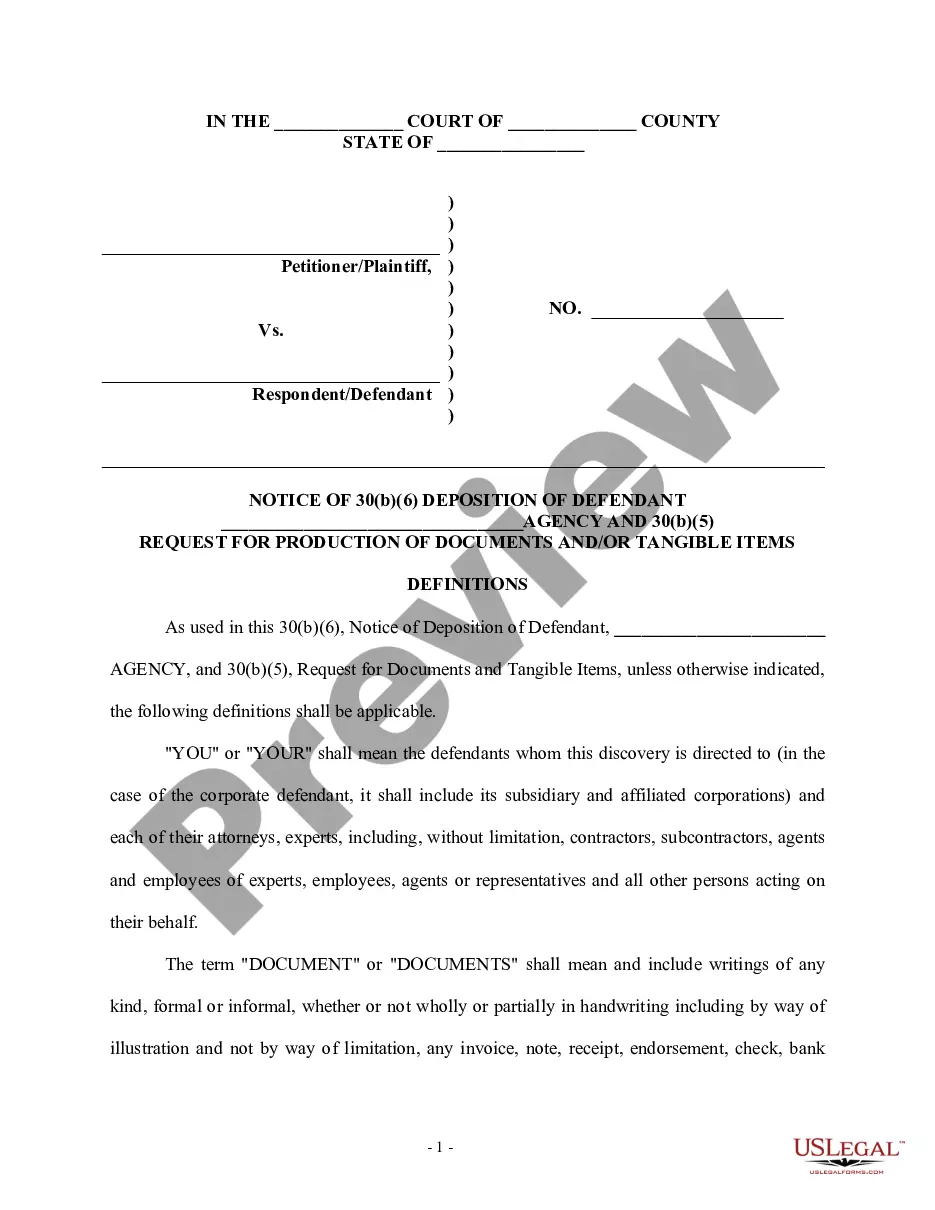
Parties may obtain discovery by one or more of the following methods: depositions upon oral examination or written questions; written interrogatories; production of documents or things or permission to enter upon land or other property for inspection and other purposes; physical and mental examinations; and requests ...
A deposition in the law of the United States, or examination for discovery in the law of Canada, involves the taking of sworn, out-of-court oral testimony of a witness that may be reduced to a written transcript for later use in court or for discovery purposes.