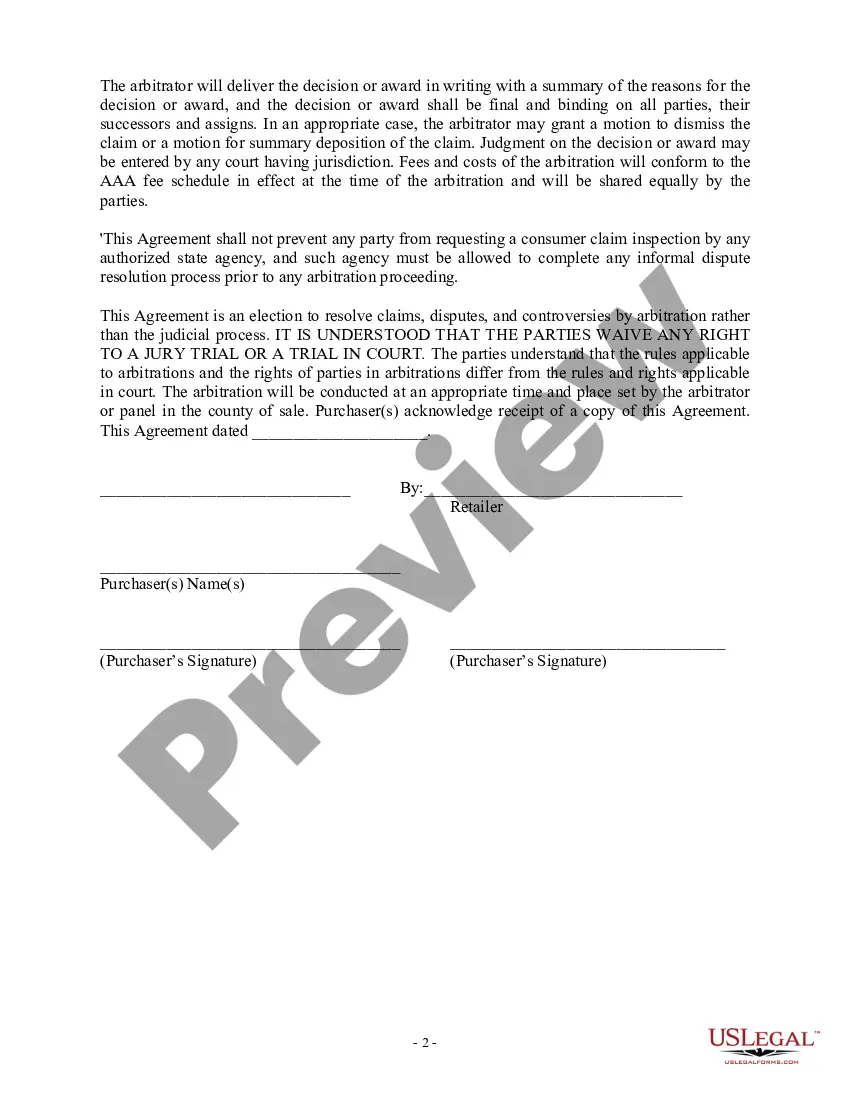
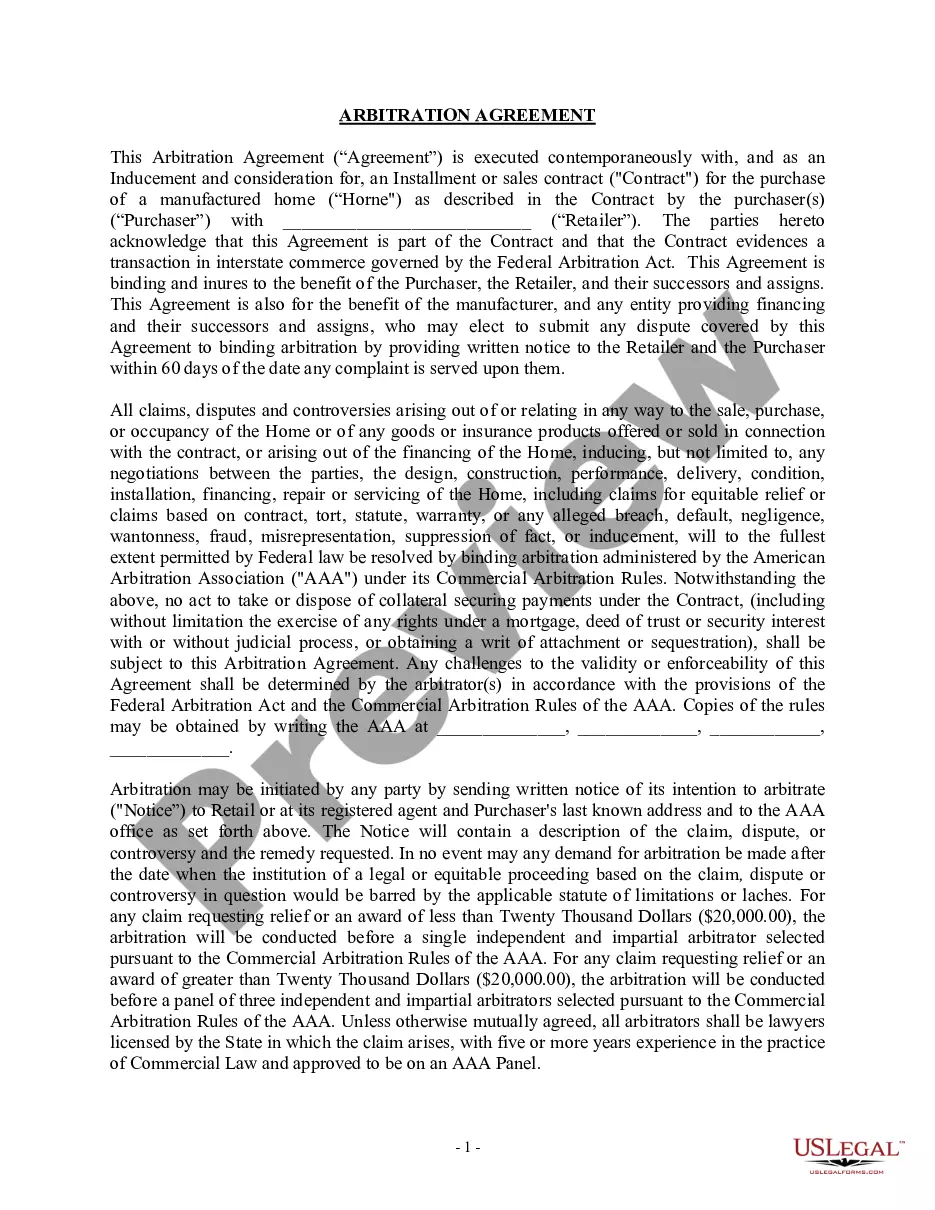
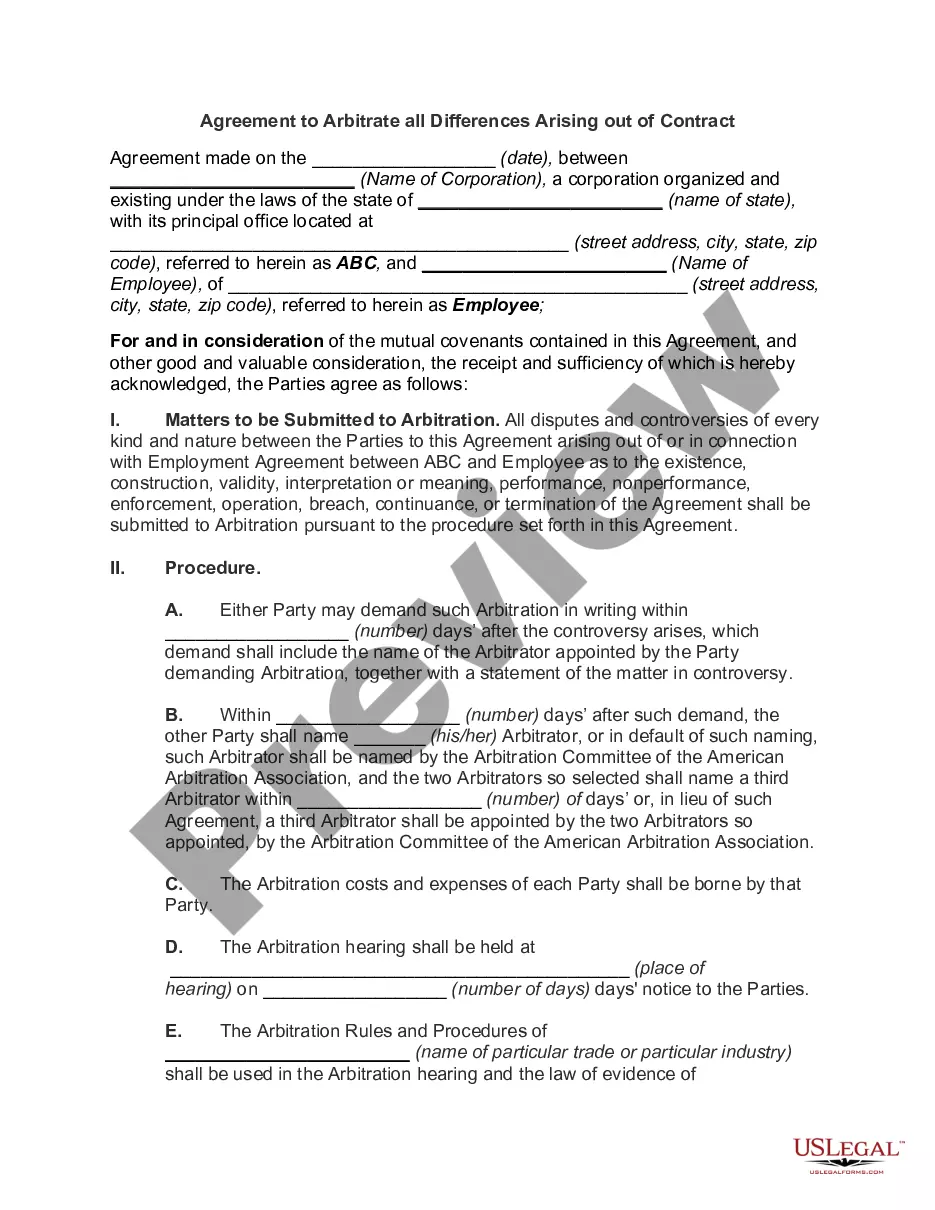
This arbitration agreement is executed contemporaneously with, and as an Inducement and consideration for, an Installment or sales contract for the purchase of a manufactured home. It provides that all claims or disputes arising out of or relating in any way to the sale, purchase, or occupancy of manufactured home resolved by binding arbitration administered by the American Arbitration Association ("AAA") under its Commercial Arbitration Rules. This Agreement is an election to resolve claims, disputes, and controversies by arbitration rather than the judicial process. The parties waive any right to a court trial.
Nebraska Arbitration Agreement
State:
Multi-State
Category:
Control #:
US-00416-1
Format:
Word;
Rich Text
107 downloads
Description
Free preview


Get your form ready online
Our built-in tools help you complete, sign, share, and store your documents in one place.
Built-in online Word editor
Make edits, fill in missing information, and update formatting in US Legal Forms—just like you would in MS Word.
Export easily
Download a copy, print it, send it by email, or mail it via USPS—whatever works best for your next step.
E-sign your document
Sign and collect signatures with our SignNow integration. Send to multiple recipients, set reminders, and more. Go Premium to unlock E-Sign.
Notarize online 24/7
If this form requires notarization, complete it online through a secure video call—no need to meet a notary in person or wait for an appointment.
Store your document securely
We protect your documents and personal data by following strict security and privacy standards.

Make edits, fill in missing information, and update formatting in US Legal Forms—just like you would in MS Word.

Download a copy, print it, send it by email, or mail it via USPS—whatever works best for your next step.

Sign and collect signatures with our SignNow integration. Send to multiple recipients, set reminders, and more. Go Premium to unlock E-Sign.

If this form requires notarization, complete it online through a secure video call—no need to meet a notary in person or wait for an appointment.

We protect your documents and personal data by following strict security and privacy standards.
Looking for another form?



How to fill out Arbitration Agreement?
You might spend numerous hours online searching for the legal document template that complies with the federal and state requirements you need.
US Legal Forms offers a multitude of legal forms that can be assessed by experts.
You can conveniently download or create the Nebraska Arbitration Agreement from my services.
If available, use the Preview button to inspect the document template as well.
- If you already possess a US Legal Forms account, you can Log In and click the Download button.
- After that, you can complete, modify, print, or sign the Nebraska Arbitration Agreement.
- Every legal document template you obtain is yours to keep indefinitely.
- To retrieve an additional copy of the acquired form, navigate to the My documents tab and click the corresponding button.
- If you are using the US Legal Forms site for the first time, follow the simple instructions below.
- First, ensure that you have chosen the correct document template for the region/area of your choice.
- Review the form description to confirm you have selected the appropriate form.
Form popularity
FAQ
"Arbitration agreement" is an agreement by the parties to submit to arbitration all or certain disputes which have arisen or which may arise between them in respect of a defined legal relationship, whether contractual or not.
Is arbitration legal? Yes. The Federal Arbitration Act, or FAA, was passed in 1925 in response to a variety of court decisions that held arbitration agreements unenforceable. This law provides that arbitration agreements are generally valid and enforceable.
Arbitration can be binding (which means the participants must follow the arbitrator's decision and courts will enforce it) or nonbinding (meaning either party is free to reject the arbitrator's decision and take the dispute to court, as if the arbitration had never taken place). Binding arbitration is more common.
The arbitration agreement is valid only if signed by parties with full civil act capacity, and such parties must be competent, specifically: (i) A person with full civil act capacity is at least 18 years old and does not lose or limit her/his civil act capacity or difficulties in perception, mastery of acts.
A mandatory arbitration agreement should identify the rules, procedures, and evidentiary guidelines to be applied. Many agreements opt for a particular forum's rules and procedures. If there are any rules that the parties want to opt out of (e.g., a limitation on discovery), state as much in the arbitration agreement.
If an employee can show some substantial relationship between the fraud committed or the misrepresentation made by the employer and the arbitration agreement, a court will void the agreement.
Thus, in order for the Arbitration Clause to be enforceable, it must be clear that the parties mutually agreed to Arbitration as an alternate forum, that the parties are affirmatively waiving any right to proceed in State Court, and finally, that the parties are waiving a right to a Trial by jury.
First, any valid arbitration agreement must reflect the conscious, mutual and free will of the parties to resort to arbitration and not to other means of dispute resolution, including State courts. The consent of both parties to submit their dispute to arbitration is the cornerstone of arbitration.
The arbitration agreement is valid only if signed by parties with full civil act capacity, and such parties must be competent, specifically: A person with full civil act capacity is at least 18 years old and does not lose or limit her/his civil act capacity or difficulties in perception, mastery of acts.
First, any valid arbitration agreement must reflect the conscious, mutual and free will of the parties to resort to arbitration and not to other means of dispute resolution, including State courts. The consent of both parties to submit their dispute to arbitration is the cornerstone of arbitration.