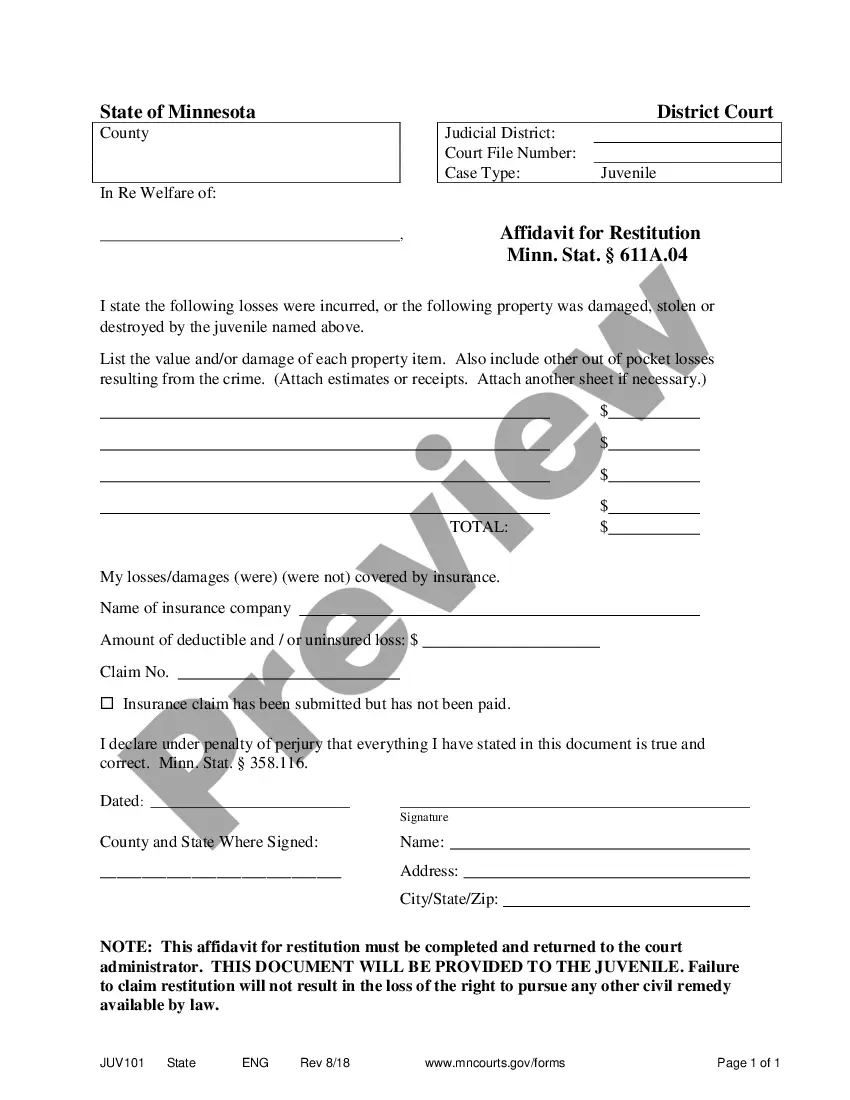
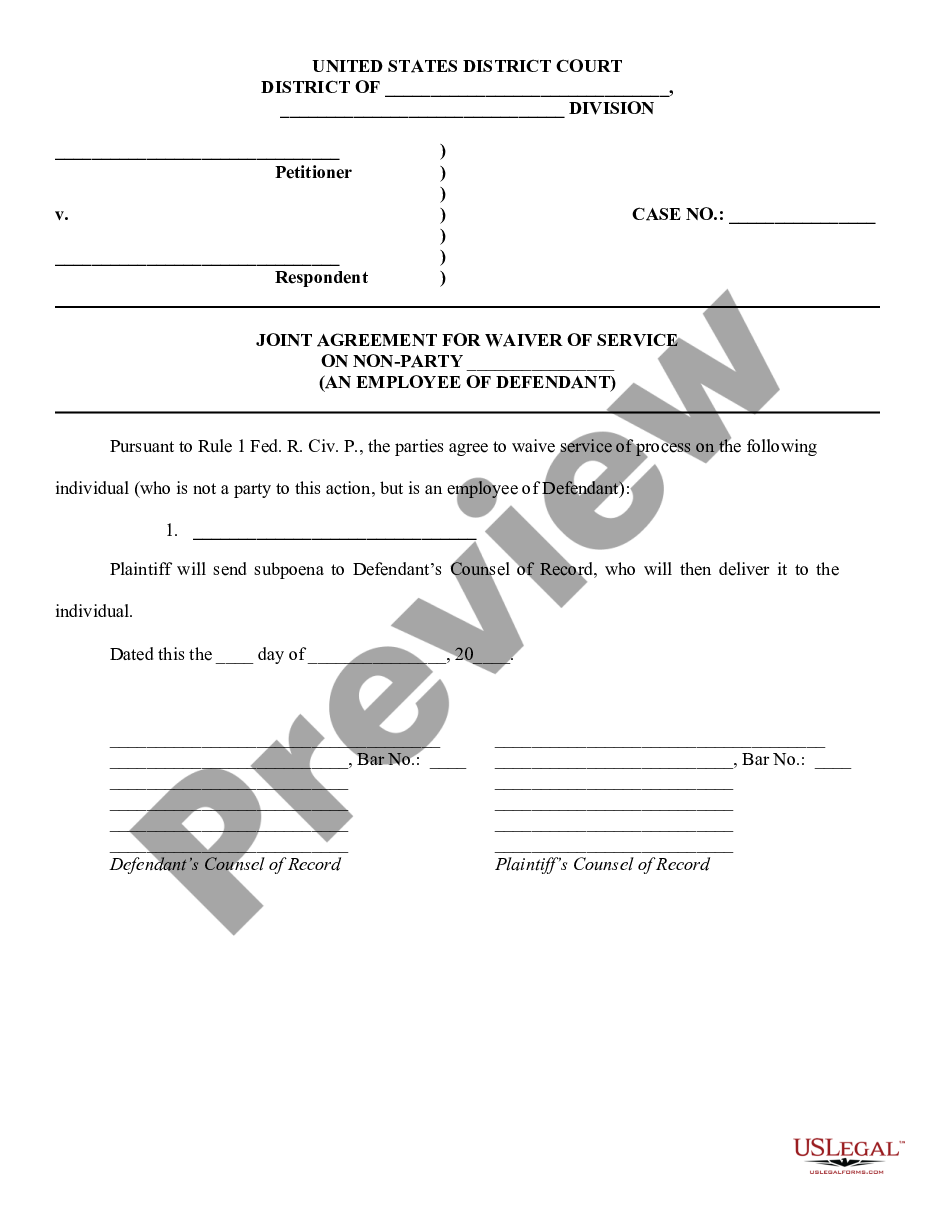
This is an official Minnesota court form for use in a minor case, an Affidavit for Restitution. USLF amends and updates these forms as is required by Minnesota Statutes and Law.
Minnesota Affidavit For Restitution
State:
Minnesota
Control #:
MN-JUV101
Format:
PDF
Instant download
This website is not affiliated with any governmental entity
Public form
Description
Get your form ready online
Our built-in tools help you complete, sign, share, and store your documents in one place.
Built-in online Word editor
Make edits, fill in missing information, and update formatting in US Legal Forms—just like you would in MS Word.
Export easily
Download a copy, print it, send it by email, or mail it via USPS—whatever works best for your next step.
E-sign your document
Sign and collect signatures with our SignNow integration. Send to multiple recipients, set reminders, and more. Go Premium to unlock E-Sign.
Notarize online 24/7
If this form requires notarization, complete it online through a secure video call—no need to meet a notary in person or wait for an appointment.
Store your document securely
We protect your documents and personal data by following strict security and privacy standards.

Make edits, fill in missing information, and update formatting in US Legal Forms—just like you would in MS Word.

Download a copy, print it, send it by email, or mail it via USPS—whatever works best for your next step.

Sign and collect signatures with our SignNow integration. Send to multiple recipients, set reminders, and more. Go Premium to unlock E-Sign.

If this form requires notarization, complete it online through a secure video call—no need to meet a notary in person or wait for an appointment.

We protect your documents and personal data by following strict security and privacy standards.
Looking for another form?

How to fill out Minnesota Affidavit For Restitution?
Obtain any template from 85,000 legal documents including Minnesota Affidavit for Restitution online with US Legal Forms. Each template is composed and revised by state-certified legal experts.
If you already possess a subscription, sign in. Once you’re on the form’s page, hit the Download button and navigate to My documents to access it.
If you haven’t subscribed yet, follow the guidelines below: Check the state-specific criteria for the Minnesota Affidavit for Restitution you wish to use. Review the description and preview the template. When you’re confident the sample is what you require, click Buy Now. Choose a subscription plan that fits your budget. Create a personal account. Make a payment in one of two suitable methods: by card or via PayPal. Select a format to download the document in; two choices are available (PDF or Word). Download the document to the My documents tab. Once your reusable form is ready, print it out or save it to your device.
- With US Legal Forms, you’ll consistently have swift access to the correct downloadable template.
- The platform will provide you access to forms and categorizes them to streamline your search.
- Utilize US Legal Forms to acquire your Minnesota Affidavit for Restitution quickly and effortlessly.
Form popularity
FAQ
Restitution in Minnesota requires offenders to compensate victims for their losses as part of their sentence. The Minnesota Affidavit For Restitution is a critical document in this process, as it outlines the damages and the amount owed. By completing this affidavit accurately, you ensure that your claim is taken seriously and processed efficiently.
The 36 hour rule in Minnesota refers to a guideline that mandates restitution orders must be submitted within 36 hours of the offense. This rule plays an essential role in the process of the Minnesota Affidavit For Restitution, as it helps victims receive timely compensation. Understanding this rule can significantly impact how you approach your restitution claims.
In Minnesota, an affidavit generally requires notarization to be legally recognized. Having a notary public witness your signature adds credibility and authenticity to the Minnesota Affidavit For Restitution. This step can help ensure that your affidavit holds up in court, so it’s a good practice to follow.
You can obtain the Minnesota Affidavit For Restitution from various sources, including local courthouses and legal aid organizations. Additionally, the uslegalforms platform offers convenient access to this form online, ensuring you have the most up-to-date version. Simply visit the website, search for the Minnesota Affidavit For Restitution, and download the form to get started.
To file for restitution in Minnesota, start by completing a Minnesota Affidavit For Restitution, detailing your losses. Submit this affidavit to the court that handled the case against the offender. The court will then review your request and determine the restitution amount. Utilizing services like US Legal Forms can streamline this process, offering templates and expert advice to ensure your filing is accurate.
In Minnesota, making a restitution payment typically involves sending the required amount to the court or the designated authority. The payment should adhere to the schedule set forth in the restitution order. For those using a Minnesota Affidavit For Restitution, it's crucial to keep records of all payments made. Platforms like US Legal Forms can provide additional resources to help you understand your payment obligations.
The process of restitution in Minnesota begins when a victim files a request through the appropriate legal channels. This often involves submitting a Minnesota Affidavit For Restitution to outline the financial losses incurred. Once filed, the court will review the affidavit, determine the amount owed, and issue a restitution order. This structured approach ensures that victims receive the compensation they deserve.
Restitution law in Minnesota requires offenders to compensate victims for losses caused by their actions. The law aims to restore victims to their original position, financially, after a crime. Under the Minnesota Affidavit For Restitution, victims can formally request compensation through the court system. Understanding these laws can help you navigate your rights and responsibilities more effectively.
In Minnesota, an affidavit typically must be notarized to confirm its authenticity. This process ensures that the person signing the document does so willingly and understands its contents. When dealing with a Minnesota Affidavit For Restitution, notarization adds an extra layer of credibility, helping to prevent disputes later on. Utilizing platforms like US Legal Forms can simplify this process by providing templates and guidance for notarization.