Nebraska Acknowledgment for Limited Liability Company
What is this form?
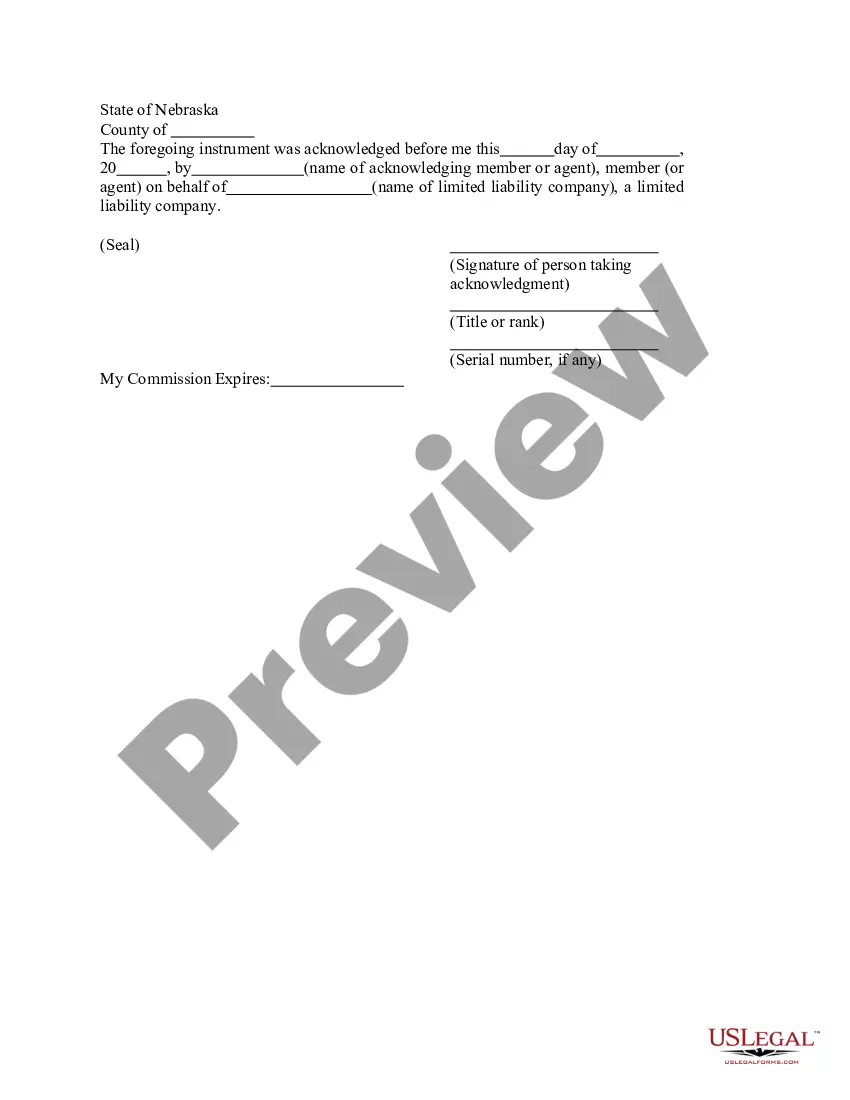
The Acknowledgment for Limited Liability Company is a legal form used to verify the signing of certain documents related to a limited liability company (LLC). This form serves as evidence that a specific member or agent has acknowledged their signature in front of a notary or authorized official. Unlike other business forms, this document specifically focuses on the acknowledgment of a member's or agent's signature, ensuring that the LLC's formal documents are executed properly and remain valid.
Key parts of this document
- Identification of the acknowledging member or agent.
- Name of the limited liability company.
- Signature of the person taking acknowledgment.
- Date of acknowledgment.
- Official seal if required by local laws.

When to use this document
This form is necessary when an LLC needs to formalize consent or acknowledgment of critical documents, such as operating agreements or amendments. It is specifically useful during the establishment of an LLC, fundraising efforts, or when significant changes occur within the company structure, and signatures on formal documents must be verified.
Who should use this form
- Members of a limited liability company who need to acknowledge documents.
- Agents who are authorized to sign on behalf of an LLC.
- Notaries or legal professionals overseeing the acknowledgment process.
How to complete this form
- Identify the member or agent who is acknowledging the document.
- Write the name of the limited liability company.
- Enter the date on which acknowledgment is made.
- Sign the document in the signature area designated for the acknowledging member or agent.
- Have the acknowledgment completed in front of a notary or authorized official.
Notarization requirements for this form
Yes, this form must be notarized to be legally valid. The authorization confirms that the member's or agent's signature has been acknowledged in front of a qualified official, ensuring the legitimacy of the document.
Get your form ready online
Our built-in tools help you complete, sign, share, and store your documents in one place.
Make edits, fill in missing information, and update formatting in US Legal Forms—just like you would in MS Word.
Download a copy, print it, send it by email, or mail it via USPS—whatever works best for your next step.
Sign and collect signatures with our SignNow integration. Send to multiple recipients, set reminders, and more. Go Premium to unlock E-Sign.
If this form requires notarization, complete it online through a secure video call—no need to meet a notary in person or wait for an appointment.
We protect your documents and personal data by following strict security and privacy standards.

Make edits, fill in missing information, and update formatting in US Legal Forms—just like you would in MS Word.

Download a copy, print it, send it by email, or mail it via USPS—whatever works best for your next step.

Sign and collect signatures with our SignNow integration. Send to multiple recipients, set reminders, and more. Go Premium to unlock E-Sign.

If this form requires notarization, complete it online through a secure video call—no need to meet a notary in person or wait for an appointment.

We protect your documents and personal data by following strict security and privacy standards.
Avoid these common issues
- Failing to properly identify the LLC or the acknowledging member/agent.
- Not having the form completed in the presence of a notary.
- Leaving out the date of acknowledgment.
Benefits of using this form online
- Easy access to legal forms that are tailored and up-to-date.
- Convenience of completing the form at your own pace.
- Provides reliability with templates drafted by licensed attorneys.
Summary of main points
- The Acknowledgment for Limited Liability Company is crucial for verifying actions undertaken by an LLC.
- Proper completion and notarization of this form enhance the enforceability of company actions.
- Using this form online simplifies the process and ensures compliance with legal requirements.
Looking for another form?
Form popularity
FAQ
Only you, as the notary, may make corrections to the notary certificate. Illegible/ Expired Notary Seal: Stamp impressions that are too dark, too light, incomplete, smudged, or in any way unreadable may cause an otherwise acceptable document to be rejected for its intended use.
Notaries are not permitted to certify copies of public documents, especially vital statistics.A notary may not notarize a certified true copy of a recordable document. Birth certificates and marriage licenses are recordable documents.
This is a form that shows that a notary public has established the identity of the signer(s) and witnessed the signature of a document. It only demonstrates that the document has been signed and does not make any claims about the information in the document.
14) Notaries may not certify or copy certify that a government record is valid or authentic. government office.
The certificate of a notary public, justice of the peace, or other authorized officer, attached to a deed, mortgage, or other instrument, setting forth that the parties thereto personally appeared before him on such a date and acknowledged the instrument to be their free and voluntary act and deed. Read v.
As long as the signer is personally present before the notary and acknowledges the signature, then the notary can proceed with performing the notarial act. A notary's certificate of acknowledgment should always reflect the date on which the signer personally appeared before the notary.
It depends. You may notarize a document that does not have pre-printed notarial wording as long as the signer tells you what type of notarization is needed.As nonattorneys, Notaries cannot decide the type of notarization to perform on a document because the choice can have important legal ramifications.
In general, a contract does not need to be notarized or witnessed to be binding.But for most contracts, we do not generally require them to be witnessed or notarized, to be "legal." The notary removes the issue as to the identity of the parties signing the contract.
A notary public verifies the identity of a document signer. Other than assuring there are no blanks left empty in the document, the content of the document is not the notary's concern. So a notary public does not validate documents.