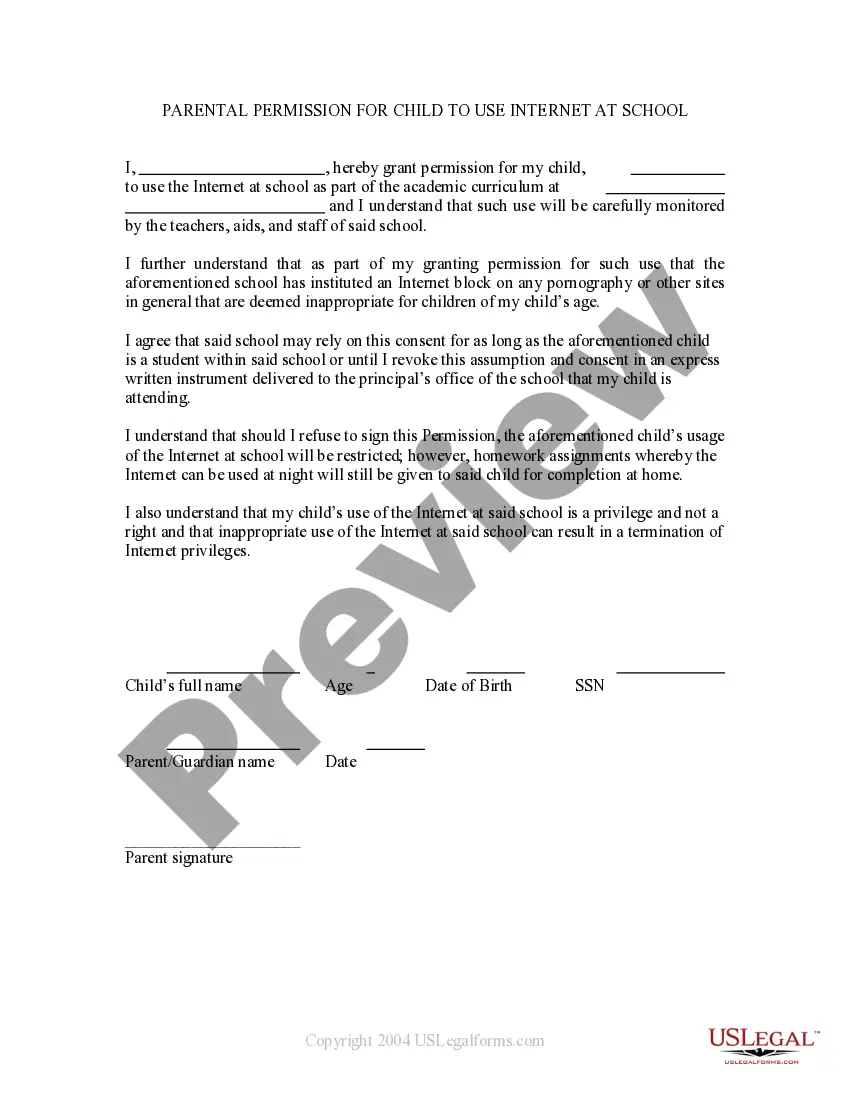
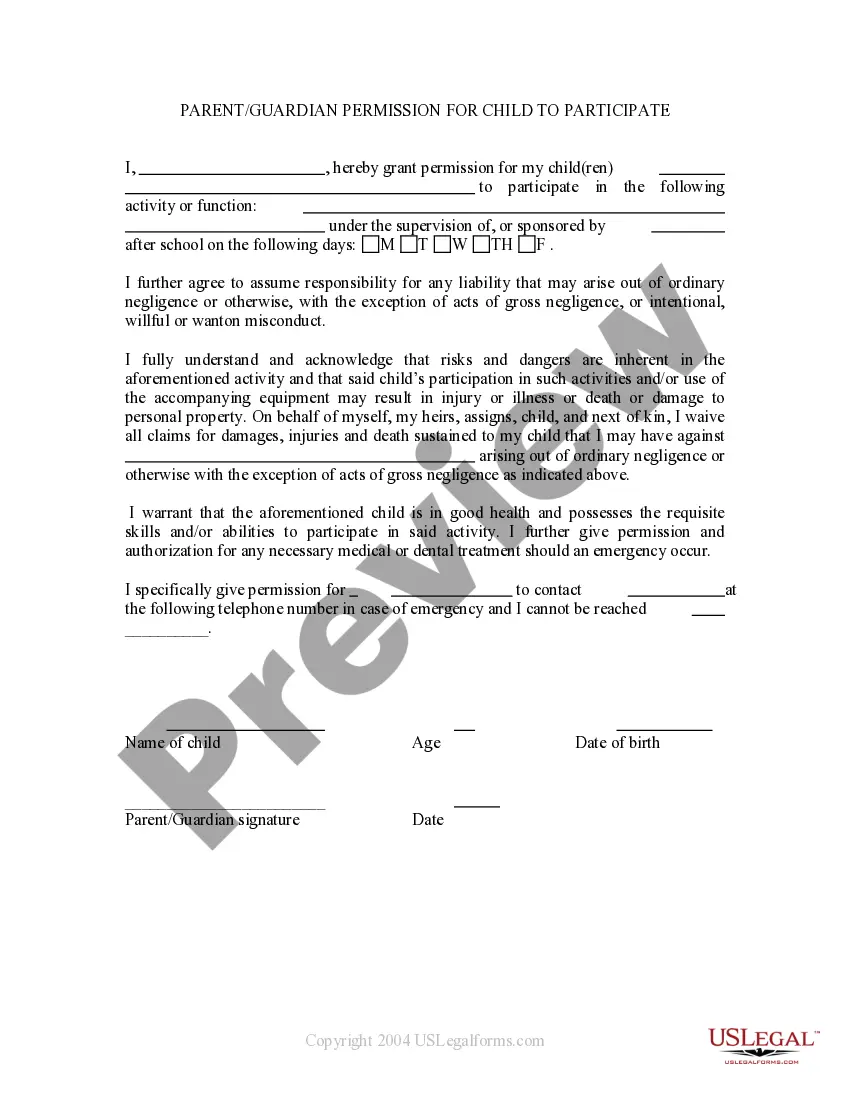
This form is signed by a parent who is granting permission for his/her child to use the Internet at school as part of the academic curriculum, and under the supervision of a teacher, aid, administrator etc.
North Dakota Parental Permission For Child To Use Internet At School
Category:
State:
Multi-State
Control #:
US-PRM-28
Format:
Word;
Rich Text
Instant download
Description
How to fill out Parental Permission For Child To Use Internet At School?
US Legal Forms - one of the largest collections of legal documents in the United States - provides a variety of legal document templates that you can download or print. By utilizing the website, you can find thousands of forms for business and personal use, organized by categories, states, or keywords. You can access the latest versions of forms such as the North Dakota Parental Consent For Child To Use Internet At School in just moments.
If you already have a subscription, Log In and obtain the North Dakota Parental Consent For Child To Use Internet At School from the US Legal Forms library. The Download button will appear on each form you view. You can access all previously obtained forms from the My documents section of your account.
If you are looking to use US Legal Forms for the first time, here are straightforward instructions to assist you in getting started: Ensure you have selected the correct form for the city/state. Click the Preview button to review the content of the form. Check the form details to confirm that you have chosen the right form. If the form doesn’t meet your requirements, utilize the Search field at the top of the screen to find one that does. Once you are content with the form, confirm your selection by clicking the Get now button. Then, select the payment plan you desire and provide your credentials to register for an account. Process the transaction. Use your credit card or PayPal account to complete the transaction. Choose the format and download the form to your device. Make adjustments. Fill out, modify, print, and sign the downloaded North Dakota Parental Consent For Child To Use Internet At School. Every template you added to your account has no expiration date and is yours permanently. Therefore, if you wish to download or print another copy, simply go to the My documents section and click on the form you need.
US Legal Forms is committed to providing a comprehensive library of legal documents tailored to meet diverse needs.
Whether for business or personal use, you can rely on their extensive resources to find the necessary legal forms quickly and efficiently.
- Access the North Dakota Parental Consent For Child To Use Internet At School with US Legal Forms, the most extensive collection of legal document templates.
- Utilize a multitude of professional and state-specific templates that fulfill your business or personal needs and requirements.
- Easily navigate through various categories to find the forms relevant to your situation.
- Stay updated with the latest legal documents available for download.
- Manage your forms efficiently through your user account.
- Enjoy a user-friendly interface designed for quick access to essential legal resources.
Form popularity
FAQ
In North Dakota, a child can express their preference regarding which parent to live with starting at age 12, but the court will ultimately consider multiple factors in making a decision. This process highlights the importance of parental guidance and support, particularly in matters of education. By obtaining North Dakota Parental Permission For Child To Use Internet At School, you can actively participate in your child's online journey, making choices that align with their needs and preferences.
The new phone law in North Dakota limits the use of handheld devices while driving, promoting safer roads for everyone. This law emphasizes the importance of focused attention, similar to how parents should focus on their children’s internet safety at school. With the North Dakota Parental Permission For Child To Use Internet At School, you can ensure that your child navigates online environments responsibly, just as you would encourage responsible phone use.
North Dakota does not have a specific bell to bell law that requires schools to enforce strict timing for class transitions. However, schools often have guidelines to ensure students use their time wisely, especially when it comes to accessing resources like the internet. Understanding the rules around internet use is crucial for parents, especially when considering North Dakota Parental Permission For Child To Use Internet At School. This permission ensures that your child’s online activities are monitored and safe.
In North Dakota, there is no specific law that sets a minimum age for leaving a child home alone. However, it is generally advised that children under the age of 10 should not be left alone for extended periods. Parents should consider the maturity level of their child when making this decision. Additionally, if you are considering allowing your child to use the internet at school, it's important to understand the North Dakota Parental Permission For Child To Use Internet At School, ensuring that you provide proper consent for their online activities.
The North Dakota Century Code is a compilation of the laws and statutes that govern the state of North Dakota. It serves as a reference for legal matters, providing clarity on various topics, including education and parental rights. This code includes provisions like the North Dakota Parental Permission For Child To Use Internet At School, which ensures that students have proper oversight when accessing online content. For any legal documentation or inquiries related to this code, US Legal Forms offers valuable templates and guidance.
Section 15.1 06 21 of the North Dakota Century Code outlines the requirements for obtaining parental permission for a child to use the internet at school. This law emphasizes the importance of parental consent prior to granting access to online resources, ensuring that parents are informed about their child's internet usage. By following this section, schools can promote a safer online environment for students. If you need assistance with the North Dakota Parental Permission For Child To Use Internet At School, consider using US Legal Forms for comprehensive resources.
Parental support has been defined as parental behaviors toward the child, such as praising, encouraging and giving physical affection, which indicate to the child that he or she is accepted and loved (Barnes et al., 2000: 176).
Legislation signed into law June 30 allows parents and students over 18 to decide for themselves whether they or their kids should repeat their 2020-21 grade. In other years, the decision to hold students back is made by school officials and teachers.
The influence and support of a parent or carer can play a vital role during a child's personal and educational development. Parents and carers are the child's first educators and have an opportunity to nurture their child's growth as well as act as an advocate for education.
Consider these other FERPA violation examples:Emailing protected student information to everyone in the class.Including social security numbers on shared documents.Posting grades and identifying information in public.Publicly disclosing a student athlete's academic status.