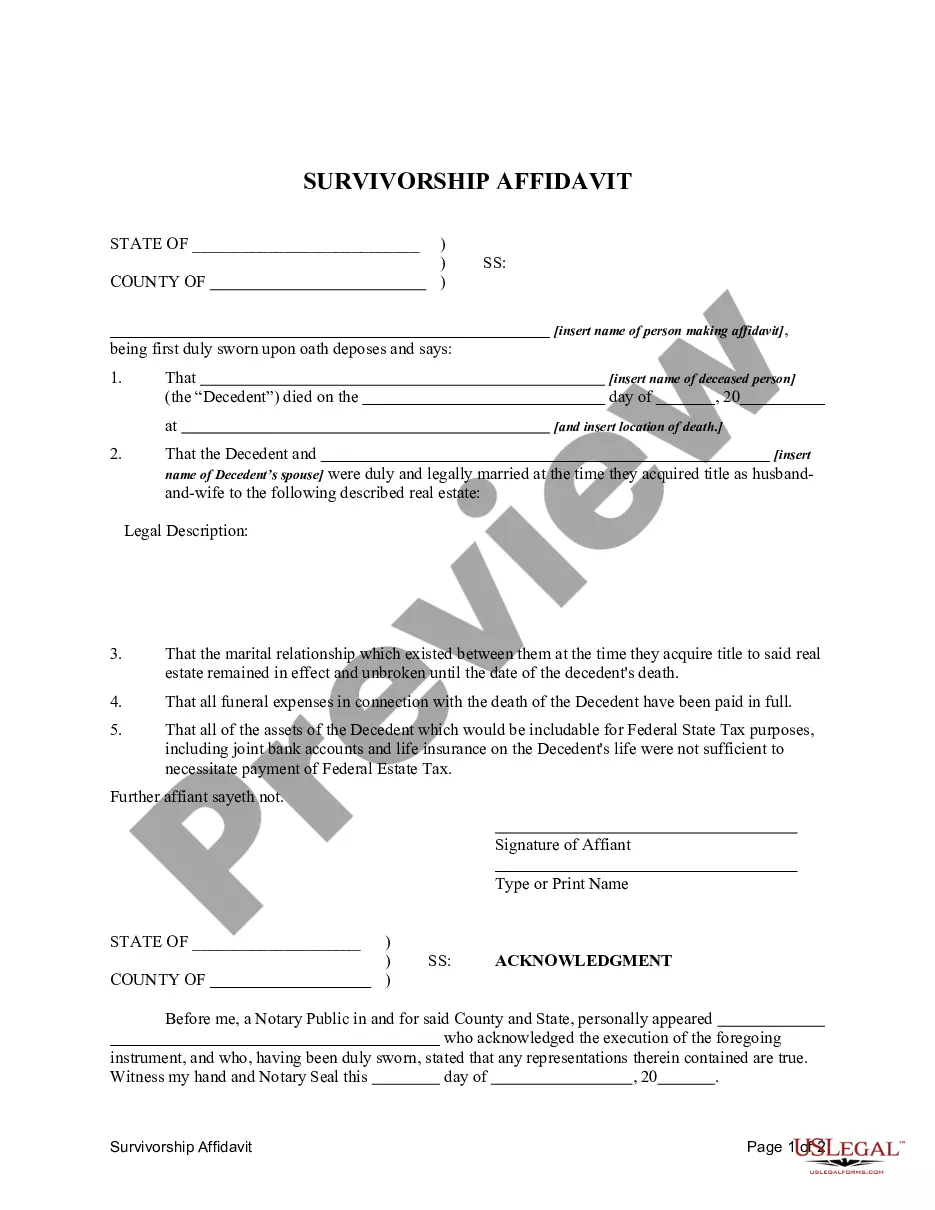
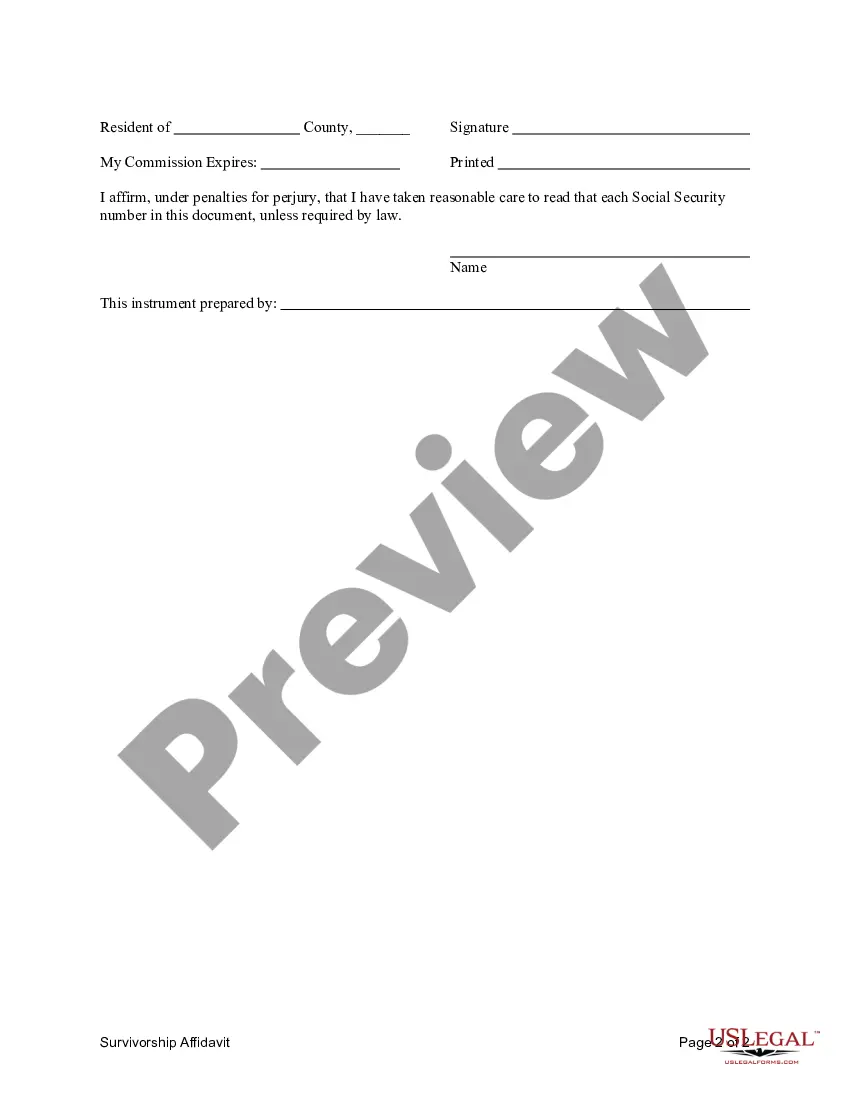
The Survivorship Affidavit is a form for a person to complete to establish the identity of the survivor in a joint tenancy or other property ownership relationship.
North Dakota Survivorship Affidavit
144 downloads
Description
Free preview

Get your form ready online
Our built-in tools help you complete, sign, share, and store your documents in one place.
Built-in online Word editor
Make edits, fill in missing information, and update formatting in US Legal Forms—just like you would in MS Word.
Export easily
Download a copy, print it, send it by email, or mail it via USPS—whatever works best for your next step.
E-sign your document
Sign and collect signatures with our SignNow integration. Send to multiple recipients, set reminders, and more. Go Premium to unlock E-Sign.
Notarize online 24/7
If this form requires notarization, complete it online through a secure video call—no need to meet a notary in person or wait for an appointment.
Store your document securely
We protect your documents and personal data by following strict security and privacy standards.

Make edits, fill in missing information, and update formatting in US Legal Forms—just like you would in MS Word.

Download a copy, print it, send it by email, or mail it via USPS—whatever works best for your next step.

Sign and collect signatures with our SignNow integration. Send to multiple recipients, set reminders, and more. Go Premium to unlock E-Sign.

If this form requires notarization, complete it online through a secure video call—no need to meet a notary in person or wait for an appointment.

We protect your documents and personal data by following strict security and privacy standards.
Looking for another form?
How to fill out Survivorship Affidavit?
If you want to comprehensive, acquire, or print legitimate record layouts, use US Legal Forms, the largest assortment of legitimate kinds, that can be found online. Utilize the site`s simple and easy hassle-free research to obtain the papers you need. Numerous layouts for organization and personal purposes are categorized by categories and states, or key phrases. Use US Legal Forms to obtain the North Dakota Survivorship Affidavit in a couple of mouse clicks.
Should you be currently a US Legal Forms buyer, log in to the profile and click on the Acquire option to obtain the North Dakota Survivorship Affidavit. Also you can entry kinds you in the past saved in the My Forms tab of your profile.
If you are using US Legal Forms initially, follow the instructions listed below:
- Step 1. Make sure you have chosen the shape for your proper area/nation.
- Step 2. Use the Review solution to check out the form`s content material. Never forget about to read the information.
- Step 3. Should you be unsatisfied using the type, make use of the Research discipline towards the top of the screen to locate other types of your legitimate type design.
- Step 4. When you have identified the shape you need, select the Acquire now option. Select the rates prepare you like and add your credentials to sign up for an profile.
- Step 5. Procedure the deal. You can use your charge card or PayPal profile to complete the deal.
- Step 6. Choose the structure of your legitimate type and acquire it on the gadget.
- Step 7. Total, change and print or indication the North Dakota Survivorship Affidavit.
Every single legitimate record design you get is your own forever. You might have acces to each and every type you saved with your acccount. Click the My Forms area and decide on a type to print or acquire once more.
Remain competitive and acquire, and print the North Dakota Survivorship Affidavit with US Legal Forms. There are thousands of specialist and state-particular kinds you may use to your organization or personal requirements.
Form popularity
FAQ
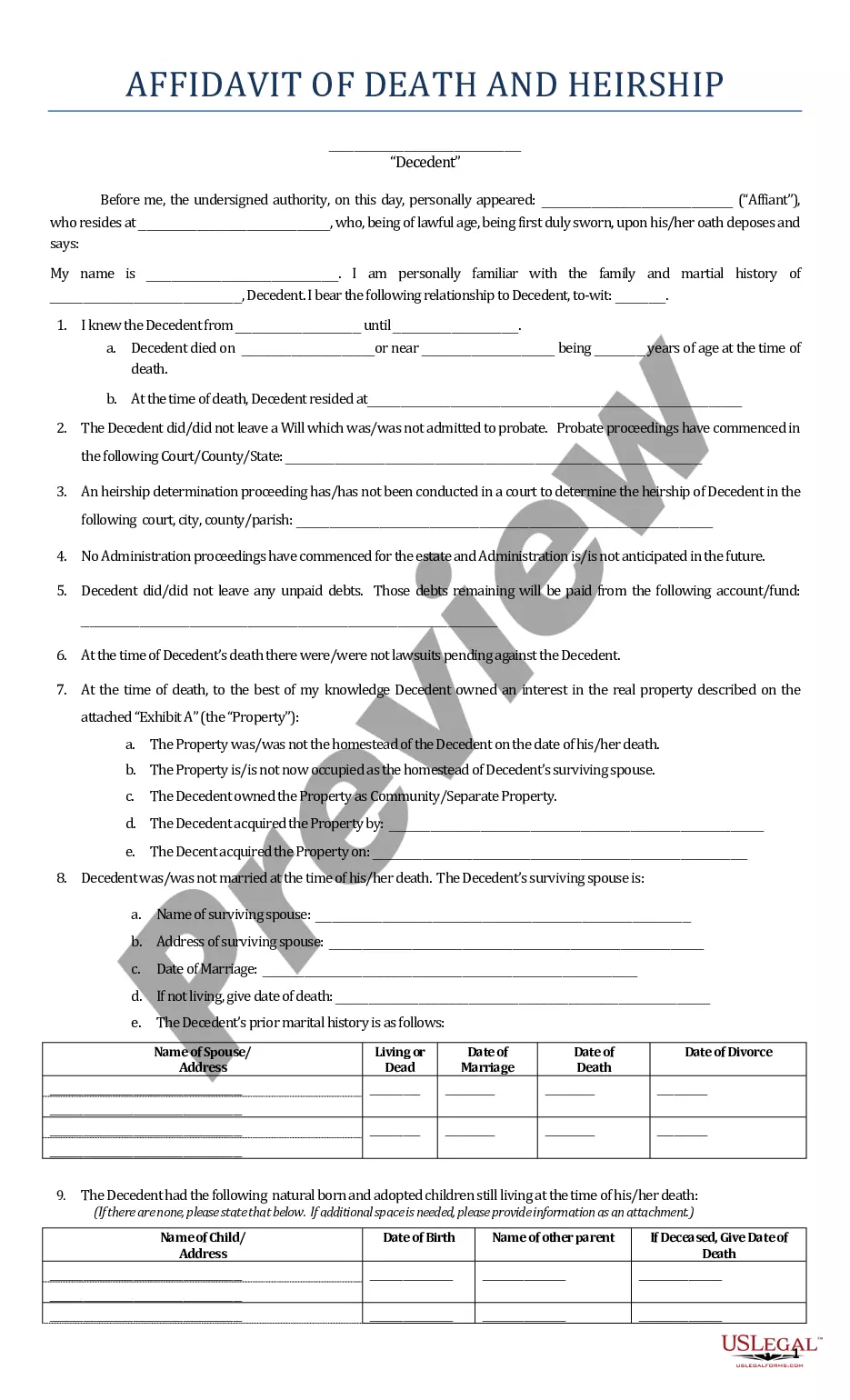
Probate Avoidance Joint Tenancy with Right of Survivorship. Adding another person to your assets as a joint owner or "joint tenant with rights of survivorship" will allow your property to pass to them upon your death without going through probate. ... Beneficiary Designations. ... Revocable Living Trust.
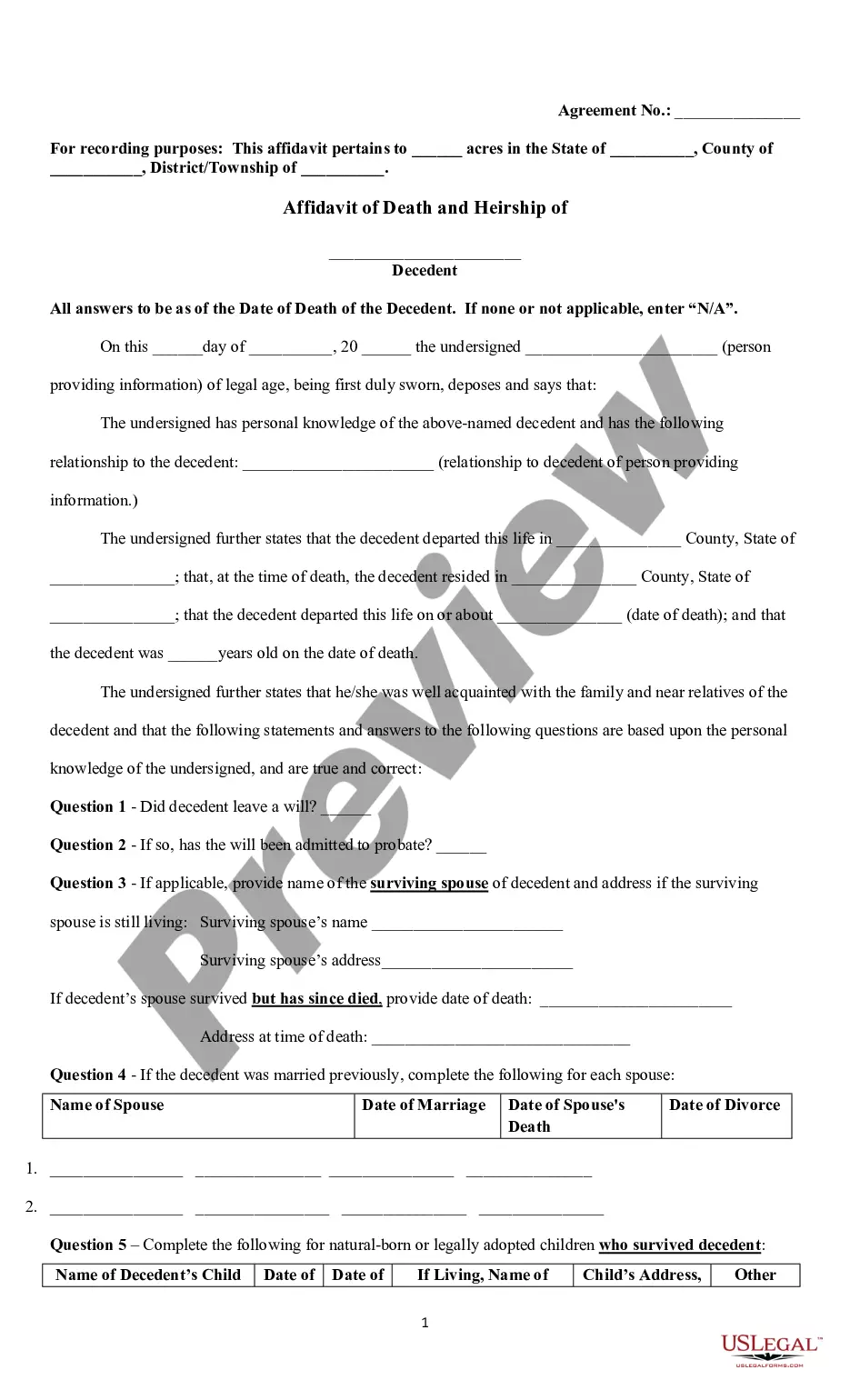
The total value of the probated property (minus any debts or other encumbrances on the property) is less than $50,000.00; No real property (real estate) is part of the probated estate; No probate case is started or completed in a North Dakota state district court, a court of any other state, or a tribal court; and.
Cent. Code § 30.1-32.1-02. An individual may transfer property to one or more beneficiaries effective at the transferor's death by a transfer on death deed.
Assets with named beneficiaries need probate. If the total estate value is less than $50,000, it may not need probate and can get an affidavit instead.
A small estate could comprise of assets worth less than around £10,000. This would mean they wouldn't own their house and any assets they do have would be items left after passing.
Die unmarried and intestate in North Dakota and your estate goes to your children in equal shares. If you don't have any children, then your parents are next in line. Finally, if you don't have a spouse, children, or surviving parents, then your estate will go to your grandparents, or descendants of your grandparents.