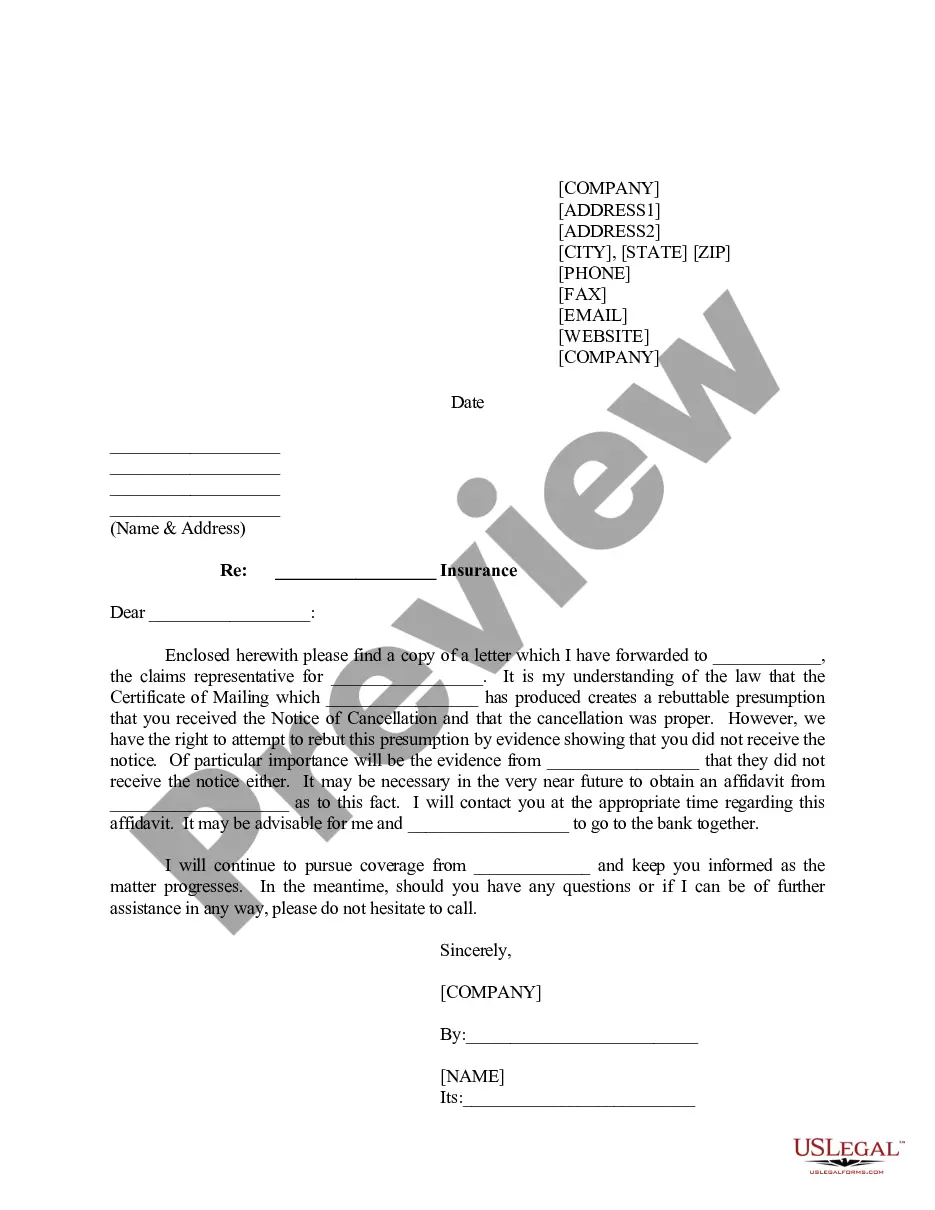
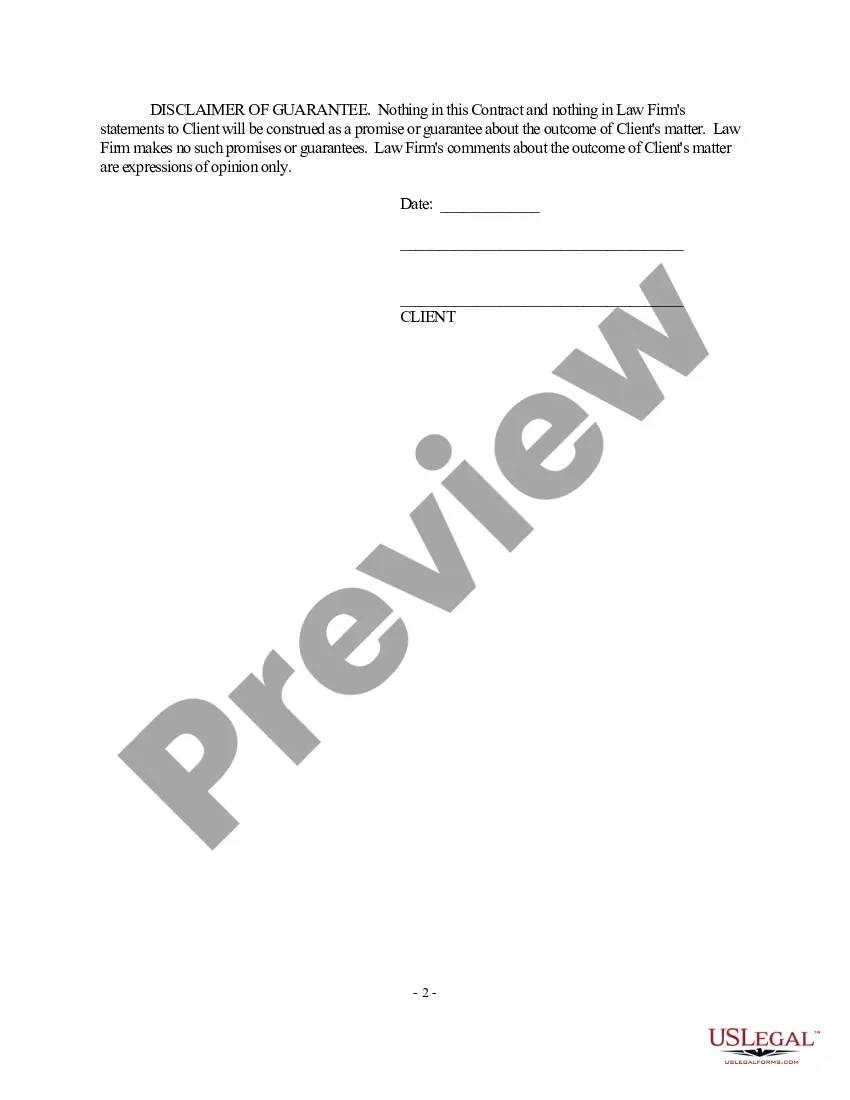
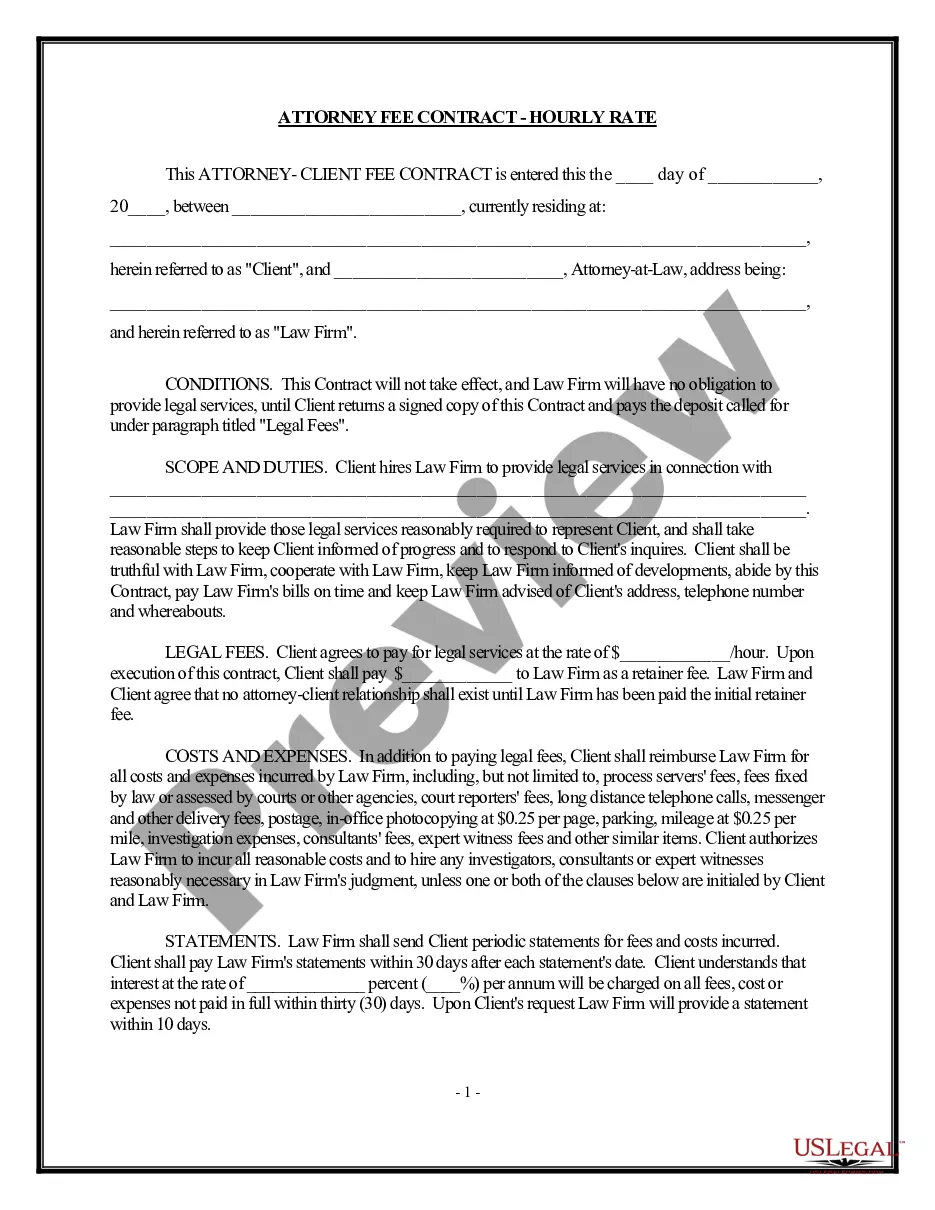
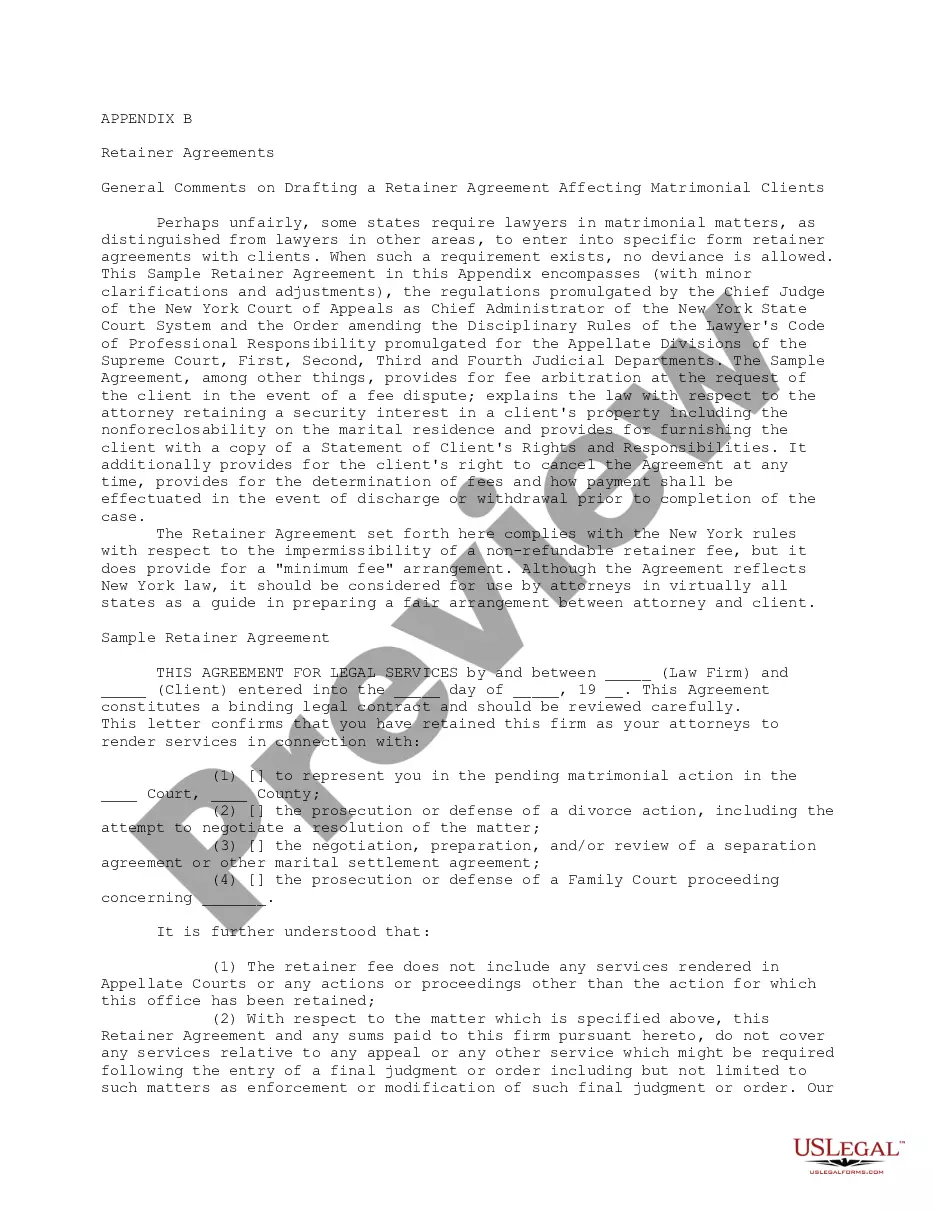
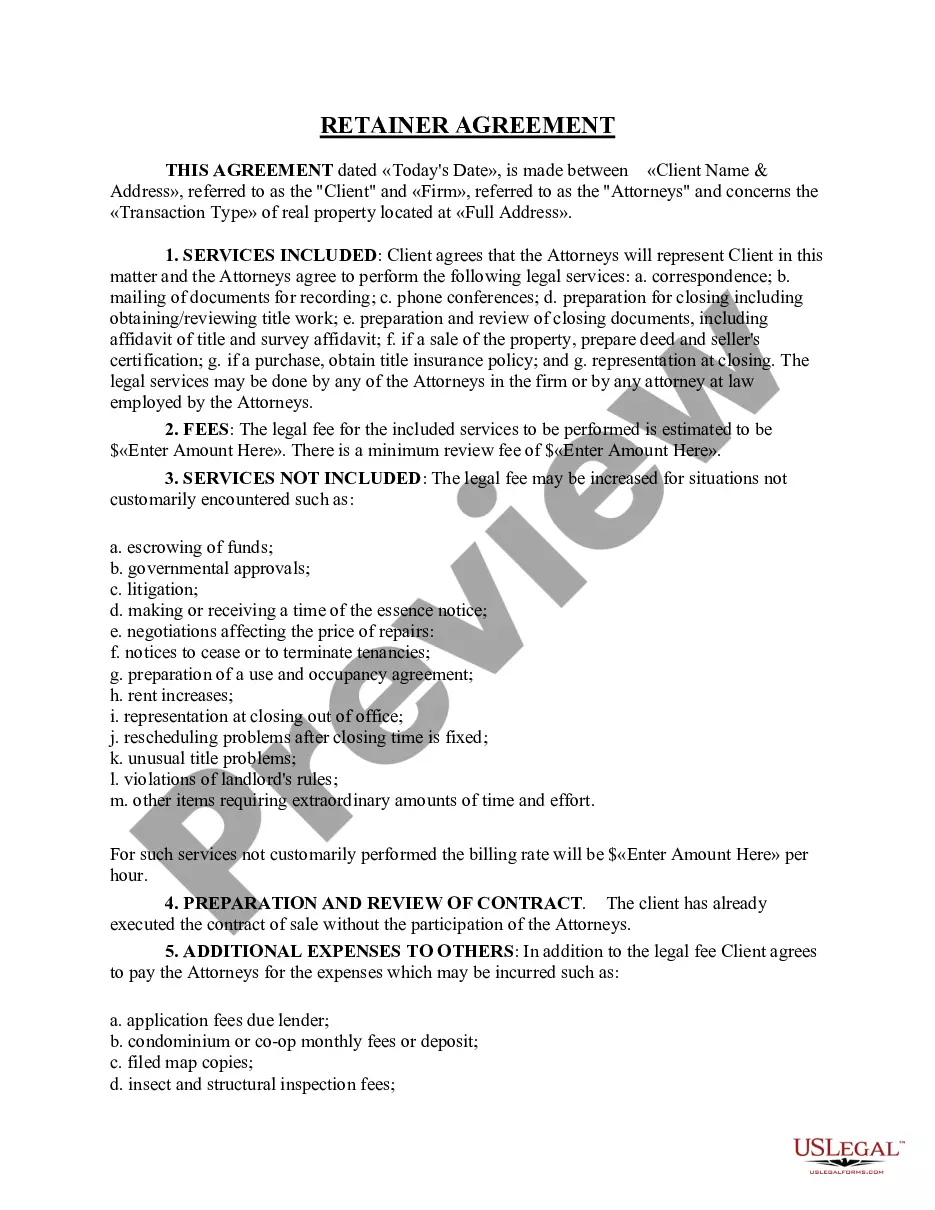
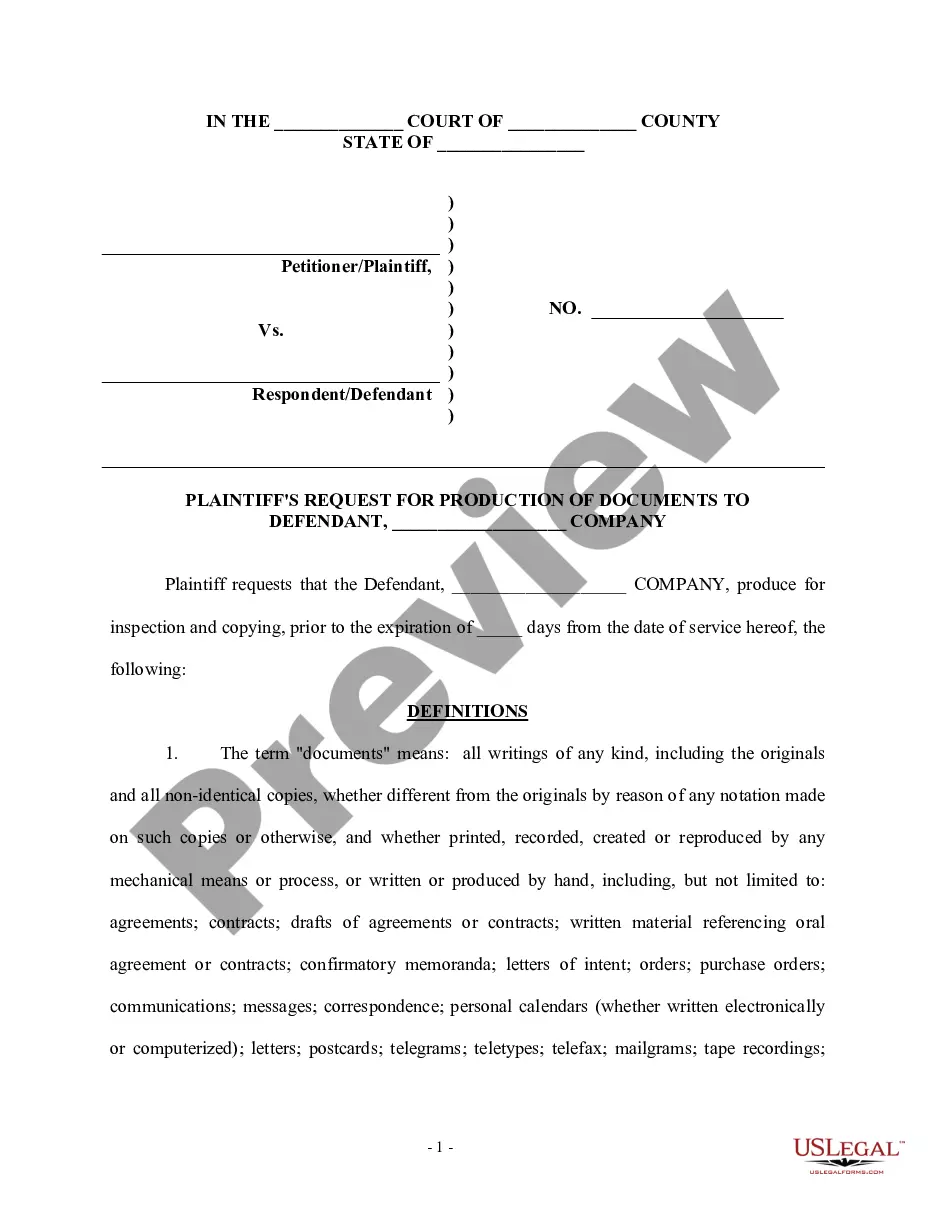
According to this agreement, client agrees to pay a retainer fee for legal services. The client and attorney agree that no attorney/client relationship will exist until the law firm has received the retainer fee from the client.
North Dakota Legal Services Agreement - Retainer
Instant download
Description
Free preview

Get your form ready online
Our built-in tools help you complete, sign, share, and store your documents in one place.
Built-in online Word editor
Make edits, fill in missing information, and update formatting in US Legal Forms—just like you would in MS Word.
Export easily
Download a copy, print it, send it by email, or mail it via USPS—whatever works best for your next step.
E-sign your document
Sign and collect signatures with our SignNow integration. Send to multiple recipients, set reminders, and more. Go Premium to unlock E-Sign.
Notarize online 24/7
If this form requires notarization, complete it online through a secure video call—no need to meet a notary in person or wait for an appointment.
Store your document securely
We protect your documents and personal data by following strict security and privacy standards.

Make edits, fill in missing information, and update formatting in US Legal Forms—just like you would in MS Word.

Download a copy, print it, send it by email, or mail it via USPS—whatever works best for your next step.

Sign and collect signatures with our SignNow integration. Send to multiple recipients, set reminders, and more. Go Premium to unlock E-Sign.

If this form requires notarization, complete it online through a secure video call—no need to meet a notary in person or wait for an appointment.

We protect your documents and personal data by following strict security and privacy standards.
Looking for another form?



How to fill out Legal Services Agreement - Retainer?
Locating the correct legal template can be a challenge.
Certainly, there are numerous templates accessible online, but how do you find the legal document you need.
Utilize the US Legal Forms website. This platform offers thousands of templates, such as the North Dakota Legal Services Agreement - Retainer, which you can use for both business and personal needs. All templates are reviewed by experts and comply with state and federal regulations.
Refrain from altering or removing any HTML tags. Only synonymize plain text outside of the HTML tags.
- If you are already a registered user, sign in to your account and click the Obtain button to access the North Dakota Legal Services Agreement - Retainer.
- Use your account to browse through the legal documents you have previously purchased.
- Navigate to the My documents section of your account and download another copy of the document you need.
- If you are a new user of US Legal Forms, here are simple instructions to follow.
- First, ensure you have selected the correct form for your jurisdiction.
- You can preview the form using the Review button and check the form details to confirm it is suitable for you.
- If the form does not meet your requirements, use the Search field to find the appropriate template.
- Once you confirm that the form is suitable, click the Purchase now button to acquire the document.
- Choose the pricing plan you prefer and enter the required information.
- Create your account and finalize your purchase using your PayPal account or credit card.
- Select the file format and download the legal template to your device.
- Complete, modify, print, and sign the acquired North Dakota Legal Services Agreement - Retainer.
- US Legal Forms is the largest repository of legal templates where you can view various document formats.
- Utilize the service to obtain professionally crafted documents that comply with state regulations.
Form popularity
FAQ
Think of a retainer contract as a work-for-hire agreement where you complete either a set amount of work for the client on a monthly basis or commit a set number of hours to their work. In exchange for your rolling services, the client pays you a fixed amount of money for an agreed number of hours each month.
A retainer is a pricing agreement between an agency and a client for a set rate and period of time. Agencies work with their client to scope out what work will likely need to be completed, agree upon a monthly allotment of hours and then work collaboratively to meet their marketing needs and goals.
The attorney cannot claim the retainer fee until he has completed the work and invoiced the client. Any remaining retainer fee after paying the hourly attorney fees should be returned to the client.
You may have signed a retainer agreement or a contract with an attorney, believing that he or she was the best choice, only to have communication break down or decide that you are simply not happy with your representation. Fortunately, California law permits you to terminate your contract for legal representation.
In the example above, the retainer is considered unearned until the court case is closed and finalized. These unearned fees do not belong to the person performing the tasks?in this case, the lawyer?until work begins. Any unearned retainer fees that are not used can be returned to the client.
Finally, a retainer fee is sometimes considered a down payment on legal services that the client will need. This means the legal fees will be subtracted from the retainer until the retainer is used up. The lawyer would then bill you for any additional time spent on your case or ask you to pay an additional retainer.
The steps often are: Review the Retainer Agreement. ... Hire a New Attorney. ... Send a Termination Letter to Fire an Attorney. ... Finalize the Arrangement Regarding the Transfer of Files. ... Inform the Court.
Be flexible. Be prepared to negotiate the terms of the retainer agreement. If the client is resistant to agreeing to a retainer, try offering a lower fee in exchange for a longer contract term. Or, propose a trial period to start off the relationship.