North Dakota Boarding Stable Agreement - Horse Equine Forms
What is this form?
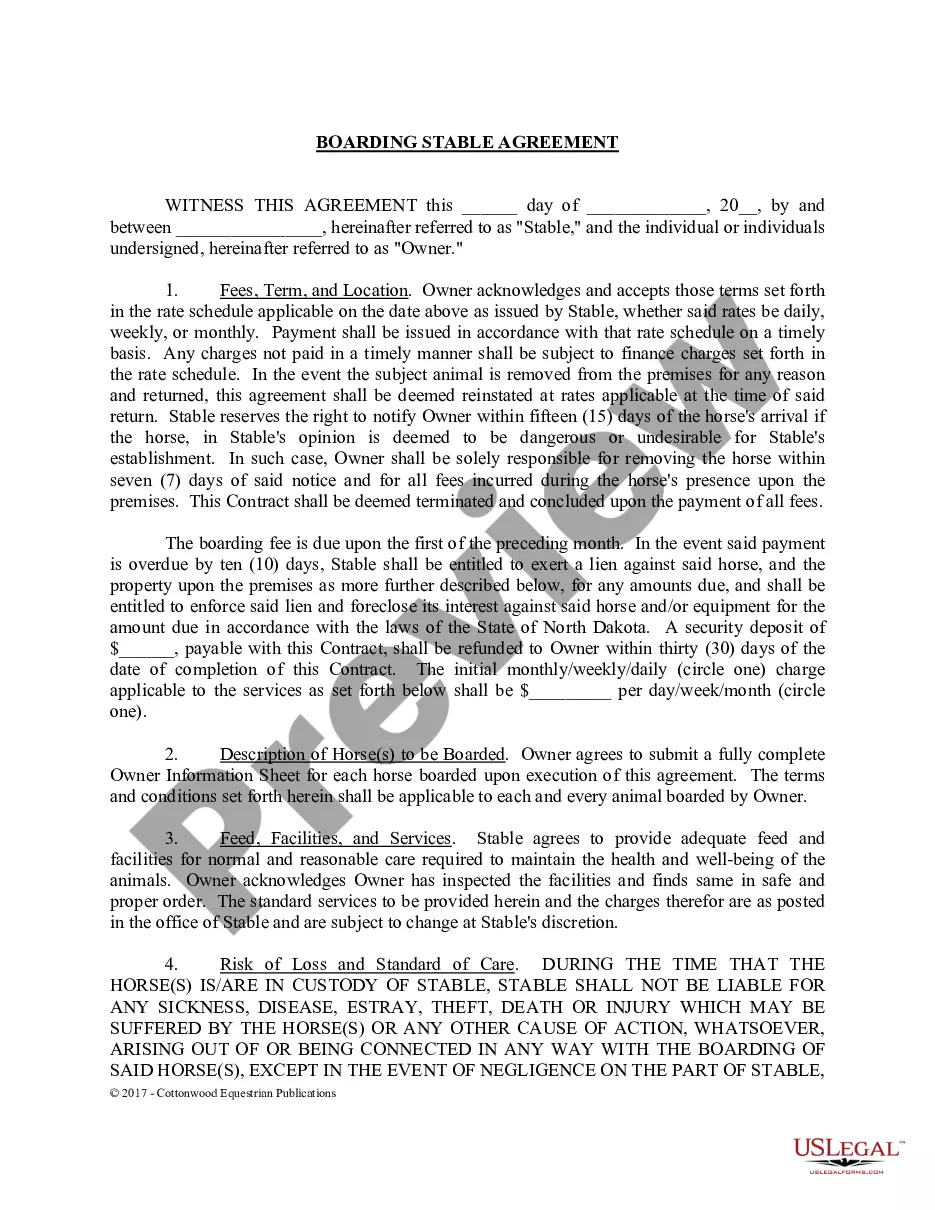
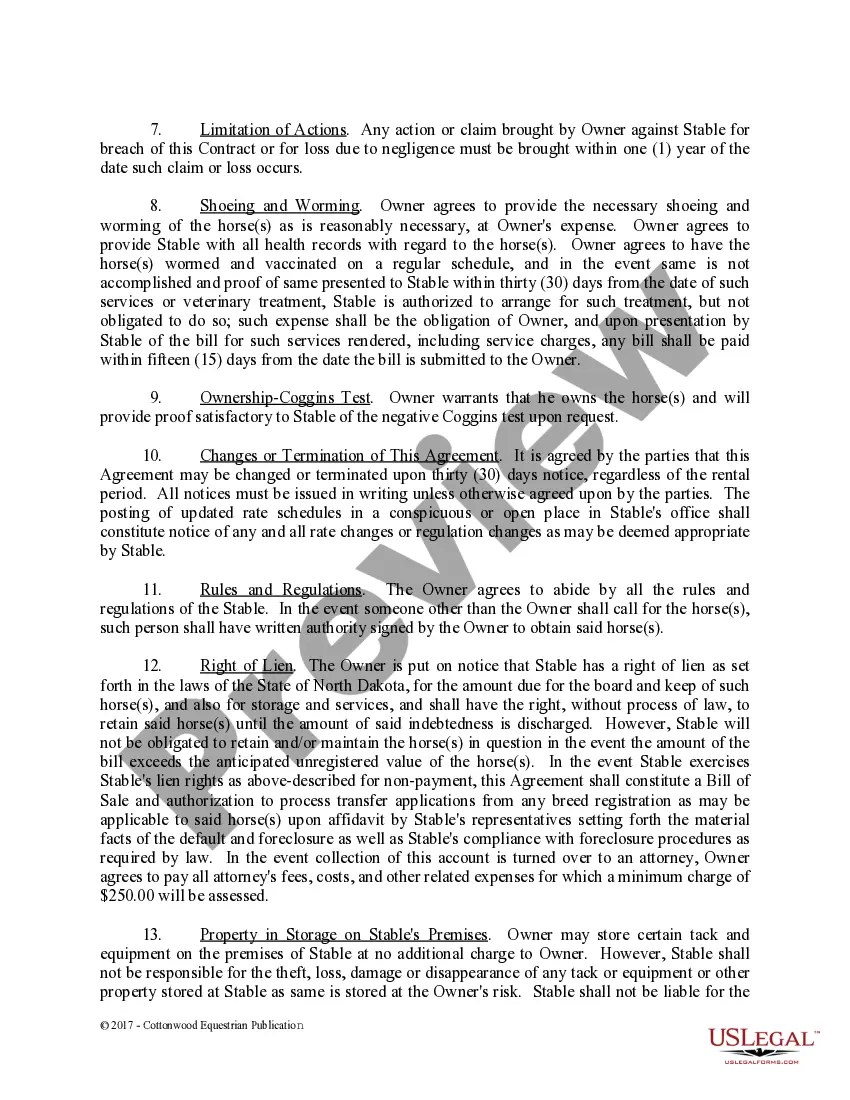
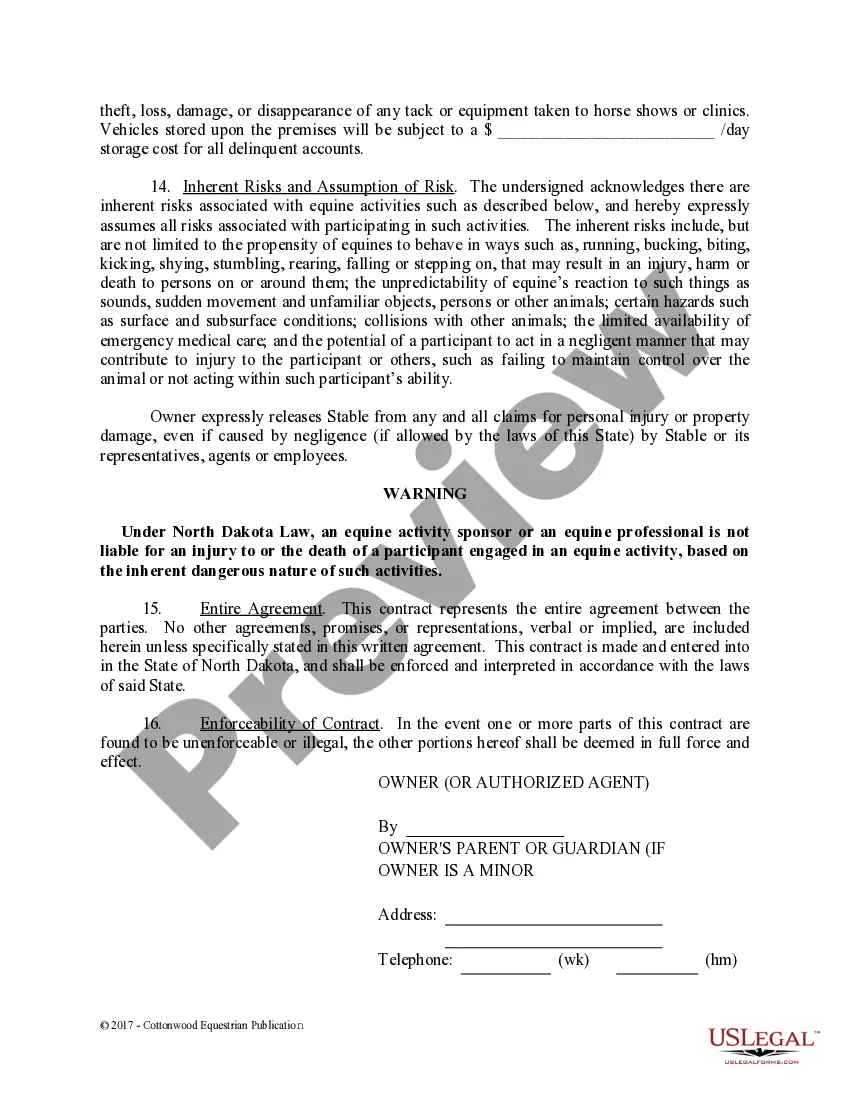
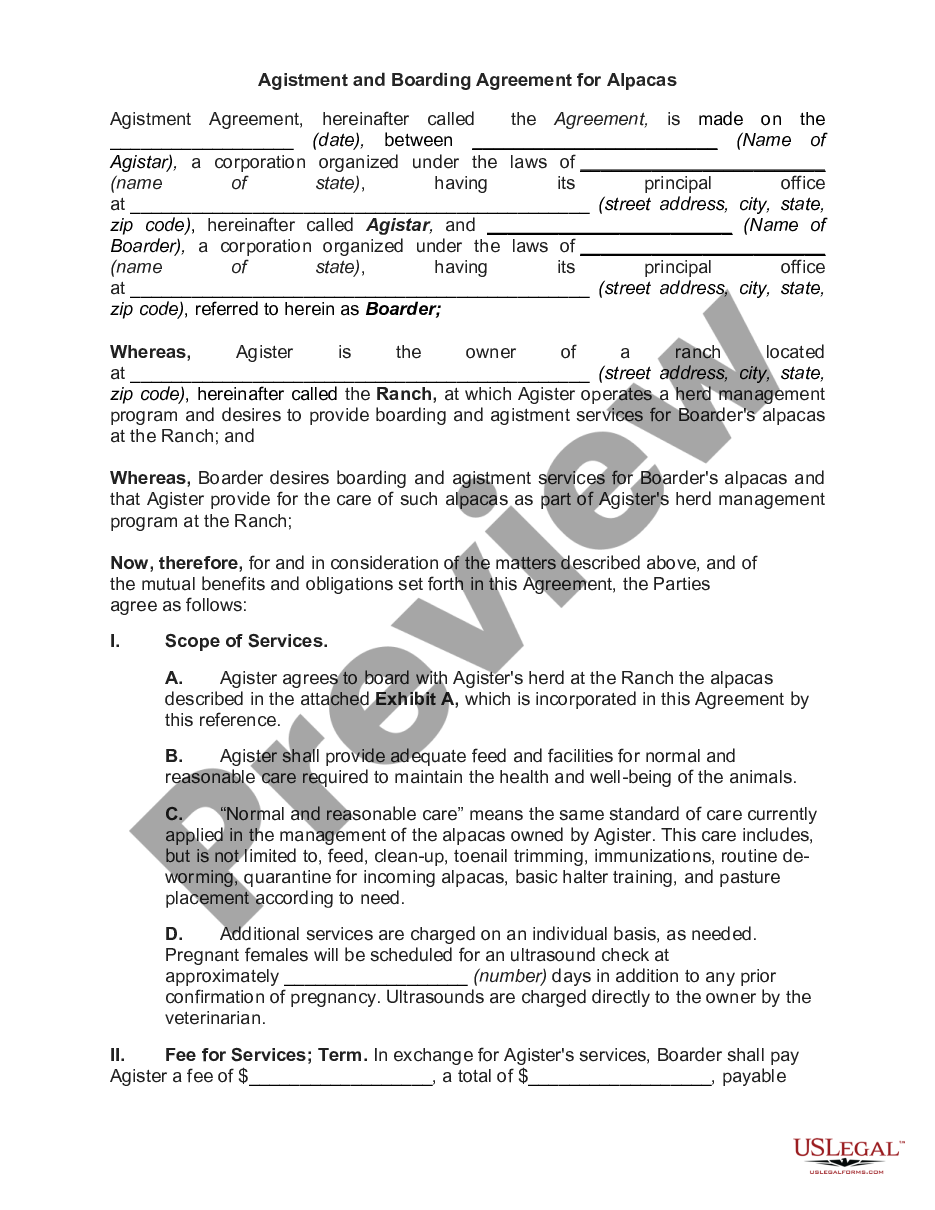
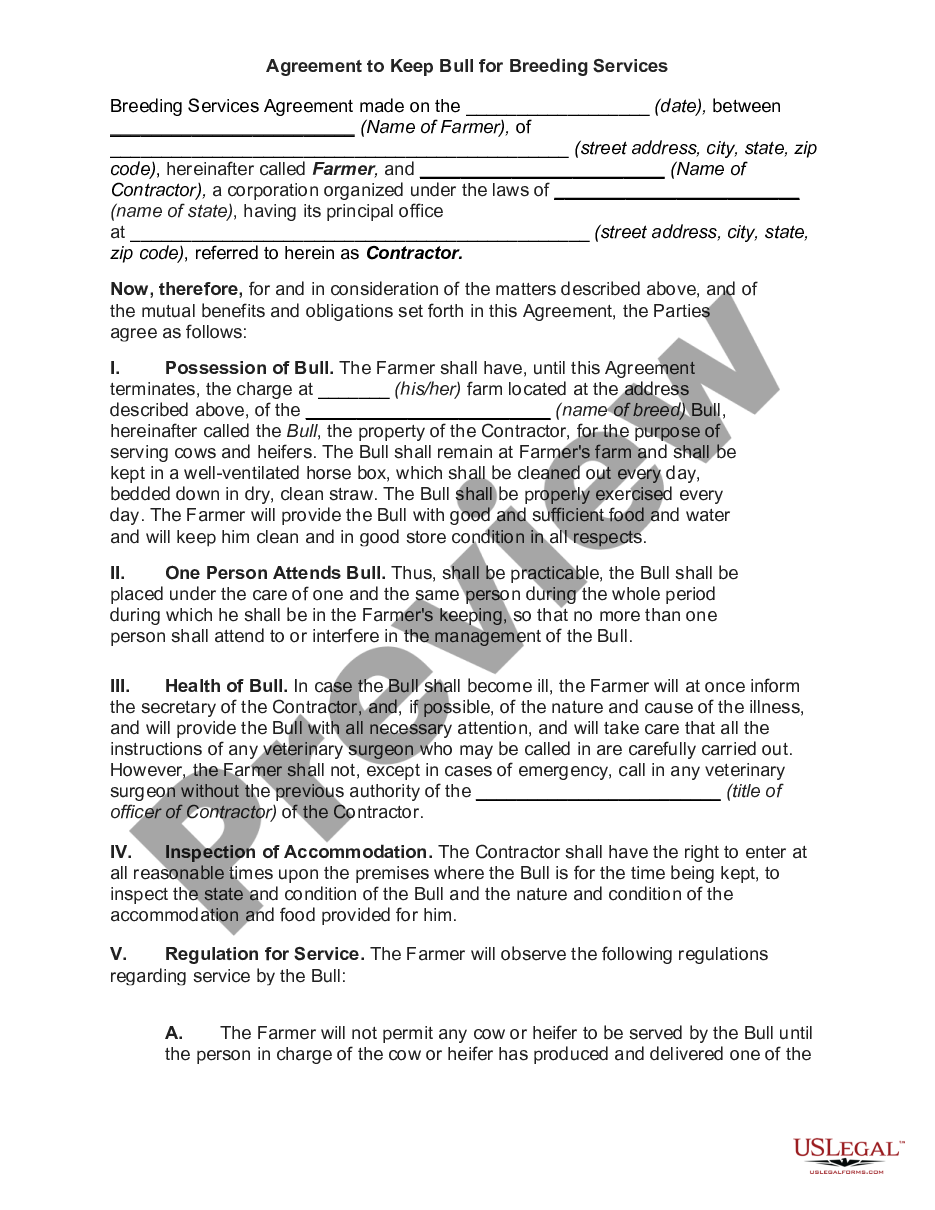
The Boarding Stable Agreement is a legal document that establishes the relationship between a stable owner and a horse owner. This form outlines the terms and conditions for boarding horses, including payment, care, and liability. It distinguishes itself from other equine agreements by specifically addressing the responsibilities of each party regarding fees, emergency care, and risk management during the boarding period.
Main sections of this form
- Fees, term, and location details for boarding services.
- A description of the horse(s) to be boarded.
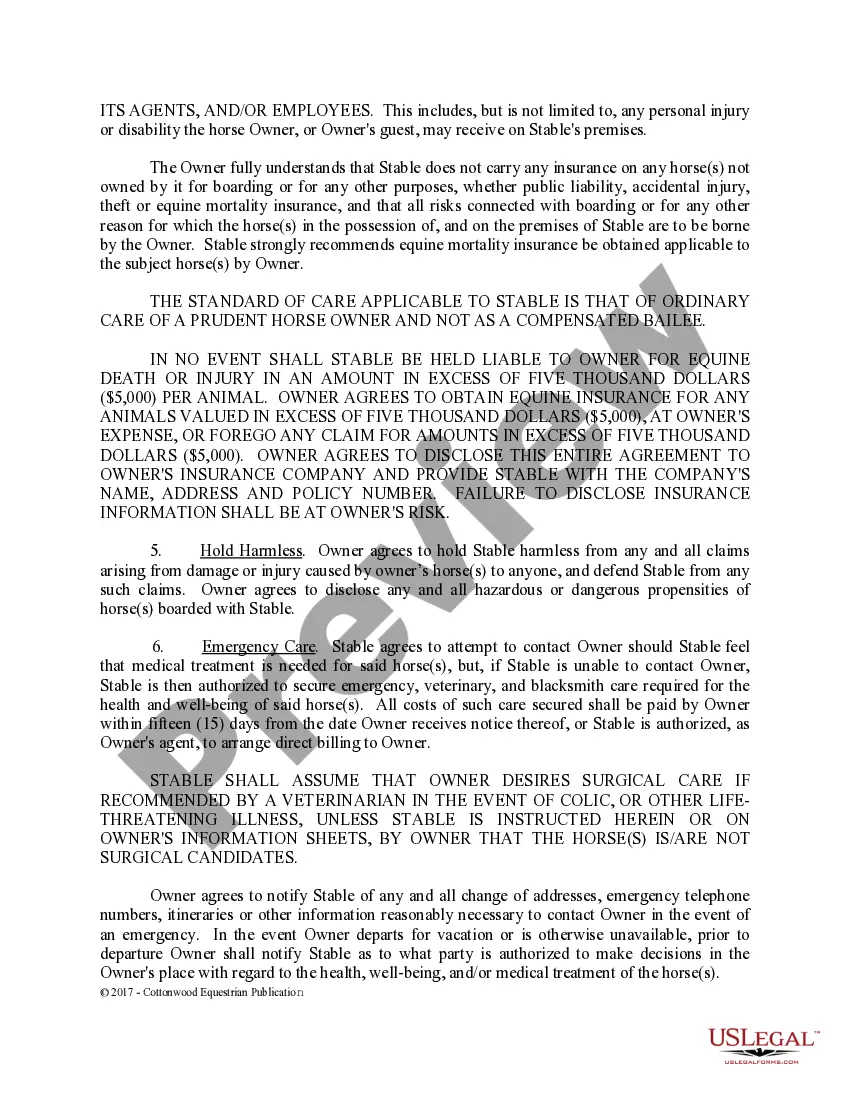
- Standard of care and risk of loss clauses.
- Emergency care procedures and obligations.
- Owner's responsibilities regarding medical care and insurance for the horse(s).
- Notice of stable's lien rights and termination conditions.
When this form is needed
This Boarding Stable Agreement should be used when a horse owner needs to arrange for the boarding of their horse at a stable. It is essential when establishing clear expectations regarding care, payment, and liability, particularly if the horse will stay for an extended period. This form is useful for new clients seeking boarding services or existing owners needing to renew their agreements.
Who needs this form
- Horse owners looking to board their horses at a stable.
- Stable owners needing a formalized agreement with horse owners.
- Individuals or businesses engaged in equine services or activities.
How to prepare this document
- Identify the parties: Enter the names of the stable owner and horse owner.
- Specify the fees and terms: Fill in details regarding the boarding charges and payment schedule.
- Describe the horse(s): Provide relevant details for each horse being boarded.
- Detail emergency care preferences: Indicate how you want to handle medical emergencies for the horse(s).
- Provide insurance information: Disclose any existing equine insurance coverage to the stable owner.
- Sign and date the agreement: Ensure all parties sign to make the agreement legally binding.
Notarization requirements for this form
This form does not typically require notarization unless specified by local law.
Get your form ready online
Our built-in tools help you complete, sign, share, and store your documents in one place.
Make edits, fill in missing information, and update formatting in US Legal Forms—just like you would in MS Word.
Download a copy, print it, send it by email, or mail it via USPS—whatever works best for your next step.
Sign and collect signatures with our SignNow integration. Send to multiple recipients, set reminders, and more. Go Premium to unlock E-Sign.
If this form requires notarization, complete it online through a secure video call—no need to meet a notary in person or wait for an appointment.
We protect your documents and personal data by following strict security and privacy standards.

Make edits, fill in missing information, and update formatting in US Legal Forms—just like you would in MS Word.

Download a copy, print it, send it by email, or mail it via USPS—whatever works best for your next step.

Sign and collect signatures with our SignNow integration. Send to multiple recipients, set reminders, and more. Go Premium to unlock E-Sign.

If this form requires notarization, complete it online through a secure video call—no need to meet a notary in person or wait for an appointment.

We protect your documents and personal data by following strict security and privacy standards.
Mistakes to watch out for
- Not reading the entire agreement before signing.
- Failing to provide accurate information about the horse(s).
- Overlooking the insurance requirements outlined in the agreement.
- Neglecting to specify emergency contact information adequately.
Why use this form online
- Convenient access to legal documents from anywhere.
- Editable templates that allow customization to meet individual needs.
- Immediate download for quick use without waiting for physical copies.
- Designed by licensed attorneys to ensure compliance with legal standards.
Legal use & context
- This contract represents the entire agreement between the stable and the horse owner.
- It is legally enforceable and designed to protect the rights and responsibilities of both parties.
- It includes limitation clauses to reduce liabilities for the stable in certain situations.
Main things to remember
- The Boarding Stable Agreement is crucial for legally binding arrangements between stable and horse owners.
- Terms related to fees, care, and liabilities must be clearly defined and agreed upon.
- Filling out this form correctly prevents common legal mistakes and misunderstandings.
Looking for another form?
Form popularity
FAQ
The cost of boarding averages $400 to $500 per month but can go as high as $1,200 to $2,500 in metropolitan areas. Services such as mucking out stalls, feeding and turning out your horse to pasture may not be included in the price. For those lucky enough to own sufficient land, there are still costs to consider.
If you have the space and facility to keep your equines at home, it's more cost effective and offers a number of advantages that boarding does not.Keeping a horse on full board offers owners virtually hassle-free maintenance. Full board includes, at the very least, feeding, stall cleaning and turnout.
Equine/Stable Liability will be required; Care, Custody, Control to provide coverage for the non-owned boarded horses; General Liability and Property insurance.
Numbers Game. The reality is that boarding facilities operate on slim profit margins. By the time costs are considered for hay, grain, bedding, labor for feeding, cleaning stalls, doing turnout, etc., the board fees typically do not leave a lot left over, Sherrick-von Schiller said.
Boarding a horse can cost anywhere from $100 per month for pasture board, with no inside stabling to over $1000 per month in barns with stalls, individual turn-out, arenas and other amenities close to urban areas.
The average cost for horse full boarding is between $300 to $700 per month. However, it can be much higher depending on the location. In some areas, it can cost as much as $2000 to $3000.
Numbers Game. The reality is that boarding facilities operate on slim profit margins. By the time costs are considered for hay, grain, bedding, labor for feeding, cleaning stalls, doing turnout, etc., the board fees typically do not leave a lot left over, Sherrick-von Schiller said.Labor costs are also significant.
Full board will include all the necessities for the horse, plus a stall with full turn out to pasture. Full board does not require owners to visit their horses every day; instead, staff at the barn clean the stall, feed the horse, and bring him in/out of the pasture.