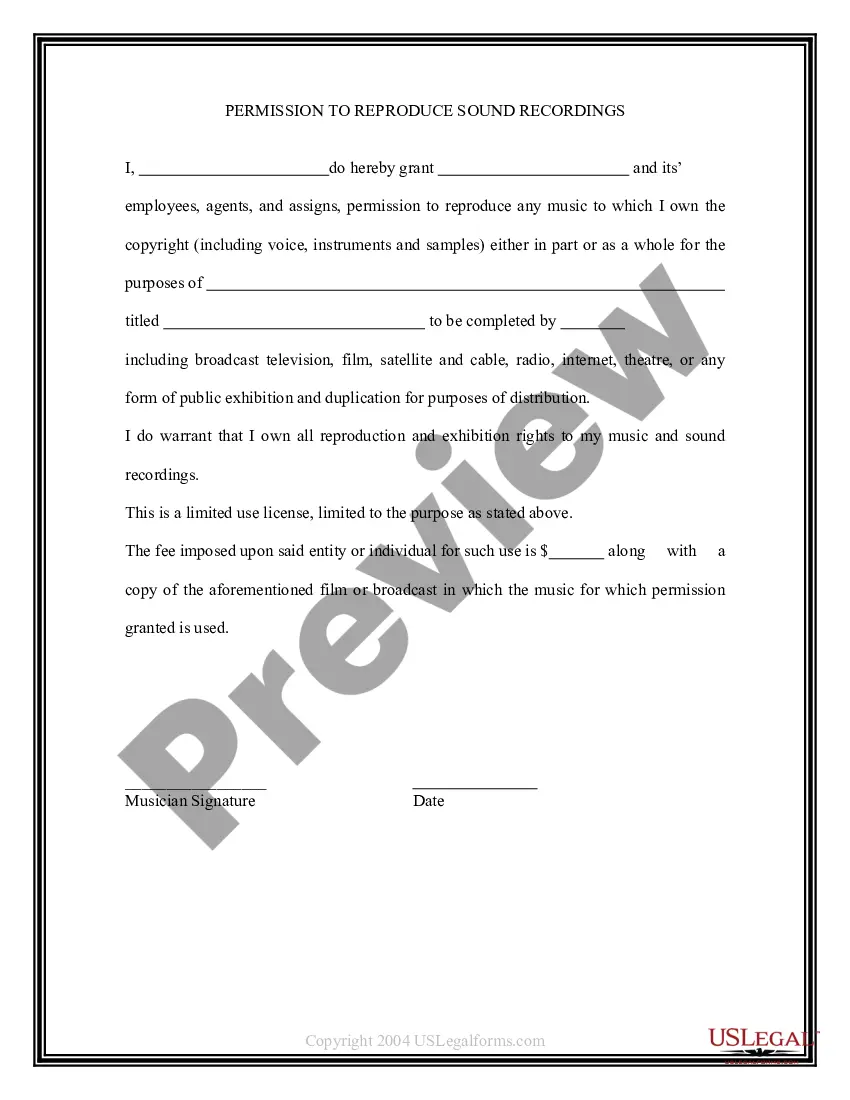
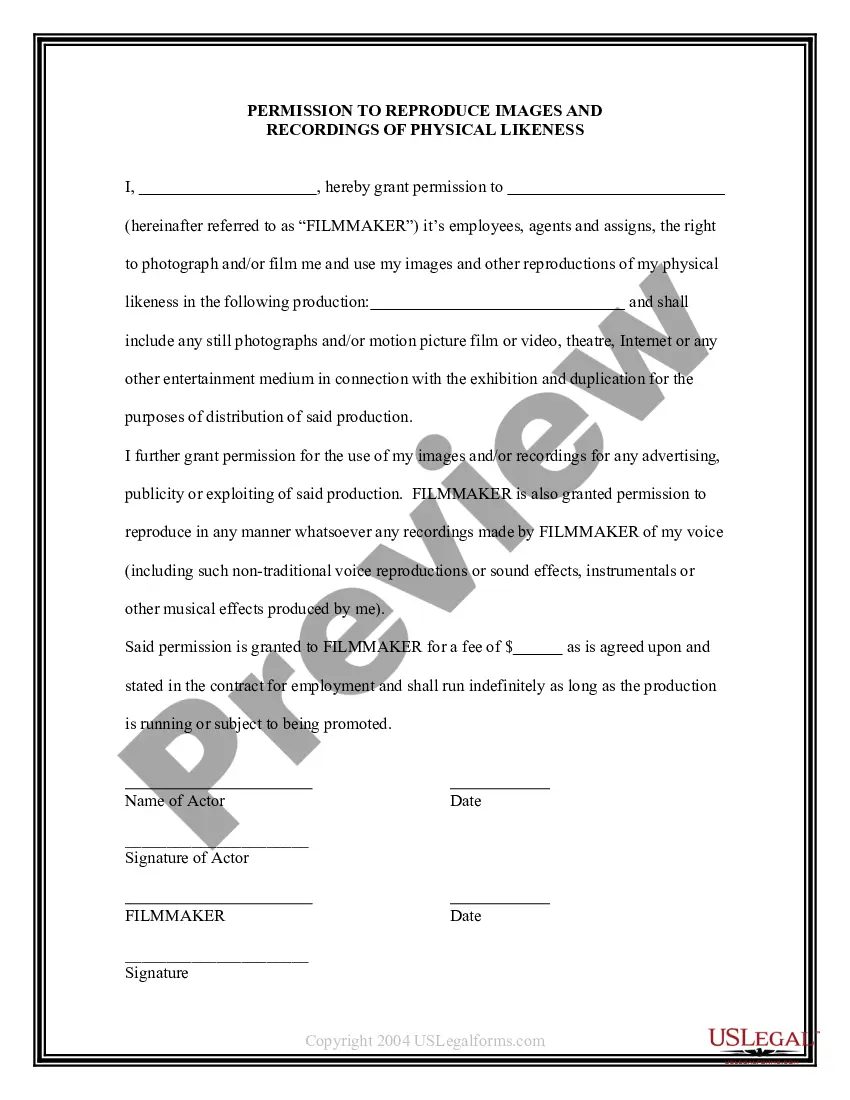
This is a form signed by a musician or owner of music granting permission to reproduce copyrighted music for use in a film, television, Internet, radio etc.
North Carolina Permission To Reproduce Sound Recordings
State:
Multi-State
Control #:
US-PRM-23
Format:
Word;
Rich Text
Instant download
Description

How to fill out Permission To Reproduce Sound Recordings?
You can spend time online searching for the valid document template that meets the federal and state requirements you need.
US Legal Forms offers numerous legitimate forms that are assessed by specialists.
It is easy to download or print the North Carolina Permission To Reproduce Sound Recordings from our platform.
- If you already possess a US Legal Forms account, you may Log In and click the Download button.
- Subsequently, you can complete, modify, print, or sign the North Carolina Permission To Reproduce Sound Recordings.
- Every legal document template you acquire is yours to keep indefinitely.
- To obtain another copy of any purchased form, navigate to the My documents tab and click the relevant button.
- If you are using the US Legal Forms website for the first time, follow the straightforward instructions below.
- First, ensure you have selected the correct document template for the county/town of your choice.
- Review the form description to confirm you have chosen the right form.
- If available, utilize the Preview button to view the document template as well.
- If you wish to find another version of your form, use the Search field to locate the template that suits your needs and requirements.
- Once you have found the template you desire, click Get now to proceed.
- Select the pricing plan you prefer, enter your details, and create an account on US Legal Forms.
- Complete the payment process. You can use your credit card or PayPal account to purchase the legitimate form.
- Choose the format of your document and download it to your device.
- Make alterations to your document if necessary. You can complete, modify, sign, and print North Carolina Permission To Reproduce Sound Recordings.
- Download and print thousands of document layouts using the US Legal Forms site, which offers the largest selection of legitimate forms.
- Utilize professional and state-specific templates to address your business or personal needs.
Form popularity
FAQ
The NC Electronic Surveillance Act states you cannot record audio without the consent of at least one person involved in the conversation. This means that if you speak to someone at your door through the app, it is fine to share that recording.
North Carolina's wiretapping law is a "one-party consent" law. North Carolina makes it a crime to intercept or record any "wire, oral, or electronic communication" unless one party to the conversation consents.
A traditional surveillance camera system with video cables and a DVR typically doesn't have a microphone. You'll need to buy specific audio surveillance cameras and DVRs to record audio with these systems.
Criminal penaltiesIllegally recording an in-person or electronic conversation is a felony offense. N.C. Gen. Stat. § 15A-287.
The general rule in North Carolina is that an individual who has the consent of one of the parties to either an in-person conversation or electronic communication can lawfully record it or disclose its contents.
A recording may be unlawful (under civil law) if it constitutes a misuse of private information, a breach of confidence, a breach of GDPR or Data Protection regulations. One of the questions for the court is whether the individual had a reasonable expectation of privacy in the particular circumstances.
North Carolina's wiretapping law is a "one-party consent" law. North Carolina makes it a crime to intercept or record any "wire, oral, or electronic communication" unless one party to the conversation consents. N.C. Gen.
North Carolina recording law stipulates that it is a one-party consent state. In North Carolina, it is a criminal offense to use any device to record or share communications, whether they are wire, oral or electronic, without the consent of at least one person taking part in the communication.