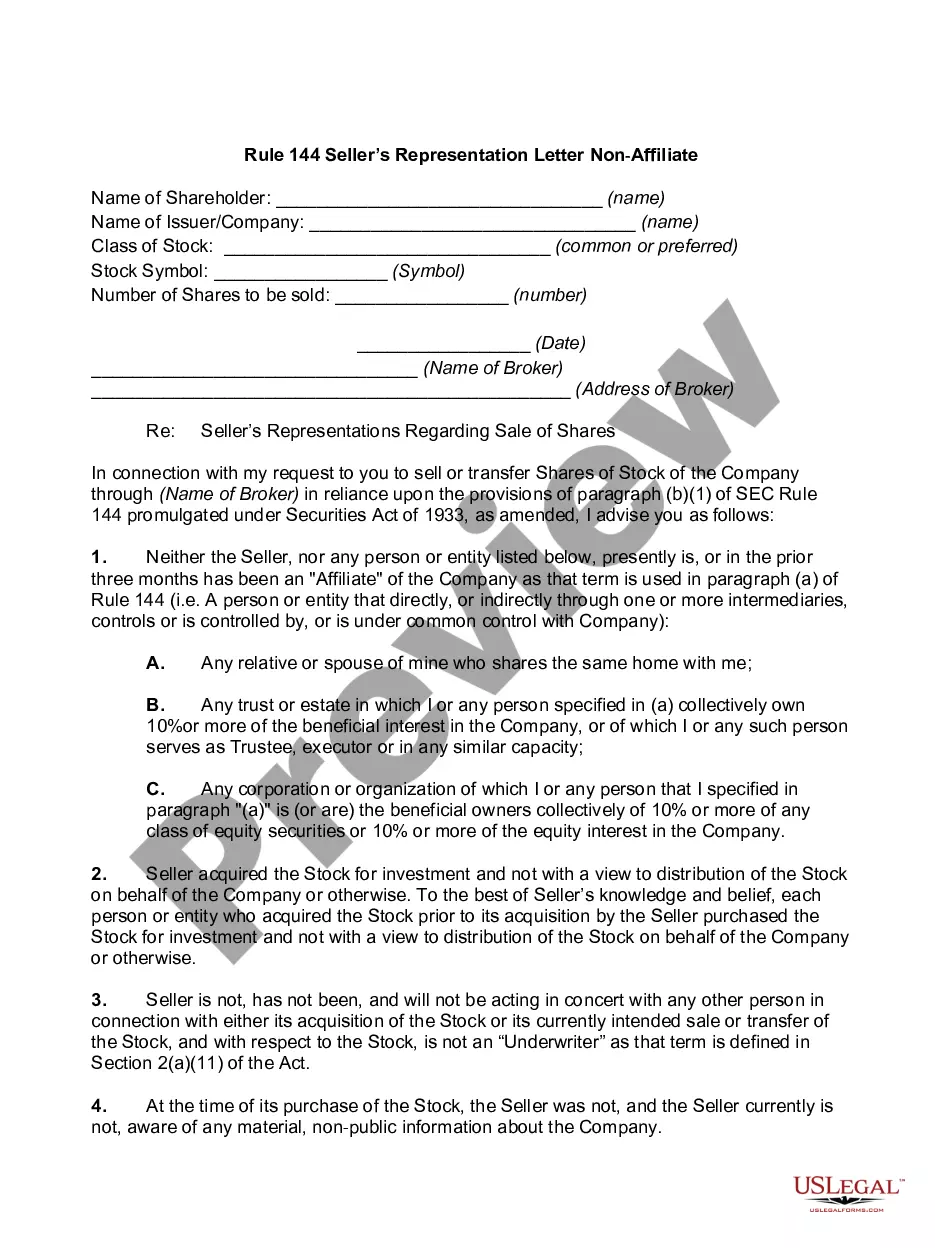
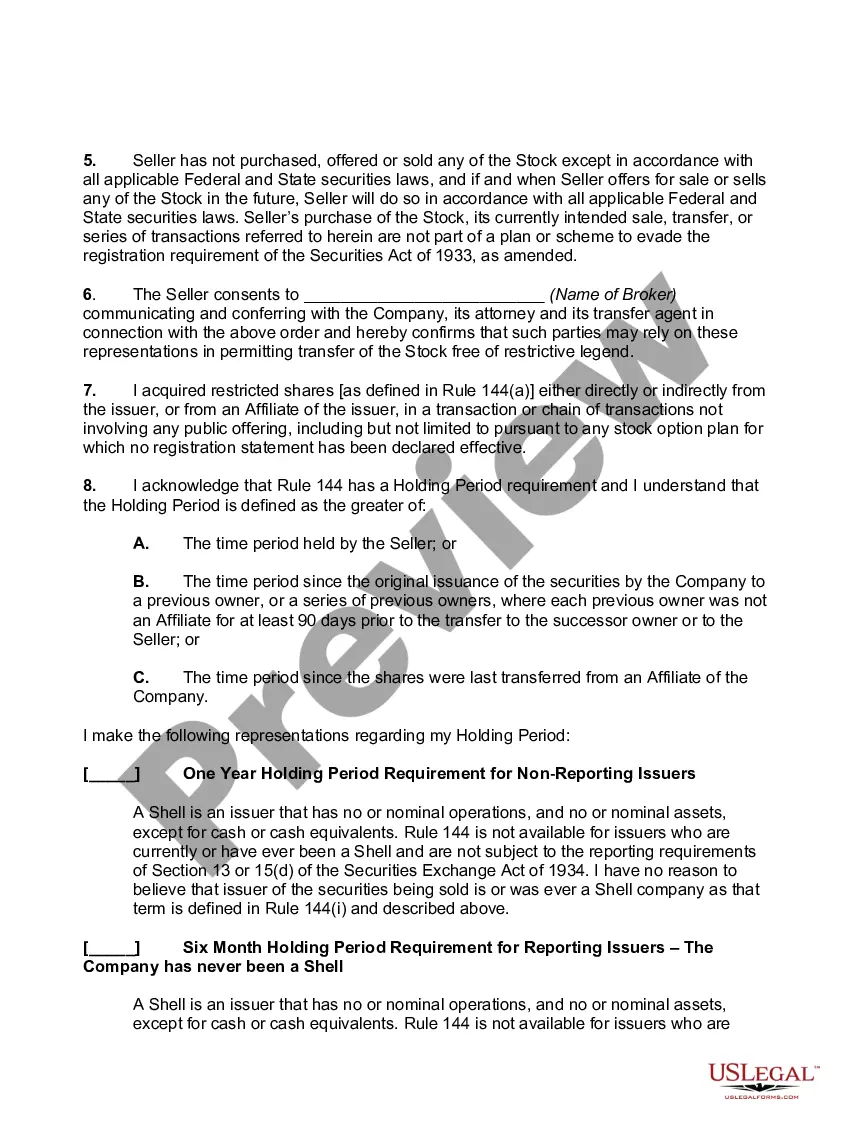
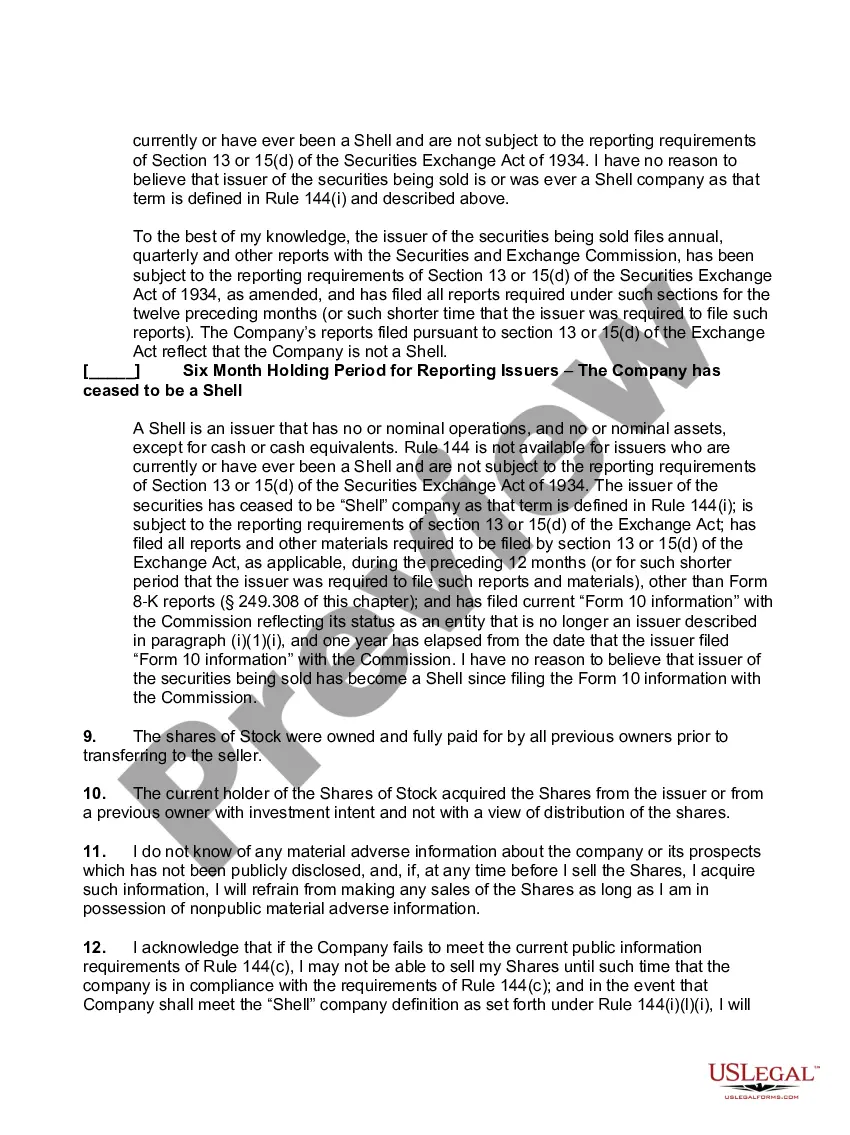
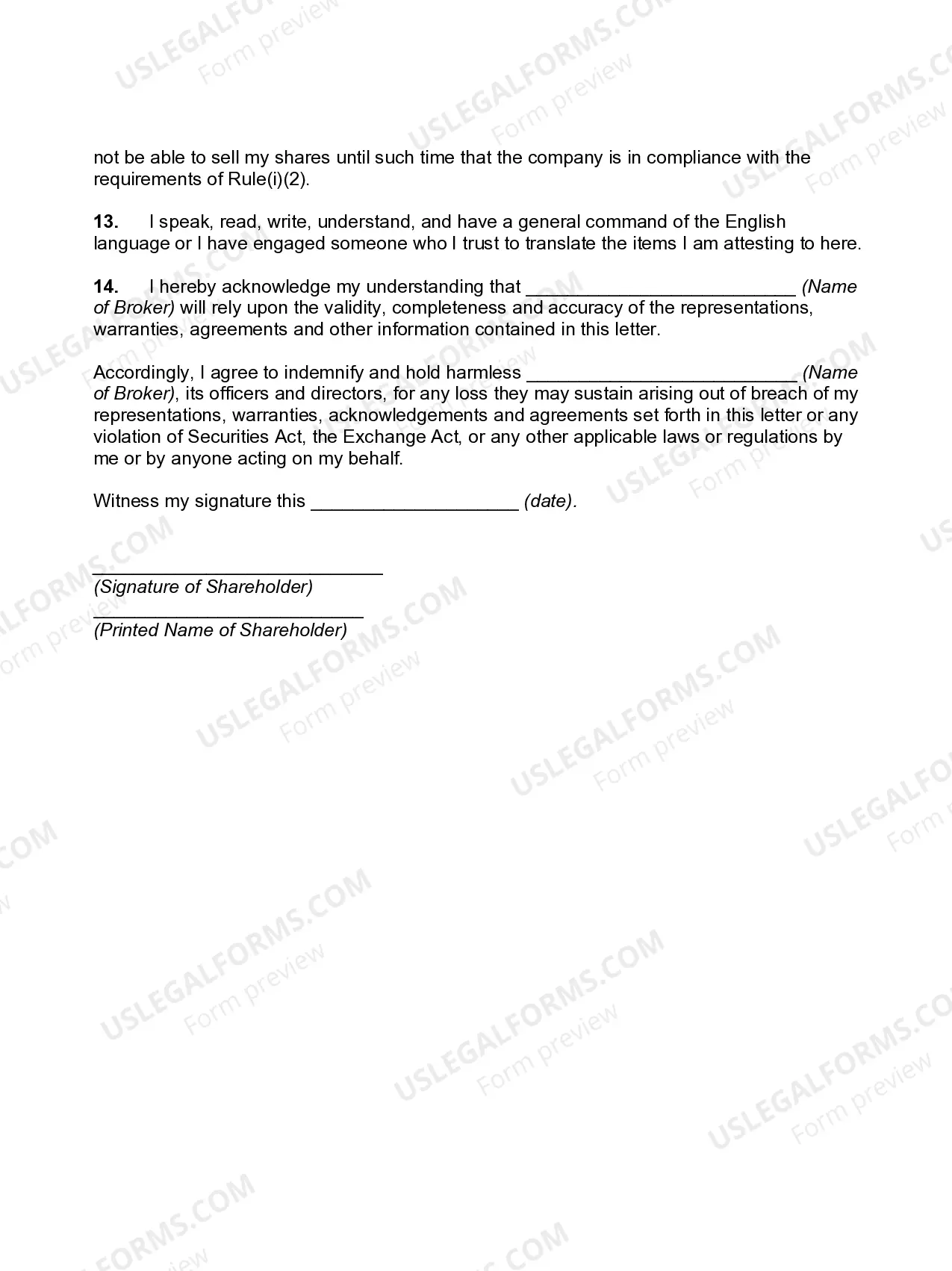
North Carolina Rule 144 Seller's Representation Letter Non-Affiliate
Description

Get your form ready online
Our built-in tools help you complete, sign, share, and store your documents in one place.
Make edits, fill in missing information, and update formatting in US Legal Forms—just like you would in MS Word.
Download a copy, print it, send it by email, or mail it via USPS—whatever works best for your next step.
Sign and collect signatures with our SignNow integration. Send to multiple recipients, set reminders, and more. Go Premium to unlock E-Sign.
If this form requires notarization, complete it online through a secure video call—no need to meet a notary in person or wait for an appointment.
We protect your documents and personal data by following strict security and privacy standards.

Make edits, fill in missing information, and update formatting in US Legal Forms—just like you would in MS Word.

Download a copy, print it, send it by email, or mail it via USPS—whatever works best for your next step.

Sign and collect signatures with our SignNow integration. Send to multiple recipients, set reminders, and more. Go Premium to unlock E-Sign.

If this form requires notarization, complete it online through a secure video call—no need to meet a notary in person or wait for an appointment.

We protect your documents and personal data by following strict security and privacy standards.
Looking for another form?
How to fill out Rule 144 Seller's Representation Letter Non-Affiliate?
If you need to access extensive, download, or print sanctioned document templates, utilize US Legal Forms, the largest selection of legal forms available online.
Take advantage of the site's user-friendly and convenient search feature to find the documents you require.
A range of templates for business and personal purposes are organized by categories and jurisdictions, or keywords.
Step 4. Once you have found the form you desire, click the Get Now button. Choose your preferred pricing plan and enter your details to create an account.
Step 5. Complete the transaction. You can use your credit card or PayPal account to finalize the payment.
- Utilize US Legal Forms to locate the North Carolina Rule 144 Seller's Representation Letter Non-Affiliate in just a few clicks.
- If you are already a US Legal Forms user, Log In to your account and click the Download option to obtain the North Carolina Rule 144 Seller's Representation Letter Non-Affiliate.
- You can also access forms you previously downloaded in the My documents tab of your account.
- If this is your first time using US Legal Forms, follow the steps outlined below.
- Step 1. Confirm that you have selected the form for the correct city/state.
- Step 2. Use the Preview option to review the content of the form. Be sure to read the summary.
- Step 3. If you are not satisfied with the form, use the Search field at the top of the screen to find alternative versions of the legal form template.
Form popularity
FAQ
Rule 144(f) allows securities to be sold directly to market makers, as that term is defined in Section 3(a)(38) of the Exchange Act. The market maker exception will apply only if the market-making firm purchases the Rule 144 securities as principal.
Rule 144 at (a)(1) defines an affiliate of an issuing company as a person that directly, or indirectly through one or more intermediaries, controls, or is controlled by, or is under common control with, such issuer.
Rule 144 is the most common exemption that allows the resale of unregistered securities in the public stock market, which is otherwise illegal in the U.S. The regulation gives a specific set of conditions that a shareholder must meet in order to sell unregistered, "restricted," or "controlled" securities in the public
(Rule 144 Resale) Summary. This form of broker's representation letter may be used in connection with a resale of restricted securities by an affiliate of the issuer in reliance on Rule 144 (17 C.F.R. § 230.144) under the Securities Act of 1933, as amended (Securities Act).
Rule 144 provides an exemption and permits the public resale of restricted or control securities if a number of conditions are met, including how long the securities are held, the way in which they are sold, and the amount that can be sold at any one time.
affiliate of a nonreporting issuer must hold the securities for one year before any public resale. After one year, a nonaffiliate may freely resell such securities without regard to any of the Rule 144 conditions.
Rule 144 does not apply to private transactions, including sales, gifts, estate distributions and pledges, but does apply to the purchaser, donee, beneficiary and pledgee, when they sell the stock into the public market.
Rule 144 applies to the sale into the public securities market of restricted stock by anyone and of unrestricted stock sold by a controlling person (affiliate) of an issuing company. Sales into the public market involve a brokerage firm and are not face-to-face sales negotiated between a seller and a buyer.
Counsel delivering an opinion as part of a Rule 144 sale typically relies on, among other things, a representation letter from the seller to establish certain facts underlying the opinion, and the seller's broker and the issuer's transfer agent may require a similar representation letter.