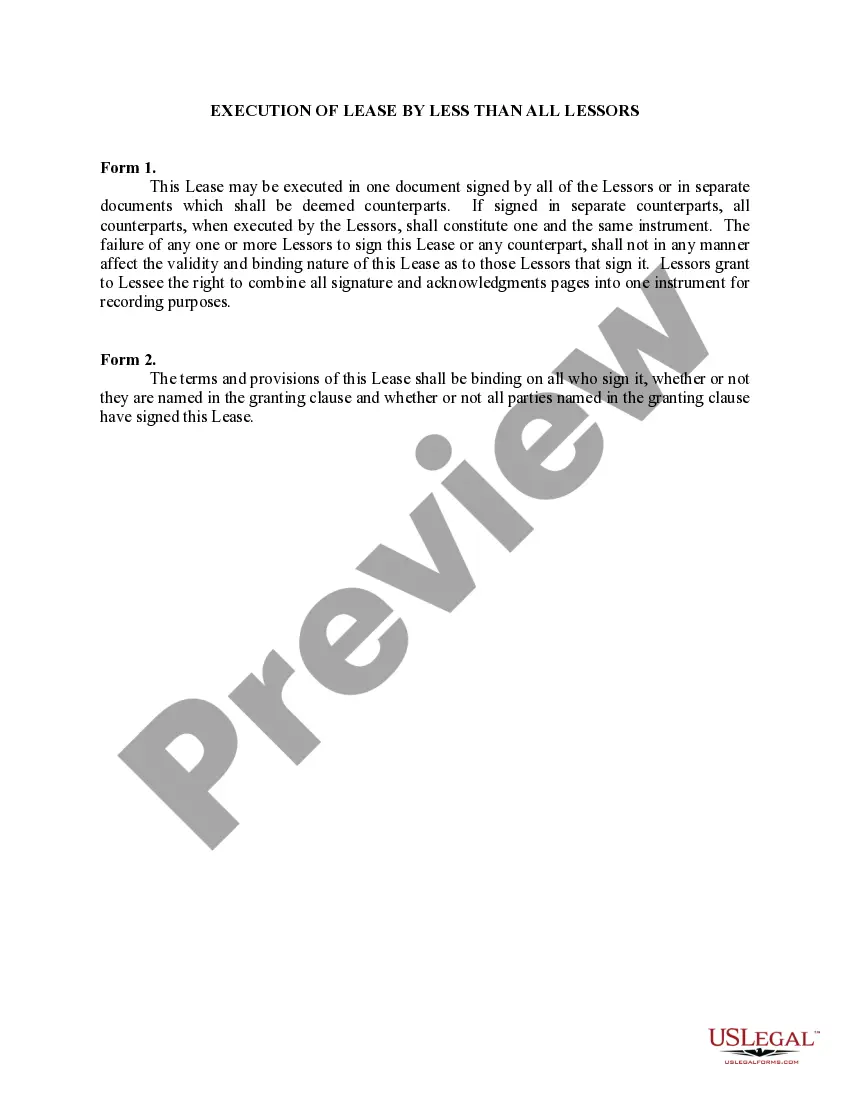
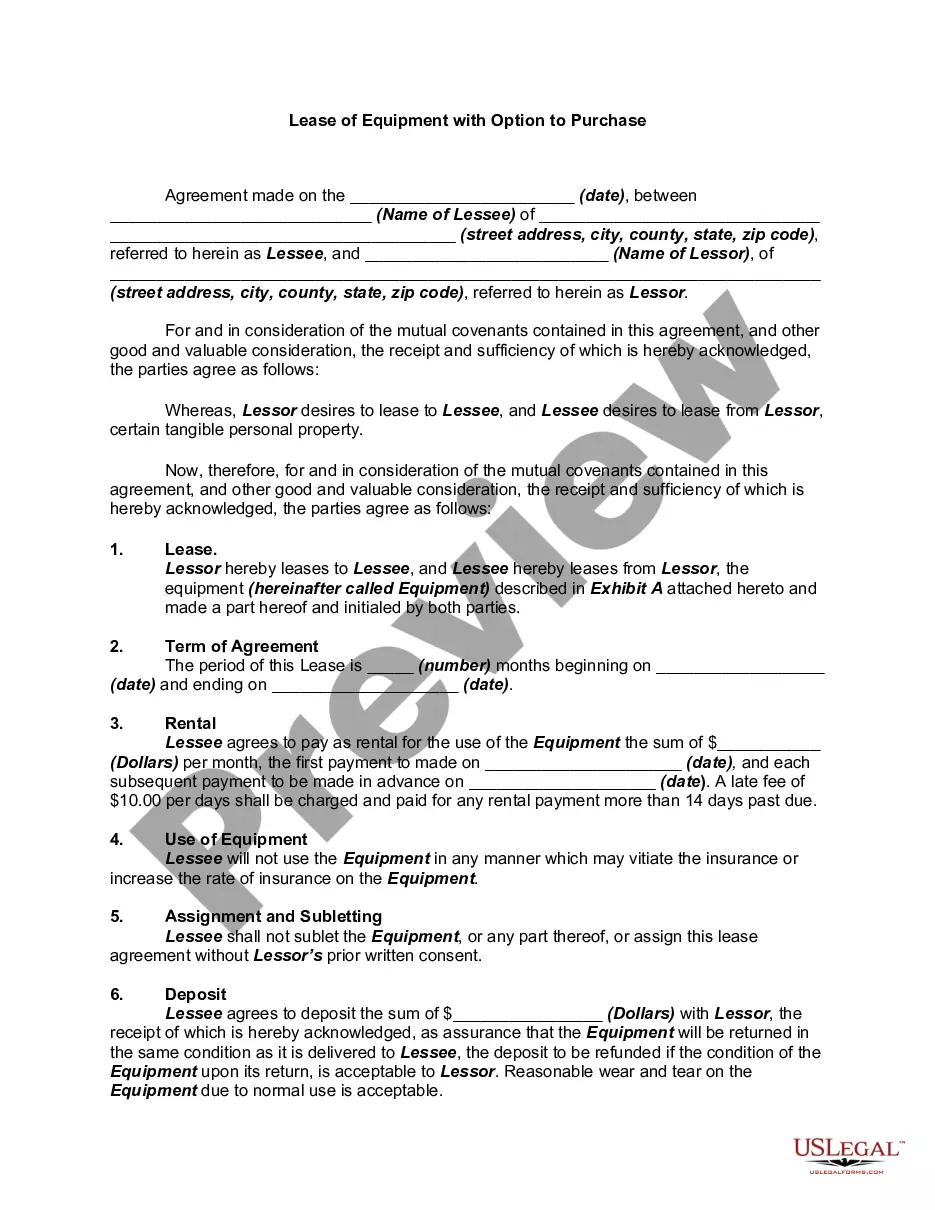
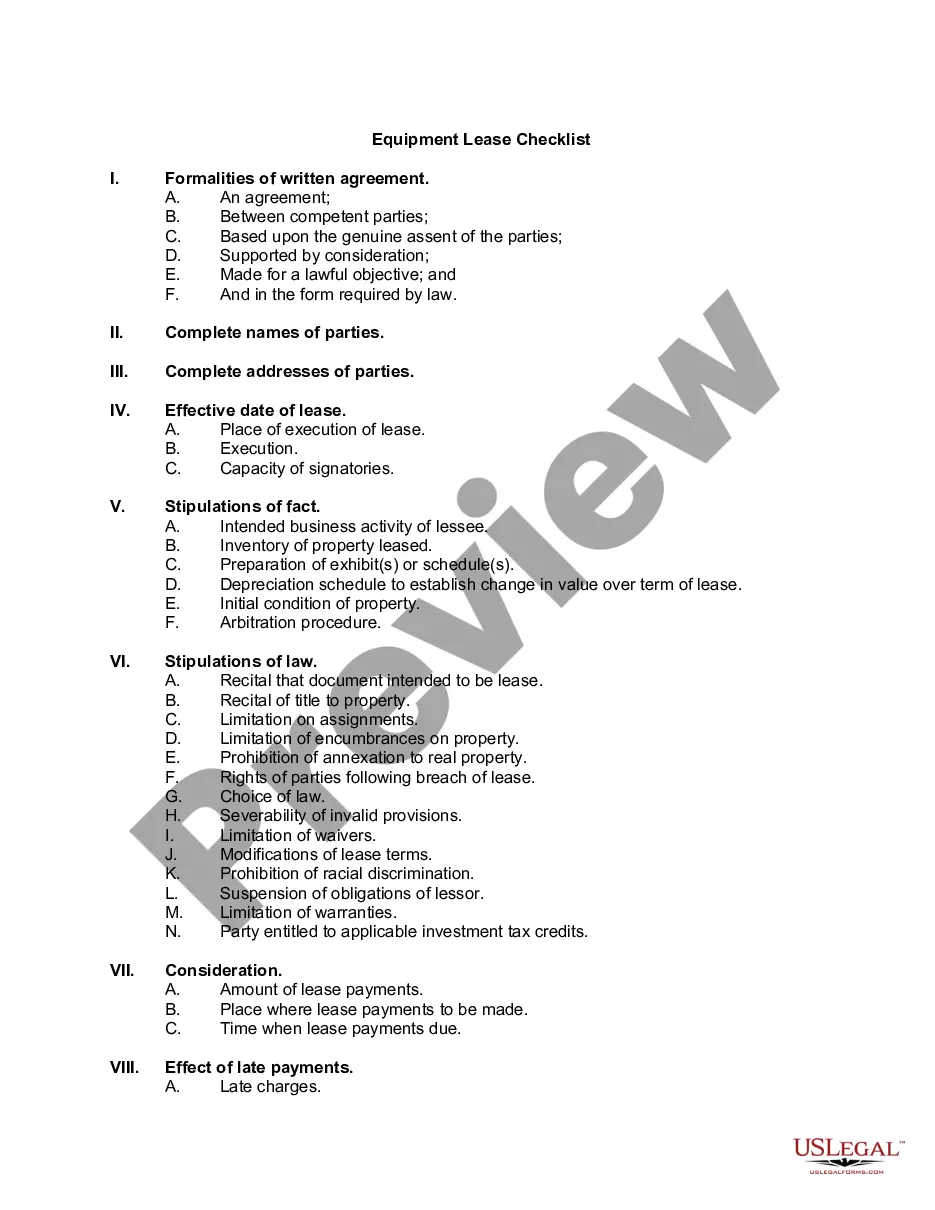
Leasing equipment can help your business stay up-to-date with the latest technology. Other benefits of leasing include making lower monthly payments than you would have with a loan, getting a fixed financing rate instead of a floating rate, benefiting from tax advantages, and conserving working capital by avoiding cash-devouring down payments. Leasing also has its downside, however: You may pay a higher price over the long term. You are also committed to retaining a piece of equipment for a certain time period, which can be problematic if your business is in flux.
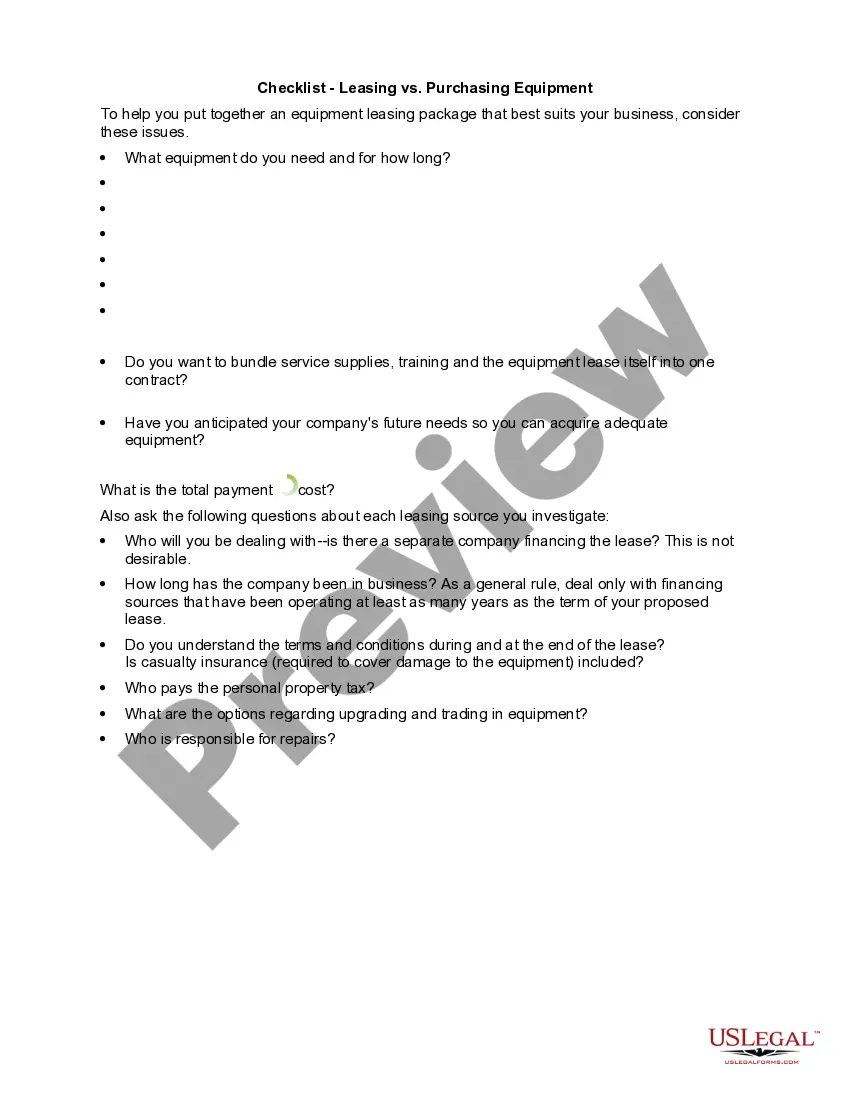
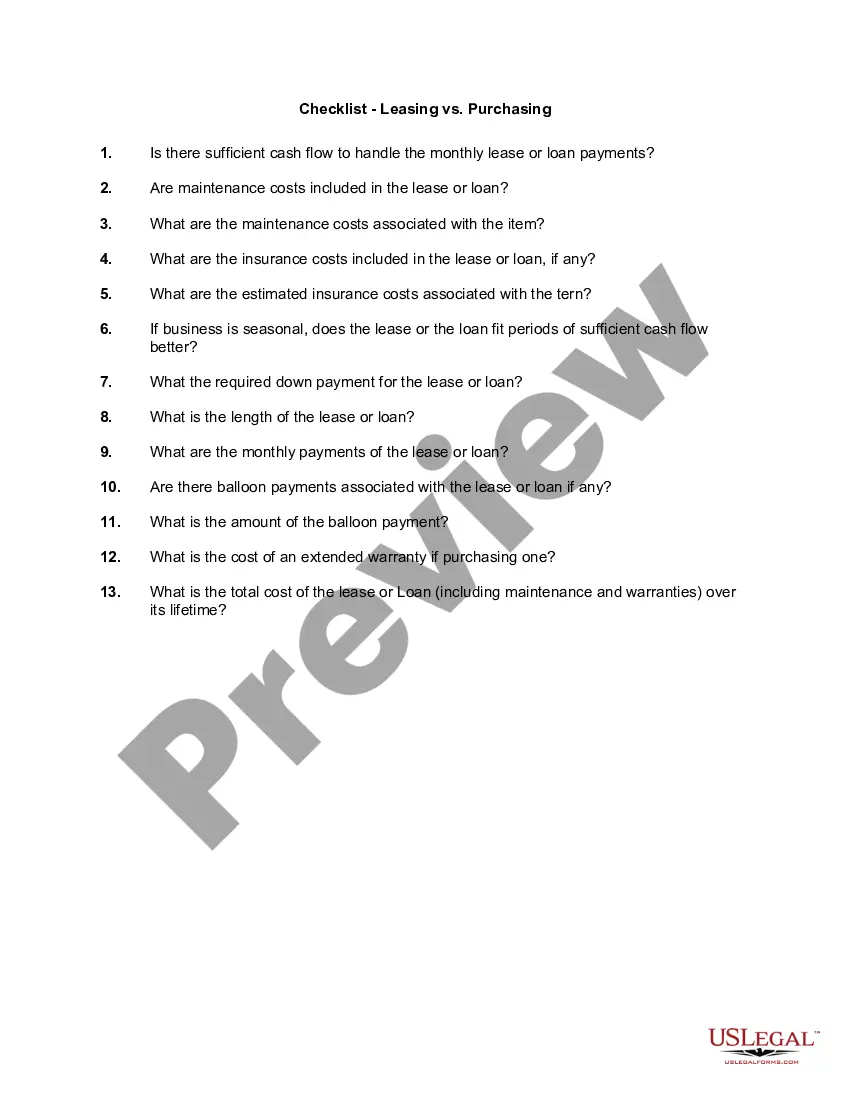
Every lease decision is unique so it's important to study the lease agreement carefully. When deciding to obtain equipment, you need to determine whether it is better to lease or purchase the equipment. You might use this checklist to compare the costs for each option.
North Carolina Checklist - Leasing vs. Purchasing Equipment
Category:
State:
Multi-State
Control #:
US-03082BG
Format:
Word;
Rich Text
Instant download
Description
Get your form ready online
Our built-in tools help you complete, sign, share, and store your documents in one place.
Built-in online Word editor
Make edits, fill in missing information, and update formatting in US Legal Forms—just like you would in MS Word.
Export easily
Download a copy, print it, send it by email, or mail it via USPS—whatever works best for your next step.
E-sign your document
Sign and collect signatures with our SignNow integration. Send to multiple recipients, set reminders, and more. Go Premium to unlock E-Sign.
Notarize online 24/7
If this form requires notarization, complete it online through a secure video call—no need to meet a notary in person or wait for an appointment.
Store your document securely
We protect your documents and personal data by following strict security and privacy standards.

Make edits, fill in missing information, and update formatting in US Legal Forms—just like you would in MS Word.

Download a copy, print it, send it by email, or mail it via USPS—whatever works best for your next step.

Sign and collect signatures with our SignNow integration. Send to multiple recipients, set reminders, and more. Go Premium to unlock E-Sign.

If this form requires notarization, complete it online through a secure video call—no need to meet a notary in person or wait for an appointment.

We protect your documents and personal data by following strict security and privacy standards.
Looking for another form?


How to fill out Checklist - Leasing Vs. Purchasing Equipment?
You can dedicate numerous hours online trying to locate the legal document template that meets the federal and state requirements you need.
US Legal Forms offers thousands of legal forms that can be examined by experts.
You can effectively obtain or create the North Carolina Checklist - Leasing vs. Purchasing Equipment from my service.
If you wish to find another version of your form, use the Search field to locate the template that suits your needs and requirements.
- If you already possess a US Legal Forms account, you can sign in and click the Download button.
- Subsequently, you can complete, modify, print, or sign the North Carolina Checklist - Leasing vs. Purchasing Equipment.
- Every legal document template you purchase is yours for an extended period.
- To download another copy of any purchased form, go to the My documents tab and click the corresponding button.
- If you are using the US Legal Forms website for the first time, follow the straightforward instructions below.
- First, ensure you have chosen the correct document template for your selected county/region.
- Review the form description to confirm you have selected the correct form.
- If available, utilize the Preview button to view the document template as well.
Form popularity
FAQ
Leasing offers several advantages over purchasing assets, including lower initial costs, flexibility in upgrading, and potential tax benefits. You can enjoy the benefits of using new or updated equipment without tying up your capital. Furthermore, when you lease, you may avoid depreciation costs associated with ownership. For a complete understanding, consult the North Carolina Checklist - Leasing vs. Purchasing Equipment available from uslegalforms.
Leasing an asset allows you to preserve capital, as you avoid the large upfront costs associated with purchasing equipment. This flexibility enables you to allocate funds to other critical areas of your business. Additionally, leased equipment is often easier to upgrade, keeping you at the forefront of technology. Referencing the North Carolina Checklist - Leasing vs. Purchasing Equipment can help you maximize the benefits of leasing.
The North Carolina Checklist - Leasing vs. Purchasing Equipment outlines key differences: when you buy equipment, you gain ownership and long-term value, while leasing provides flexibility and lower upfront costs. Purchasing may require a significant upfront investment, whereas leasing typically offers a lower monthly payment. Each choice carries unique advantages and consequences, so understanding these will help in making the best decision.
When you look at the North Carolina Checklist - Leasing vs. Purchasing Equipment, some disadvantages of leasing include higher overall costs in the long run. Lease agreements can come with restrictions, and you might face penalties for excessive wear or exceeding usage limits. Additionally, at the end of a lease, you own nothing, which means you need to consider long-term value and sustainability in your decision.
When considering the North Carolina Checklist - Leasing vs. Purchasing Equipment, it's important to note that leasing can provide immediate tax benefits. Lease payments are generally fully deductible as a business expense, which can lower your taxable income. On the other hand, purchasing equipment allows for depreciation, which can also have tax advantages. Ultimately, the choice may depend on your specific financial situation.
In many cases, leasing can be more beneficial than buying when it comes to taxes. Since lease payments can often be deducted from income, businesses may enjoy lower tax bills compared to the depreciation schedules for owned equipment. As with the North Carolina Checklist - Leasing vs. Purchasing Equipment, reviewing your specific financial situation with a professional can clarify the advantages of leasing over buying.
To record a lease on equipment, you will typically need to establish both your asset and liability in your accounting system. The leased equipment should be recorded as an asset at its fair value, while lease payments create a corresponding liability. For businesses following the North Carolina Checklist - Leasing vs. Purchasing Equipment, accurate recording ensures compliance and helps in analyzing financial health.
Yes, equipment lease payments are generally tax deductible as a business expense. This means that you can deduct the entire amount of your lease payments from your taxable income, contributing to potential tax savings. As you assess the North Carolina Checklist - Leasing vs. Purchasing Equipment, it is wise to consult with a tax professional to maximize these benefits.
Leasing equipment can offer significant tax benefits, especially under current tax regulations. Typically, lease payments may qualify as deductible business expenses, which can reduce your taxable income. When considering the North Carolina Checklist - Leasing vs. Purchasing Equipment, many businesses find that claiming these deductions enhances their financial position.