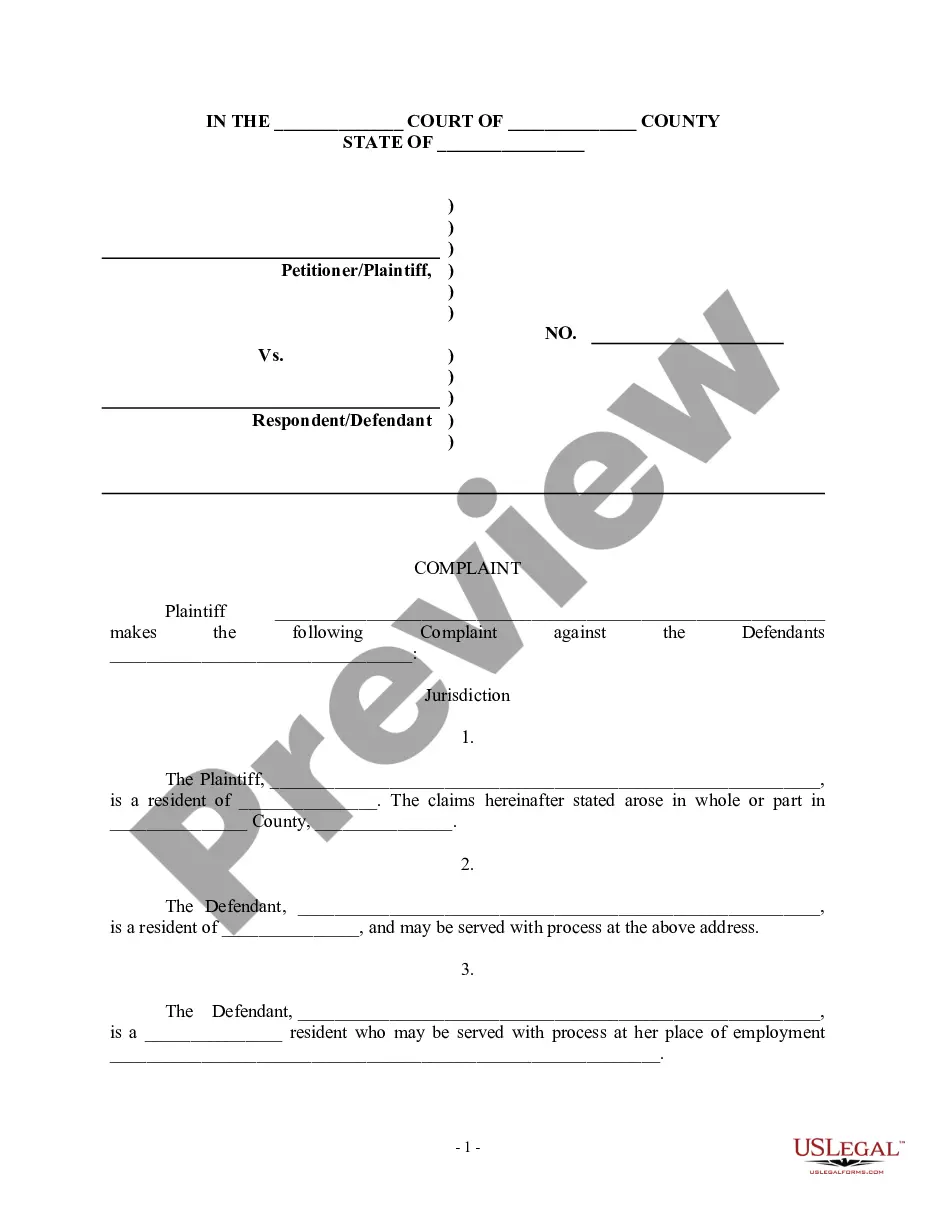
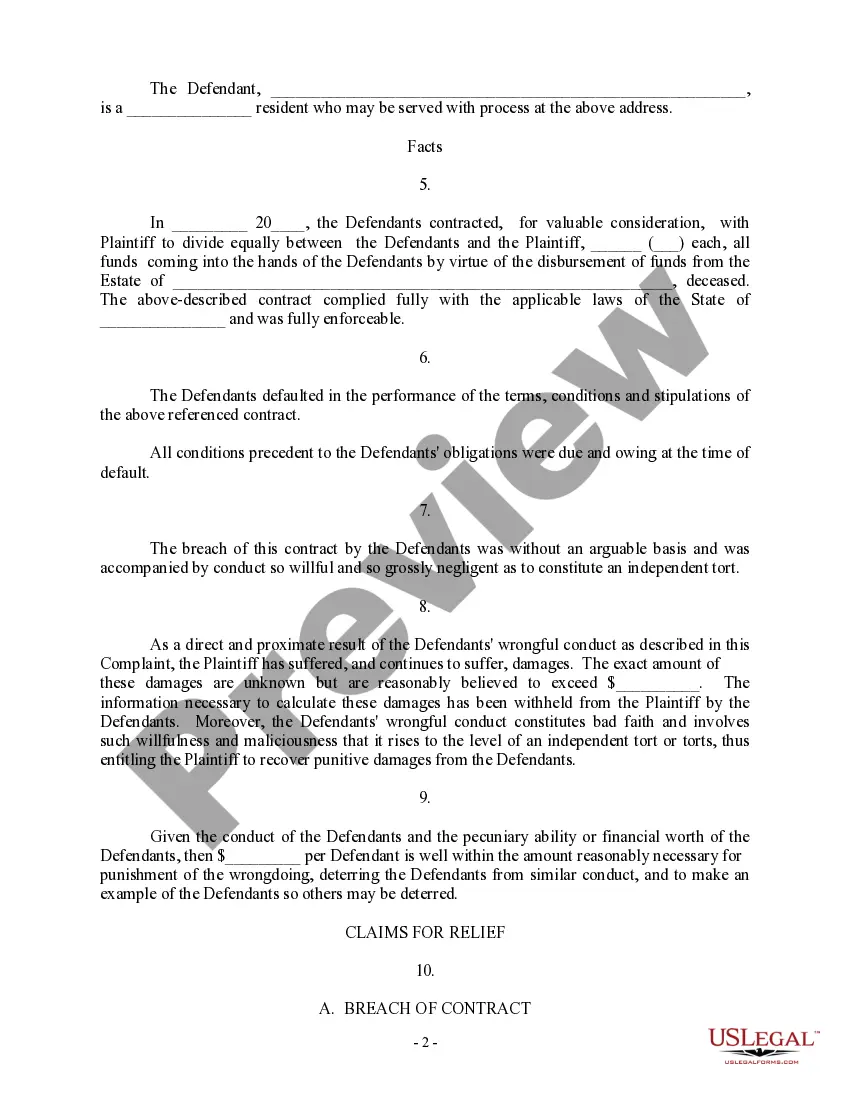
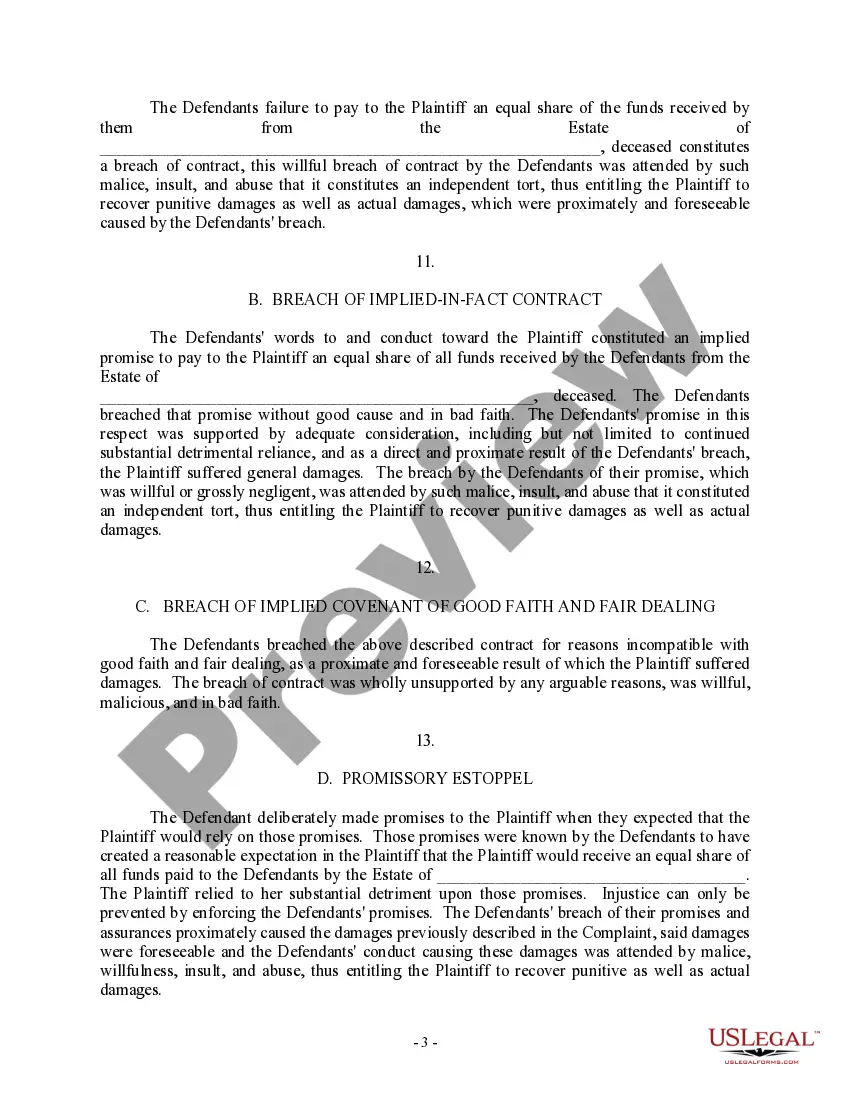
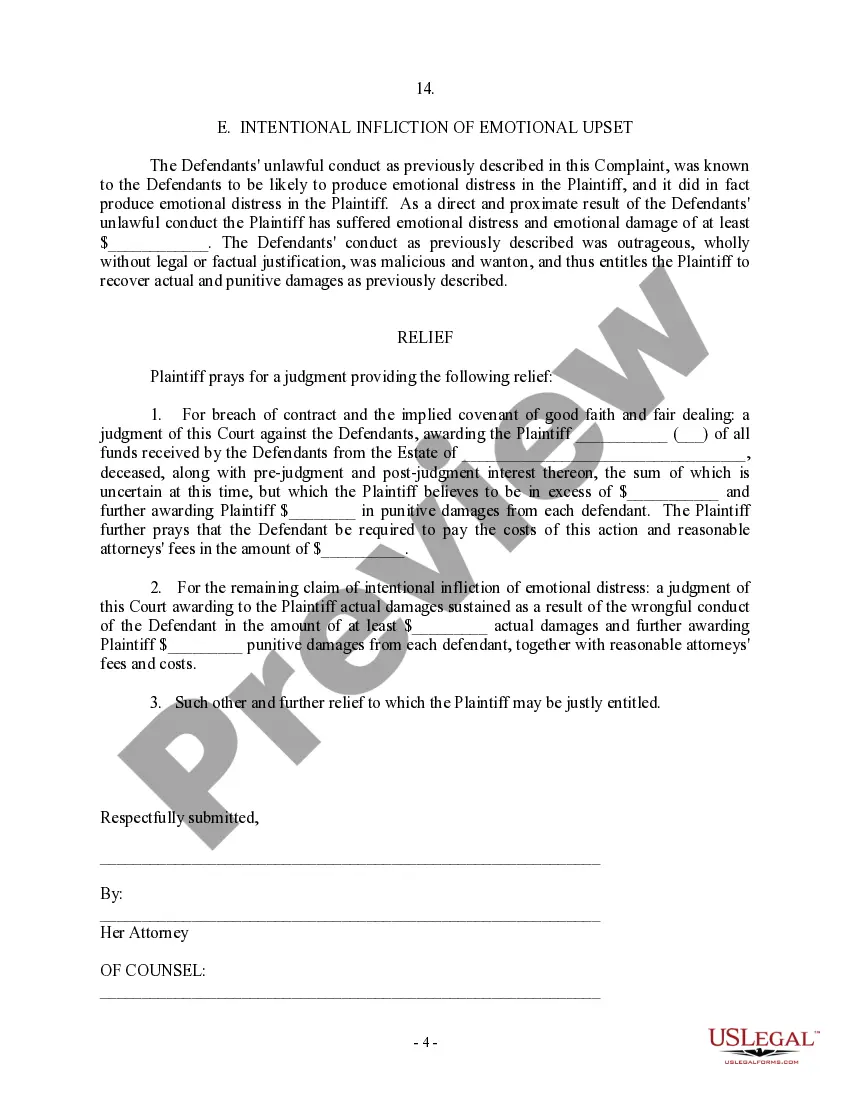
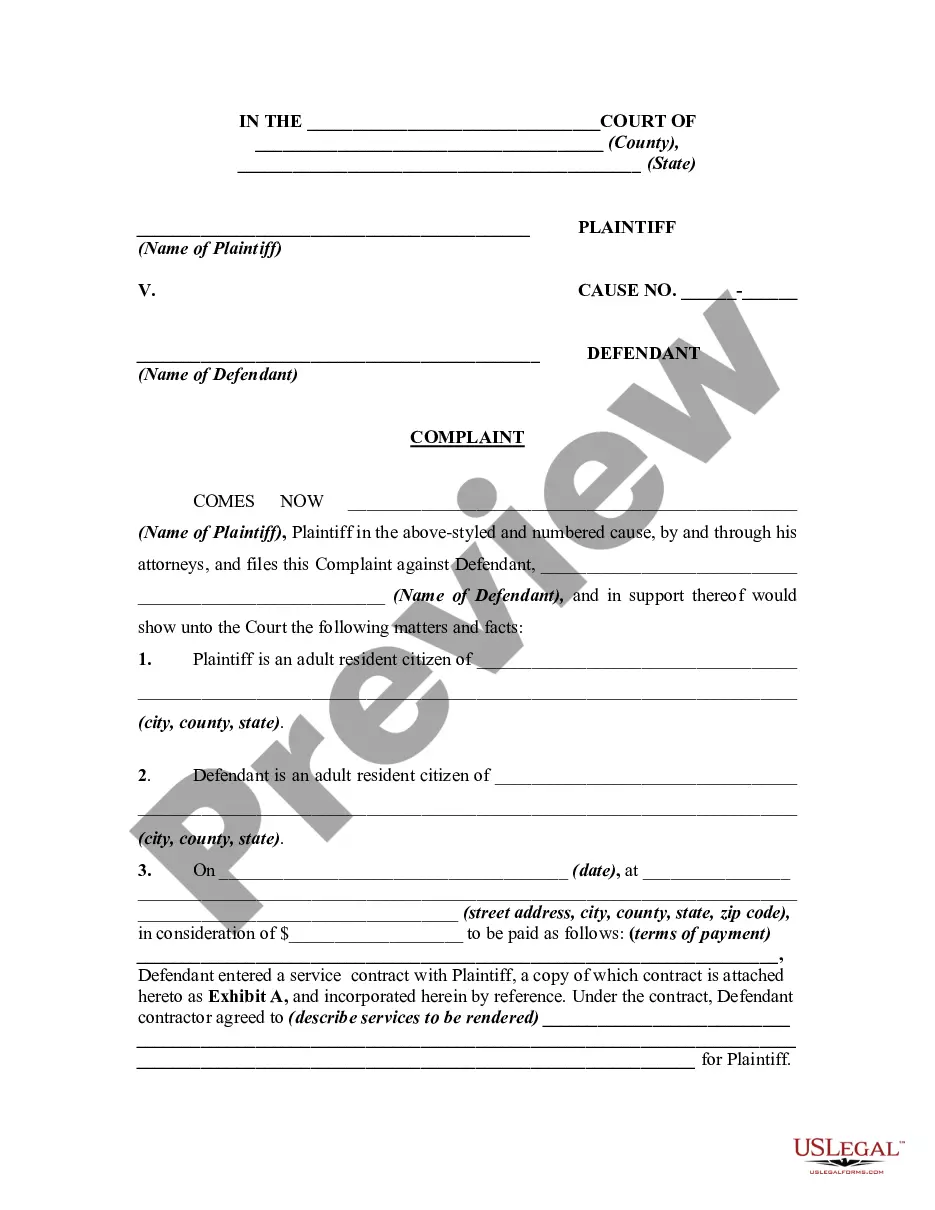
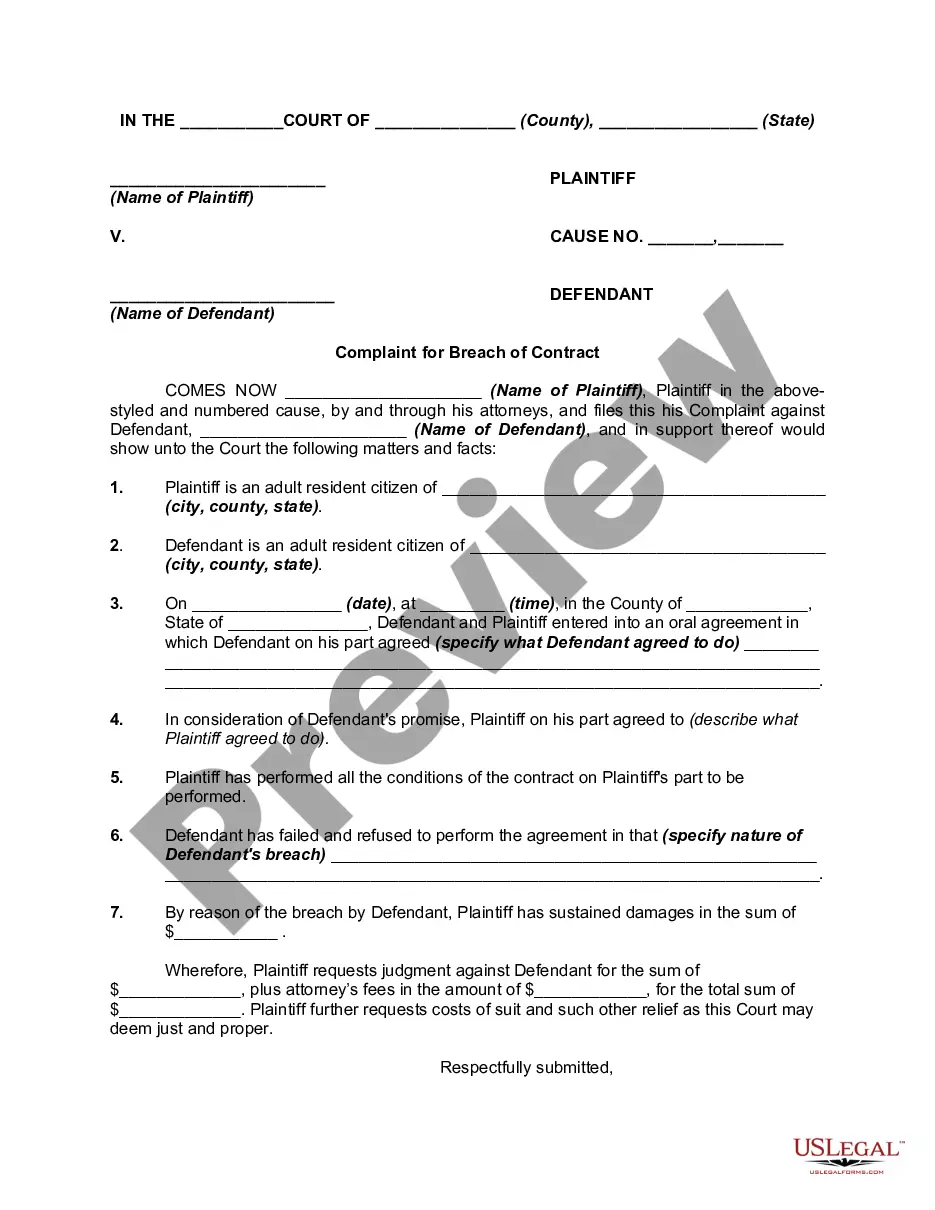
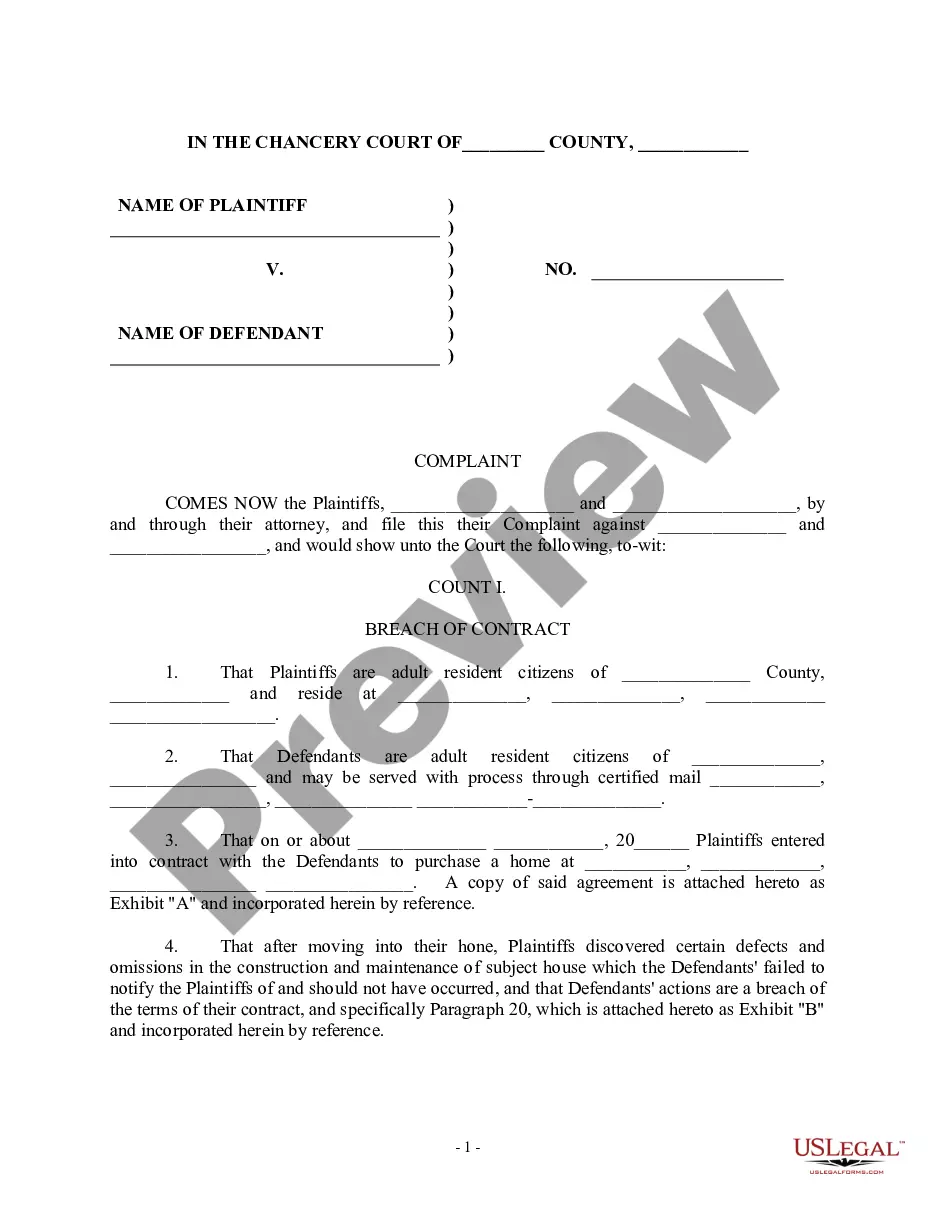
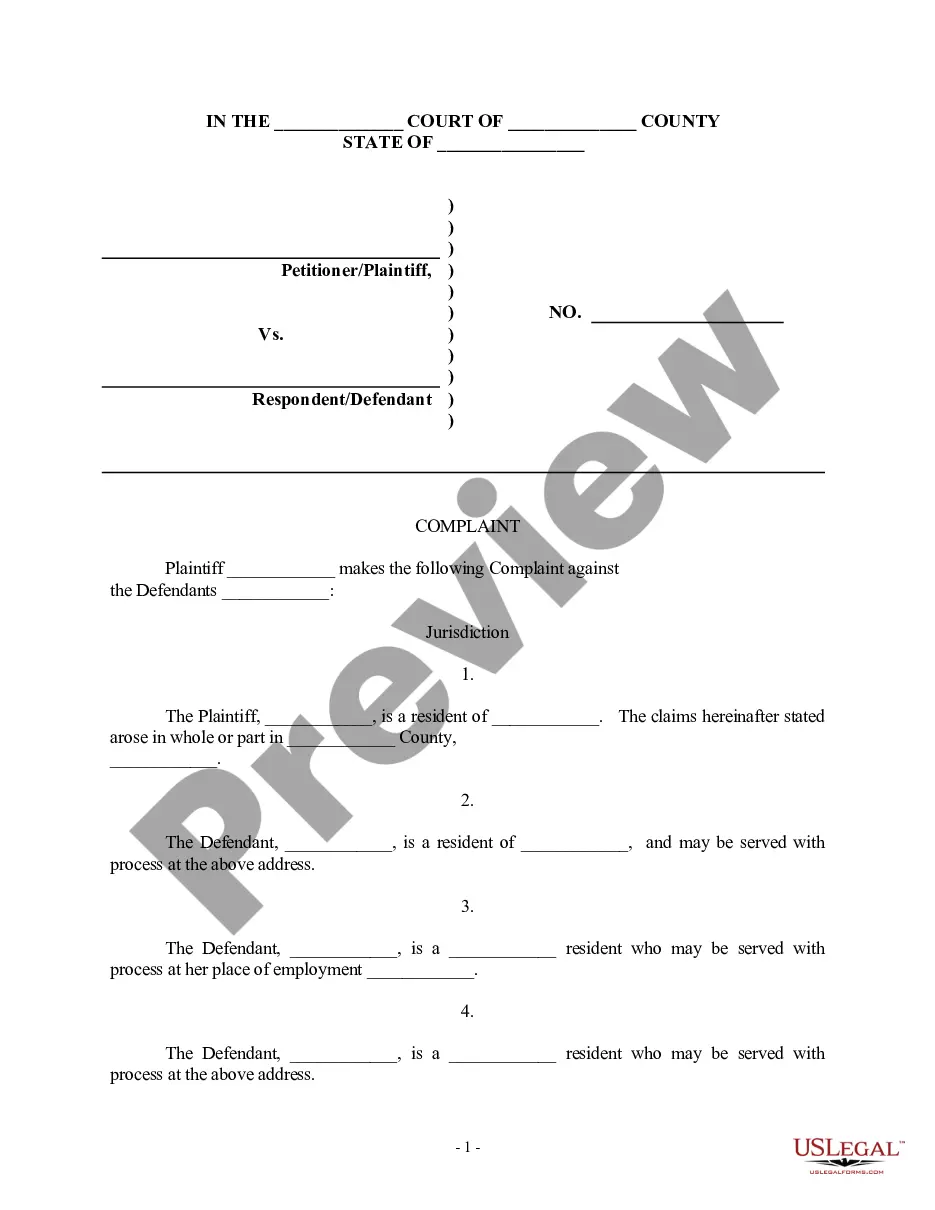
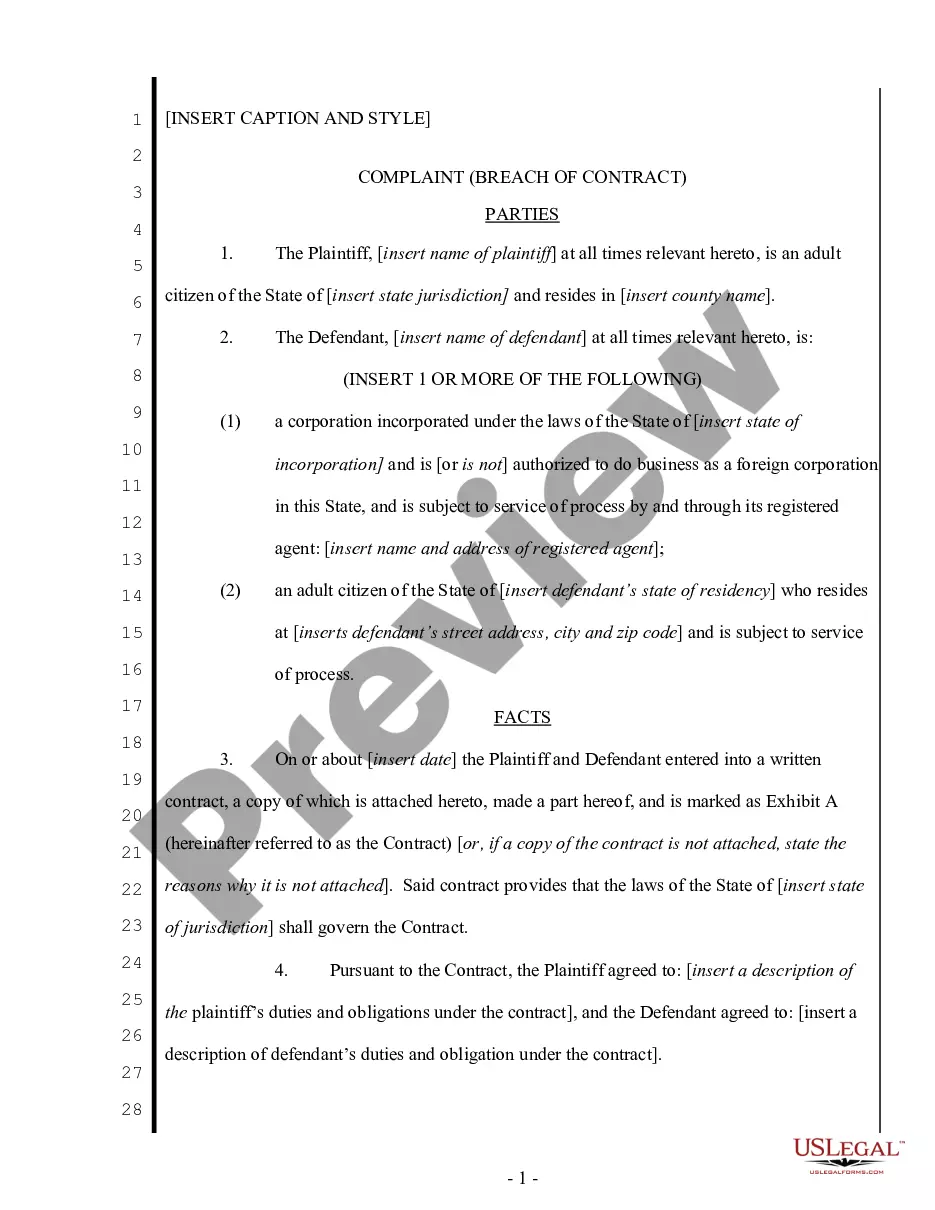
This form is a Complaint. Plaintiff brings an action against defendant for breach of contract and requests a monetary award, plus punitive damages.
North Carolina Complaint regarding Breach of Contract, Implied Contract, Good Faith and Fair Dealing, Promissory Estoppel, Emotional Distress
State:
Multi-State
Control #:
US-01598
Format:
Word;
Rich Text
1,457 downloads
Description
Free preview

Get your form ready online
Our built-in tools help you complete, sign, share, and store your documents in one place.
Built-in online Word editor
Make edits, fill in missing information, and update formatting in US Legal Forms—just like you would in MS Word.
Export easily
Download a copy, print it, send it by email, or mail it via USPS—whatever works best for your next step.
E-sign your document
Sign and collect signatures with our SignNow integration. Send to multiple recipients, set reminders, and more. Go Premium to unlock E-Sign.
Notarize online 24/7
If this form requires notarization, complete it online through a secure video call—no need to meet a notary in person or wait for an appointment.
Store your document securely
We protect your documents and personal data by following strict security and privacy standards.

Make edits, fill in missing information, and update formatting in US Legal Forms—just like you would in MS Word.

Download a copy, print it, send it by email, or mail it via USPS—whatever works best for your next step.

Sign and collect signatures with our SignNow integration. Send to multiple recipients, set reminders, and more. Go Premium to unlock E-Sign.

If this form requires notarization, complete it online through a secure video call—no need to meet a notary in person or wait for an appointment.

We protect your documents and personal data by following strict security and privacy standards.
Looking for another form?
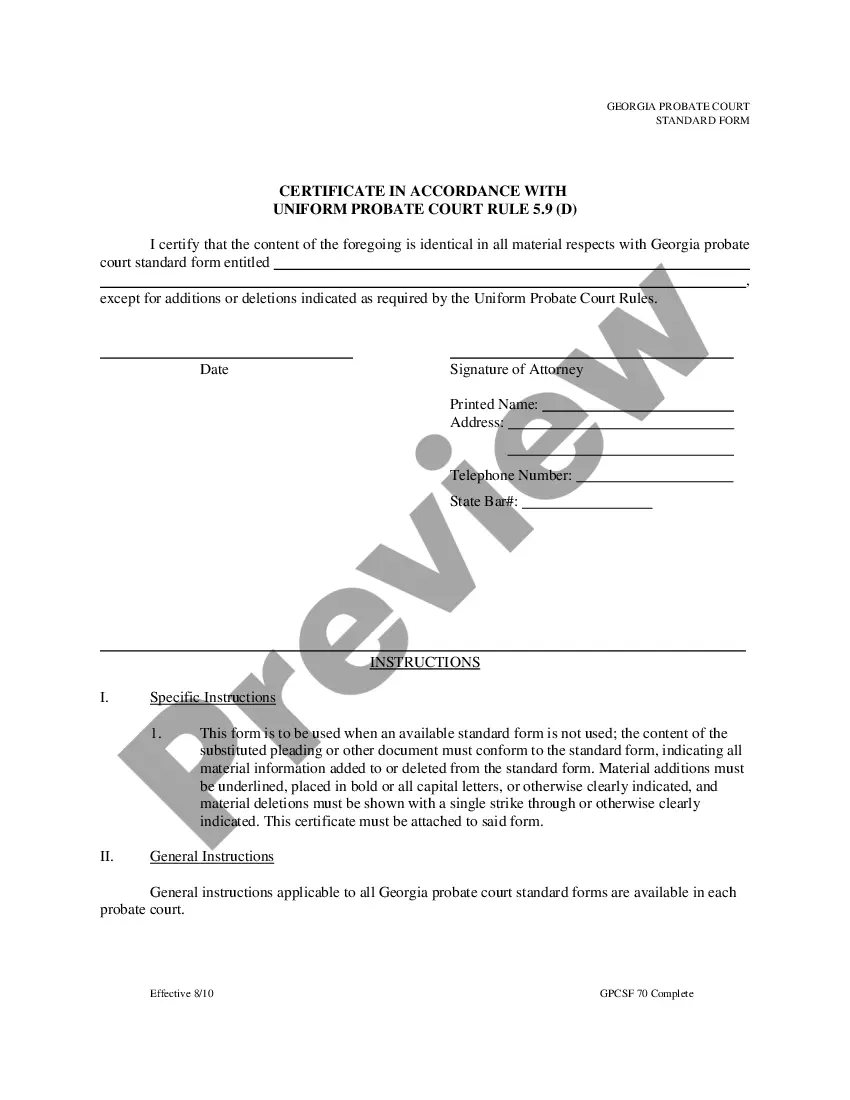

How to fill out Complaint Regarding Breach Of Contract, Implied Contract, Good Faith And Fair Dealing, Promissory Estoppel, Emotional Distress?
Are you in the location where you will require documents for either business or personal purposes nearly every working day.
There is an array of legal document templates available online, yet locating versions you can trust isn't straightforward.
US Legal Forms offers a vast collection of form templates, such as the North Carolina Complaint regarding Breach of Contract, Implied Contract, Good Faith and Fair Dealing, Promissory Estoppel, Emotional Distress, which are designed to comply with federal and state regulations.
When you locate the correct document, click Acquire now.
Select the pricing plan you prefer, provide the necessary information to create your account, and complete your purchase using your PayPal or credit card. Choose a convenient file format and download your copy. Access all the document templates you have purchased in the My documents menu. You can obtain another copy of North Carolina Complaint regarding Breach of Contract, Implied Contract, Good Faith and Fair Dealing, Promissory Estoppel, Emotional Distress at any time if needed. Simply click on the required form to download or print the document template. Utilize US Legal Forms, the most extensive collection of legal forms, to save time and prevent errors. The service offers properly crafted legal document templates that you can use for various purposes. Create an account on US Legal Forms and start simplifying your life.
- If you are already familiar with the US Legal Forms website and possess an account, simply Log In.
- Then, you can download the North Carolina Complaint regarding Breach of Contract, Implied Contract, Good Faith and Fair Dealing, Promissory Estoppel, Emotional Distress template.
- If you do not have an account and wish to use US Legal Forms, follow these steps.
- Obtain the document you need and ensure it is for your correct city/county.
- Use the Review button to evaluate the form.
- Read the description to confirm you have selected the appropriate document.
- If the form isn’t what you are looking for, utilize the Search field to find the form that meets your needs.
Form popularity
FAQ
In order to establish breach of contract, a plaintiff must establish: 1) a valid and enforceable contract; 2) performance by the plaintiff; 3) breach by the defendant; and 4) injury arising as a result of defendant's breach.
The statute of repose provides the period within which all claims must be initiated, no matter when discovered by the owner. In North Carolina, the statue of repose is six years, and the period generally begins to run upon substantial completion of the project.
A bad faith claim arises when one party acts in an unethical or deceptive manner. Unlike a breach of contract claim, a bad faith claim is not a violation of any specific provision of a contract but rather of the spirit of the agreement itself.
That there has been a breach of the implied covenant of good faith and fair dealing in this case, the plaintiff must prove to you that the defendant, with no legitimate purpose: 1) acted with bad motives or intentions or engaged in deception or evasion in the performance of contract; and 2) by such conduct, denied the ...
Is there a statute of limitations on HOA violations in North Carolina / South Carolina? In North Carolina, financial penalties must be imposed within three years of the violation. In South Carolina, the statute of limitations is determined by the community association and its CC&Rs.
This is because under N.C. Gen. Stat. § 1-47(2) sealed instruments are governed by a ten-year statute of limitations. Thus, since the note in Pedlow was signed under seal, and no payments were made, the court concluded that the statute of limitations would run ten years from the date of the debtor's signature.
The discovery rule also applies to the North Carolina statute of limitations for personal injury cases: If an injury is not immediately apparent, the statute of limitations does not begin to run until it is or should have been discovered.