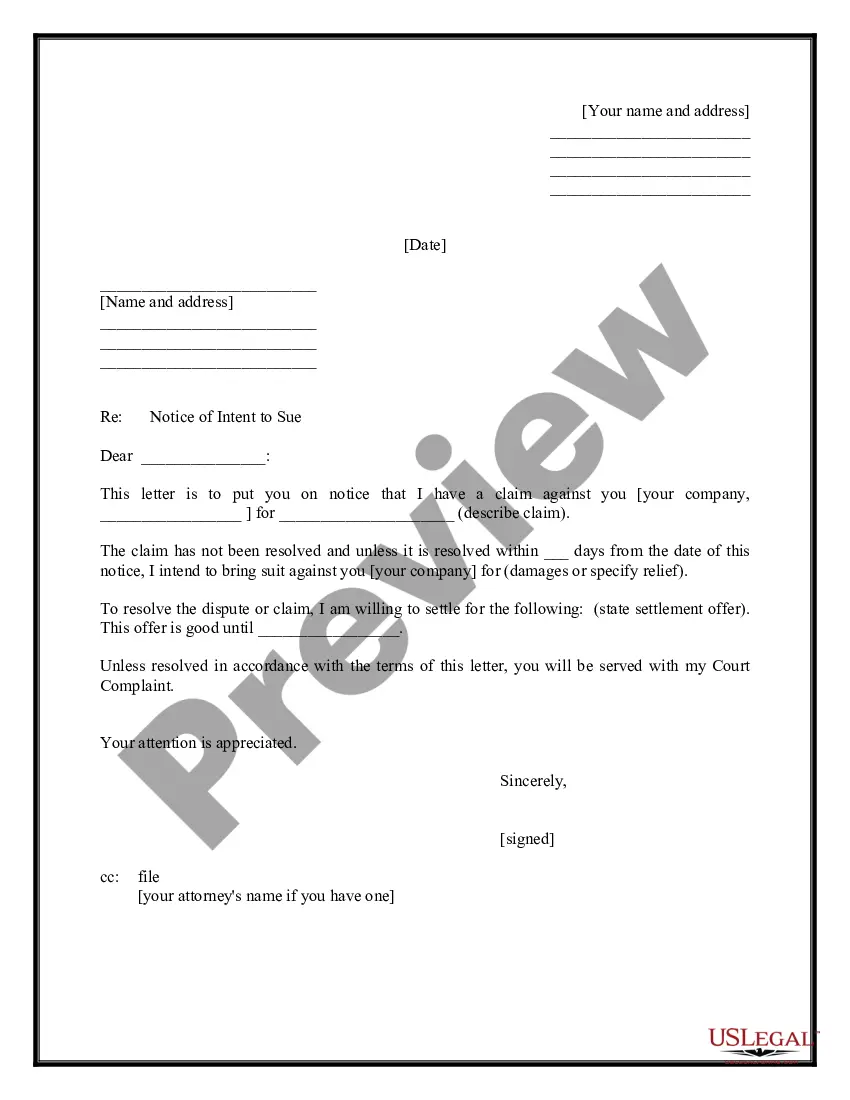
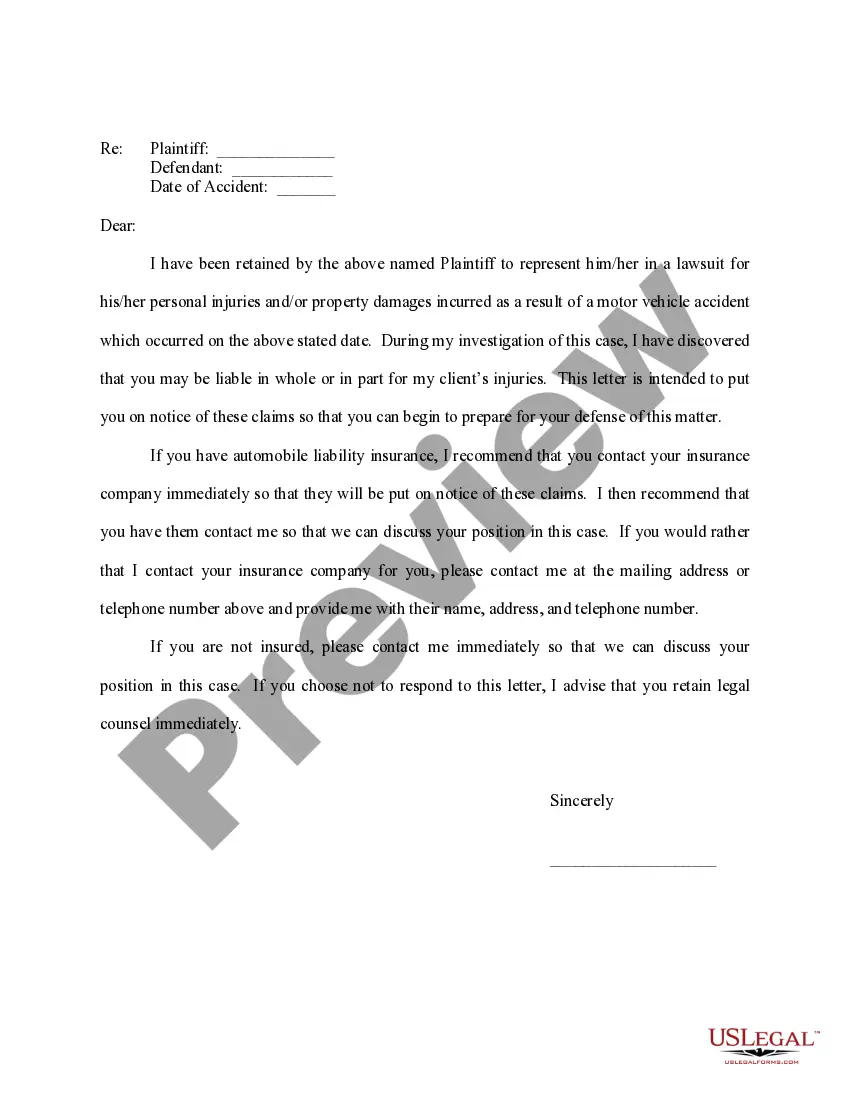
North Carolina Letter of Intent to Sue
Description
Get your form ready online
Our built-in tools help you complete, sign, share, and store your documents in one place.
Make edits, fill in missing information, and update formatting in US Legal Forms—just like you would in MS Word.
Download a copy, print it, send it by email, or mail it via USPS—whatever works best for your next step.
Sign and collect signatures with our SignNow integration. Send to multiple recipients, set reminders, and more. Go Premium to unlock E-Sign.
If this form requires notarization, complete it online through a secure video call—no need to meet a notary in person or wait for an appointment.
We protect your documents and personal data by following strict security and privacy standards.

Make edits, fill in missing information, and update formatting in US Legal Forms—just like you would in MS Word.

Download a copy, print it, send it by email, or mail it via USPS—whatever works best for your next step.

Sign and collect signatures with our SignNow integration. Send to multiple recipients, set reminders, and more. Go Premium to unlock E-Sign.

If this form requires notarization, complete it online through a secure video call—no need to meet a notary in person or wait for an appointment.

We protect your documents and personal data by following strict security and privacy standards.
Looking for another form?
How to fill out Letter Of Intent To Sue?
If you wish to total, download, or create approved document templates, utilize US Legal Forms, the largest collection of legal forms that are accessible online.
Take advantage of the site’s simple and convenient search to locate the documents you require. Numerous templates for business and personal purposes are categorized by types and states, or keywords.
Use US Legal Forms to obtain the North Carolina Letter of Intent to Sue with just a few clicks.
Step 5. Process the transaction. You can use your credit card or PayPal account to complete the transaction.
Step 6. Select the format of your legal form and download it to your device. Step 7. Fill out, modify, and print or sign the North Carolina Letter of Intent to Sue. Each legal document template you obtain is yours indefinitely.
You have access to every form you downloaded within your account. Select the My documents section and choose a form to print or download again. Complete and download, and print the North Carolina Letter of Intent to Sue with US Legal Forms. There are millions of professional and state-specific forms you can utilize for your business or personal needs.
- If you are already a US Legal Forms user, Log In to your account and click the Download button to find the North Carolina Letter of Intent to Sue.
- You can also access forms you previously downloaded in the My documents tab of your account.
- If you are using US Legal Forms for the first time, follow the instructions below.
- Step 1. Ensure you have selected the form for the correct area/state.
- Step 2. Use the Review option to examine the form’s content. Don’t forget to read the summary.
- Step 3. If you are not satisfied with the form, utilize the Search field at the top of the screen to find other versions of the legal form template.
- Step 4. Once you have located the form you need, click the Buy now button. Choose the pricing plan you prefer and enter your details to register for an account.
Form popularity
FAQ
But, now that you filed the lawsuit, you have to let the defendant know formally that you are suing. This is called "service". You have to have all papers "served" on every party in the whole lawsuit. To start your case, you have to have the defendant served with a Summons, Complaint and Civil Lawsuit Notice.
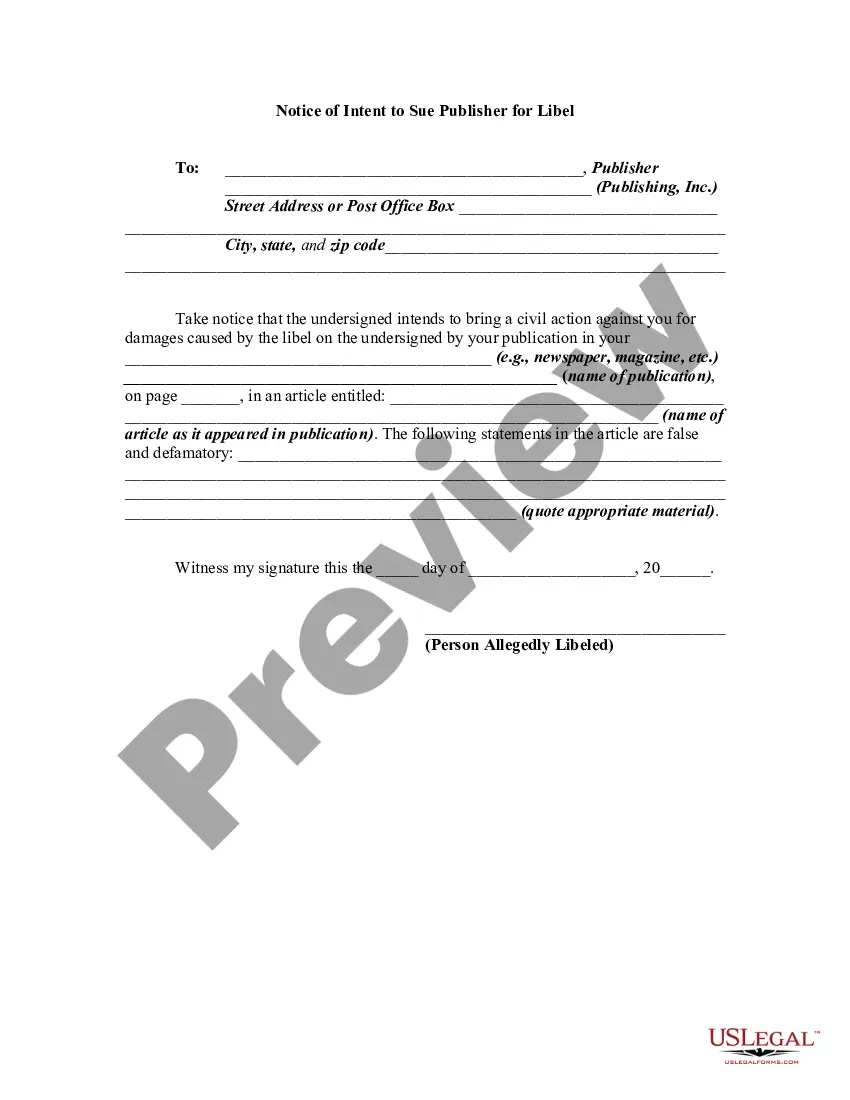
An intent to sue letter should have the addresses of both parties, a detailed description of the dispute, the settlement demand (e.g., payment amount, cease and desist, repair damages, etc.), the sender's contact information, and the deadline for the proposed settlement.
Court Fees Filing a civil action (includes a $52.00 administrative fee) The administrative fee does not apply to applications for a writ of habeas corpus or to persons granted in forma pauperis status under 28 U.S.C § 1915.$402.00Filing a notice of appeal with the Fourth Circuit Court of Appeal1$505.0021 more rows ?
North Carolina's civil statute of limitations laws provide a three-year time limit for personal injuries, fraud, and many other causes of action, but just a one-year limit for defamation.
There is no filing fee for responding to a lawsuit or making a counterclaim. You are required to file your Answer with the Clerk of Court and send a copy to the Plaintiff. You may serve your Answer by delivering a copy to the Plaintiff or by mailing it to the Plaintiff's last known address.
North Carolina's criminal statute of limitations is two years for most misdemeanors, and there is no statute of limitations for felonies or crimes classified as "malicious" misdemeanors.
Be polite. Don't personally attack your adversary, even if you believe it's deserved, because it invites the other side to respond similarly. Calm people are more believable because it demonstrates their confidence in their position, including when presenting an argument in court.
Many people reach an agreement about the terms of payment after the court decides how much money one party must pay the other. If there is no agreement, the winning party can begin the collections process. The clerk of superior court will record the judgment, and interest will begin to accrue if it is not paid.