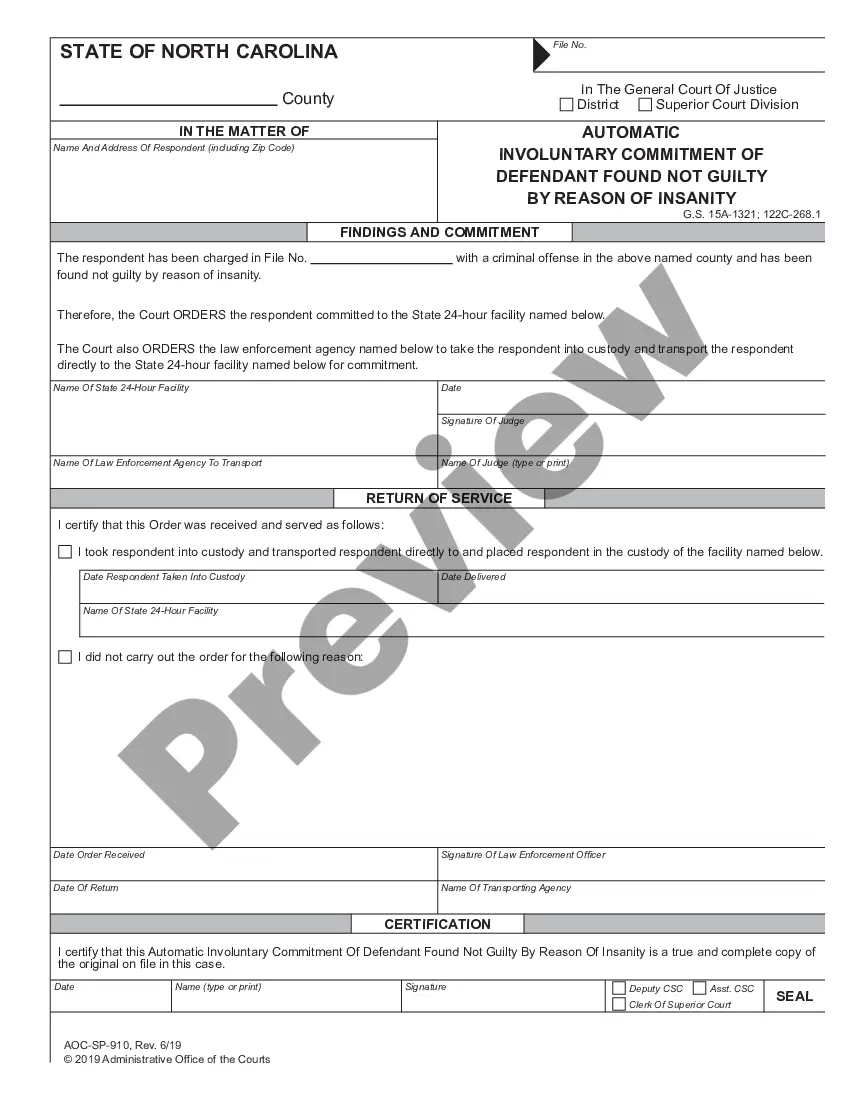
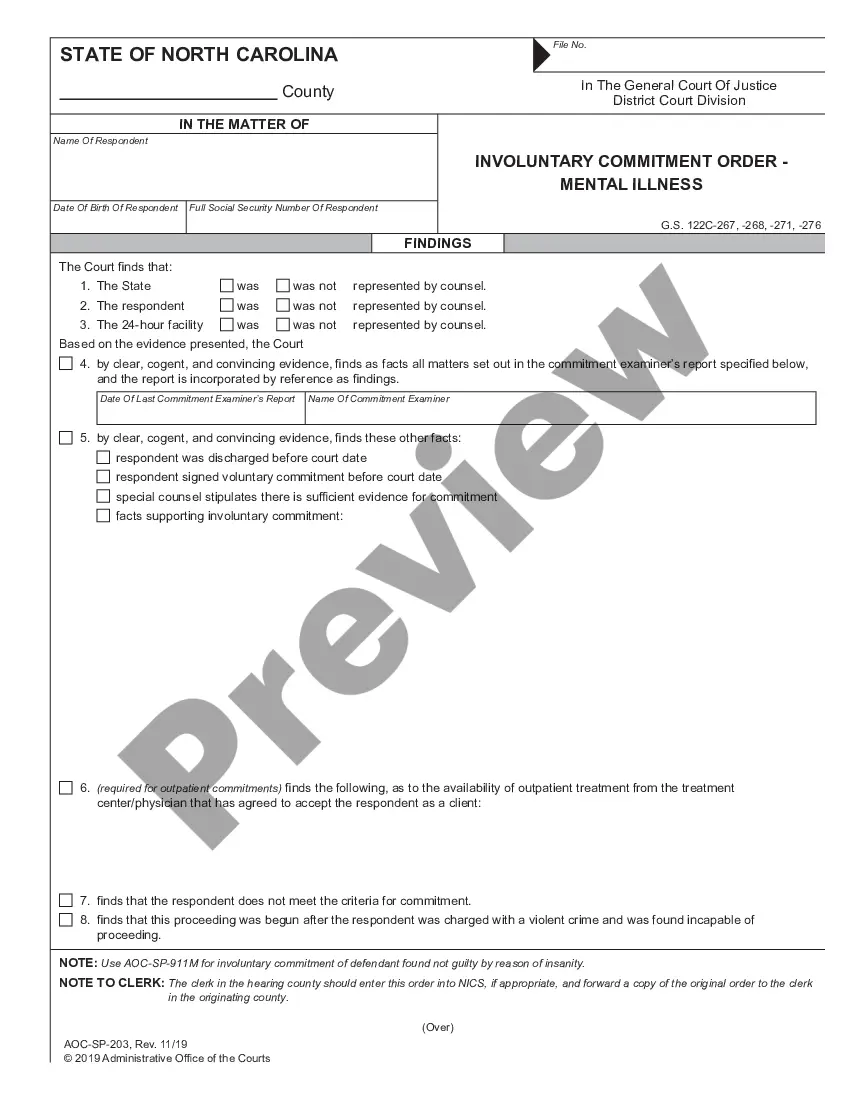
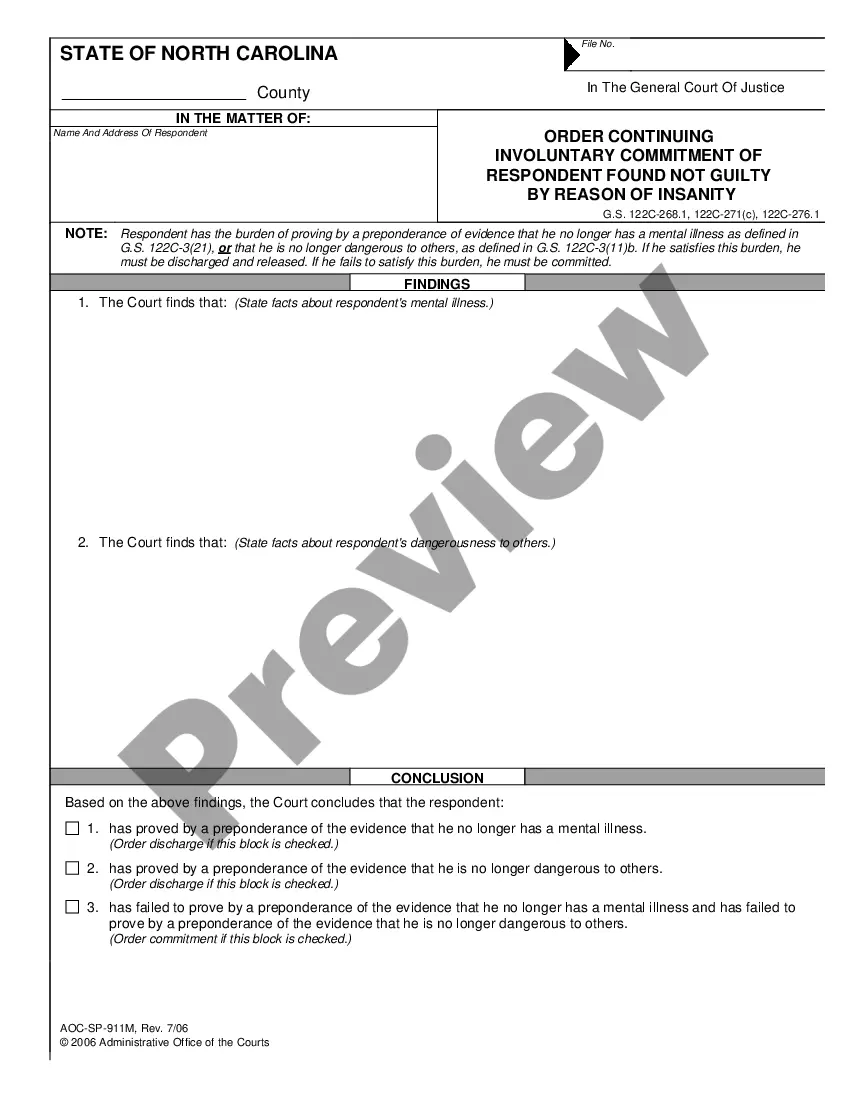
Automatic Involuntary Commitment of Defendant Found Not Guilty by Reason of Insanity : This is an official form from the North Carolina Administration of the Courts (AOC), which complies with all applicable laws and statutes. USLF amends and updates the forms as is required by North Carolina statutes and law.
North Carolina Automatic Involuntary Commitment of Defendant Found Not Guilty by Reason of Insanity
State:
North Carolina
Category:
Control #:
NC-SP-910M
Format:
PDF
Instant download
This website is not affiliated with any governmental entity
Public form
Description
Get your form ready online
Our built-in tools help you complete, sign, share, and store your documents in one place.
Built-in online Word editor
Make edits, fill in missing information, and update formatting in US Legal Forms—just like you would in MS Word.
Export easily
Download a copy, print it, send it by email, or mail it via USPS—whatever works best for your next step.
E-sign your document
Sign and collect signatures with our SignNow integration. Send to multiple recipients, set reminders, and more. Go Premium to unlock E-Sign.
Notarize online 24/7
If this form requires notarization, complete it online through a secure video call—no need to meet a notary in person or wait for an appointment.
Store your document securely
We protect your documents and personal data by following strict security and privacy standards.

Make edits, fill in missing information, and update formatting in US Legal Forms—just like you would in MS Word.

Download a copy, print it, send it by email, or mail it via USPS—whatever works best for your next step.

Sign and collect signatures with our SignNow integration. Send to multiple recipients, set reminders, and more. Go Premium to unlock E-Sign.

If this form requires notarization, complete it online through a secure video call—no need to meet a notary in person or wait for an appointment.

We protect your documents and personal data by following strict security and privacy standards.
Looking for another form?

How to fill out North Carolina Automatic Involuntary Commitment Of Defendant Found Not Guilty By Reason Of Insanity?
Steer clear of expensive attorneys and discover the North Carolina Automatic Involuntary Commitment of Defendant Found Not Guilty by Reason of Insanity you need at a reasonable cost on the US Legal Forms website.
Utilize our straightforward grouping feature to locate and download legal and tax documents. Review their descriptions and examine them thoroughly before downloading.
Make payment via credit card or PayPal. Choose to download the document in PDF or DOCX format. Click Download and locate your document in the My documents section. Feel free to save the file to your device or print it. After downloading, you can fill out the North Carolina Automatic Involuntary Commitment of Defendant Found Not Guilty by Reason of Insanity by hand or with editing software. Print it and reuse the template multiple times. Achieve more for less with US Legal Forms!
- Moreover, US Legal Forms provides users with step-by-step guidance on how to download and complete each form.
- US Legal Forms users simply need to Log In and access the specific document they require from their My documents section.
- Those who have not yet secured a subscription should adhere to the instructions outlined below.
- Confirm that the North Carolina Automatic Involuntary Commitment of Defendant Found Not Guilty by Reason of Insanity is permissible for use in your area.
- If possible, review the description and utilize the Preview feature thoroughly before downloading the documents.
- If you are certain the form meets your needs, click on Buy Now.
- Should the form be incorrect, use the search tool to locate the appropriate one.
- Then, create your account and select a subscription option.
Form popularity
FAQ
Double jeopardy is an American Constitutional principle that bars the government from trying a person more than once for the same conduct. It protects you from being prosecuted again for the same offense following an acquittal or a conviction.
Not guilty means that a defendant is not legally answerable for the criminal charge filed against him/her. An acquittal is a finding by a judge or jury that a defendant is not guilty of the crime charged. Note that an acquittal does not mean that the defendant is innocent in a criminal case.
Essentially, a verdict of not guilty is an acquittal. If a jury or judge finds you not guilty of a criminal charge, you are acquitted and your case is closed.
The obvious application of double jeopardy is when law enforcement finds new evidence of the defendant's guilt after the jury has already acquitted them. The prosecution cannot charge them again, even if the evidence shows that they probably are guilty.
An acquittal is a decision that the defendant is absolved of the charges of which they're accused. While being found not guilty is an acquittal, there are other reasons that a court may acquit. An acquittal can come about if an appeals court or trial judge determines that there is insufficient evidence to proceed.
New evidence can be applied during a retrial at a district court. Thus one can be tried twice for the same alleged crime. If one is convicted at the district court, the defence can make an appeal on procedural grounds to the supreme court.Again, new evidence might be introduced by the prosecution.
Originally Answered: What happens if you admit you're guilty, after you've been found not guilty? The doctrine of "double jeopardy" prevents those acquitted from being tried twice for the same crime.An admission of guilt after acquittal could then be used in a subsequent trial.
Definition. At the end of a criminal trial, a finding by a judge or jury that a defendant is not guilty. An acquittal signifies that a prosecutor failed to prove his or her case beyond a reasonable doubt, not that a defendant is innocent.
The Double Jeopardy Clause in the Fifth Amendment to the US Constitution prohibits anyone from being prosecuted twice for substantially the same crime. The relevant part of the Fifth Amendment states, "No person shall . . . be subject for the same offense to be twice put in jeopardy of life or limb . . . . "