North Carolina Quitclaim Deed for One Individual to Three Individuals as Joint Tenants with the Right of Survivorship
What is this form?
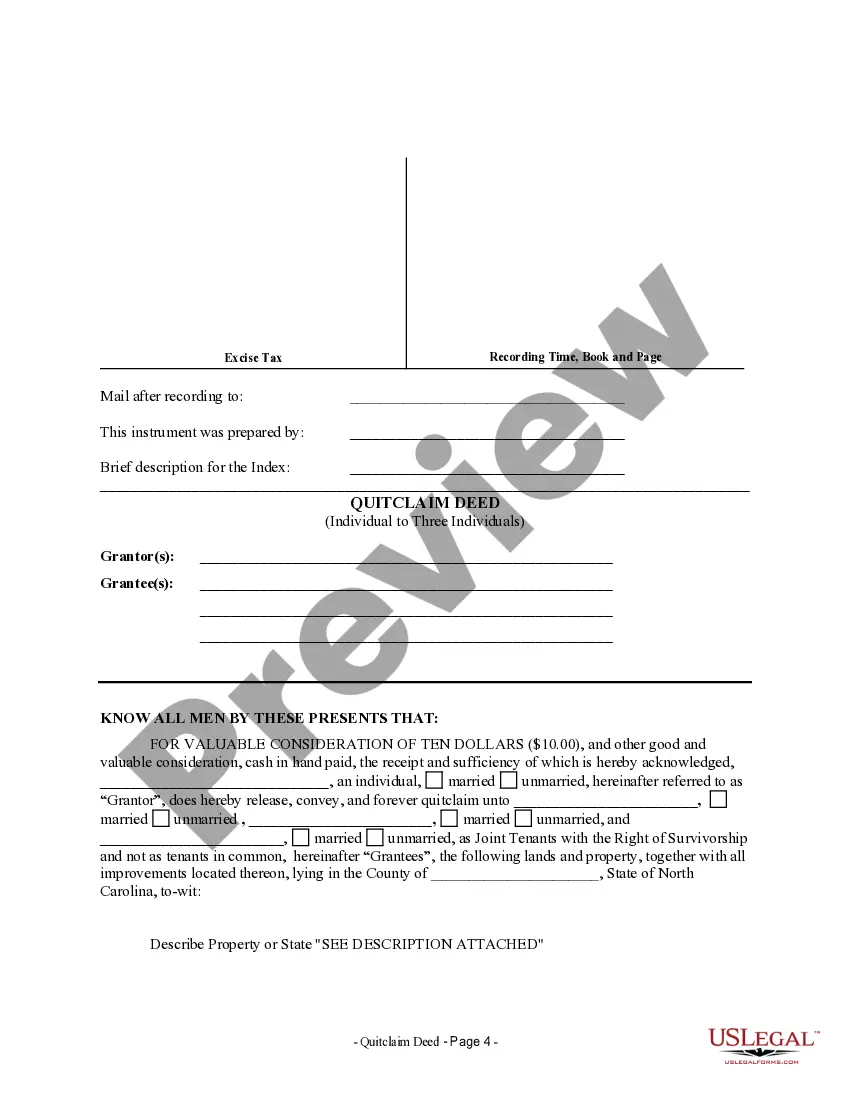
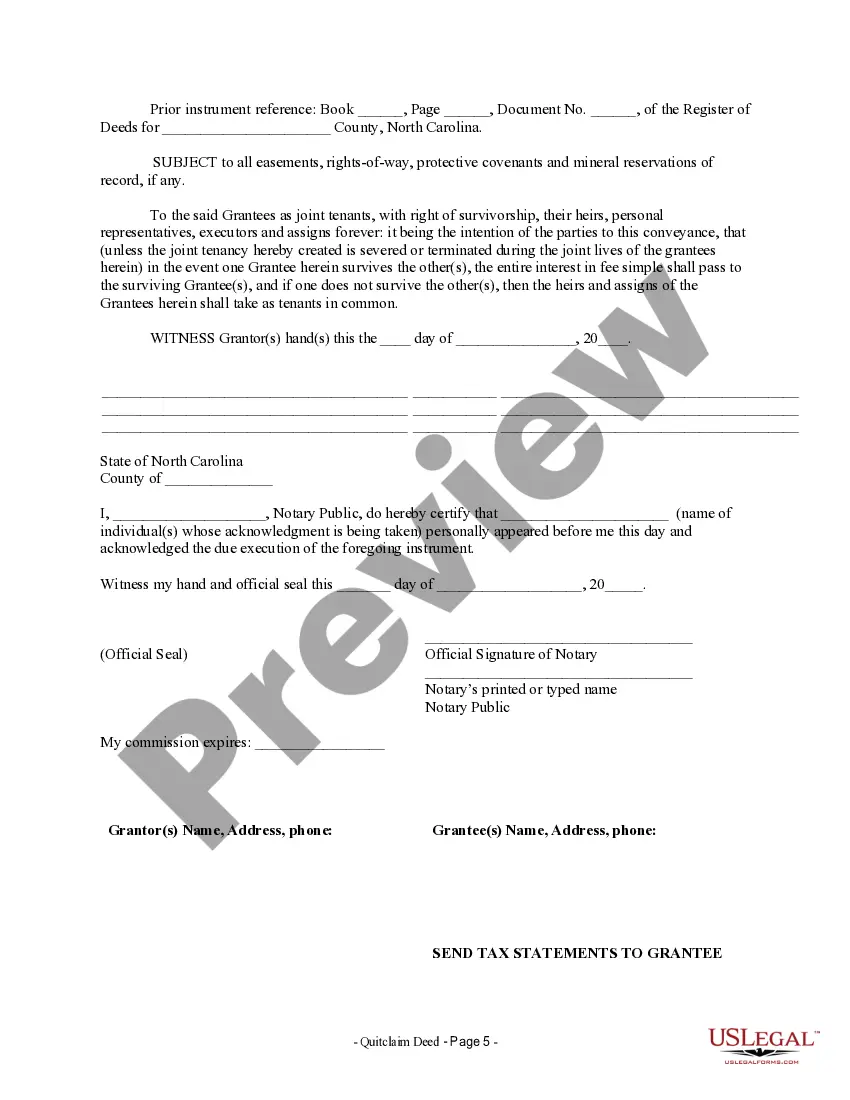
This Quitclaim Deed is a legal document used to transfer property ownership from one individual to three individuals as joint tenants with the right of survivorship. This form allows the grantor to convey their interest in the property to the grantees, ensuring that if one joint tenant passes away, their share automatically passes to the surviving tenants, rather than going through probate. This distinguishes it from other deeds like warranty deeds, which offer guarantees about the title's condition.
Key parts of this document
- Identification of the grantor (the individual transferring the property).
- Identification of the grantees (the three individuals receiving the property).
- Property description including location and details.
- Statement of transfer, indicating the joint tenancy with right of survivorship.
- Signatures of the grantor and a notary public for validation.




When to use this document
This form is typically used when a property owner wishes to transfer their interest in real estate to multiple people as joint tenants. Common scenarios include transferring property to family members or friends when the owner wants to ensure that the property passes automatically to the remaining joint tenants upon their death.
Who needs this form
- Individuals looking to transfer property ownership to multiple people.
- Property owners who want to establish joint tenancy for estate planning.
- Those wishing to simplify the inheritance process for their property.
Steps to complete this form
- Identify the grantor by providing their full name and marital status.
- List the grantees as joint tenants, including their names and marital statuses.
- Clearly describe the property being transferred, including any relevant identification information.
- Ensure all necessary fields are filled out, including date and signatures.
- Have the document notarized to ensure legal validity.
Does this form need to be notarized?
This form needs to be notarized to ensure legal validity. US Legal Forms provides secure online notarization powered by Notarize, allowing you to complete the process through a verified video call, available anytime.
Get your form ready online
Our built-in tools help you complete, sign, share, and store your documents in one place.
Make edits, fill in missing information, and update formatting in US Legal Forms—just like you would in MS Word.
Download a copy, print it, send it by email, or mail it via USPS—whatever works best for your next step.
Sign and collect signatures with our SignNow integration. Send to multiple recipients, set reminders, and more. Go Premium to unlock E-Sign.
If this form requires notarization, complete it online through a secure video call—no need to meet a notary in person or wait for an appointment.
We protect your documents and personal data by following strict security and privacy standards.

Make edits, fill in missing information, and update formatting in US Legal Forms—just like you would in MS Word.

Download a copy, print it, send it by email, or mail it via USPS—whatever works best for your next step.

Sign and collect signatures with our SignNow integration. Send to multiple recipients, set reminders, and more. Go Premium to unlock E-Sign.

If this form requires notarization, complete it online through a secure video call—no need to meet a notary in person or wait for an appointment.

We protect your documents and personal data by following strict security and privacy standards.
Mistakes to watch out for
- Failing to accurately describe the property may cause complications.
- Not having the document notarized, which can lead to issues in validity.
- Leaving signature fields incomplete can render the document ineffective.
Advantages of online completion
- Convenient access to fill out the form from anywhere at any time.
- Editability allows users to easily make adjustments before finalizing.
- Reliable format created by licensed attorneys ensures legal compliance.
Main things to remember
- The Quitclaim Deed facilitates the transfer of property ownership among multiple individuals while ensuring survivorship rights.
- It is essential to complete the deed accurately to avoid legal complications.
- Notarization is required for the deed to be enforceable.
- This form is specifically tailored for use under North Carolina laws.
Looking for another form?
Form popularity
FAQ
To create a joint tenancy, all you need to do is put the right words on the title document, such as a deed to real estate, a car's title slip, or the signature card establishing a bank account.
Joint tenants, on the other hand, must obtain equal shares of the property with the same deed, at the same time. The terms of either a joint tenancy or tenancy in common are outlined in the deed, title, or other legally binding property ownership document.
Adding someone to your house deed requires the filing of a legal form known as a quitclaim deed. When executed and notarized, the quitclaim deed legally overrides the current deed to your home. By filing the quitclaim deed, you can add someone to the title of your home, in effect transferring a share of ownership.
Ownership of real property can be held in equal or unequal shares among the property's co-owners. In a joint tenancy, there is equal ownership, but a tenancy in common arrangement can have ownership divided unequally.
Joint tenancy is a form of property ownership normally associated with real estate. Each party in a joint tenancy has an equal interest in the propertythe financial obligations as well as any benefits.
For example, joint tenants must all take title simultaneously from the same deed while tenants in common can come into ownership at different times. Another difference is that joint tenants all own equal shares of the property, proportionate to the number of joint tenants involved.
Step 1: Get a Notice200b200b200b of death f200b200borm. Step 2: Fill in Notice of de200bath form. Step 3: Create an electronic notice of Sale (eNOS) record. Step 4: Get a certified copy200b of the Death Certificate. Step 5: Get the origina200bl Certificate of Title or arrange for it to be produced by the bank.
Joint ownership. Unlike a tenancy in common, where co-owners may possess unequal interests, the legal interest of each joint owner is equal to the interest of every other joint owner. If there are three joint owners, each owns an equal, undivided, one-third interest in the entire property.
The dangers of joint tenancy include the following: Danger #1: Only delays probate. When either joint tenant dies, the survivor usually a spouse or child immediately becomes the owner of the entire property. But when the survivor dies, the property still must go through probate.