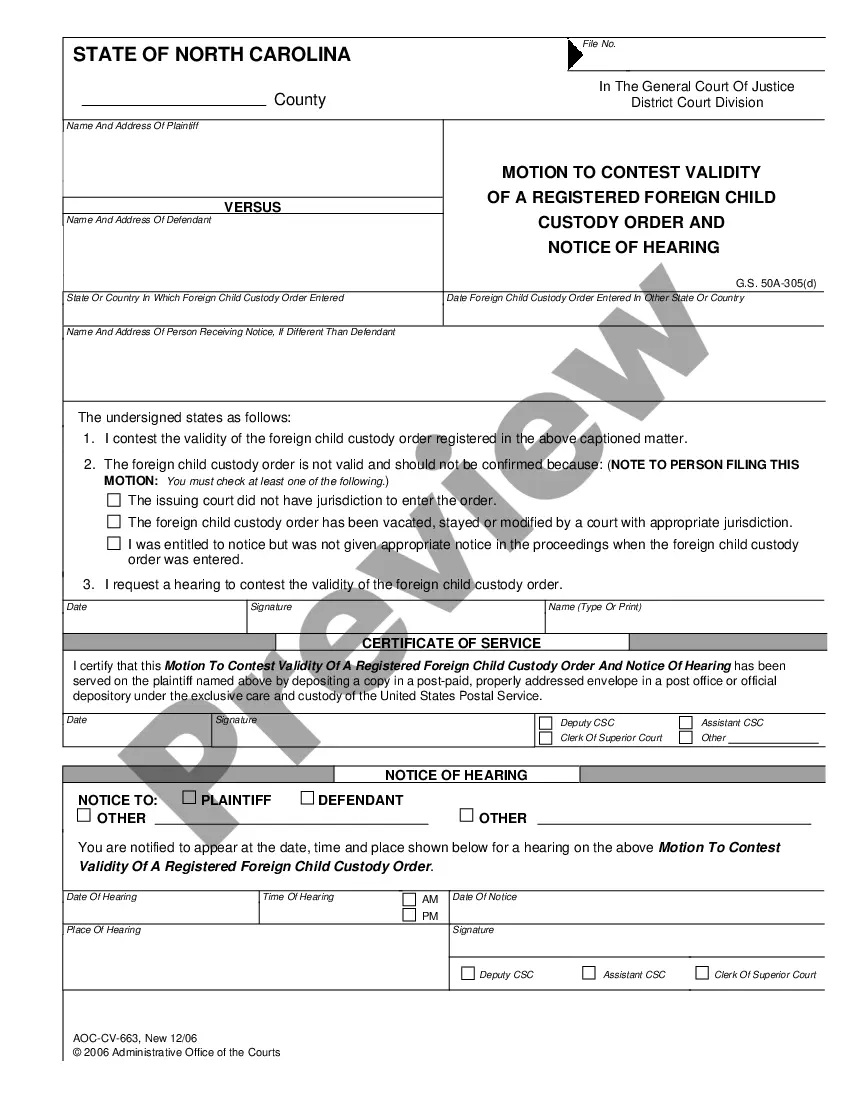
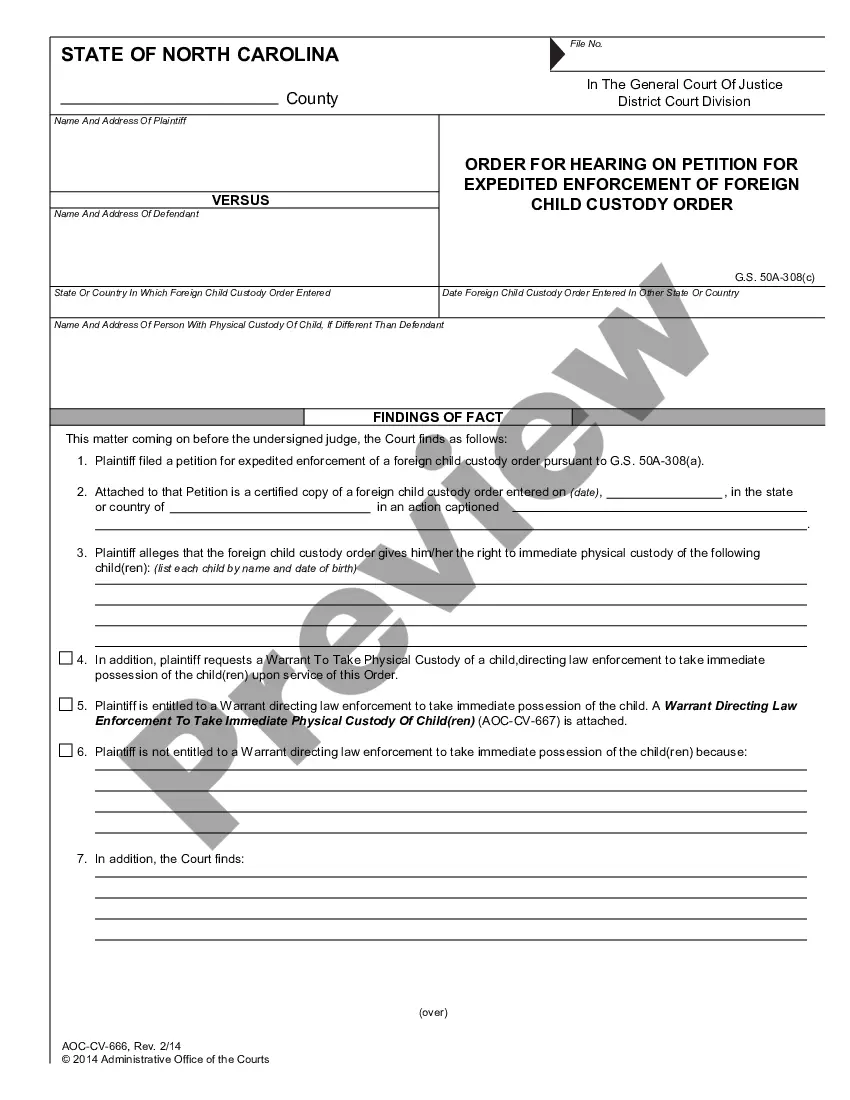
North Carolina Motion to Contest Validity of a Registered Foreign Child Custody Order and Notice of Hearing
Description
Get your form ready online
Our built-in tools help you complete, sign, share, and store your documents in one place.
Make edits, fill in missing information, and update formatting in US Legal Forms—just like you would in MS Word.
Download a copy, print it, send it by email, or mail it via USPS—whatever works best for your next step.
Sign and collect signatures with our SignNow integration. Send to multiple recipients, set reminders, and more. Go Premium to unlock E-Sign.
If this form requires notarization, complete it online through a secure video call—no need to meet a notary in person or wait for an appointment.
We protect your documents and personal data by following strict security and privacy standards.

Make edits, fill in missing information, and update formatting in US Legal Forms—just like you would in MS Word.

Download a copy, print it, send it by email, or mail it via USPS—whatever works best for your next step.

Sign and collect signatures with our SignNow integration. Send to multiple recipients, set reminders, and more. Go Premium to unlock E-Sign.

If this form requires notarization, complete it online through a secure video call—no need to meet a notary in person or wait for an appointment.

We protect your documents and personal data by following strict security and privacy standards.
Looking for another form?




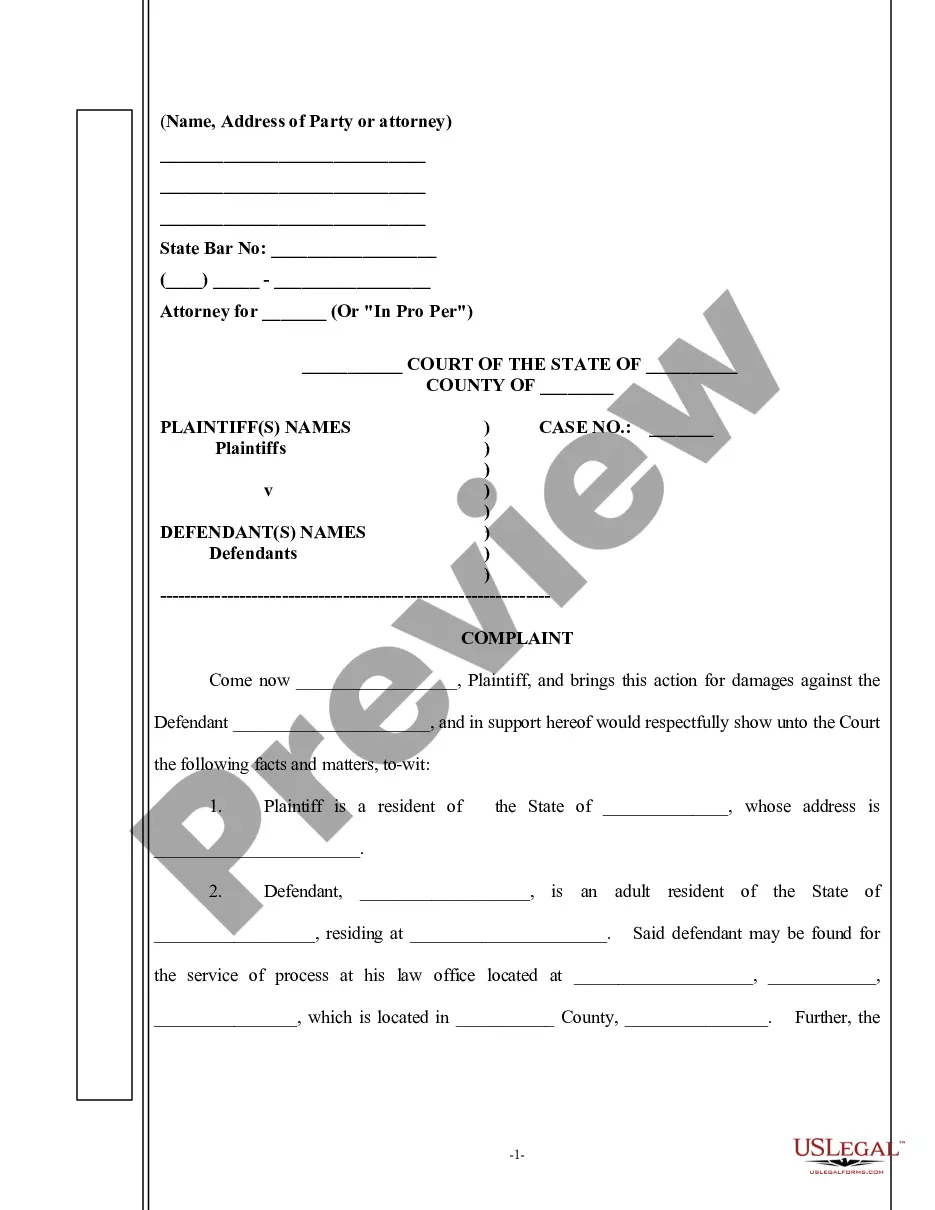
How to fill out North Carolina Motion To Contest Validity Of A Registered Foreign Child Custody Order And Notice Of Hearing?
Steer clear of costly lawyers and locate the North Carolina Motion to Challenge Validity of a Registered Foreign Child Custody Order and Notice of Hearing you require at an affordable rate on the US Legal Forms site.
Utilize our straightforward category functionality to search for and acquire legal and tax documents. Review their descriptions and preview them prior to downloading.
Choose to obtain the document in PDF or DOCX format. Simply click Download and locate your document in the My documents section. Feel free to save the template to your device or print it out. After downloading, you can complete the North Carolina Motion to Challenge Validity of a Registered Foreign Child Custody Order and Notice of Hearing by hand or using editing software. Print it out and reuse the document multiple times. Achieve more for less with US Legal Forms!
- Furthermore, US Legal Forms offers users detailed guidance on how to download and fill out each and every document.
- Subscribers of US Legal Forms just need to Log In and retrieve the specific document they need to their My documents section.
- Those who have not yet subscribed should adhere to the suggestions below.
- Ensure the North Carolina Motion to Challenge Validity of a Registered Foreign Child Custody Order and Notice of Hearing is suitable for use in your area.
- If possible, review the description and utilize the Preview option before downloading the forms.
- If you are confident the document is correct for you, click on Buy Now.
- If the document is inaccurate, use the search tool to find the correct one.
- Then, create your account and choose a subscription option.
- Pay using a card or PayPal.
Form popularity
FAQ
Foreign order means a court or administrative order entered by a tribunal other than one in the state of Washing- ton, including an order entered by a tribunal in an Indian tribe or another state or country.
The Court in its inherent jurisdiction has the power to set aside its own Judgment or Order made without jurisdiction or if same has been fraudulently obtained. In such circumstance, an appeal for the purpose of having the null judgment or order cannot be said to be necessary.
An order to show cause is a type of court order that requires one or more of the parties to a case to justify, explain, or prove something to the court. Courts commonly use orders to show cause when the judge needs more information before deciding whether or not to issue an order requested by one of the parties.
The Court in its inherent jurisdiction has the power to set aside its own Judgment or Order made without jurisdiction or if same has been fraudulently obtained. In such circumstance, an appeal for the purpose of having the null judgment or order cannot be said to be necessary.
To ask a court to set aside (cancel) a court order or judgment, you have to file a request for order to set aside, sometimes called a motion to set aside or motion to vacate. The terms set aside or vacate a court order basically mean to cancel or undo that order to start over on a particular issue.
The judge will review the exceptions filed against the magistrates report and recommended order. If the exceptions have merit, the judge will deny the magistrates report and order and enter their own order.
The way that a party asks a court to enforce its order is through a particular type of motion, called an Order to Show Cause.Those sanctions can include such things as a money judgement against the non-compliant party if they fail to pay the money that they were supposedly ordered to pay.
The Court order is invalid because the court had no authority to act (subject matter jurisdiction), or you were not served with legal notice in the original case (personal jurisdiction).
Our appellate courts have held that one superior court judge may only modify, overrule, or change the order of another superior court judge where the original order was (1) interlocutory, (2) discretionary, and (3) there has been a substantial change of circumstances since the entry of the prior order.