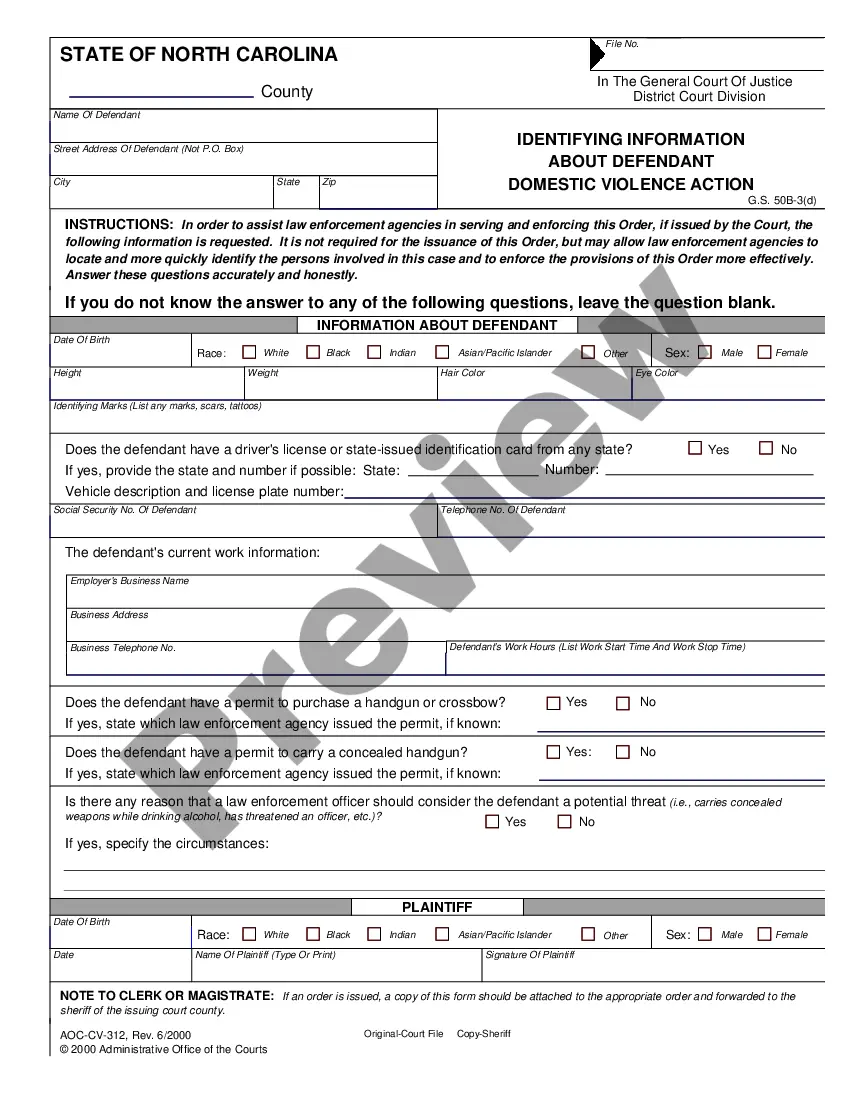
Identifying Information About Defendant in a Domestic Violence Action: This is an official form from the North Carolina Administration of the Courts - AOC, which complies with all applicable laws and statutes. USLF amends and updates the forms as is required by North Carolina statutes and law.
North Carolina Identifying Information about Defendant Domestic Violence Action
Instant download
This website is not affiliated with any governmental entity
Public form
Description
Get your form ready online
Our built-in tools help you complete, sign, share, and store your documents in one place.
Built-in online Word editor
Make edits, fill in missing information, and update formatting in US Legal Forms—just like you would in MS Word.
Export easily
Download a copy, print it, send it by email, or mail it via USPS—whatever works best for your next step.
E-sign your document
Sign and collect signatures with our SignNow integration. Send to multiple recipients, set reminders, and more. Go Premium to unlock E-Sign.
Notarize online 24/7
If this form requires notarization, complete it online through a secure video call—no need to meet a notary in person or wait for an appointment.
Store your document securely
We protect your documents and personal data by following strict security and privacy standards.

Make edits, fill in missing information, and update formatting in US Legal Forms—just like you would in MS Word.

Download a copy, print it, send it by email, or mail it via USPS—whatever works best for your next step.

Sign and collect signatures with our SignNow integration. Send to multiple recipients, set reminders, and more. Go Premium to unlock E-Sign.

If this form requires notarization, complete it online through a secure video call—no need to meet a notary in person or wait for an appointment.

We protect your documents and personal data by following strict security and privacy standards.
Looking for another form?
How to fill out North Carolina Identifying Information About Defendant Domestic Violence Action?
Stay clear of expensive lawyers and discover the North Carolina Identifying Information about Defendant Domestic Violence Action you seek at a reasonable cost on the US Legal Forms website.
Utilize our straightforward categories feature to locate and acquire legal and tax documents. Review their descriptions and preview them before downloading.
Choose to download the document in PDF or DOCX format. Simply click Download and locate your form in the My documents section. You can save the form to your device or print it out. After downloading, you can fill out the North Carolina Identifying Information about Defendant Domestic Violence Action either manually or with the assistance of editing software. Print it and reuse the template multiple times. Achieve more for less with US Legal Forms!
- Moreover, US Legal Forms provides users with detailed instructions on how to download and complete each form.
- US Legal Forms users only need to sign in and access the exact form they require in their My documents section.
- Those who have not yet subscribed should adhere to the guidelines outlined below.
- Confirm that the North Carolina Identifying Information about Defendant Domestic Violence Action is suitable for use in your location.
- If possible, examine the description and utilize the Preview option prior to downloading the document.
- If you are confident the template satisfies your requirements, click Buy Now.
- If the form is inaccurate, use the search tool to find the correct one.
- Next, create your account and select a subscription plan.
- Make payment via card or PayPal.
Form popularity
FAQ
Defendant - In a civil suit, the person complained against; in a criminal case, the person accused of the crime.
The right to effective assistance of counsel; The right to plead not guilty; The right to a jury trial; The right to testify and present evidence at trial; The right to not testify or present evidence at trial; and. The right to appeal.
Be Punctual. Make sure that you never arrive late for court. Dress to Impress. My clients dress to impress. Drop the Negative Attitudes. Show respect for the court. Keep a Poker Face. When you're in court and listening to testimony, keep a poker face. Leaving Court.
(Entry 1 of 2) law. : a person or group against whom a criminal or civil action is brought : someone who is being sued or accused of committing a crime if the jury finds the defendant not guilty compare plaintiff.
The Role of Juries The jury decides whether a defendant is "guilty" or "not guilty" in criminal cases, and "liable" or "not liable" in civil cases. When cases are tried before a jury, the judge still has a major role in determining which evidence may be considered by the jury.
During the trial, lawyers present evidence through witnesses who testify about what they saw or know. After all the evidence is presented, the lawyers give their closing arguments. Finally, the jury decides if the defendant is guilty or not guilty. The jury must find the defendant guilty beyond a reasonable doubt.
In some cases, a person can face both civil and criminal charges, becoming a defendant in both cases. For example, John has been accused of embezzling $100,000 from his employer. John may be charged with embezzlement as a crime, being subject to potential prison time and other penalties.
The defendant in a lawsuit is the person against whom the action is brought, by the plaintiff. A defendant in an arbitration case or a divorce case is called the "respondent." U.S. Law has two kinds of court cases which involve defendants: Criminal cases, which involve a defendant who is accused of a crime.