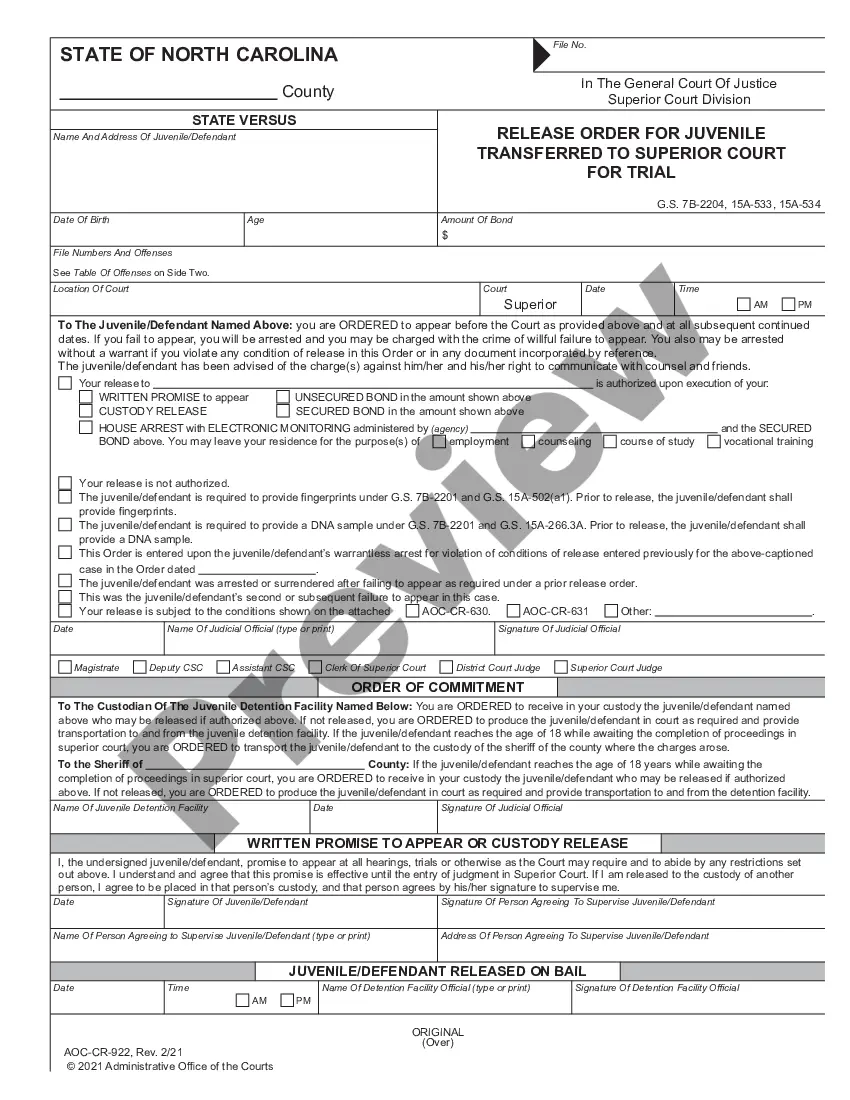
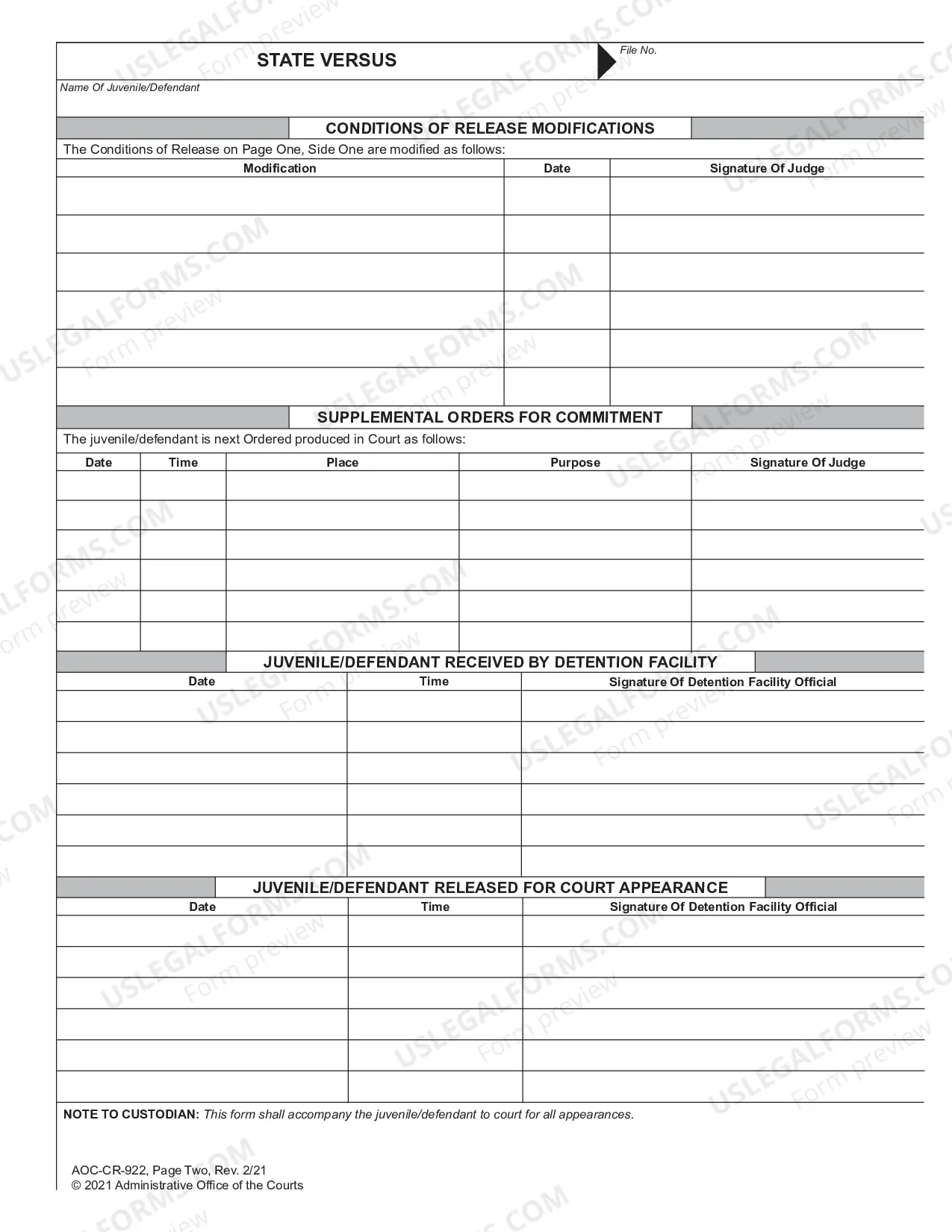
Release Order for Juvenile Whose Case is Transferred to Superior Court: This is an official form from the North Carolina Administration of the Courts (AOC), which complies with all applicable laws and statutes. USLF amends and updates the forms as is required by North Carolina statutes and law.
North Carolina Release Order for Juvenile Whose Case is Transferred to Superior Court
Instant download
This website is not affiliated with any governmental entity
Public form
Description
Free preview

Get your form ready online
Our built-in tools help you complete, sign, share, and store your documents in one place.
Built-in online Word editor
Make edits, fill in missing information, and update formatting in US Legal Forms—just like you would in MS Word.
Export easily
Download a copy, print it, send it by email, or mail it via USPS—whatever works best for your next step.
E-sign your document
Sign and collect signatures with our SignNow integration. Send to multiple recipients, set reminders, and more. Go Premium to unlock E-Sign.
Notarize online 24/7
If this form requires notarization, complete it online through a secure video call—no need to meet a notary in person or wait for an appointment.
Store your document securely
We protect your documents and personal data by following strict security and privacy standards.

Make edits, fill in missing information, and update formatting in US Legal Forms—just like you would in MS Word.

Download a copy, print it, send it by email, or mail it via USPS—whatever works best for your next step.

Sign and collect signatures with our SignNow integration. Send to multiple recipients, set reminders, and more. Go Premium to unlock E-Sign.

If this form requires notarization, complete it online through a secure video call—no need to meet a notary in person or wait for an appointment.

We protect your documents and personal data by following strict security and privacy standards.
Looking for another form?

How to fill out North Carolina Release Order For Juvenile Whose Case Is Transferred To Superior Court?
Steer clear of pricey attorneys and locate the North Carolina Release Order for Juvenile Whose Case is Transferred to Superior Court you seek at an affordable price on the US Legal Forms site. Utilize our straightforward categories feature to discover and acquire legal and tax documents. Review their descriptions and preview them thoroughly before downloading.
Furthermore, US Legal Forms offers users detailed instructions on how to download and complete each form.
After downloading, you can complete the North Carolina Release Order for Juvenile Whose Case is Transferred to Superior Court either by hand or using editing software. Print it and reuse the document multiple times. Achieve more for less with US Legal Forms!
- US Legal Forms subscribers simply need to Log In and download the particular document they require to their My documents section.
- Those who have not subscribed yet should adhere to the guidelines outlined below.
- Verify that the North Carolina Release Order for Juvenile Whose Case is Transferred to Superior Court is applicable where you reside.
- If possible, read the description and utilize the Preview feature prior to downloading the template.
- If you are confident the document is right for you, click on Buy Now.
- Should the template be incorrect, use the search feature to locate the appropriate one.
- Next, create your account and select a subscription plan.
- Make your payment via card or PayPal.
- Choose to receive the document in PDF or DOCX format.
- Simply click Download and find your document in the My documents section. You are welcome to save the form to your device or print it out.
Form popularity
FAQ
A juvenile petition concerns a child under 18 years old. The petition might be used to determine custody. The petition may be regarding the child's delinquent behavior.A juvenile petition is in many ways the minor's version of a criminal complaint in adult cases.
Although courts with juvenile jurisdiction handle a variety of cases, including abuse, neglect, adoption, and traffic violations, the Juvenile Court Statistics series focuses on the disposition of delinquency cases and formally pro- cessed status offense cases.
Although courts with juvenile jurisdiction handle a variety of cases, including abuse, neglect, adoption, and traffic violations, the Juvenile Court Statistics series focuses on the disposition of delinquency cases and formally pro- cessed status offense cases.
How are juvenile cases handled? In North Carolina, juvenile cases are sent to the state district courts for hearings. These courts have authority over delinquent and undisciplined juveniles.
A judicial waiver occurs when a juvenile court judge transfers a case from juvenile to adult court in order to deny the juvenile the protections that juvenile jurisdictions provide.
The Supreme Court has not ruled on whether juveniles have the right to bail, the right to a speedy trial, or the right to self- representation under the United States Constitution, and the North Carolina General Assembly did not extend those rights to juveniles as part of the Juvenile Code. G.S. 7B- 2405.
Terms are generally set by the legislature rather than determined by judicial discretion. In which of following cases did the court rule that a juvenile court cannot adjudicate a case and then transfer it to the criminal court for adult processing on the same offense? The case of Breed v.
With a discretionary waiver, the judge in a juvenile court has some discretion in deciding whether a juvenile defendant will be transferred to criminal court or not.With a discretionary waiver, the burden of proof is on the state, and a preponderance of the evidence is typically required to prove one's case.
The three types of a judicial waiver are discretionary, mandatory, and presumptive.