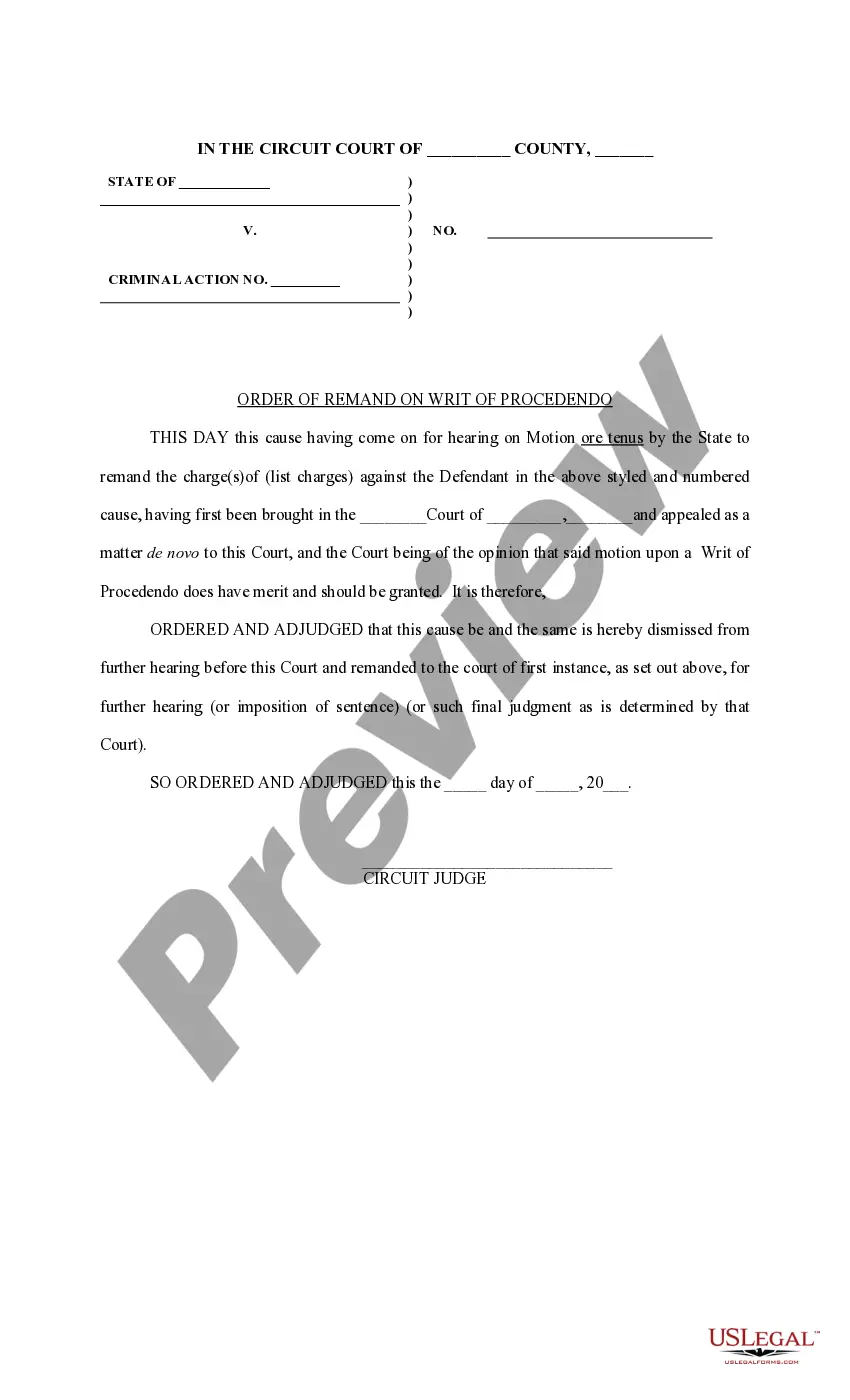
Order of Remand: This is an official form from the North Carolina Administration of the Courts (AOC), which complies with all applicable laws and statutes. USLF amends and updates the forms as is required by North Carolina statutes and law.
North Carolina Order of Remand
Instant download
This website is not affiliated with any governmental entity
Public form
Description



How to fill out North Carolina Order Of Remand?
Avoid pricey attorneys and find the North Carolina Order of Remand you want at a reasonable price on the US Legal Forms website. Use our simple categories functionality to look for and download legal and tax files. Go through their descriptions and preview them prior to downloading. In addition, US Legal Forms provides users with step-by-step instructions on how to download and complete each and every template.
US Legal Forms clients just need to log in and obtain the specific form they need to their My Forms tab. Those, who haven’t obtained a subscription yet must follow the tips listed below:
- Make sure the North Carolina Order of Remand is eligible for use where you live.
- If available, read the description and use the Preview option before downloading the templates.
- If you’re confident the document suits you, click on Buy Now.
- If the form is incorrect, use the search engine to get the right one.
- Next, create your account and choose a subscription plan.
- Pay out by credit card or PayPal.
- Select download the document in PDF or DOCX.
- Click Download and find your template in the My Forms tab. Feel free to save the form to the gadget or print it out.
After downloading, you can fill out the North Carolina Order of Remand by hand or with the help of an editing software program. Print it out and reuse the template multiple times. Do more for less with US Legal Forms!
Form popularity
FAQ
Instead, the appellate court will remand, or send, the case back to the trial court for the trial court to actually fix or re-decide the issue. This means that the issue or issues wrongly decided will be re-tried or re-heard by the trial judge based on and within the instructions given by the appellate court.
If the Court of Appeals reversed and remanded the trial court's orders on the issues that you've appealed, then it means that it has found that the trial judge was wrong on that issue, by either misapplying the law or in failing to have sufficient evidence to support their decision based on the testimony and evidence
Some cases will result in a reversal and remand. This means that the Court of Appeals found an error and the case is remanded, or sent back, to the same trial judge to re-decide the case.However other times the remand language from the Court of Appeals is so specific that the judge must decide the case differently.
A remand may be a full remand, essentially ordering an entirely new trial; when an appellate court grants a full remand, the lower court's decision is "reversed and remanded."If the federal court decides that the case was not one in which removal was permissible, it may remand the case to state court.
A remand under rule 8.528(c) is not a decision final on filing because it is not a separately filed order; rather, as part of its appellate judgment at the end of its opinion in such cases the Supreme Court simply orders the cause remanded to the Court of Appeal for disposition of the remaining issues in the appeal.
Definition from Nolo's Plain-English Law Dictionary The decision of a court of appeal ruling that the judgment of a lower court was incorrect and is reversed. The result is that the lower court which tried the case is instructed to dismiss the original action, retry the case, or is ordered to change its judgment.
To remand something is to send it back.When an appellate court reverses the decision of a lower court, the written decision often contains an instruction to remand the case to the lower court to be reconsidered in light of the appellate court's ruling.
Some cases will result in a reversal and remand. This means that the Court of Appeals found an error and the case is remanded, or sent back, to the same trial judge to re-decide the case.
This means that your Social Security case is going to be sent back to the Administrative Law Judge (ALJ) to make another decision.This means you have lost the appeal as the Federal Court is agreeing with the ALJ's decision. A Federal Judge can also decide to reverse the decision made by the ALJ which means you won.