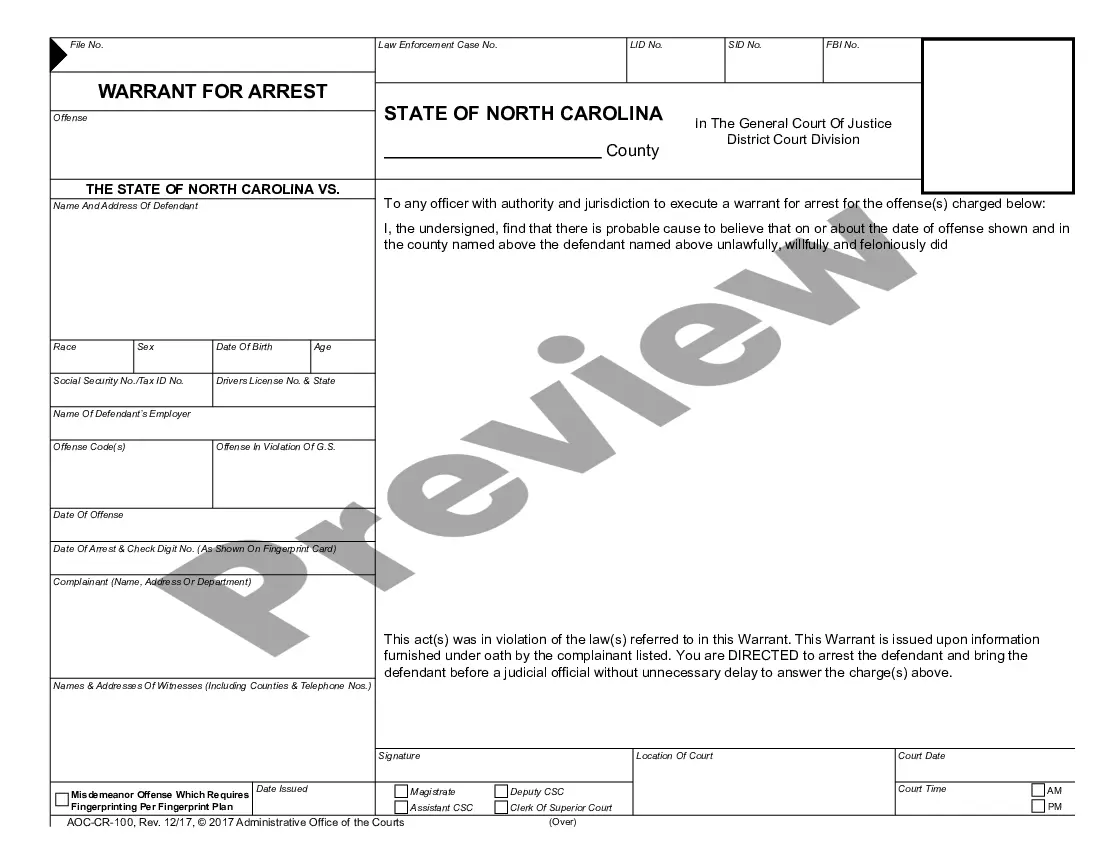
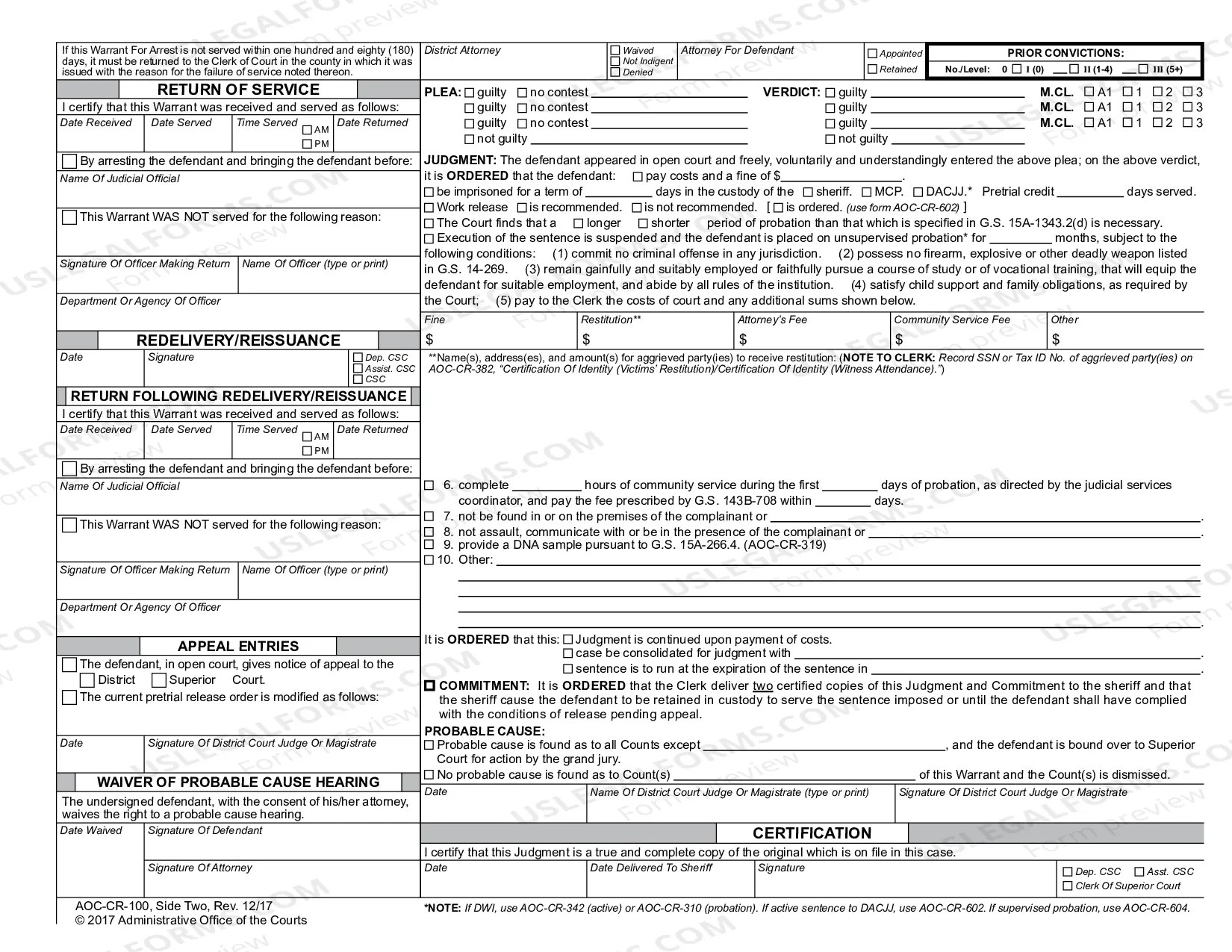
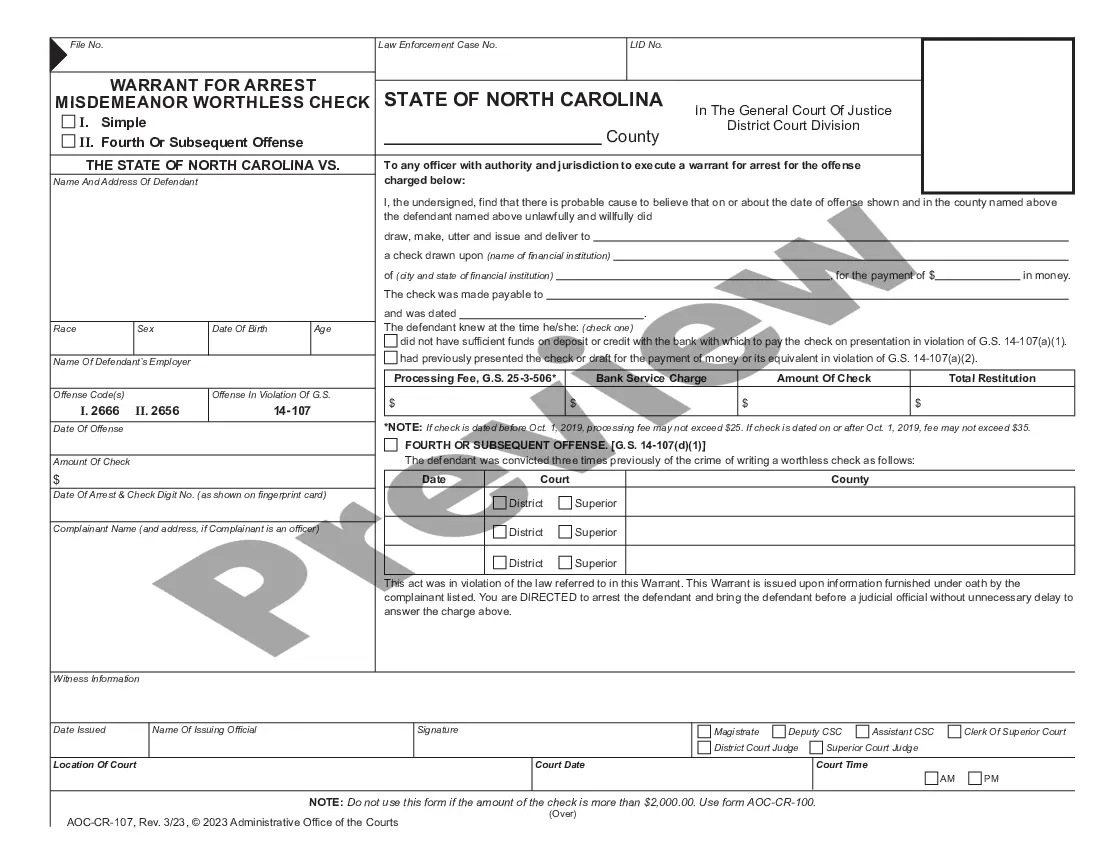
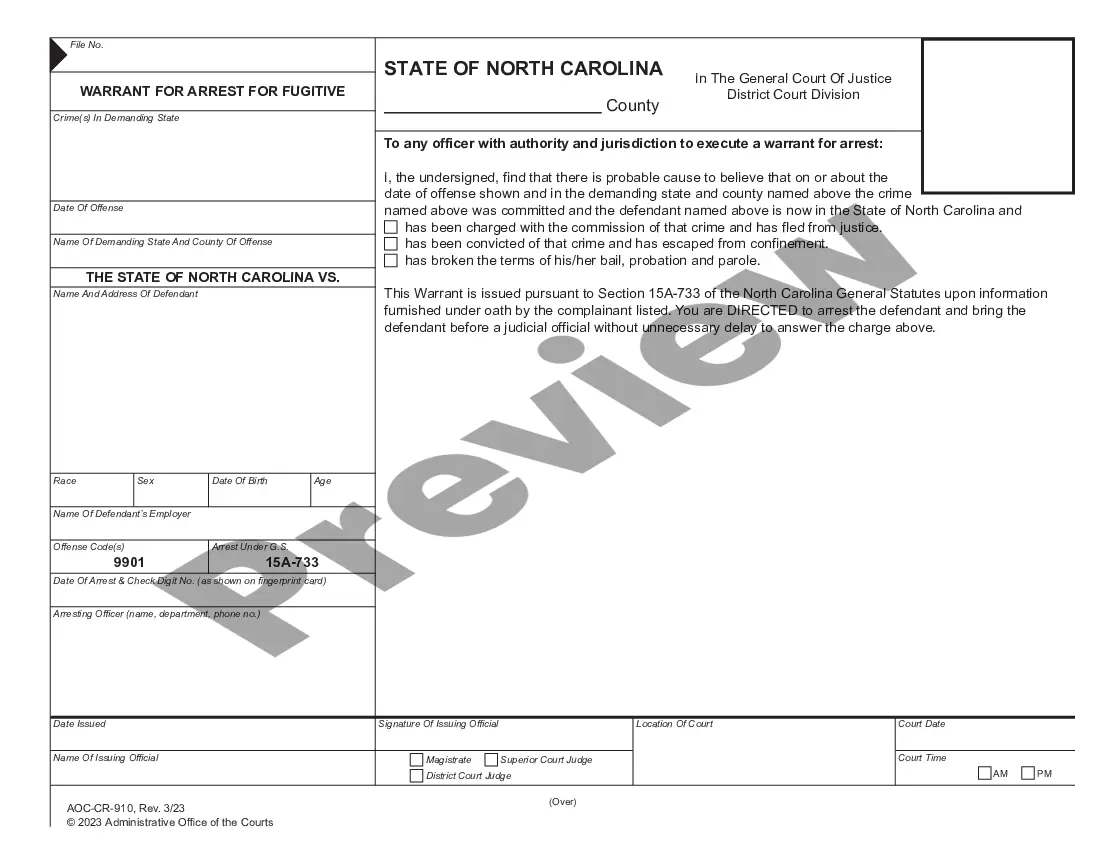
Warrant for Arrest: This is an official form from the North Carolina Administration of the Courts (AOC), which complies with all applicable laws and statutes. USLF amends and updates the forms as is required by North Carolina statutes and law.
North Carolina Warrant For Arrest
Instant download
This website is not affiliated with any governmental entity
Public form
Description
Free preview
Get your form ready online
Our built-in tools help you complete, sign, share, and store your documents in one place.
Built-in online Word editor
Make edits, fill in missing information, and update formatting in US Legal Forms—just like you would in MS Word.
Export easily
Download a copy, print it, send it by email, or mail it via USPS—whatever works best for your next step.
E-sign your document
Sign and collect signatures with our SignNow integration. Send to multiple recipients, set reminders, and more. Go Premium to unlock E-Sign.
Notarize online 24/7
If this form requires notarization, complete it online through a secure video call—no need to meet a notary in person or wait for an appointment.
Store your document securely
We protect your documents and personal data by following strict security and privacy standards.

Make edits, fill in missing information, and update formatting in US Legal Forms—just like you would in MS Word.

Download a copy, print it, send it by email, or mail it via USPS—whatever works best for your next step.

Sign and collect signatures with our SignNow integration. Send to multiple recipients, set reminders, and more. Go Premium to unlock E-Sign.

If this form requires notarization, complete it online through a secure video call—no need to meet a notary in person or wait for an appointment.

We protect your documents and personal data by following strict security and privacy standards.
Looking for another form?

How to fill out North Carolina Warrant For Arrest?
Steer clear of expensive attorneys and locate the North Carolina Warrant For Arrest you seek at an affordable rate on the US Legal Forms platform.
Utilize our straightforward categories feature to discover and acquire legal and tax documents. Review their summaries and preview them before downloading.
Choose to acquire the document in PDF or DOCX format. Click on Download and locate your document in the My documents section. You are welcome to save the template to your device or print it. After downloading, you can fill out the North Carolina Warrant For Arrest manually or using editing software. Print it and reuse the document multiple times. Achieve more for less with US Legal Forms!
- Moreover, US Legal Forms offers users comprehensive guidance on how to obtain and complete each document.
- US Legal Forms users simply need to Log In and access the specific document they require from their My documents section.
- Those who have not yet secured a subscription should adhere to the steps outlined below.
- Ensure the North Carolina Warrant For Arrest is valid for use in your area.
- If applicable, browse the description and utilize the Preview feature before downloading the template.
- If you are confident that the document meets your requirements, click on Purchase Now.
- In case the document is incorrect, use the search tool to find the appropriate one.
- Subsequently, create your account and select a subscription plan.
- Make payment via card or PayPal.
Form popularity
FAQ
An arrest warrant could also hinder your ability to get a job or get a license in a new state. The company or the DMV may conduct a background check on you. If they do this, they will be able to access the database and see the warrant out for your arrest.
A court order is a legal command issued by a judge or other judicial official. Court orders are sometimes referred to by other names such as magistrate's order, search warrant, show cause order, order to appear, summons or clerk's order.
Yes. The DMV will check to see if you have outstanding warrants or a bench warrant. They may have a Department of Public Safety (DPS) officer on-site. This is a tactic that some cities use to arrest people with outstanding warrants.
N.C. Gen. Stat. §132-1.4(a) provides in part that records of criminal investigations conducted by public law enforcement agencies or records of criminal intelligence information compiled by public law enforcement agencies are not public records as defined by G.S. 132-1.
Information about criminal cases in the North Carolina court system can be accessed by visiting a public, self-service terminal located at a clerk of court's office in any county. You can use the terminal to search for cases by defendant name, case number, or victim or witness name.
If a law enforcement officer stops an individual with an outstanding bench warrant against him, the person may be detained on the warrant, and may be held in jail until a bond is posted or a hearing is held on the warrant.
Some court records are specifically named in another statue as being public unless sealed by the court: "arrest and search warrants that have been returned by law enforcement agencies, indictments, criminal summons, and nontestimonial identification orders." N.C. Gen. Stat. § 132-1.4(k).
§ 132-1, and a specific statute about court records, N.C. Gen. Stat. A§ 7A-109(a). The court records statute requires that all records be open to public inspection, except as prohibited by law.