North Carolina Warranty Deed - Trust to Trust

What this document covers
A Warranty Deed - Trust to Trust is a legal document used for transferring property ownership between two trusts. In this scenario, the grantor is a trust transferring property to another trust (the grantee). This type of deed ensures that the transfer is done in accordance with state laws and includes warranties that protect the grantee's interest in the property. It differs from other types of deeds by specifically involving trusts as parties in the transaction, making it essential for situations where property is held in trust.
What’s included in this form
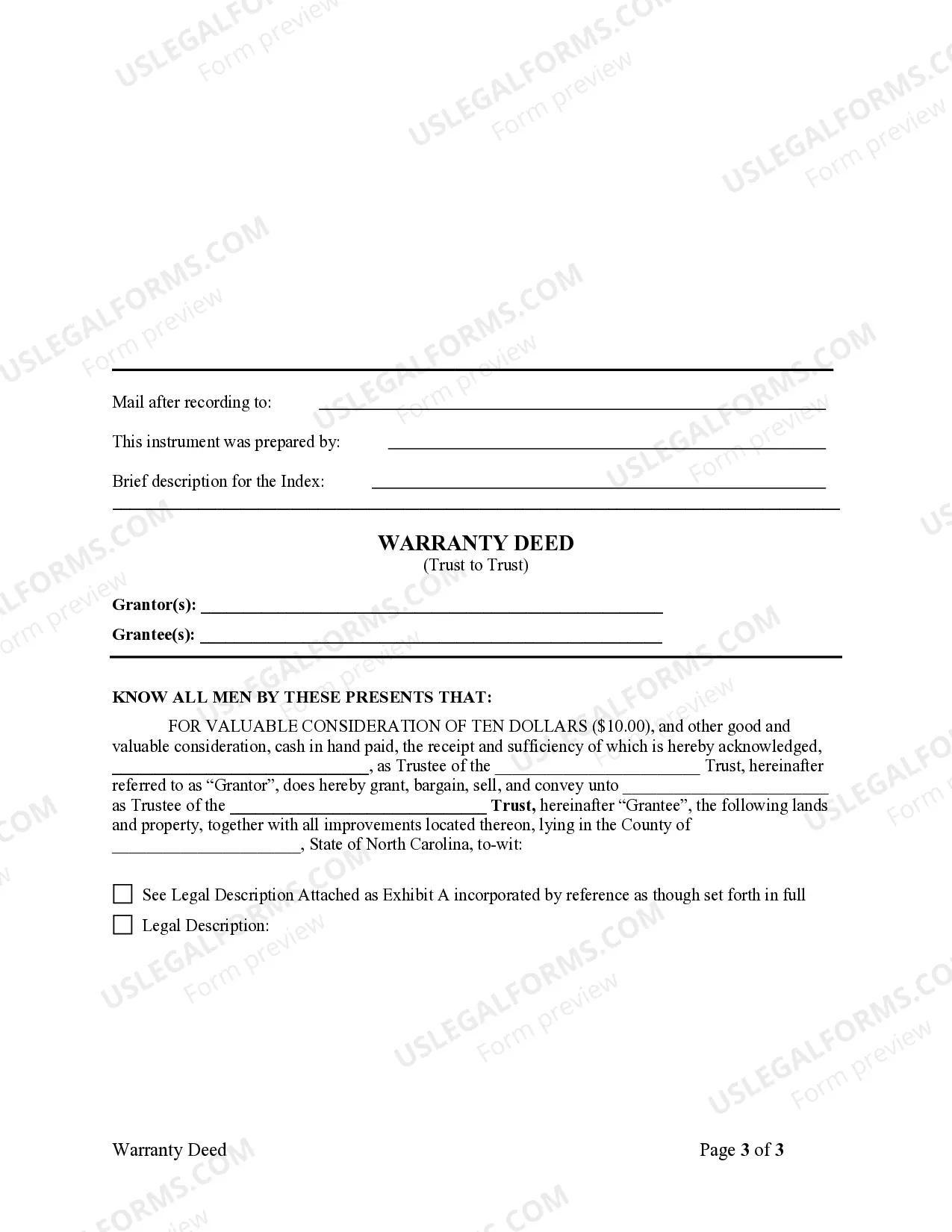
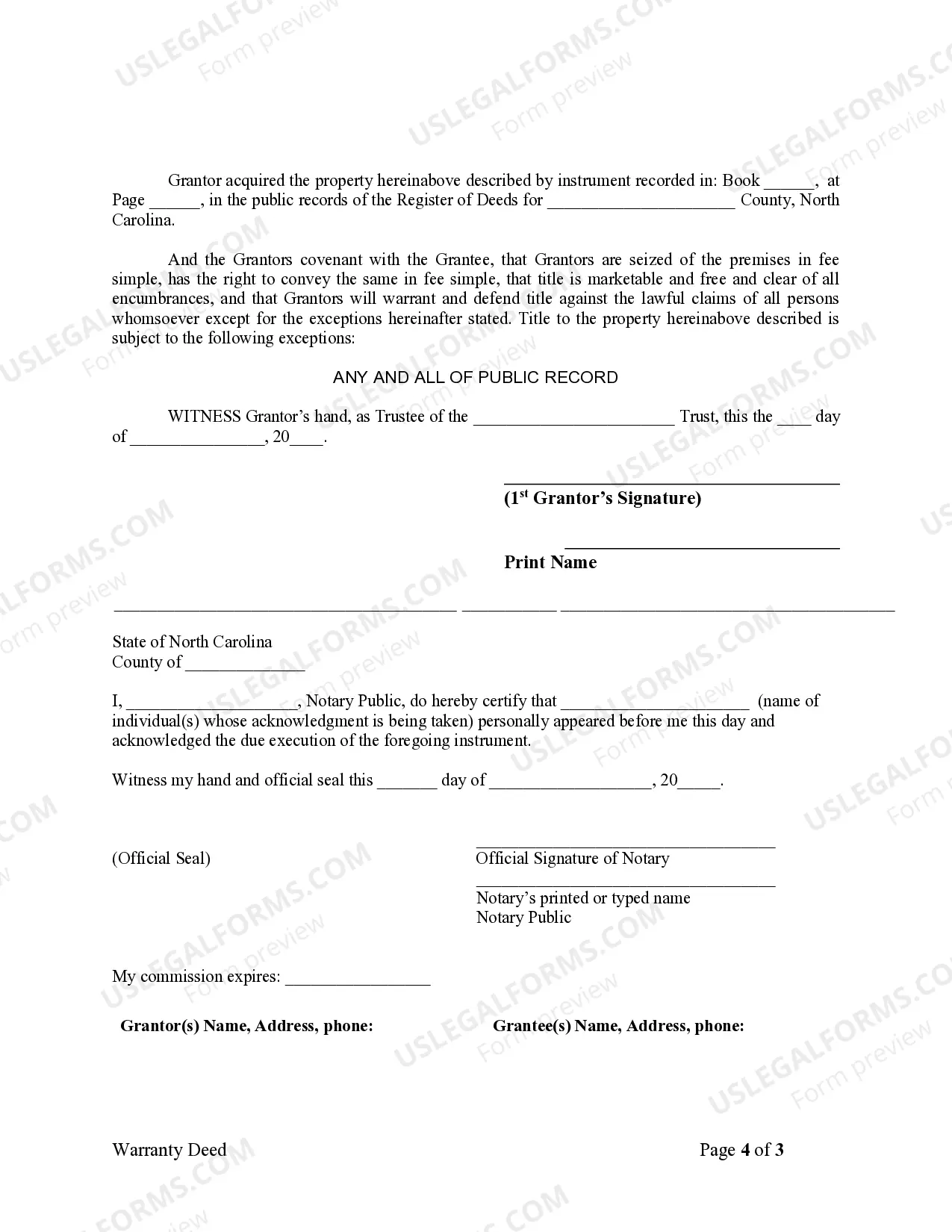
- Grantor and Grantee Names: Identification of the trusts involved in the transfer.
- Property Description: Details including location and specifics of the property being transferred.
- Consideration Clause: A statement acknowledging the value exchanged for the property transfer.
- Covenant of Seisin: Assurance that the grantor has the right to convey the property.
- Exceptions to Title: Any known encumbrances or issues related to the property.
- Date of Transfer: The exact date when the property is officially transferred.






When to use this form
This form is necessary in various situations, including when one trust wishes to transfer property to another trust, typically for estate planning purposes. It can be used when assets are being repositioned within family trusts or for other legal and financial reasons that require a documented transfer of property ownership between trust entities.
Who should use this form
This form is suitable for:
- Trustees of one trust transferring property to another trust.
- Individuals involved in estate planning who manage property through trusts.
- Lawyers and legal representatives handling property transfers between trusts.
How to prepare this document
- Identify the parties involved: Fill in the names of the grantor and grantee trusts.
- Specify the property: Enter the detailed description, including the location and any relevant features.
- Enter the consideration: Input the amount of consideration exchanged for the property.
- Complete the covenant of seisin: Confirm the grantor's legal authority to convey the property.
- Include any exceptions: List any known encumbrances or issues related to the property title.
- Date and sign: Ensure the form is dated and signed appropriately by the trustee of the grantor trust.
Notarization guidance
This form does not typically require notarization unless specified by local law. However, it is advisable to confirm any legal requirements in your jurisdiction to ensure validity.
Get your form ready online
Our built-in tools help you complete, sign, share, and store your documents in one place.
Make edits, fill in missing information, and update formatting in US Legal Forms—just like you would in MS Word.
Download a copy, print it, send it by email, or mail it via USPS—whatever works best for your next step.
Sign and collect signatures with our SignNow integration. Send to multiple recipients, set reminders, and more. Go Premium to unlock E-Sign.
If this form requires notarization, complete it online through a secure video call—no need to meet a notary in person or wait for an appointment.
We protect your documents and personal data by following strict security and privacy standards.

Make edits, fill in missing information, and update formatting in US Legal Forms—just like you would in MS Word.

Download a copy, print it, send it by email, or mail it via USPS—whatever works best for your next step.

Sign and collect signatures with our SignNow integration. Send to multiple recipients, set reminders, and more. Go Premium to unlock E-Sign.

If this form requires notarization, complete it online through a secure video call—no need to meet a notary in person or wait for an appointment.

We protect your documents and personal data by following strict security and privacy standards.
Typical mistakes to avoid
- Failing to include all trustee names: Ensure that both grantor and grantee trustees are fully identified.
- Omitting property details: Provide a clear and complete description of the property.
- Incorrect dates: Double-check that the date of execution is accurate and formatted correctly.
- Missing signatures: All necessary parties must sign the document for it to be valid.
Benefits of completing this form online
- Convenience: Easily download the form at any time from your computer.
- Editability: Fill out the form digitally, which reduces the chances of errors.
- Reliability: The forms are drafted by licensed attorneys to meet legal standards.
Legal use & context
- This warranty deed serves as a formal record of the property transfer between trusts.
- The grantor guarantees a clear title and assures the grantee of their rights to the property.
- Using this form helps to mitigate disputes over property ownership and clarifies the rights of parties involved.
Key takeaways
- A Warranty Deed â Trust to Trust is essential for transferring property between trusts.
- Ensure all details are accurately filled out to avoid legal issues.
- Consider notarization to enhance the document's validity.
- The form is compliant with North Carolina laws for property transfers.
Looking for another form?
Form popularity
FAQ
Yes, there are key differences between the two. With a deed, you transfer the ownership of the property to one party. In contrast, a deed of trust does not mean the holder owns the property. In an arrangement involving a deed of trust, the borrower signs a contract with the lender with details regarding the loan.
To make the form legally binding, you must sign it in front of a notary public. You must then file your signed and notarized deed with the county office that's in charge of recording property documents. Once the grantee signs the warranty deed, he/she legally has ownership and claim to the property.
The answer is yes. Parties to a transaction are always free to prepare their own deeds. If you do so, be sure your deed measures up to your state's legal regulations, to help avert any legal challenge to the deed later.
Under the Grantor section of the deed, write the name of the person transferring title. Under Grantee, write the name of the person receiving title. Describe the parcel of land. Use the street address and include the North Carolina County where the land is located.
The person who owns the property usually signs a promissory note and a deed of trust. The deed of trust does not have to be recorded to be valid.
The name and address of the seller (called the grantor) The name and address of the buyer (called the grantee) A legal description of the property (found on the previous deed) A statement that the grantor is transferring the property to the grantee.
Transferring Real Property to a Trust You can transfer your home (or any real property) to the trust with a deed, a document that transfers ownership to the trust. A quitclaim deed is the most common and simplest method (and one you can do yourself).
Some owners are put off using solicitors duke to the deed of trust cost. Individuals can write out their own, and use someone else as a witness. However, this may have errors or not be a legally binding document. The investment of getting a deed of trust when buying a property is often worth it in the long term.
Party information: names and addresses of the trustor(s), trustee(s), beneficiary(ies), and guarantor(s) (if applicable) Property details: full address of the property and its legal description (which can be obtained from the County Recorder's Office)