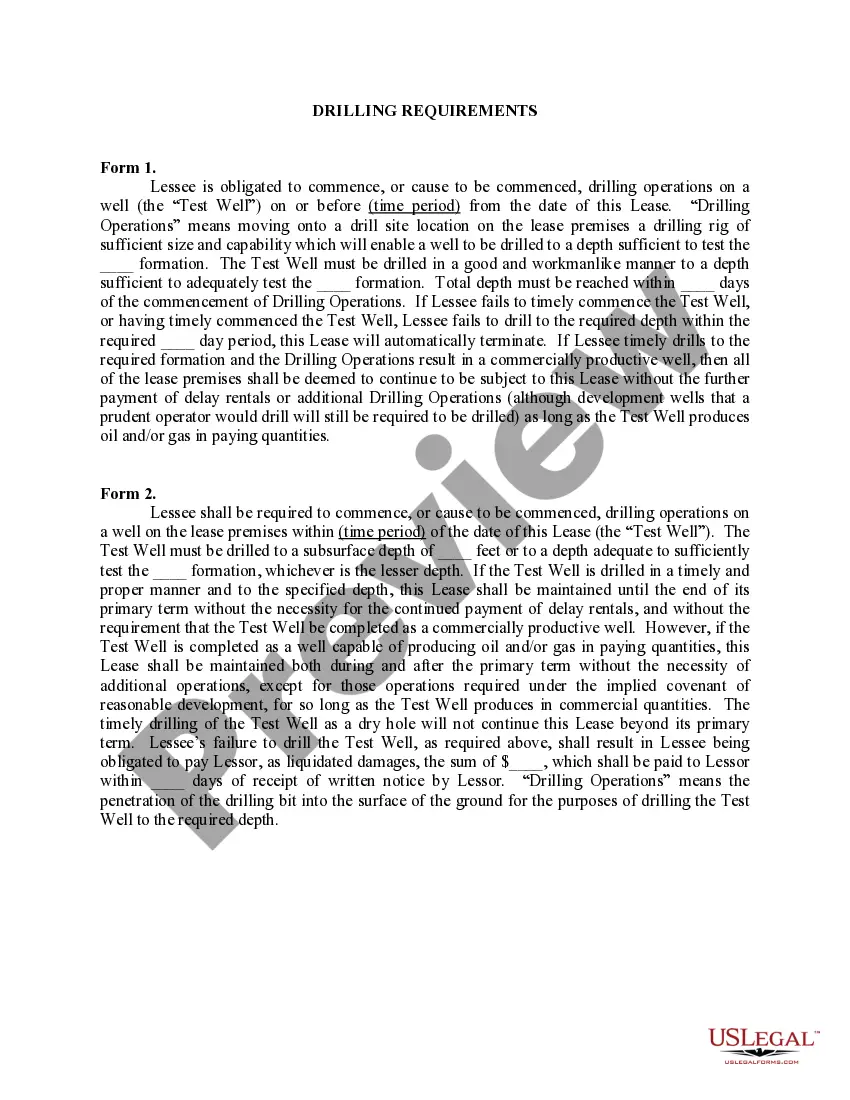
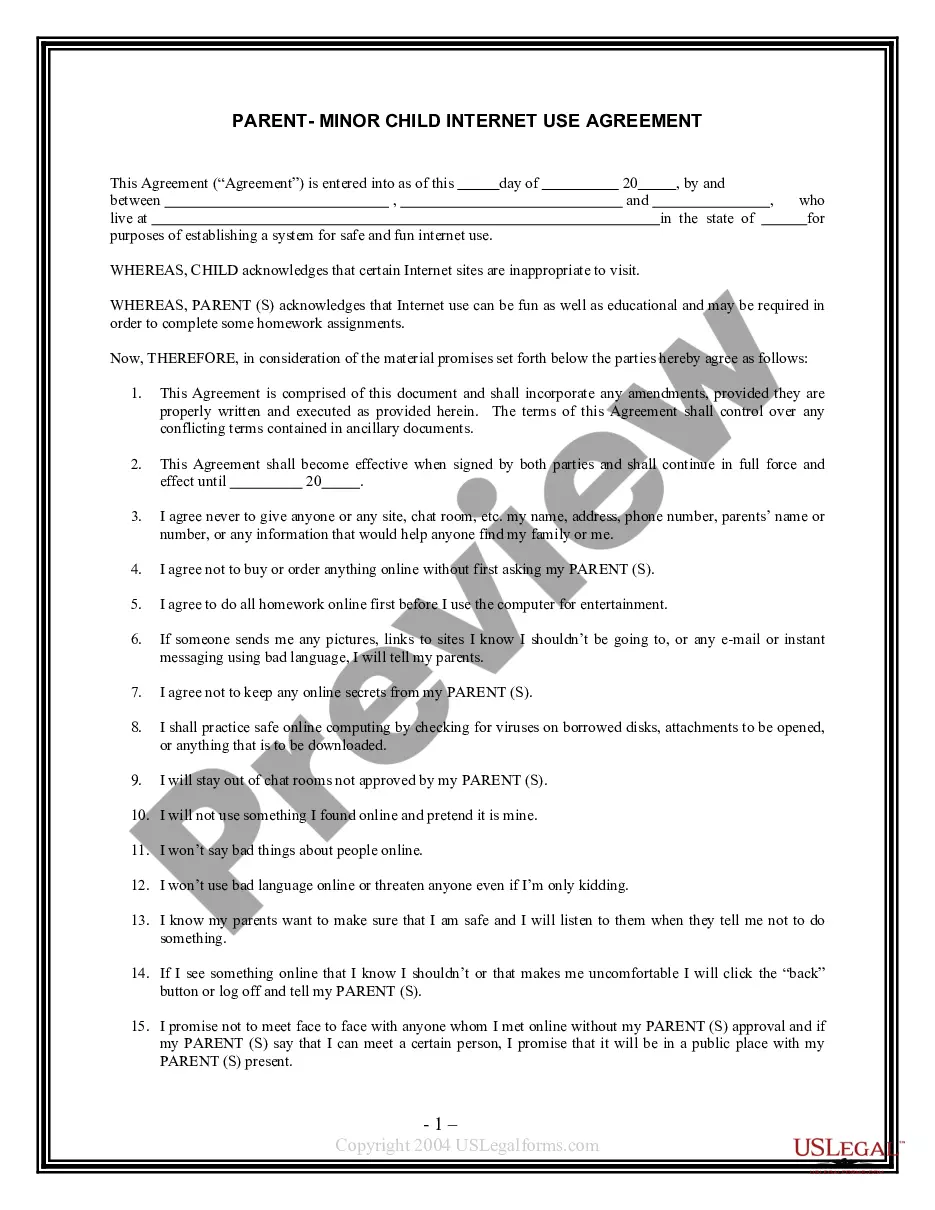
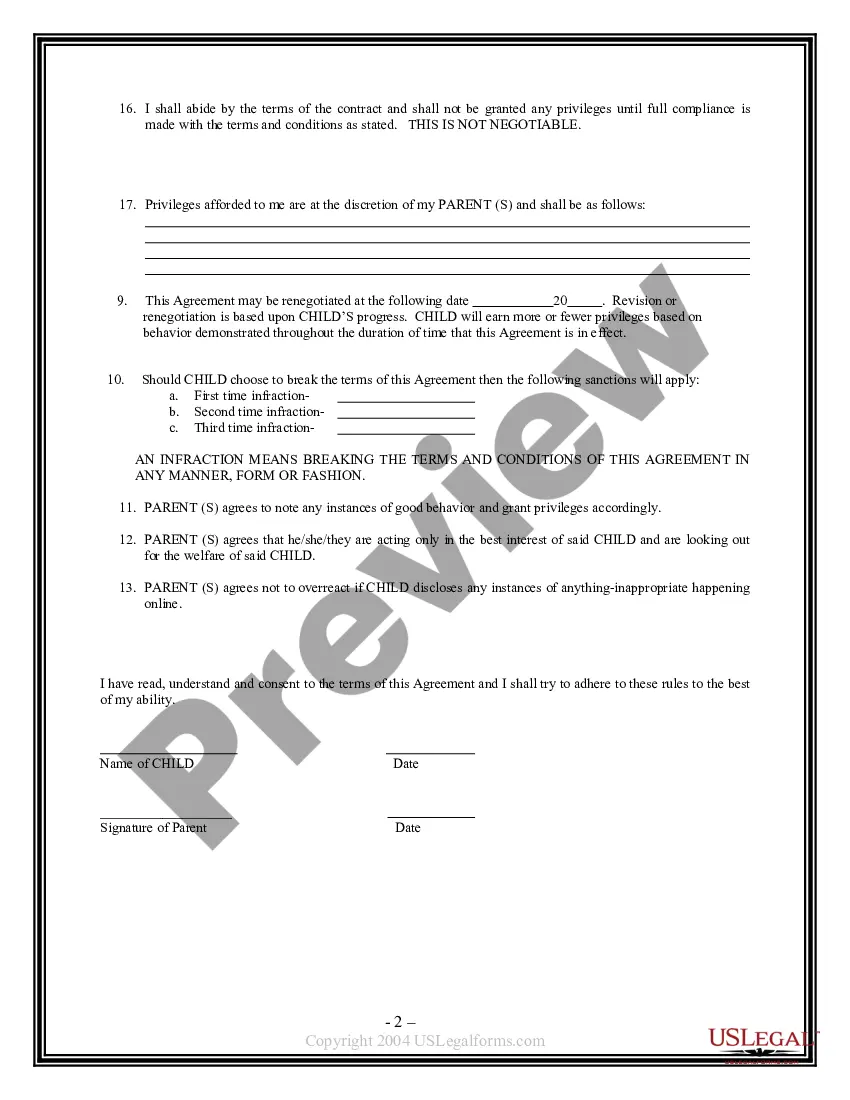
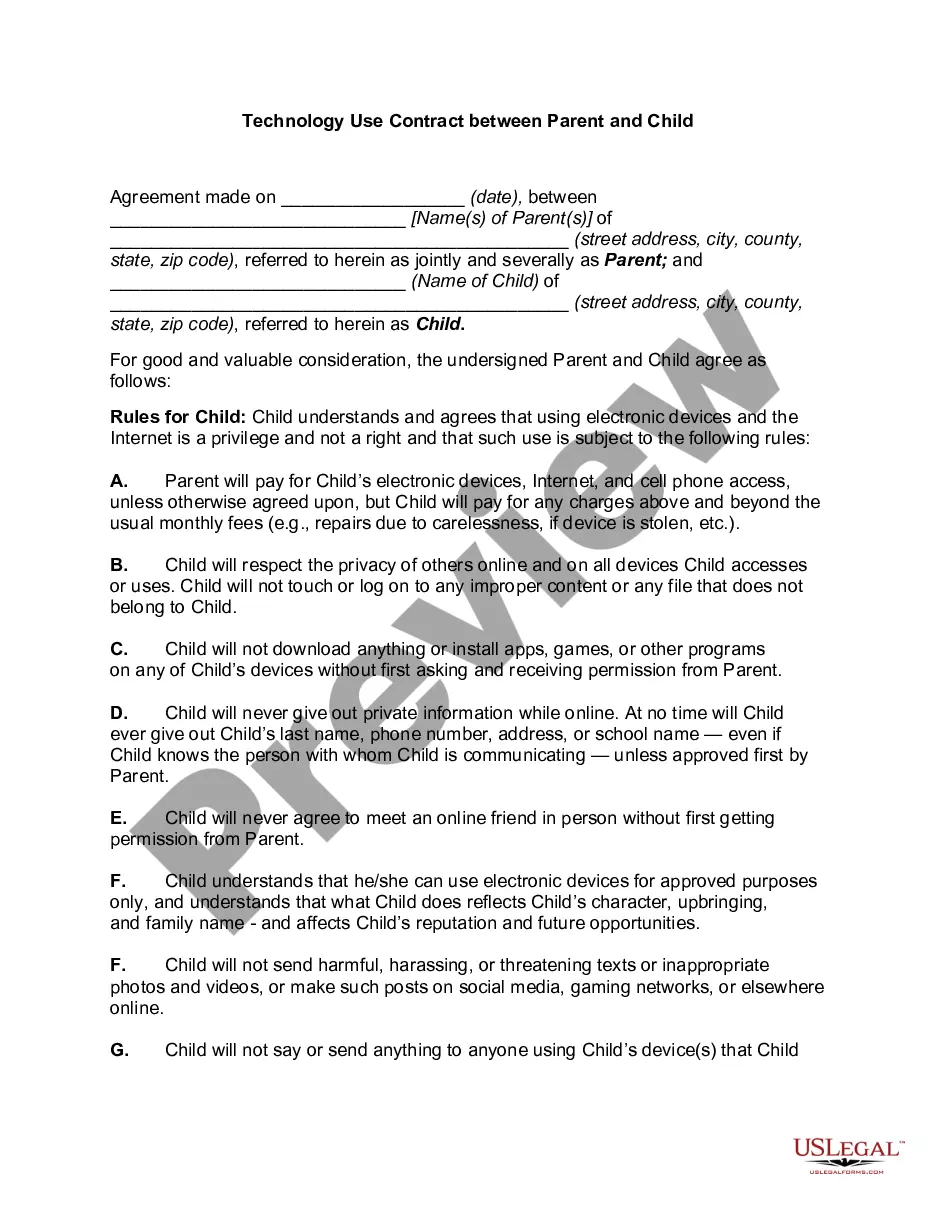
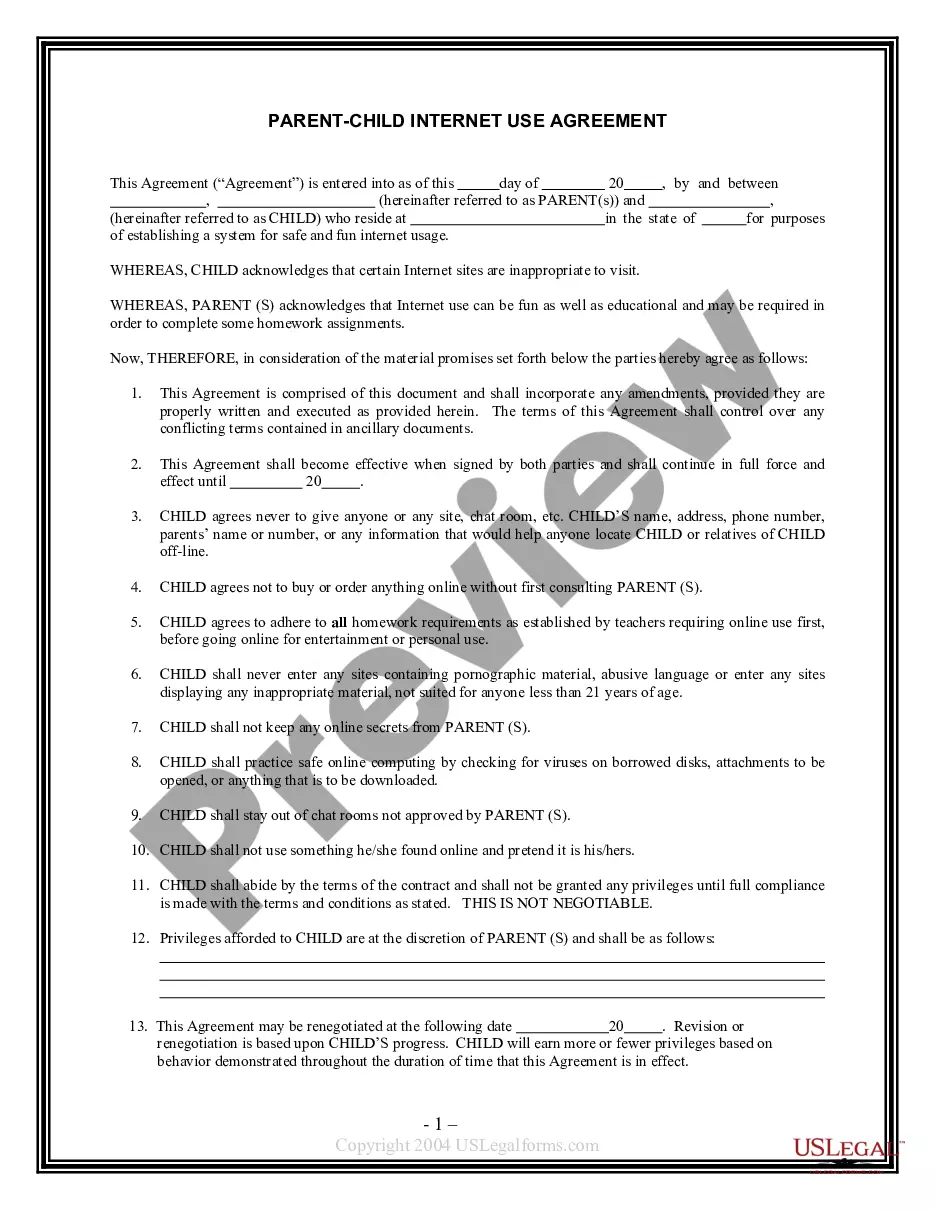
This is a contract between parent(s) and a younger child introducing child to Internet safety by describing what types of sites child should not contact and other general rules for Internet use.
Montana Parent - Minor Child Internet Use Agreement
Category:
State:
Multi-State
Control #:
US-PC10
Format:
Word;
Rich Text
Instant download
Description
Free preview
Get your form ready online
Our built-in tools help you complete, sign, share, and store your documents in one place.
Built-in online Word editor
Make edits, fill in missing information, and update formatting in US Legal Forms—just like you would in MS Word.
Export easily
Download a copy, print it, send it by email, or mail it via USPS—whatever works best for your next step.
E-sign your document
Sign and collect signatures with our SignNow integration. Send to multiple recipients, set reminders, and more. Go Premium to unlock E-Sign.
Notarize online 24/7
If this form requires notarization, complete it online through a secure video call—no need to meet a notary in person or wait for an appointment.
Store your document securely
We protect your documents and personal data by following strict security and privacy standards.

Make edits, fill in missing information, and update formatting in US Legal Forms—just like you would in MS Word.

Download a copy, print it, send it by email, or mail it via USPS—whatever works best for your next step.

Sign and collect signatures with our SignNow integration. Send to multiple recipients, set reminders, and more. Go Premium to unlock E-Sign.

If this form requires notarization, complete it online through a secure video call—no need to meet a notary in person or wait for an appointment.

We protect your documents and personal data by following strict security and privacy standards.
Looking for another form?





How to fill out Parent - Minor Child Internet Use Agreement?
Locating the appropriate legal document template can be a challenge. Clearly, there are numerous formats available online, but how do you discover the legal form you need? Utilize the US Legal Forms website. This service provides thousands of templates, such as the Montana Parent - Minor Child Internet Use Agreement, suitable for both business and personal purposes. All forms are vetted by professionals and comply with state and federal regulations.
If you are currently registered, Log In to your account and click the Download button to access the Montana Parent - Minor Child Internet Use Agreement. Use your account to browse the legal forms you have previously purchased. Navigate to the My documents section of your account to obtain another copy of the document you need.
If you are a new user of US Legal Forms, here are straightforward steps to follow: First, ensure you have selected the right form for your city/state. You can view the form using the Review button and examine the form summary to confirm it is the correct one for your needs. If the form does not satisfy your requirements, utilize the Search field to locate the appropriate form. Once you are confident that the form is suitable, click the Purchase now button to acquire the form. Choose the pricing plan you desire and enter the necessary information. Create your account and complete the transaction using your PayPal account or credit card. Select the file format and download the legal document template to your device. Complete, modify, print, and sign the obtained Montana Parent - Minor Child Internet Use Agreement. US Legal Forms is the largest repository of legal forms where you can find a variety of document templates. Use the service to download professionally crafted documents that meet state requirements.
Form popularity
FAQ
Can My Visitation Rights Be Denied By The Court? Yes. If the custodial parent files a complaint or an injunction to the court, in order to deny the noncustodial parent, their visitation rights, the court may grant so, on the basis of the complaint.
The court can restrict or deny a noncustodial parent visitation grounds on the flowing grounds: If the parent has a history of molesting the child. If the court believes that the parent can kidnap the child. If the parent is likely to abuse drugs while taking care of the child.
Father's Right to Child Support in Montana In cases where fathers are awarded the role of primary custodian, they have the same rights to collecting child support from the child's mother as a mother would in the same position, and fathers also have equal access to child support enforcement services through the state.
Do Fathers Have the Same Parental Rights as Mothers? The short answer to your question is yes, fathers do have the same parental rights as mothers.
Child custody laws in Montana allow judges to take a child's wishes into account as a single factor in custody determinations, but will not allow any child under 18 to unilaterally decide which parent to reside with.
Based on this a married fathers rights over a child include the rights to make decisions concerning the legal matters, as well as educational, health and welfare and religious matters. A father's rights over a child will also require him to provide food, clothes and shelter for his child.
Under Montana law, anyone under the age of 18 is considered a minor. (Montana Code Annotated - Title 41 §1-101.) As a minor, a child technically can't refuse to visit with a parent.
Your partner cannot legally stop you from having access to your child unless continued access will be of detriment to your child's welfare. Until a court order is arranged, one parent may attempt to prevent a relationship with the other. If this happens, your main priority should be the welfare of your child.
In Montana, the court system uses parenting plans to determine the custody of minor children, including when and where each parent will be with and responsible for each child. It also includes who is responsible for decision-making and provides for the financial care of the child.
If the question of who the child is to live with has to be resolved through court proceedings, then the courts will start to place weight on a child's wishes when they are considered competent to understand the situation. This can be around the age of 12 or 13 but varies on the circumstances.