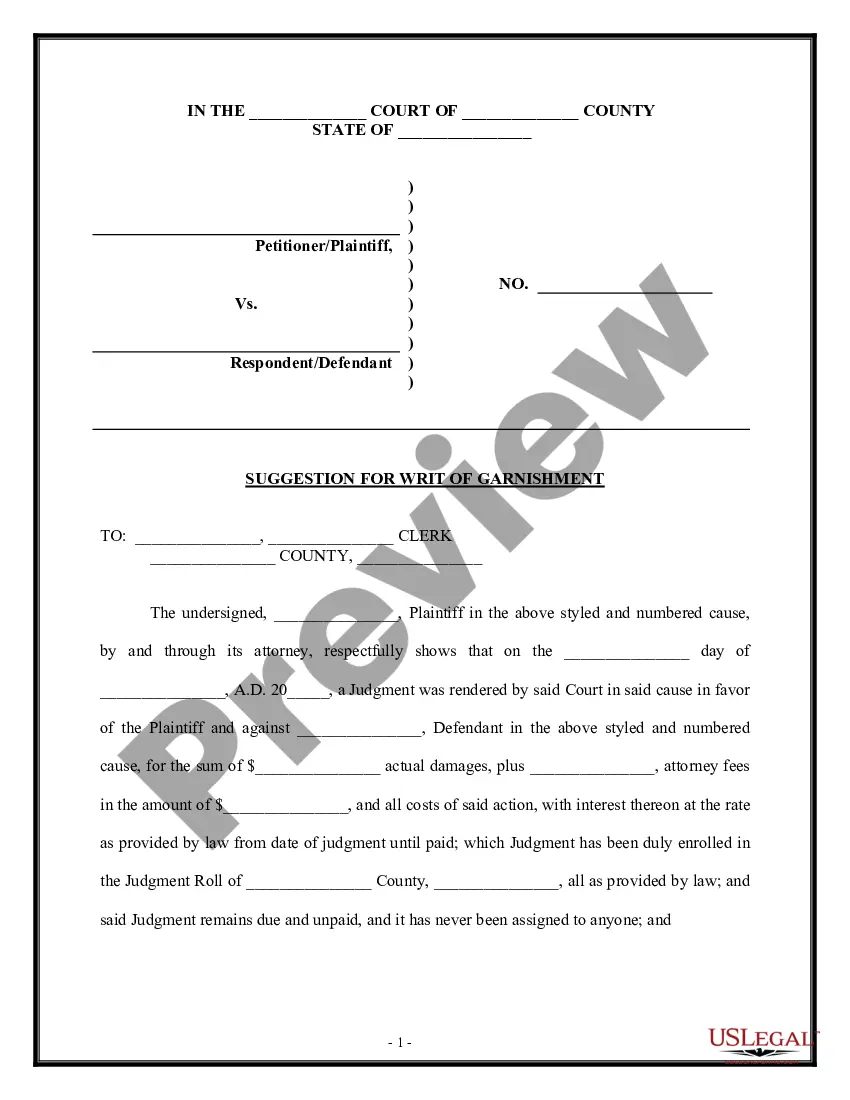
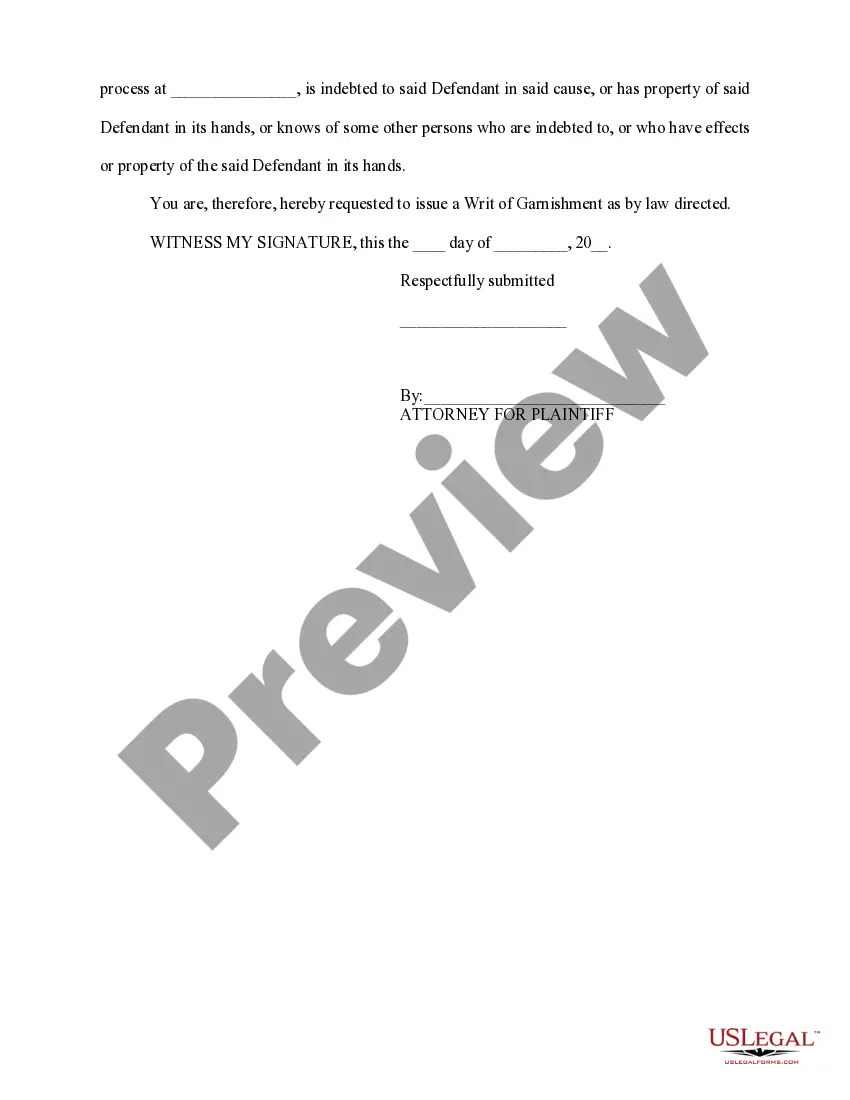
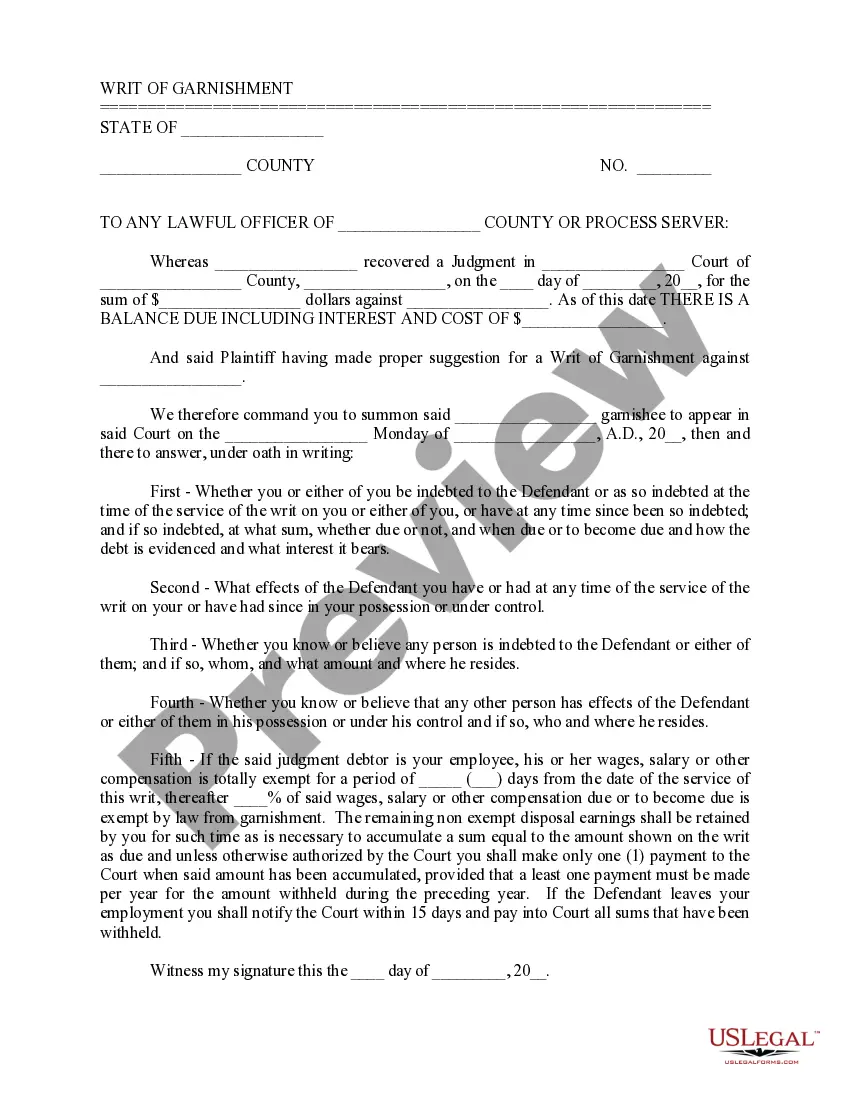
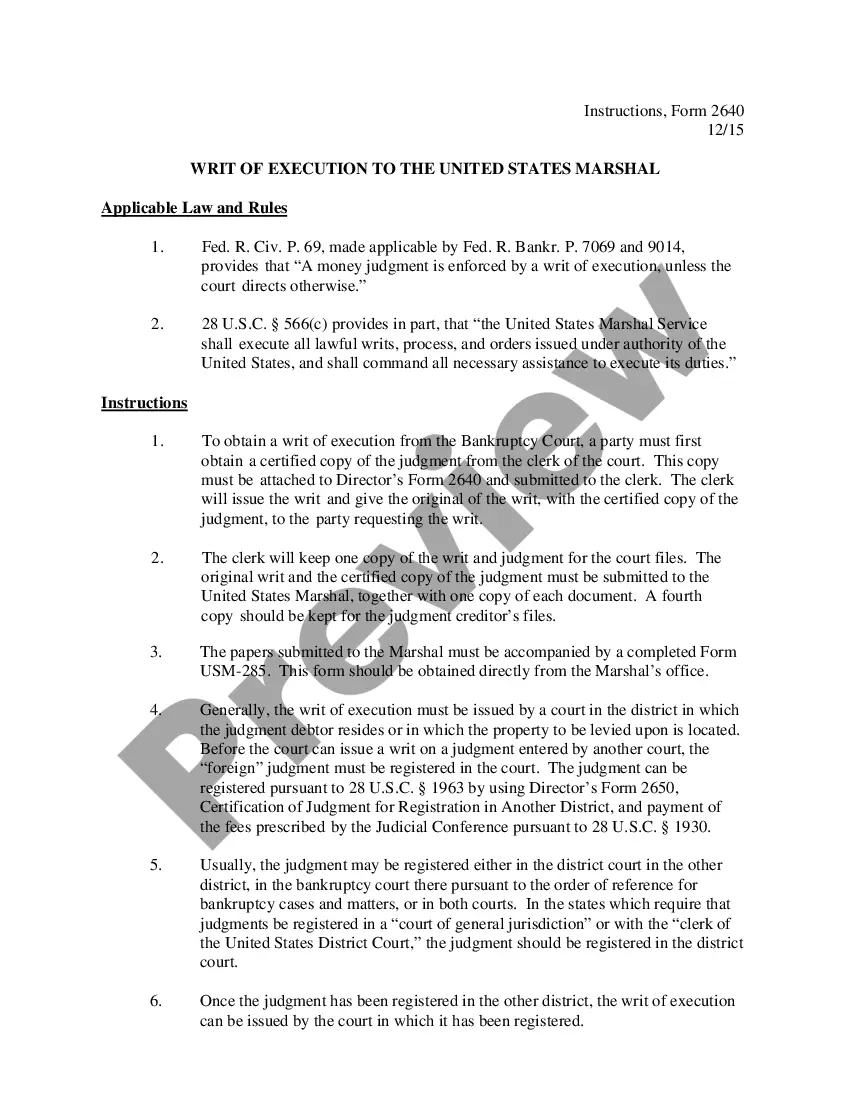
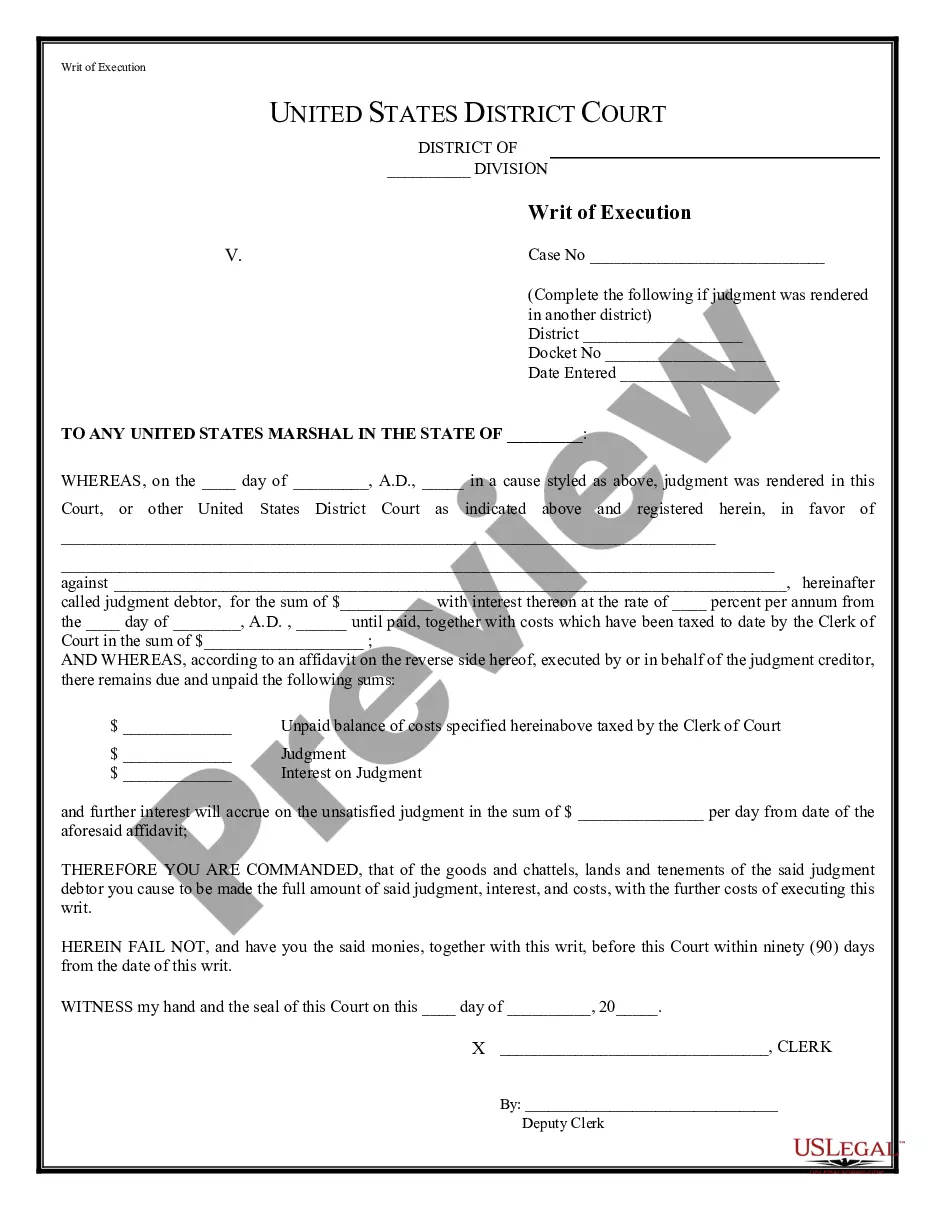
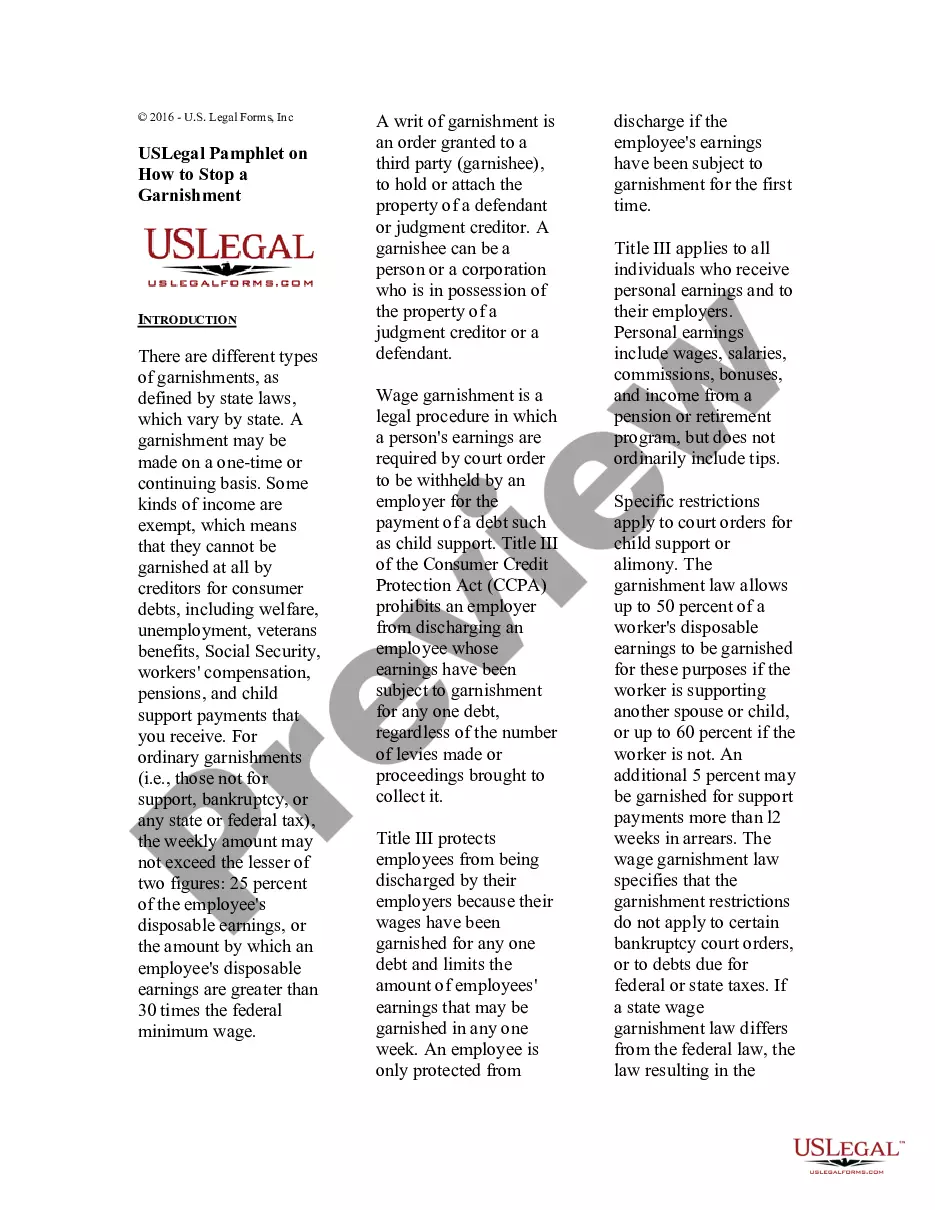
This form is a Suggestion for a Writ of Garnishment. Plaintiff obtained a judgment against defendant and in the process of collection, the plaintiff requests that garnishment be placed on the property of the defendant to satisfy the judgment. Therefore, the court orders that a writ of garnishment be granted in favor of plaintiff.
Montana Suggestion for Writ of Garnishment
State:
Multi-State
Control #:
US-00987
Format:
Word;
Rich Text
284 downloads
Description
Free preview

Get your form ready online
Our built-in tools help you complete, sign, share, and store your documents in one place.
Built-in online Word editor
Make edits, fill in missing information, and update formatting in US Legal Forms—just like you would in MS Word.
Export easily
Download a copy, print it, send it by email, or mail it via USPS—whatever works best for your next step.
E-sign your document
Sign and collect signatures with our SignNow integration. Send to multiple recipients, set reminders, and more. Go Premium to unlock E-Sign.
Notarize online 24/7
If this form requires notarization, complete it online through a secure video call—no need to meet a notary in person or wait for an appointment.
Store your document securely
We protect your documents and personal data by following strict security and privacy standards.

Make edits, fill in missing information, and update formatting in US Legal Forms—just like you would in MS Word.

Download a copy, print it, send it by email, or mail it via USPS—whatever works best for your next step.

Sign and collect signatures with our SignNow integration. Send to multiple recipients, set reminders, and more. Go Premium to unlock E-Sign.

If this form requires notarization, complete it online through a secure video call—no need to meet a notary in person or wait for an appointment.

We protect your documents and personal data by following strict security and privacy standards.
Looking for another form?


How to fill out Suggestion For Writ Of Garnishment?
It is feasible to spend numerous hours online seeking the sanctioned document format that complies with the federal and state standards you desire. US Legal Forms provides a vast array of sanctioned forms that are reviewed by experts.
You can easily download or print the Montana Suggestion for Writ of Garnishment from our platform. If you already possess a US Legal Forms account, you can Log In and click the Download button. After that, you can fill out, amend, print, or sign the Montana Suggestion for Writ of Garnishment.
Every sanctioned document format you purchase is yours indefinitely. To obtain an additional copy of the acquired form, navigate to the My documents section and click the appropriate option. If you are using the US Legal Forms website for the first time, follow the simple instructions below: First, ensure you have selected the correct format for the region/town of your choice. Review the form description to confirm you have chosen the right form. If available, utilize the Preview button to view the format simultaneously. To obtain another version of the form, use the Search field to find the format that meets your needs and requirements.
Avoid altering or deleting any HTML tags. Only synonymize plain text outside of the HTML tags.
- Once you have identified the format you want, click Buy now to proceed.
- Select the pricing plan you prefer, enter your details, and create a free account on US Legal Forms.
- Complete the purchase. You can use your credit card or PayPal account to buy the sanctioned form.
- Choose the format of the document and download it to your device.
- Make modifications to the document if necessary. You can fill out, amend, sign, and print the Montana Suggestion for Writ of Garnishment.
- Download and print numerous document templates using the US Legal Forms website, which offers the largest selection of sanctioned forms.
- Utilize professional and state-specific templates to address your business or personal needs.
Form popularity
FAQ
Another way to stop a wage garnishment is by negotiating with your creditor. Many creditors are reluctant to settle debts once they have a garnishment. However, an attorney can help you negotiate the best settlement by offering a lump sum amount or payment terms.
Collect evidence showing how detrimental the wage garnishment is to your financial stability or how you qualify for an exemption. In either case, the creditor may agree to a solution that doesn't involve a garnishment, such as an adjustment payment plan or a settlement for a lump sum.
5 Ways to Stop a Garnishment Pay Off the Debt. If your financial situation is dire, paying off the debt may not be an option. ... Work With Your Creditor. ... Challenge the Garnishment. ... File a Claim of Exemption. ... File for Bankruptcy.
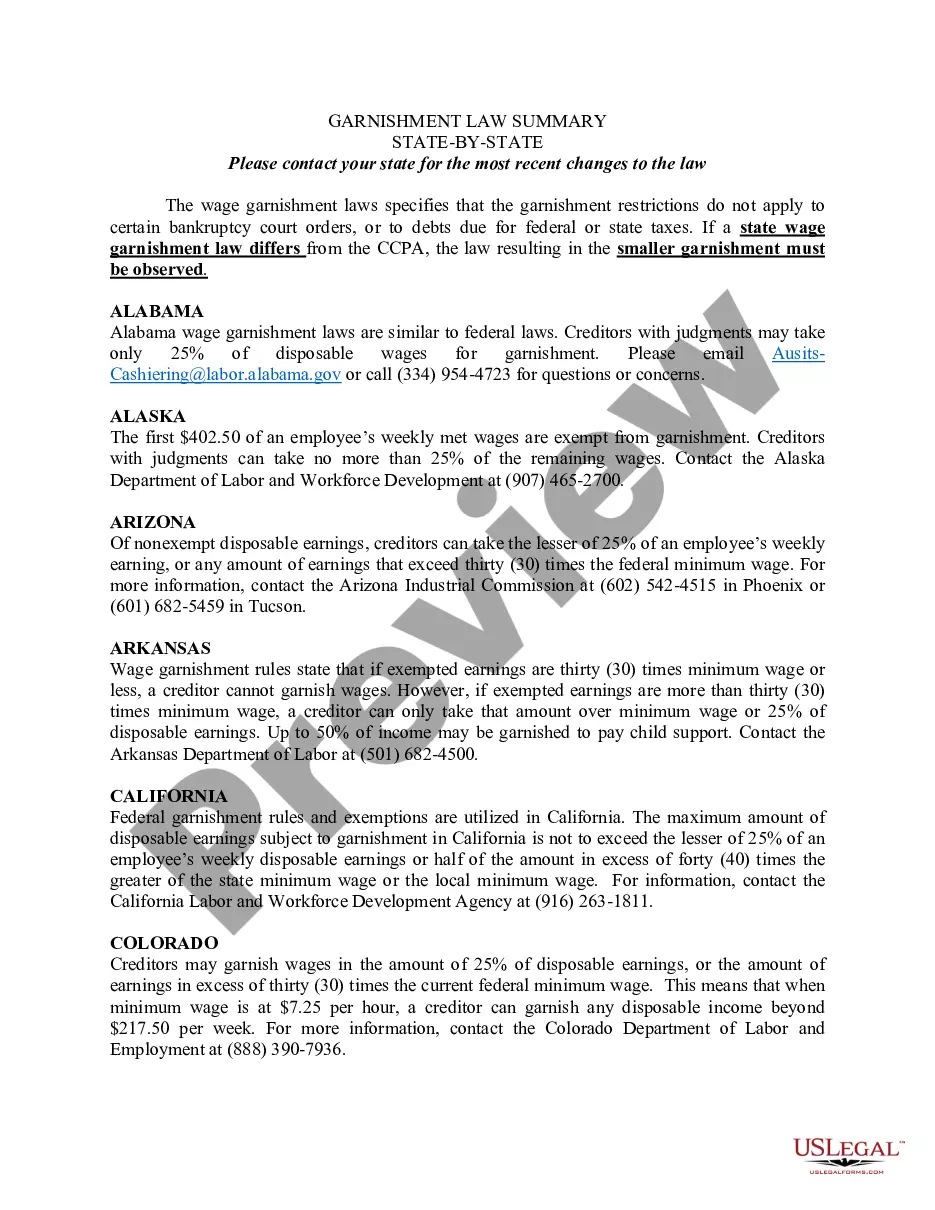
If you can't afford that, you can try to negotiate with the creditor and work out a payment plan. Another way to stop wage garnishment in Montana is by filing bankruptcy. Filing a bankruptcy case triggers the automatic stay, which requires most debt collection tools like garnishment to stop.
5 Ways to Stop a Garnishment Pay Off the Debt. If your financial situation is dire, paying off the debt may not be an option. ... Work With Your Creditor. ... Challenge the Garnishment. ... File a Claim of Exemption. ... File for Bankruptcy.
Wage garnishment can be a painful and embarrassing process for the employee.
At a minimum, your written objection to the garnishment should include the following information: the case number and case caption (ex: "XYZ Bank vs. John Doe") the date of your objection. your name and current contact information. the reasons (or "grounds") for your objection, and. your signature.
For example, North Carolina, Pennsylvania, South Carolina and Texas don't allow wage garnishment for debts owed to creditors although federal law allows it.