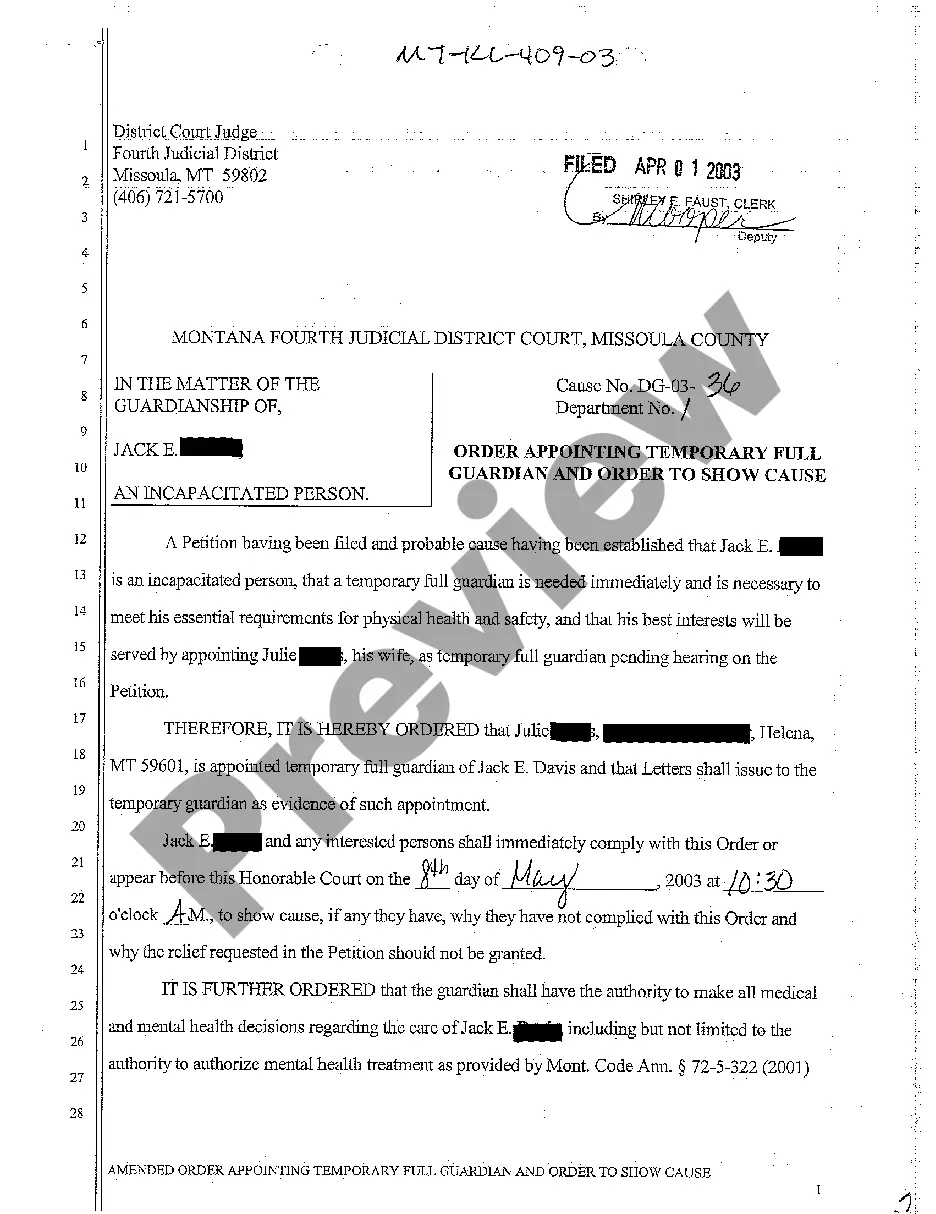
Montana Order Appointing Temporary Co-Conservators and Order to Show Cause
Description









How to fill out Montana Order Appointing Temporary Co-Conservators And Order To Show Cause?
Obtain a printable Montana Order Appointing Temporary Co-Conservators and Order to Show Cause in just a few mouse clicks from the most extensive collection of legal e-documents.
Locate, download, and print professionally composed and certified samples on the US Legal Forms website.
After downloading your Montana Order Appointing Temporary Co-Conservators and Order to Show Cause, you can fill it out in any online editor or print it and complete it by hand. Utilize US Legal Forms to access 85,000 professionally drafted, state-specific documents.
- US Legal Forms has been the leading provider of affordable legal and tax templates for US citizens and residents online since 1997.
- Clients who already have a subscription must Log In directly to their US Legal Forms account, retrieve the Montana Order Appointing Temporary Co-Conservators and Order to Show Cause, and find it saved under the My documents section.
- Clients without a subscription are required to follow the instructions below.
- Ensure your form complies with your state’s regulations.
- If available, review the form’s description for more information.
- If provided, examine the form to see additional details.
- Once you are confident the form is suitable for you, click Buy Now.
- Establish a personal account.
- Choose a plan.
- Pay via PayPal or credit card.
- Download the form in Word or PDF format.
Form popularity
FAQ
A temporary conservator is usually appointed for a fixed time period, usually 30 to 60 days. These conservatorships can be of the person, of the estate, or both. The main role of the temporary conservator is to ensure the temporary care, protection, and support of the conservatee.
A conservatorship is necessary for those individuals who have neither a power of attorney or healthcare directive, and have lost the ability to make informed decisions and/or care for themselves. A conservatorship may also be necessary for other reasons, such as an invalid or fraudulent power of attorney document.
The conservator has the power to collect all the conservatee's assets, pay bills, make investments, etc. The conservator must seek court supervision for major transactions, such as purchase or sale of property, borrowing money, or gifting of assets.
A conservatorship may be established after a relative, friend, or public official petitions the court for appointment of a conservator. The petition must contain information on why the individual cannot manage his or her financial affairs or make appropriate decisions concerning his or her personal care.
A conservatorship is a court case where a judge appoints a responsible person or organization (called the conservator) to care for another adult (called the conservatee) who cannot care for himself or herself or manage his or her own finances.
A conservator is a person appointed by the probate court to oversee the financial or personal affairs of an adult who is determined to be incapable of managing his or her own affairs or unable to care for himself or herself.
When comparing the difference between power of attorney and conservatorship, keep in mind that a person creates a power of attorney before a person they are incapacitated. In contrast, a conservatorship is formed after a person is no longer able to competently make critical financial decisions on his or her own.
Guardianship Versus Conservatorship What Is the Difference?A guardian of the person is responsible for decisions about care provisions and living arrangements of the ward. A guardian of the estate, also known as a conservator, is charged with the ward's property and financial affairs.
How is a guardianship or conservatorship set up? Someone interested in the individual's welfare must file a petition in Superior Court, Probate Division, requesting appointment of a guardian or conservator. Once the petition is reviewed by the Probate Division and accepted for filing, a hearing is scheduled.