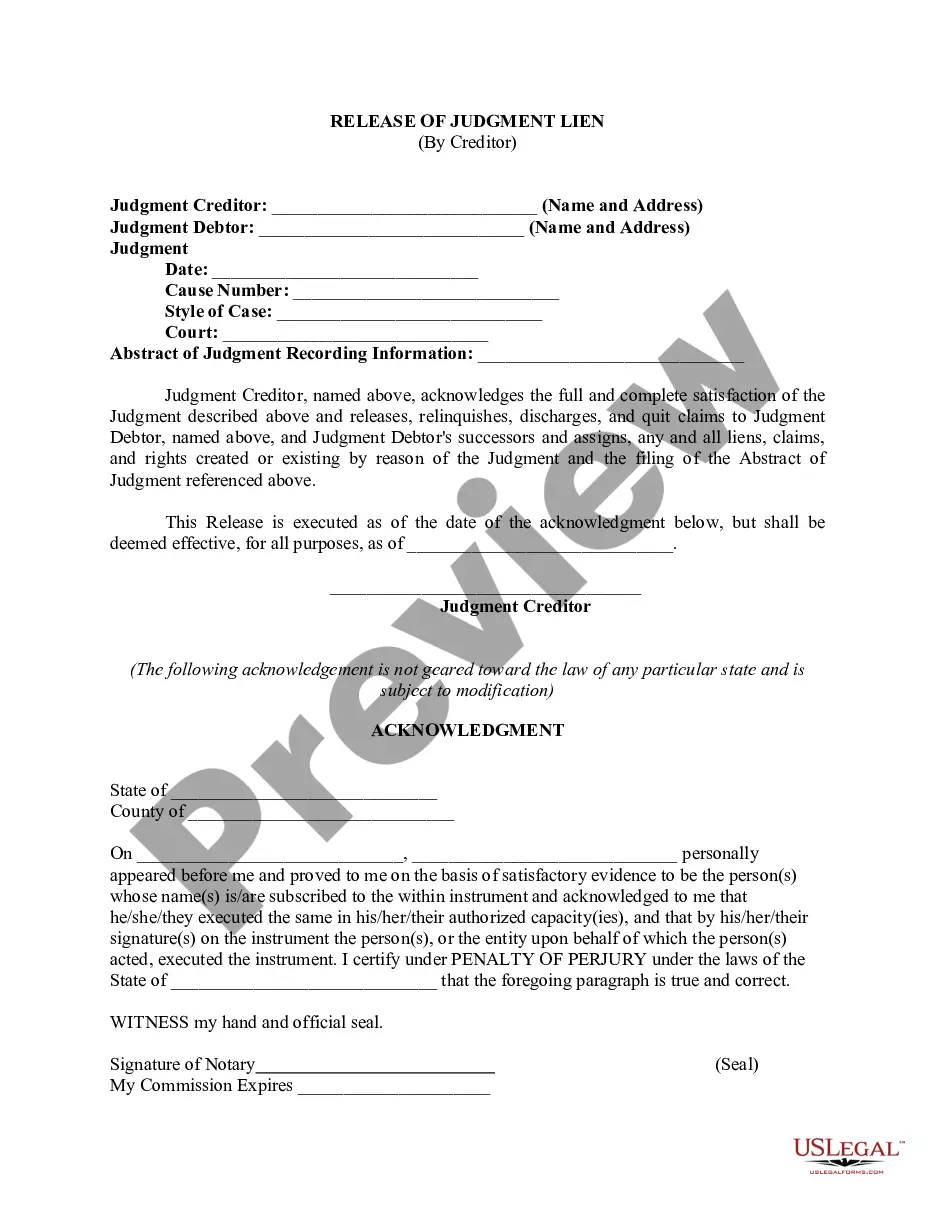
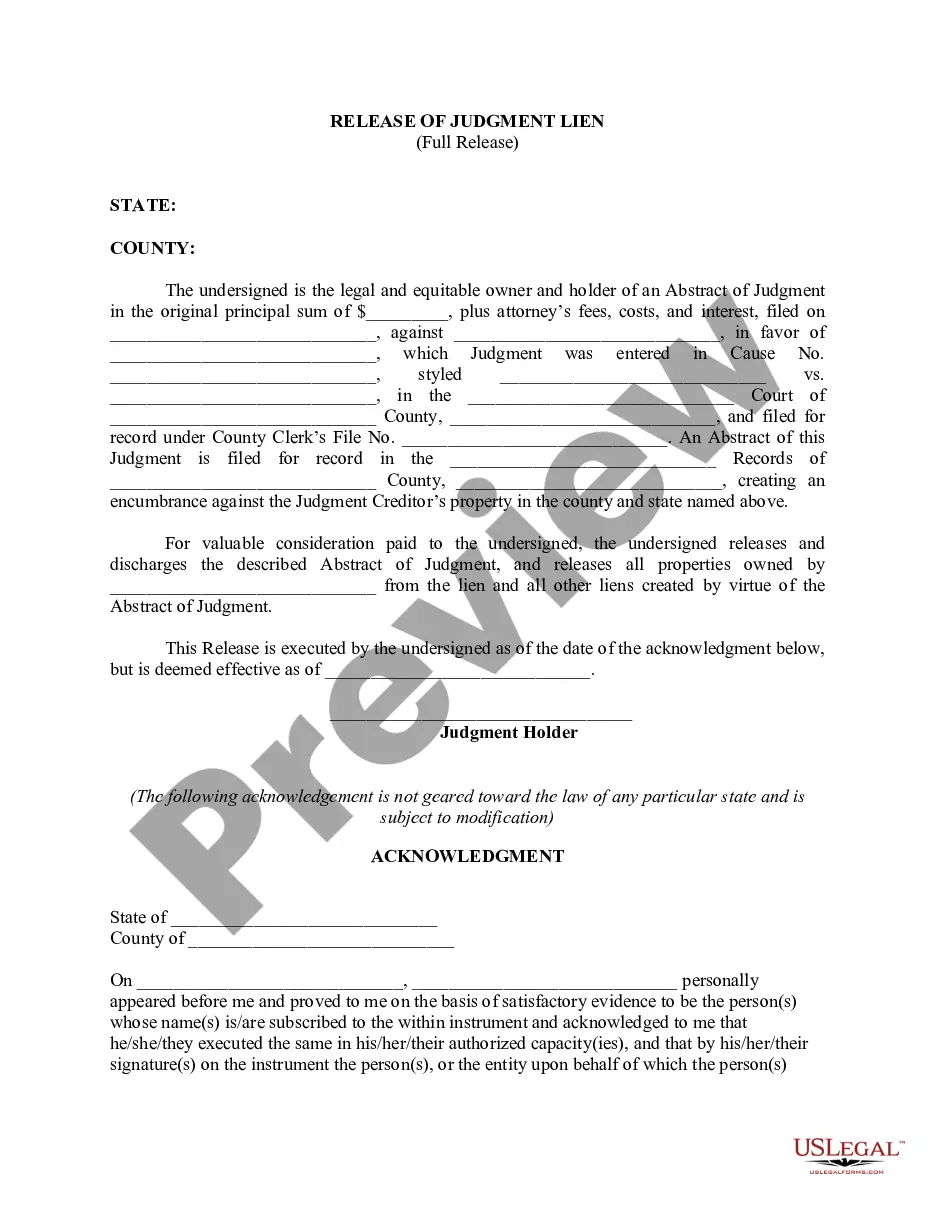
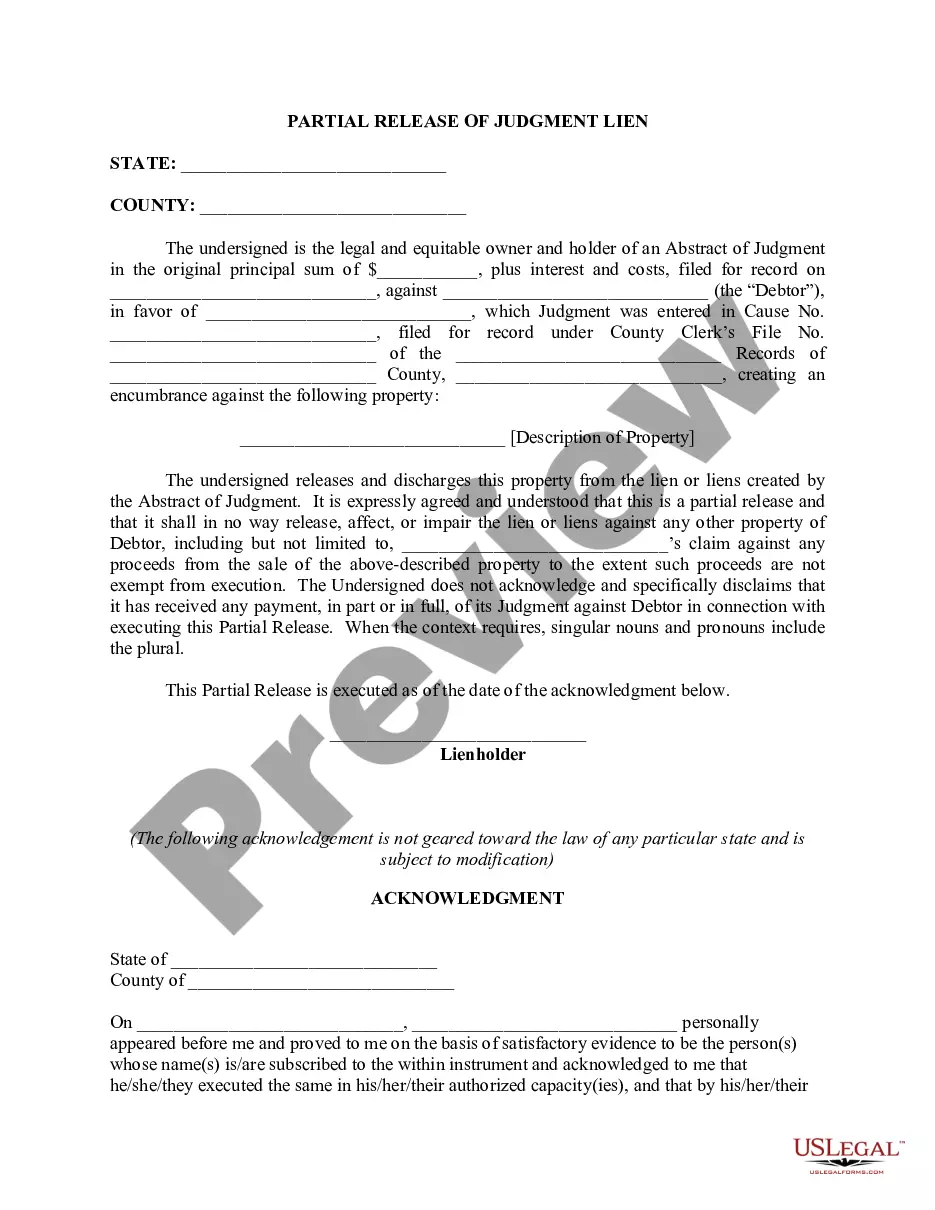
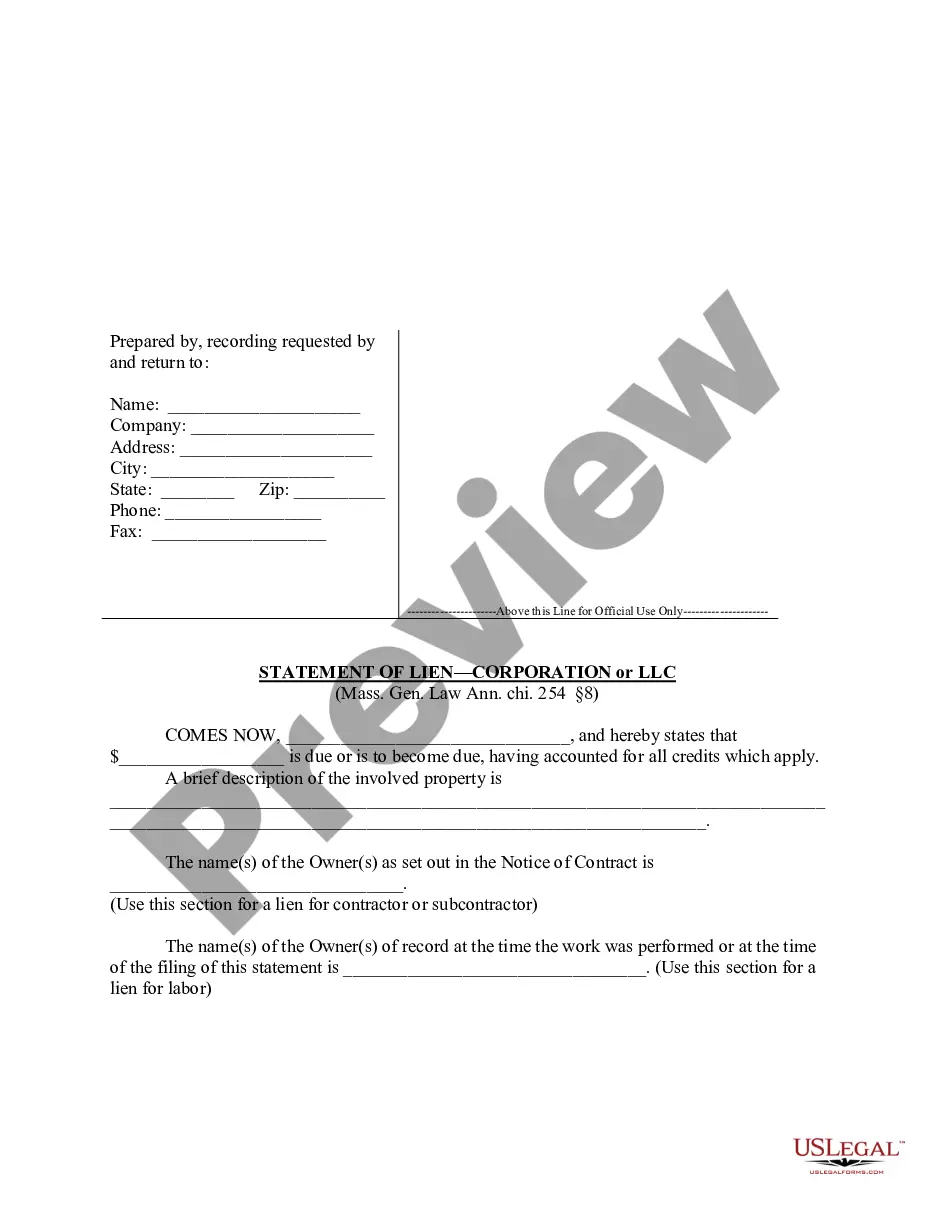
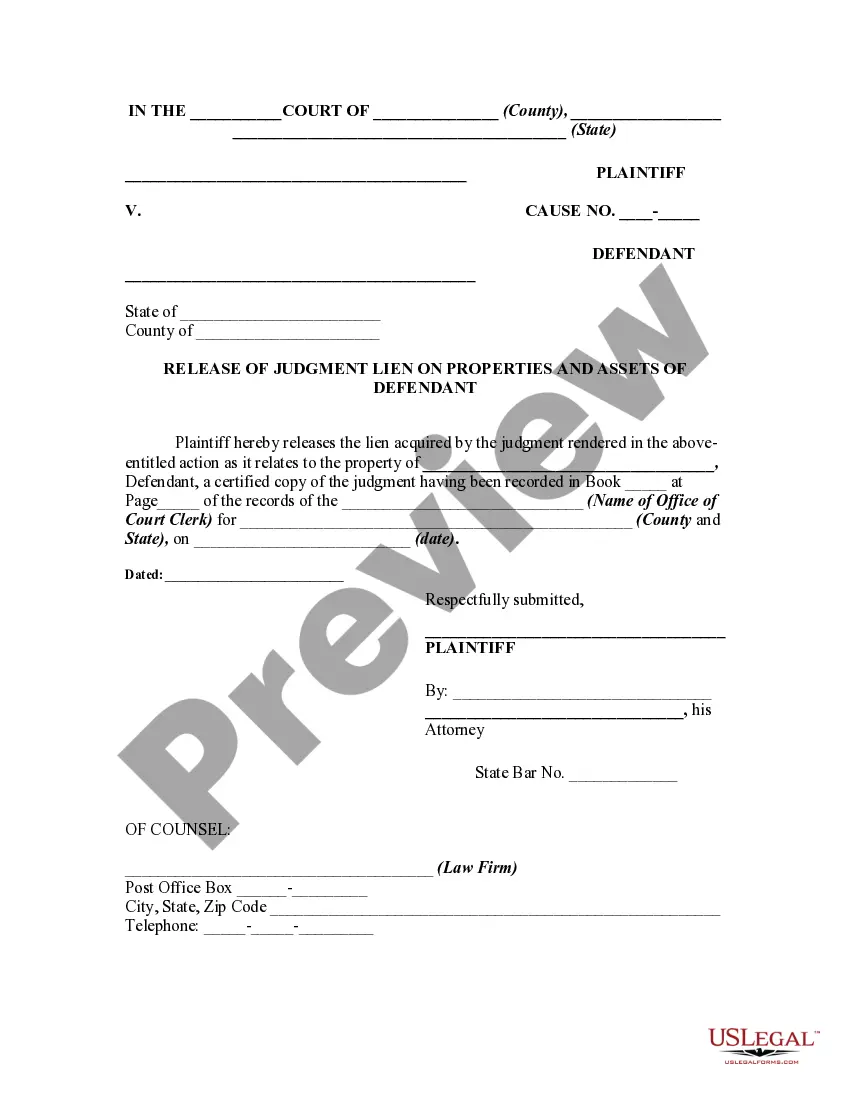
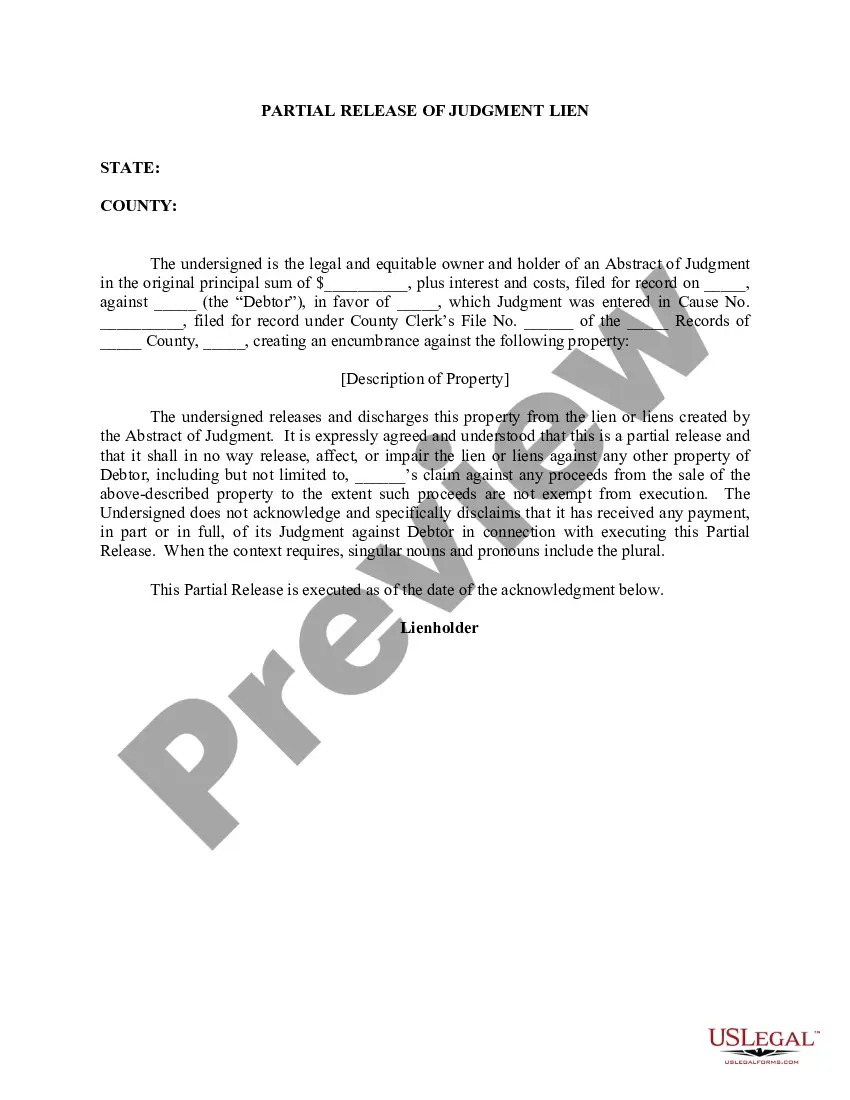
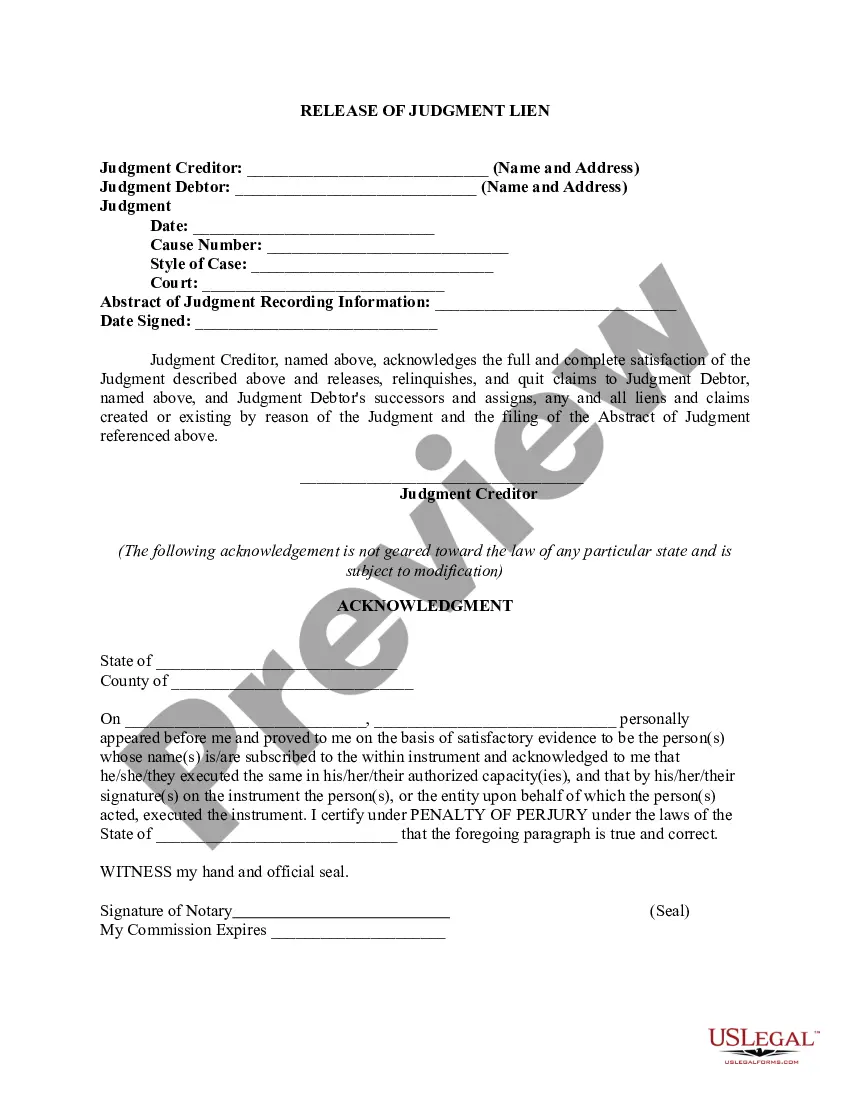
Mississippi Release of Judgment Lien on Properties and Assets of Defendant

State:
Multi-State
Control #:
US-00972BG
Format:
Word; 
Rich Text
138 downloads

Description

A judgment lien is created when a court grants a creditor an interest in the debtor's property, based upon a court judgment. A plaintiff who obtains a monetary judgment is termed a "judgment creditor." The defendant becomes a "judgment debtor."


Judgment liens may be created through a wide variety of circumstances. Laws regarding judgment liens vary by jurisdiction, so local laws should be consulted.
Get your form ready online

Our built-in tools help you complete, sign, share, and store your documents in one place.

Built-in online Word editor

Make edits, fill in missing information, and update formatting in US Legal Forms—just like you would in MS Word.

Export easily

Download a copy, print it, send it by email, or mail it via USPS—whatever works best for your next step.

E-sign your document

Sign and collect signatures with our SignNow integration. Send to multiple recipients, set reminders, and more. Go Premium to unlock E-Sign.

Notarize online 24/7

If this form requires notarization, complete it online through a secure video call—no need to meet a notary in person or wait for an appointment.

Store your document securely

We protect your documents and personal data by following strict security and privacy standards.

Form selector

Make edits, fill in missing information, and update formatting in US Legal Forms—just like you would in MS Word.

Form selector

Download a copy, print it, send it by email, or mail it via USPS—whatever works best for your next step.

Form selector

Sign and collect signatures with our SignNow integration. Send to multiple recipients, set reminders, and more. Go Premium to unlock E-Sign.

Form selector

If this form requires notarization, complete it online through a secure video call—no need to meet a notary in person or wait for an appointment.

Form selector

We protect your documents and personal data by following strict security and privacy standards.

Looking for another form?

This field is required
Ohio
Select state

How to fill out Release Of Judgment Lien On Properties And Assets Of Defendant?

If you wish to compile, obtain, or print legal document templates, utilize US Legal Forms, the widest selection of legal forms available online.

Take advantage of the site's straightforward and effortless search to locate the documents you need.

A variety of templates for business and personal purposes are categorized by types and keywords, or you can search by terms.

Once you have found the form you want, click on the Get now option. Choose the payment plan you prefer and enter your credentials to register for an account.

Complete the transaction. You can use your credit card or PayPal account to finalize the purchase. Step 6. Select the format of the legal document and download it to your device. Step 7. Complete, modify, and print or sign the Mississippi Release of Judgment Lien on Properties and Assets of Defendant. Every legal document template you obtain is yours indefinitely. You have access to every document you downloaded in your account. Click the My documents section and select a document to print or download again.

  1. Utilize US Legal Forms to find the Mississippi Release of Judgment Lien on Properties and Assets of Defendant with just a few clicks.
  2. If you are already a US Legal Forms user, Log In to your account and click the Download option to access the Mississippi Release of Judgment Lien on Properties and Assets of Defendant.
  3. You can also access forms you previously downloaded from the My documents tab in your account.
  4. If you are using US Legal Forms for the first time, follow the instructions below.
  5. Confirm that you have selected the form for the appropriate city/state.
  6. Use the Preview option to review the form's content. Don't forget to check the description.
  7. If you are not satisfied with the form, use the Search field at the top of the screen to find other types of the legal document template.

Form popularity

FAQ

What documents do you require to release a lien on a property? U.S. District Court requires an original or certified copy of the Short Form Deed of Trust, and an Order from the appropriate Judge.

A tax lien is valid for seven years unless a continuation is filed before it expires. The continuation extends the lien another seven years. Mississippi law allows continuations on state liens until they're paid in full; so continuations can be filed repeatedly making a tax lien valid indefinitely.

Judgment liens are involuntary, general liens. If a lawsuit results in a money judgment against the loser, the winner (judgment creditor) may obtain a lien against the loser's (the judgment debtor's) property.

A judgment lien is a type of non-consensual lien (a lien that attaches to a property without the owner's agreement). It's created when someone wins a lawsuit against the property owner and then records the judgment against an asset such as a house, land, bank account, or other personal assets.

A judicial lien is created when a court grants a creditor an interest in the debtor's property, after a court judgment.

A judgment lien is a type of non-consensual lien (a lien that attaches to a property without the owner's agreement). It's created when someone wins a lawsuit against the property owner and then records the judgment against an asset such as a house, land, bank account, or other personal assets.

Involuntary Lien: A lien imposed against property without consent of the owner. Taxes, special assessments, federal income tax liens, and State tax liens are examples of involuntary liens.

All actions founded on any judgment or decree rendered by any court of record in this state, shall be brought within seven (7) years next after the rendition of such judgment or decree, or last renewal of judgment or decree, whichever is later.

Trusted and secure by over 3 million people of the world’s leading companies

Mississippi Release of Judgment Lien on Properties and Assets of Defendant