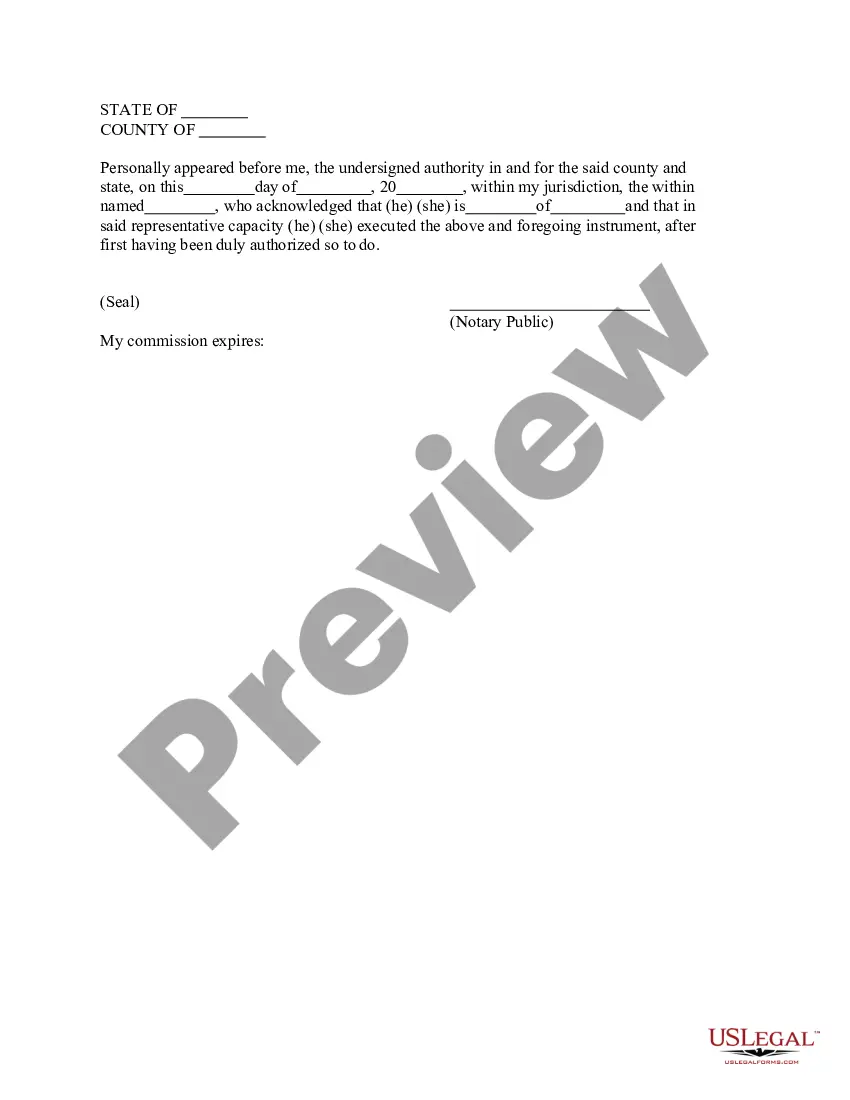
Mississippi Acknowledgment for Representative Capacities
Understanding this form
The Acknowledgment for Representative Capacities form is a legal document used to confirm the authority of an individual acting on behalf of another party. This form is particularly important in situations where someone is required to represent another person or entity in legal matters. It provides formal documentation of this representative capacity, ensuring all actions executed under this authority are legally recognized. Unlike other acknowledgment forms, this document specifically focuses on representative roles, providing a clear declaration of the representative's authority.
Key components of this form
- Identifying information of the representative and the party they represent.
- A declaration confirming the representative's capacity.
- Date and notary section for official acknowledgment.
- Signature fields for the representative and notary public.
Situations where this form applies
This form is needed in various situations, such as when a business appoints an individual to act on its behalf, or when a family member requires someone to manage their affairs due to incapacity. It is often used in real estate transactions, legal proceedings, or other formal agreements where representation is required.
Who needs this form
This form is intended for:
- Individuals acting as representatives for others.
- Businesses appointing agents to handle legal matters.
- Families needing to document caregiving arrangements.
- Attorneys or legal professionals needing to confirm representation.
How to complete this form
- Identify the parties involved: Provide the names of the representative and the person or entity they are representing.
- Declare the capacity: Clearly state the role of the representative (e.g., agent, attorney-in-fact).
- Add the date: Enter the date when the acknowledgment is being made.
- Sign the form: The representative must sign to confirm the truth of the information provided.
- Notarization: If required, present the form to a notary public for official acknowledgment.
Does this form need to be notarized?
This document requires notarization to meet legal standards. US Legal Forms provides secure online notarization powered by Notarize, allowing you to complete the process through a verified video call, available 24/7.
Get your form ready online
Our built-in tools help you complete, sign, share, and store your documents in one place.
Make edits, fill in missing information, and update formatting in US Legal Forms—just like you would in MS Word.
Download a copy, print it, send it by email, or mail it via USPS—whatever works best for your next step.
Sign and collect signatures with our SignNow integration. Send to multiple recipients, set reminders, and more. Go Premium to unlock E-Sign.
If this form requires notarization, complete it online through a secure video call—no need to meet a notary in person or wait for an appointment.
We protect your documents and personal data by following strict security and privacy standards.

Make edits, fill in missing information, and update formatting in US Legal Forms—just like you would in MS Word.

Download a copy, print it, send it by email, or mail it via USPS—whatever works best for your next step.

Sign and collect signatures with our SignNow integration. Send to multiple recipients, set reminders, and more. Go Premium to unlock E-Sign.

If this form requires notarization, complete it online through a secure video call—no need to meet a notary in person or wait for an appointment.

We protect your documents and personal data by following strict security and privacy standards.
Mistakes to watch out for
- Failing to provide full names of all parties involved.
- Not stating the representative's authority clearly.
- Omitting the date of acknowledgment.
- Not having the form notarized if required by law.
Why use this form online
- Convenience of filling out the form at your own pace.
- Easy access to templates drafted by licensed attorneys.
- Ability to review and edit the form before downloading.
- Secure storage of completed forms for future reference.
Looking for another form?

Form popularity
FAQ
Step 1: Require Personal Appearance. Step 2: Check Over The Document. Step 3: Carefully Identify The Signer. Step 4: Record Your Journal Entry. Step 5: Complete The Notarial Certificate. A Last Note: Never Give Advice.
For an acknowledgment, the signer must always: Be positively identified by the Notary. The Notary must always identify the signer for an acknowledgement; whether the signer personally knows the Notary, presents an ID document, or is identified by a credible witness depends on the circumstances.
The preparer of the document adds both acknowledgment certificates for the notary public to decide and execute the acknowledgment certificate most appropriate to the situation. However, most documents that name two principal signers will generally include two notarial certificatesone for each signer.
A notary public shall provide and keep an official seal, which shall clearly show, when embossed, stamped, impressed or affixed to a document, the name of the notary, the State Seal, the words "Notary Public," and the name of the county wherein the bond and oath of office are filed, and the date the notary public's
Use an appropriate heading. You can write the letter in any format you choose but make certain to mention an appropriate heading. Insert a case caption. Add the address. Give details about the affiant. Include your name. Leave a space for the signature of the notary public.
For an acknowledgment, the signer must always: Be positively identified by the Notary. The Notary must always identify the signer for an acknowledgement; whether the signer personally knows the Notary, presents an ID document, or is identified by a credible witness depends on the circumstances.
In such cases, you should refuse to notarize, citing the blank space as a reason. Remember that you may only complete information in the notarial certificate wording. Any blanks in the main text must be completed by the signer or another individual authorized to do so before the notarization may proceed.
When you see (here insert the name and character of the officer) next to a blank as shown below, it means you should insert Your name, Notary Public in the blank.