Mississippi Agreed Order Appointing Guardian Ad Litem
Understanding this form
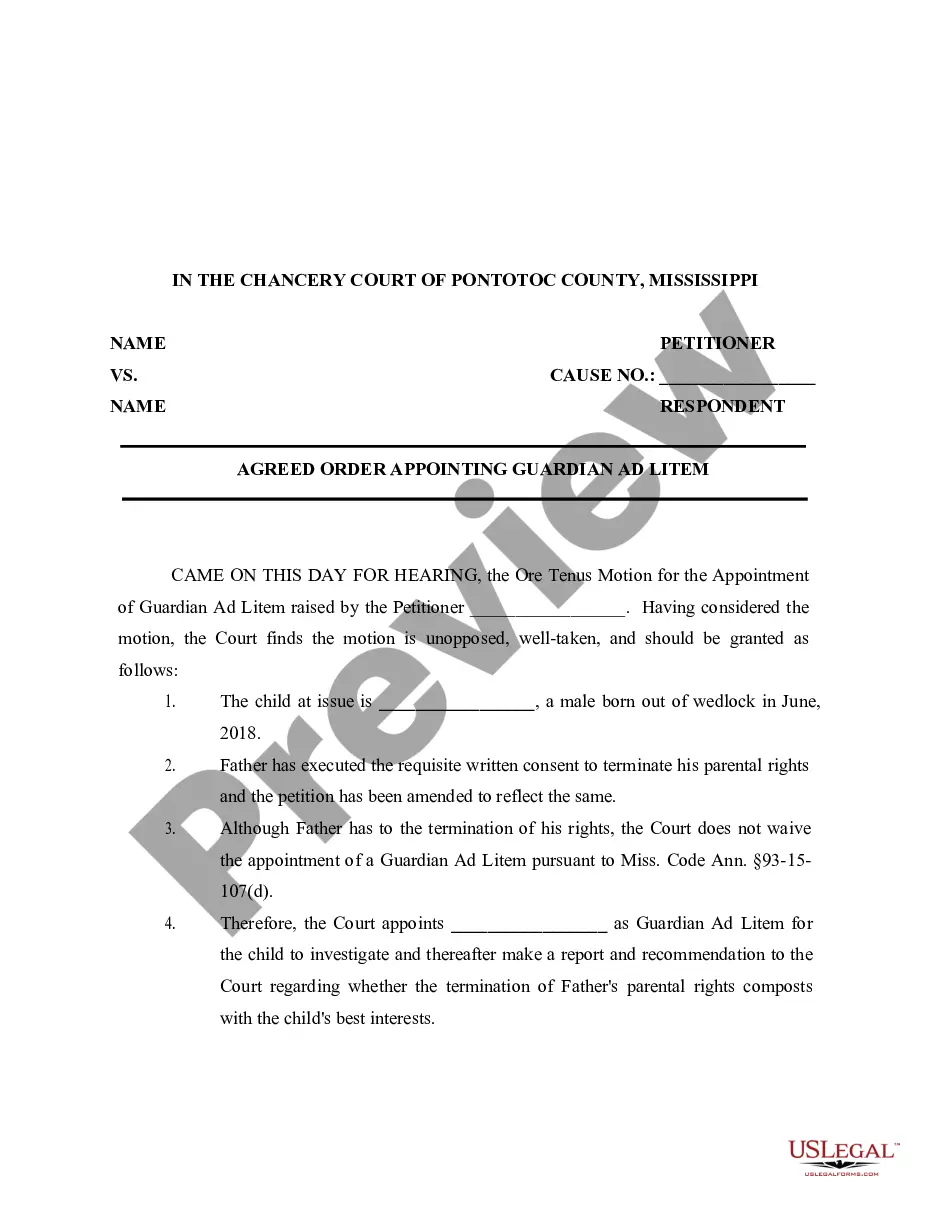
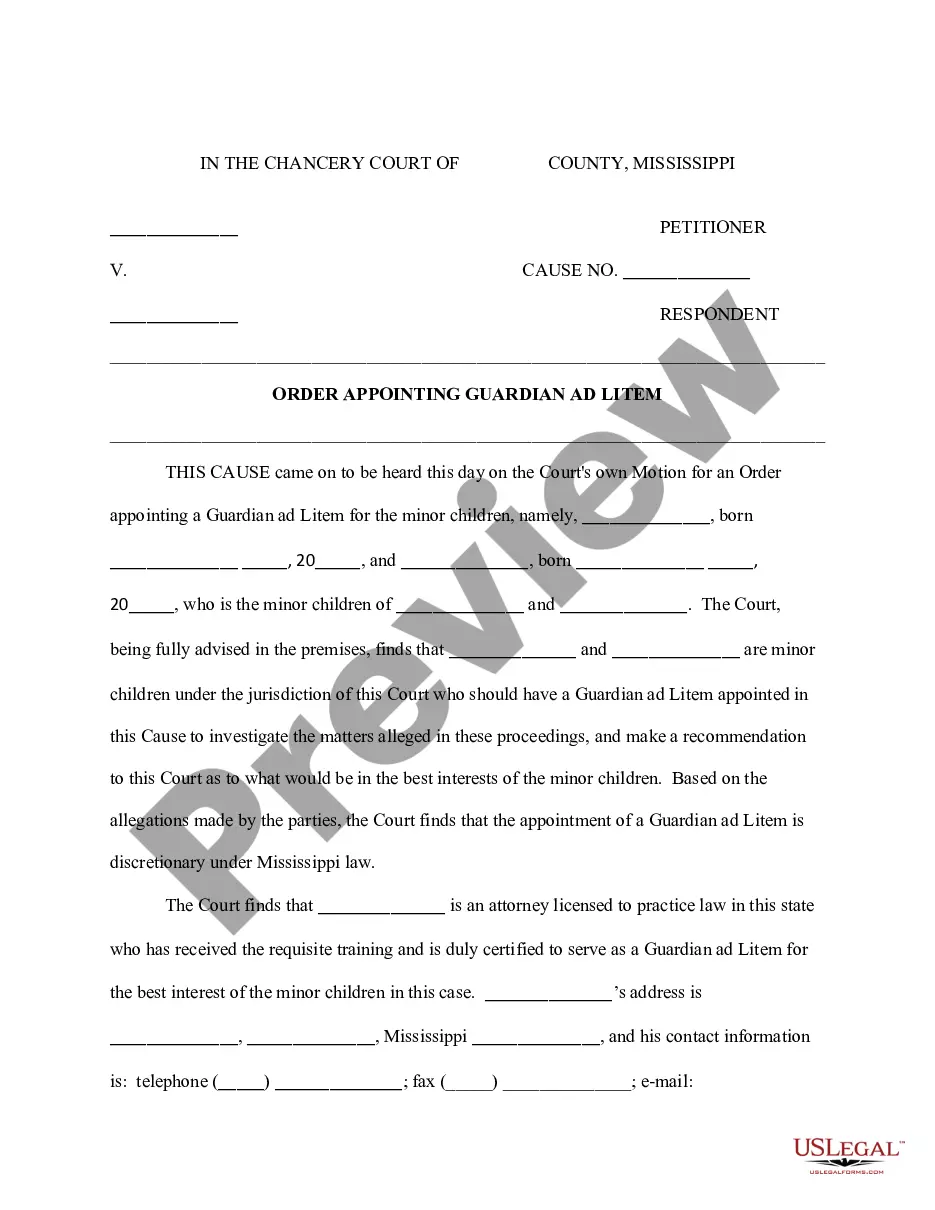
The Agreed Order Appointing Guardian Ad Litem is a legal document that authorizes the appointment of a guardian ad litem (GAL) to represent the best interests of a child during guardianship proceedings. This form differs from other guardianship forms as it specifically focuses on the role of the GAL, who acts on behalf of the child rather than the parties involved in the case. It ensures that any decisions made regarding the child's welfare align with their best interests as determined by the court.
Main sections of this form
- Case information including petitioner and respondent details
- Written consent to terminate parental rights from the father
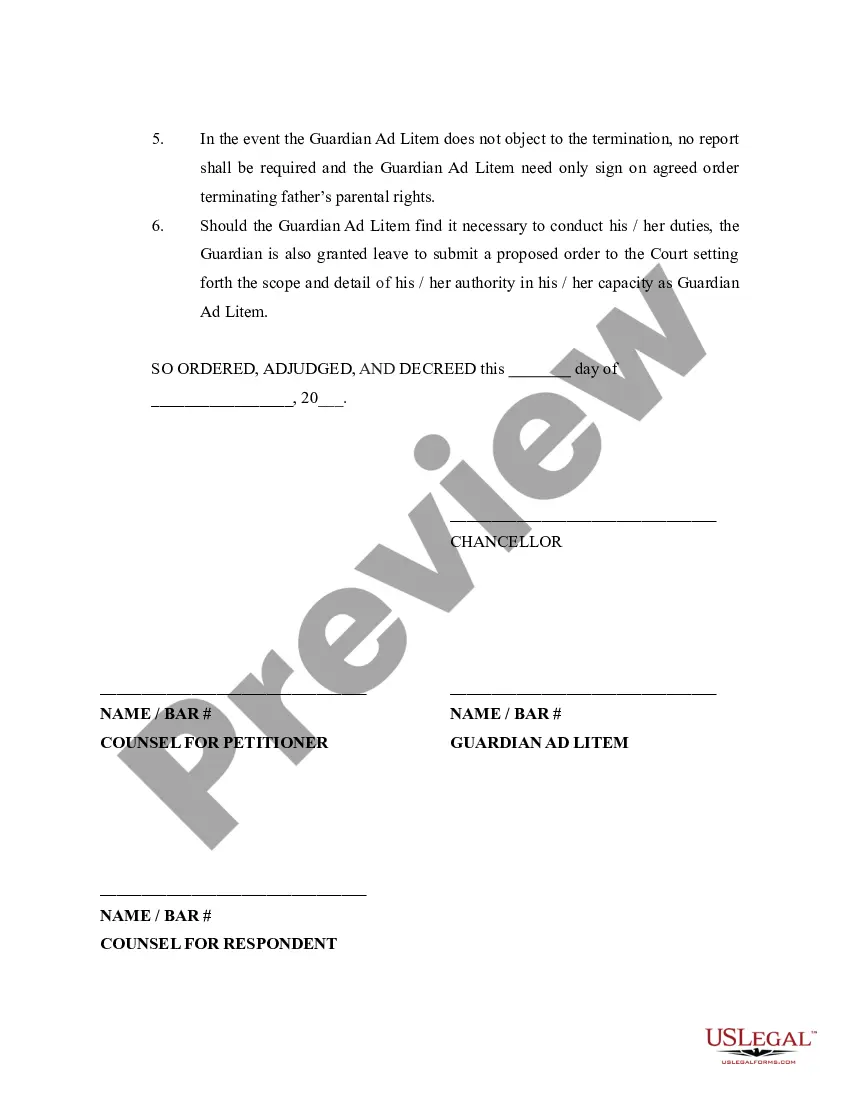
- Appointment of the guardian ad litem and their responsibilities
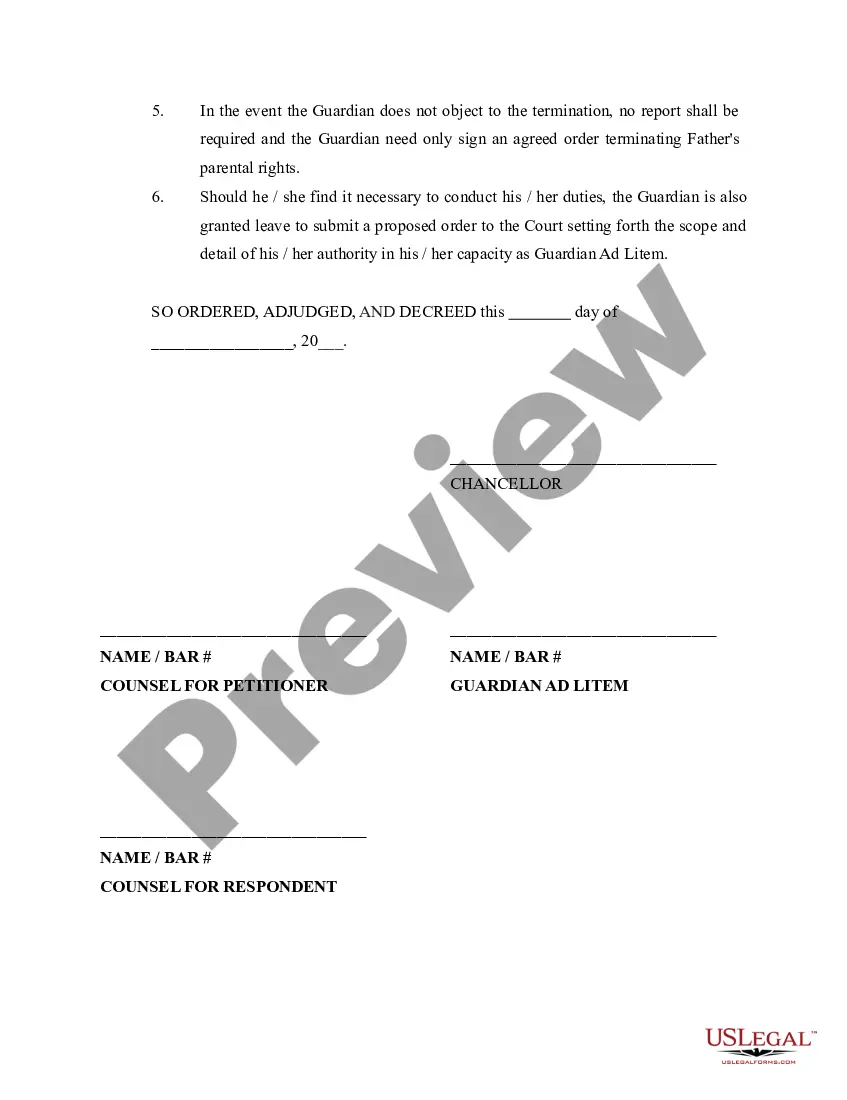
- Conditions under which a report is required from the guardian ad litem
- Signature lines for involved counsel and the chancellor

When to use this form
This form should be used when a petition is filed to establish guardianship for a child and a guardian ad litem is needed to advocate for the childâs best interests in court. Specifically, it applies in situations where one parent is consenting to the termination of their parental rights, making it critical to ensure the child's welfare is monitored by an unbiased party.
Who can use this document
- Petitioners seeking guardianship over a child
- Legal counsel representing the petitioner
- Respondents involved in the guardianship proceedings
- Guardians ad litem appointed in custody cases
How to prepare this document
- Identify the parties involved, including names of the petitioner and respondent.
- Fill in the necessary case information, such as cause number and child's details.
- Document the fatherâs written consent to terminate parental rights.
- Specify the name of the guardian ad litem being appointed.
- Ensure all parties sign the form, including legal counsel and the chancellor.
Does this form need to be notarized?
This form does not typically require notarization unless specified by local law.
Get your form ready online
Our built-in tools help you complete, sign, share, and store your documents in one place.
Make edits, fill in missing information, and update formatting in US Legal Forms—just like you would in MS Word.
Download a copy, print it, send it by email, or mail it via USPS—whatever works best for your next step.
Sign and collect signatures with our SignNow integration. Send to multiple recipients, set reminders, and more. Go Premium to unlock E-Sign.
If this form requires notarization, complete it online through a secure video call—no need to meet a notary in person or wait for an appointment.
We protect your documents and personal data by following strict security and privacy standards.

Make edits, fill in missing information, and update formatting in US Legal Forms—just like you would in MS Word.

Download a copy, print it, send it by email, or mail it via USPS—whatever works best for your next step.

Sign and collect signatures with our SignNow integration. Send to multiple recipients, set reminders, and more. Go Premium to unlock E-Sign.

If this form requires notarization, complete it online through a secure video call—no need to meet a notary in person or wait for an appointment.

We protect your documents and personal data by following strict security and privacy standards.
Typical mistakes to avoid
- Failing to provide the case number, which is essential for identification.
- Neglecting to include complete names of all parties involved.
- Not obtaining all required signatures before submitting the form.
- Overlooking the specific conditions that exempt the guardian ad litem from needing to submit a report.
Why complete this form online
- Convenience of downloading and filling out the form from home.
- Ability to edit the form easily as needed.
- Access to professionally drafted templates by licensed attorneys.
Quick recap
- The Agreed Order Appointing Guardian Ad Litem is vital for protecting a child's interests in guardianship cases.
- It is suitable for use when parental rights are being voluntarily terminated.
- Ensure you follow all procedural steps for successful completion and submission of the form.
Looking for another form?

Form popularity
FAQ
In order to file for Mississippi guardianships, you'll have to file a petition with the local court, undergo investigation from the court, testify in front of the court, and eventually be approved if a judge determines the guardianship is in the best interests of the ward.
How Do You File for Guardianship in Mississippi? The first step to appoint a guardian is to file a petition in the chancery court for the county where the ward resides. After a hearing, the court issues an order concerning guardianship.
Abandonment The timeline to be considered abandonment is based on the child's age. A child under the age of three is considered abandoned by their parents if contact has not been made for at least six months. For children over the age of three, it is considered abandonment after a year.
Who Can Serve as GAL? Must They Be an Attorney? ?The youth court may appoint either a suitable attorney or a suitable layman as guardian ad litem. In cases where the court appoints a layman as guardian ad litem, the court shall also appoint an attorney to represent the child.?
Legal guardianship means a court grants someone other than a biological parent the right to care for a minor. Custody (most often) generally describes a parent caring for his or her own child. Guardianship does not always grant custody or definitively mean a biological parent's custody is revoked.
If a party has made an allegation of neglect or abuse, the chancellor is required to appoint a GAL; otherwise, the chancellor has the discretion to decide whether or not to appoint one. At the same time that the GAL is appointed, the chancellor will designate the issues that the GAL is to investigate.
Guardianship versus parental rights The fact that the child has a guardian does not mean the parent has no rights. Parental rights usually include the option to spend time with the child, as well as the authority to make major decisions and sign contracts for the child. Having a guardian does not generally change this.
A legal guardian is someone who is appointed by the court to take responsibility for another person, known as a "ward." A ward can be either a child or an adult who for some reason cannot manage his own affairs. Although you can appoint a guardian in your will, the probate court is not obligated to accept your choice.