Mississippi Jury Instruction - Punitive Damages 0n Counterclaim
Understanding this form
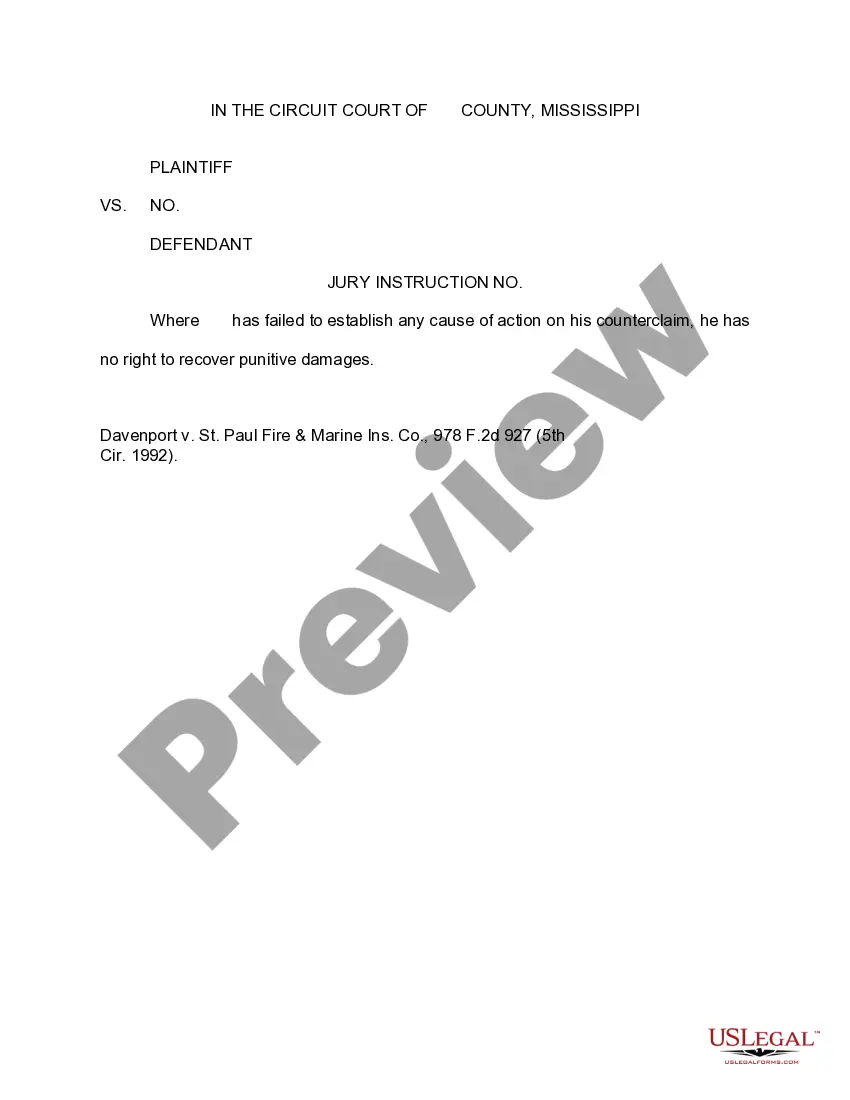
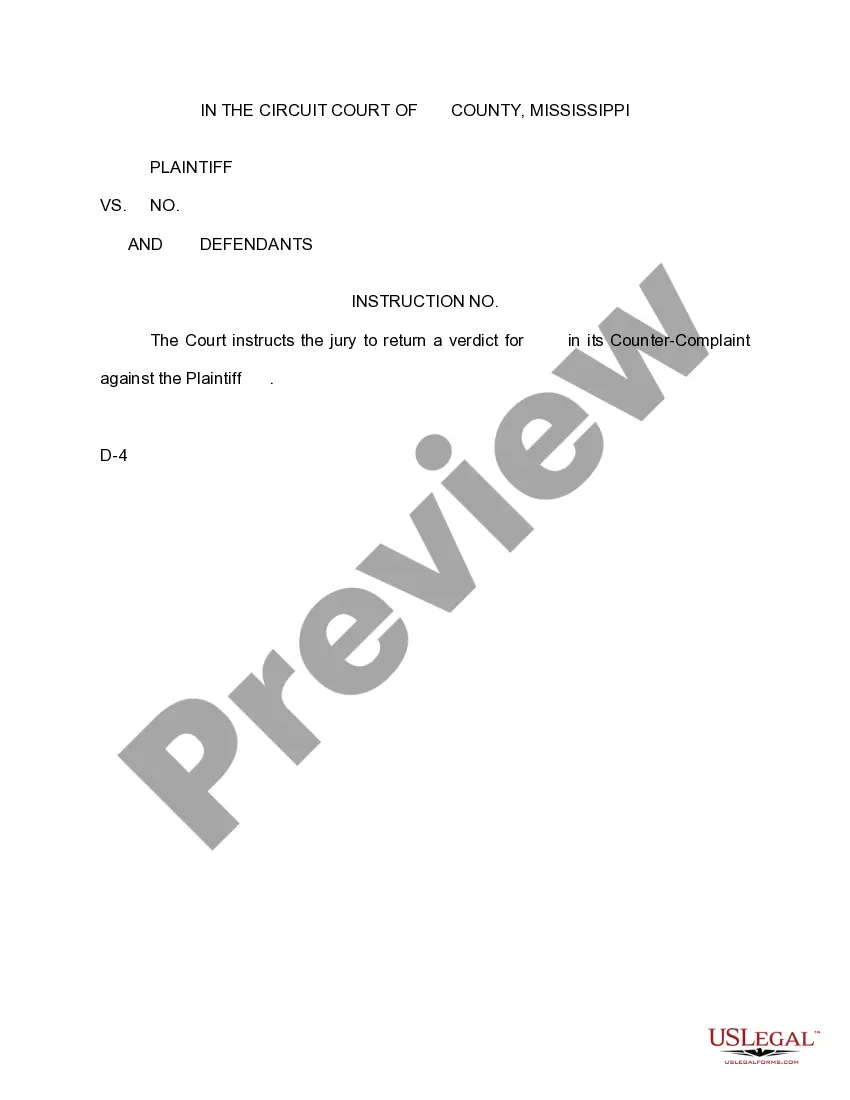
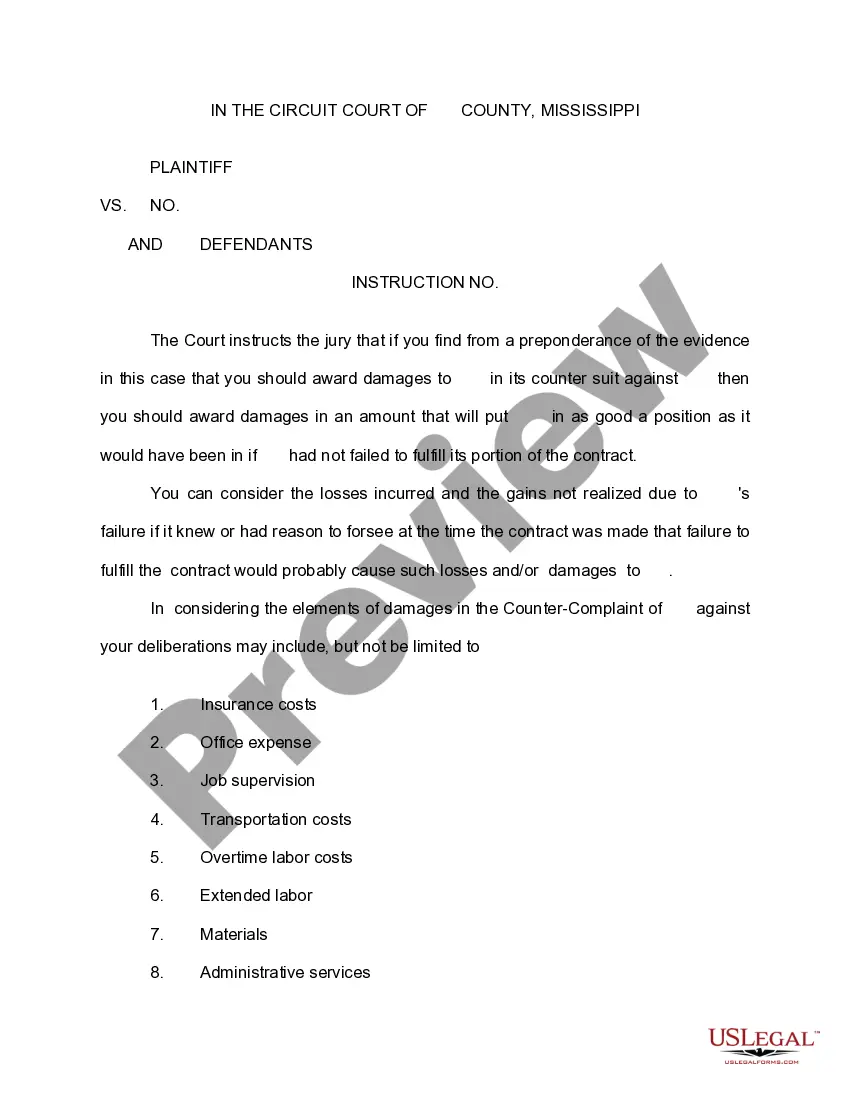
The Jury Instruction - Punitive Damages on Counterclaim form is a legal document used in Mississippi to guide juries regarding punitive damages in the context of counterclaims. It clarifies that if the counterclaimant fails to establish a cause of action, they are not entitled to recover punitive damages. This form serves as a sample instruction that should be verified for compliance with the latest case law and Mississippi regulations.
Main sections of this form
- Introduction of the case, identifying the plaintiff and defendant.
- Jury instruction detailing the requirement to establish a cause of action for punitive damages.
- Citation of relevant case law to support the instruction provided.
Common use cases
This form should be used during jury trials in Mississippi when a defendant has filed a counterclaim and seeks punitive damages. It is essential when the validity of the counterclaim is brought into question, guiding the jury on the necessary legal standards they must consider regarding punitive damages.
Who this form is for
- Attorneys representing clients in jury trials in Mississippi.
- Defendants who have filed counterclaims seeking punitive damages.
- Judges or court officials requiring sample jury instructions for reference.
How to prepare this document
- Identify the names of the plaintiff and defendant at the top of the document.
- Reference the specific case number assigned to the trial.
- Insert the jury instruction number to maintain organizational clarity.
- Review the body of the instruction to ensure it meets the requirements of the counterclaim.
- Consult current case law to ensure compliance with legal standards in Mississippi.
Does this form need to be notarized?
In most cases, this form does not require notarization. However, some jurisdictions or signing circumstances might. US Legal Forms offers online notarization powered by Notarize, accessible 24/7 for a quick, remote process.
Get your form ready online
Our built-in tools help you complete, sign, share, and store your documents in one place.
Make edits, fill in missing information, and update formatting in US Legal Forms—just like you would in MS Word.
Download a copy, print it, send it by email, or mail it via USPS—whatever works best for your next step.
Sign and collect signatures with our SignNow integration. Send to multiple recipients, set reminders, and more. Go Premium to unlock E-Sign.
If this form requires notarization, complete it online through a secure video call—no need to meet a notary in person or wait for an appointment.
We protect your documents and personal data by following strict security and privacy standards.

Make edits, fill in missing information, and update formatting in US Legal Forms—just like you would in MS Word.

Download a copy, print it, send it by email, or mail it via USPS—whatever works best for your next step.

Sign and collect signatures with our SignNow integration. Send to multiple recipients, set reminders, and more. Go Premium to unlock E-Sign.

If this form requires notarization, complete it online through a secure video call—no need to meet a notary in person or wait for an appointment.

We protect your documents and personal data by following strict security and privacy standards.
Common mistakes to avoid
- Failing to update the instruction in accordance with recent case law changes.
- Using incorrect names or case numbers that do not match the court records.
- Neglecting to clarify whether the counterclaim has sufficient evidence to support punitive damages.
Advantages of online completion
- Immediate access to legally drafted sample language tailored for Mississippi law.
- Ability to download and edit the form as needed, ensuring customization for specific cases.
- Convenience of creating legal documents from any location at any time.
Legal use & context
- Jury instructions are critical in guiding jurors towards legally sound decisions.
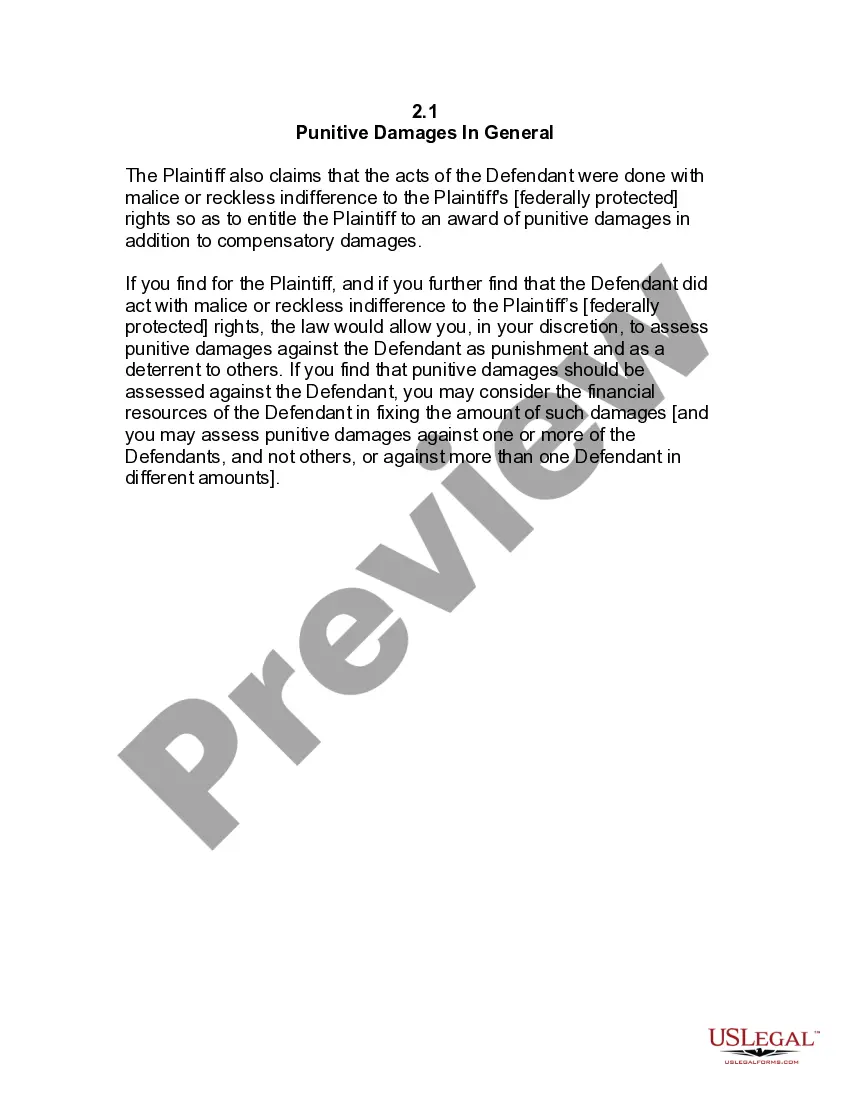
- Punitive damages are awarded at the discretion of the jury and require a clear showing of misconduct.
- Proper jury instructions can significantly impact trial outcomes, especially in civil litigation.
Looking for another form?
Form popularity
FAQ
While mandated percentage "limits" on a punitive damage award have drawn criticism, awards in excess of these limits have also drawn objection. Again, using California as an example, courts have generally found punitive damages greater than 15 percent of a defendant's net worth to be excessive.
If juries award greater compensatory damages than do judges for any given case type, then that higher award will boost punitive damages as well. This analysis indicates that juries generate higher compensatory damages as well as higher punitive damages controlling for compensatory damages.
To determine the amount of punitive damages to award, the Book of Approved Jury Instructions (BAJI) states that the jury should consider: (1) The reprehensibility of the conduct of the defendant.The other twodefendant's financial condition and the relationship to actual damagesare objective measurements.
California Civil Code 3294 allows plaintiffs to recover punitive damages when they can show that their injuries were caused by the defendant's malice, oppression or fraud, typically in cases of intentional harm or extreme recklessness.
Finally, the United States Supreme Court has set a limit on punitive damages. Punitive damages cannot exceed a 10:1 ratio. In other words, punitive damages cannot be more than 10 times the initial award given.
Although there is no maximum sum, punitive damages typically do not exceed four times the amount of compensatory damages. For example, if a plaintiff recovers $100,000 in compensatory damages and is awarded punitive damages, they most likely will receive up to $400,000 in punitive damages.
The amount of punitive damages is left to the jury's discretion. In most states, the jury is instructed to consider both objective and subjective factors.However, in most states, punitive damages are awarded when a defendant's actions are willful, malicious, oppressive, fraudulent, or reckless.
Jurisdictions employ one of three standards of proof in decisions concerning punitive damages: (1) beyond a reasonable doubt, (2) by clear and convincing evidence, and (3) by a preponderance of evidence.