Mississippi Case Management Plan Order
Overview of this form
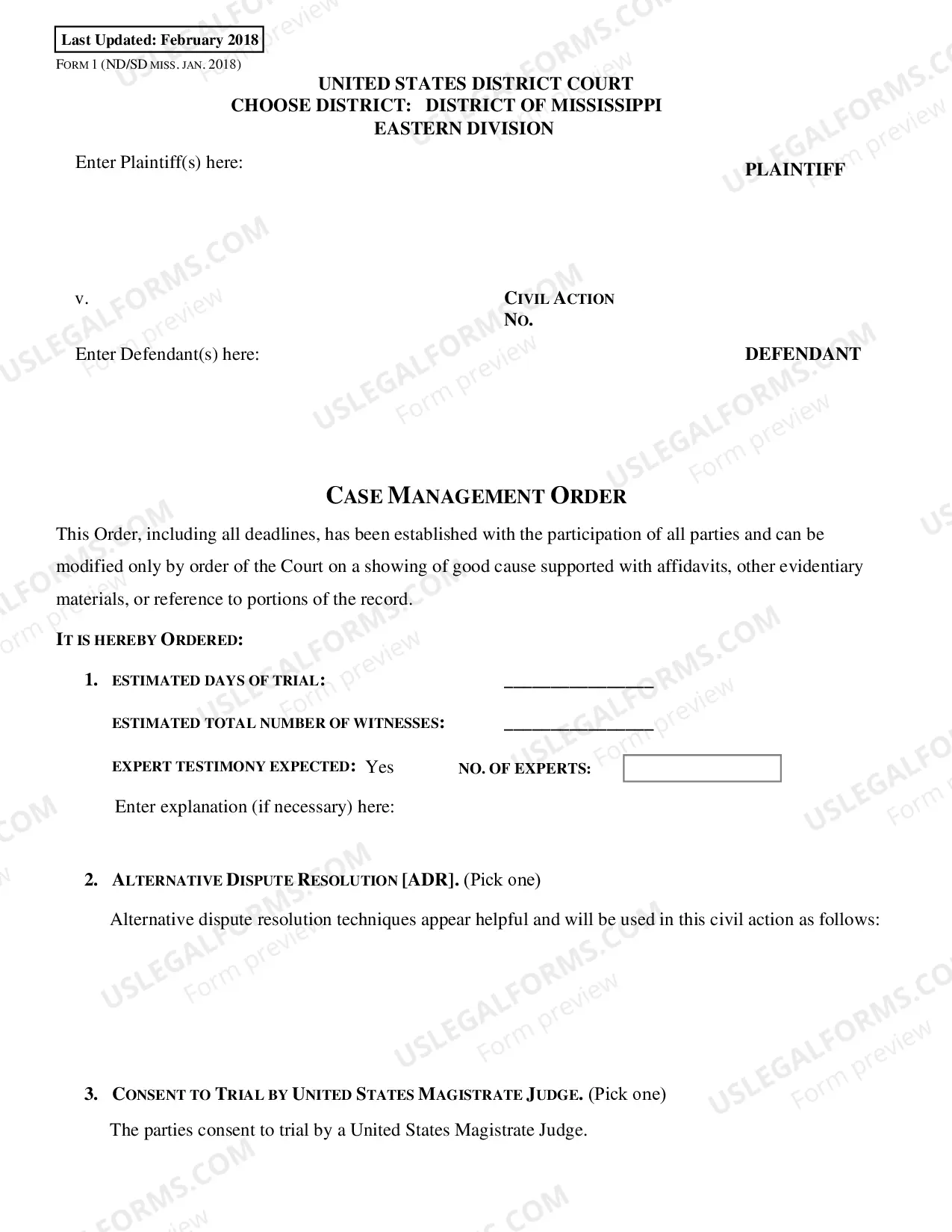
The Case Management Plan Order is a legal document used in the State of Mississippi that outlines the timeline and management of a case in court. It is assigned to a specific judge and details important deadlines related to discovery, trial dates, and pretrial conferences. This form distinguishes itself from similar documents by providing a structured plan that all parties must follow to ensure the timely progression of the case.
Form components explained
- Case track assignment: Specifies whether the case is expedited, standard, or complex.
- Alternative dispute resolution: Indicates whether techniques will be used to facilitate resolution.
- Consent to trial by magistrate judge: States if parties consent or do not consent to this type of trial.
- Disclosure requirements: Outlines initial disclosure compliance and any additional disclosure needed.
- Motions and issue bifurcation: Details potential early filing of motions and issues related to trial scheduling.
- Specific discovery provisions or limitations: Establishes limitations on interrogatories and depositions.
- Scheduling deadlines: Lists key deadlines for trials, pretrial conferences, motions, and expert disclosures.
When to use this form
This form should be used when you need to formally manage and outline the process of your case in court. It is essential for ensuring that all parties are aware of critical deadlines and expectations, which helps prevent delays in the legal process. Use this form when your case is assigned to court and requires a structured plan for management and discovery.
Who can use this document
- Litigants involved in a civil case in Mississippi.
- Attorneys representing clients in the Southern District of Mississippi.
- Individuals or entities seeking to manage case timelines and discovery professionally.
Steps to complete this form
- Identify the case track by marking the appropriate designation (expedited, standard, or complex).
- Specify any alternative dispute resolution techniques that will be used.
- Indicate whether there is consent to trial by a magistrate judge.
- Complete the disclosure section, ensuring all necessary disclosures are noted.
- Fill in specific deadlines for trial, pretrial conferences, and other scheduling-related items as required by your case.
Notarization guidance
Notarization is generally not required for this form. However, certain states or situations might demand it. You can complete notarization online through US Legal Forms, powered by Notarize, using a verified video call available anytime.
Get your form ready online
Our built-in tools help you complete, sign, share, and store your documents in one place.
Make edits, fill in missing information, and update formatting in US Legal Forms—just like you would in MS Word.
Download a copy, print it, send it by email, or mail it via USPS—whatever works best for your next step.
Sign and collect signatures with our SignNow integration. Send to multiple recipients, set reminders, and more. Go Premium to unlock E-Sign.
If this form requires notarization, complete it online through a secure video call—no need to meet a notary in person or wait for an appointment.
We protect your documents and personal data by following strict security and privacy standards.

Make edits, fill in missing information, and update formatting in US Legal Forms—just like you would in MS Word.

Download a copy, print it, send it by email, or mail it via USPS—whatever works best for your next step.

Sign and collect signatures with our SignNow integration. Send to multiple recipients, set reminders, and more. Go Premium to unlock E-Sign.

If this form requires notarization, complete it online through a secure video call—no need to meet a notary in person or wait for an appointment.

We protect your documents and personal data by following strict security and privacy standards.
Typical mistakes to avoid
- Failing to complete all required fields, which can lead to a delay in processing.
- Ignoring court-specific deadlines and requirements that may lead to filing issues.
- Not obtaining the necessary consent from all parties regarding trial preferences.
Advantages of online completion
- Convenience of completing and submitting the form anytime, anywhere.
- Editability allows you to easily make changes and updates to the form.
- Access to reliable templates drafted by licensed attorneys ensures legal compliance.
Legal use & context
- Establishes clear expectations for the case timeline and processes.
- Aids in efficient case management to reduce delays in court proceedings.
- Helps parties understand their responsibilities and deadlines within the litigation process.
Looking for another form?
Form popularity
FAQ
There are 4 levels of medical case management: Intake/ Referral, Needs Assessment, Service Planning, Monitoring and Evaluation.
1) Screening. The first step of the process is determining if the case in question requires the case management services in the first place. 2) Assessing. 3) Risk evaluation. 4) Planning. 5) Implementation. 6) Outcome evaluation.
3 Unique Case Management Models. The Brokerage Case Management Model. The Clinical Case Management Model. The Strengths-Based Clinical Case Management Model. Conclusion.
The case management process consists of five parts: assessment, treatment planning, linking, advocacy, and monitoring.
The Case Management Process consists of nine phases through which case managers provide care to their clients: Screening, Assessing, Stratifying Risk, Planning, Implementing (Care Coordination), Following-Up, Transitioning (Transitional Care), Communicating Post Transition, and Evaluating .
Case management is guided by the principles of autonomy, beneficence, nonmaleficence, and justice. Case managers come from different backgrounds within health and human services professions including nursing, medicine, social work, rehabilitation counseling, workers' compensation, and mental and behavioral health.
Case Manager duties include assessing, planning, implementing, monitoring and evaluating actions required to meet the client's health and human services needed. A certified Case Manager is a plus.
Case management is a collaborative process that assesses, plans, implements, coordinates, monitors, and evaluates the options and services required to meet the client's health and human service needs.
Some examples of case management services might be: assistance with health needs. assistance with transportation. assistance with child care.